Cleaning and Disinfection of Poultry Houses
- CONSIDERATIONS WHEN SELECTING A DISINFECTION PROCESS
- Selecting an appropriate disinfectant (or disinfection method) is an essential component of any C&D program.
- No single disinfectant is adequate for all situations.
- There are several factors to be considered since they can impact efficacy, possibly cause failure of the disinfection procedures, or result in hazards or injury to personnel or animals.
- Selection will depend on the microorganism(s) suspected, availability, the characteristics of a specific disinfectant or process, environmental factors and safety issues.
➡️MICROORGANISM CONSIDERATIONS
- Selection of a disinfectant begins with the identification of the target microorganism.
- If the organism has not been identified, or a disinfectant is needed for a wide range of organisms, a broad-spectrum approach should be utilized.
➡️Resistance and Susceptibility
- Microorganisms vary in their ability to survive or persist in the environment as well as their susceptibility to disinfection.
- Bacteria: Most vegetative bacteria (e.g., gram-positive, gram-negative) are readily inactivated by disinfectants. Some, such as Pseudomonas aeruginosa and Coxiella burnetii, can have greater resistance to disinfection.
- Mycobacteria and other acid-fast bacteria and bacterial endospores are highly resistant to disinfection, often requiring specific products, increased concentrations, or prolonged contact times.
- Fungi: The vegetative stage of fungal organisms is susceptible to most disinfectants; however, fungal spores are usually quite resistant.
- Viruses: Virus susceptibility is generally related to the presence or absence of a lipid envelope and size.
- Enveloped viruses (e.g., coronaviruses, herpesviruses, orthomyxoviruses, paramyxoviruses, retroviruses) are generally the most susceptible due to their lipophilic nature.
- The lack of envelope for non-enveloped or naked viruses (e.g., adenoviruses, picornaviruses, reoviruses, rotaviruses) makes these pathogens more hydrophilic, resulting in increased resistance.
- Small, non-enveloped viruses (e.g., parvoviruses, picornaviruses, or caliciviruses) demonstrate even greater resistance due to their size and lack of an envelope.
- Prions, the etiologic agents of bovine spongiform encephalopathy, scrapie, and chronic wasting disease, are exceptionally resistant to chemical inactivation.
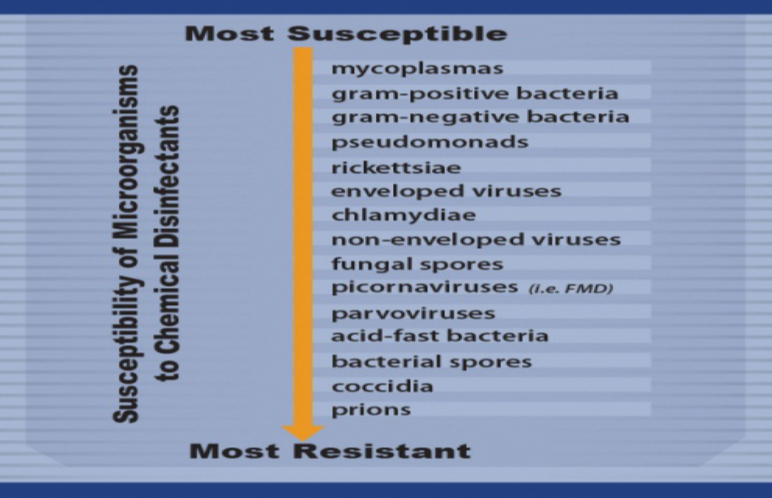
Source: Clint May and Andrew Kingsbury, Iowa State University (2014).