Care of patients with renal failure
- Anatomy of the urinary system
➡️Components of the urinary
system:
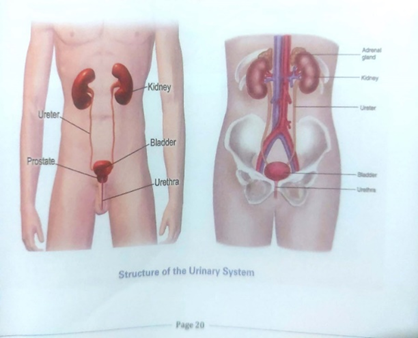
The kidneys, which are excretory organs.
The ureters are the tubes that carry urine from the kidneys to the bladder.
The bladder, which is the place where urine is collected.
The urethra is the passage through which urine exits the body.
➡️The function of the
urinary system:
Formation and excretion of urine, and the elimination of toxins and excess
water from the body.
Description of the parts of the urinary system:
1- The Kidneys (The Kidney):
The human body contains two kidneys, each about 10-12 cm long, approximately 6
cm wide, and about 2.5 cm thick. Each kidney weighs about 150 grams in men and
130 grams in women. The right kidney is positioned lower than the left kidney
due to the presence of the liver above it. The kidneys resemble a bean in shape
and are dark brown in color. At the upper part of each kidney lies the adrenal
gland. Each kidney is composed of several units called nephrons, and each
kidney contains between one million to two million nephrons, with their number
decreasing with age or disease.
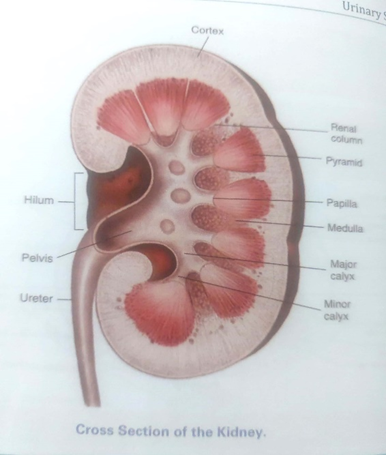
➡️The kidney is composed from the outside to the inside of:
- Bowman Wallet
- The crust layer
- Medulla layer
Each kidney contains about a million filtration units (nephrons), which are the
filters in the kidney responsible for purifying the blood. They are connected
by connective tissue, and each tubule begins in the cortex layer with a
crescent-shaped indentation called Bowman's capsule, which contains a bundle of
blood vessels that start from the afferent artery and end at the efferent
artery.
The Bowman’s capsule and the blood vessels inside tiny structures called
Malpighian corpuscles, of which there are thousands in the cortex.
A convoluted tubule exits Bowman's capsule, called the proximal convoluted
tubule, which heads towards the medulla, forming the descending limb, then
returns to the cortex, forming the ascending limb. In the cortex, it convolutes
upon itself to form the distal convoluted tubule. Finally, it returns to the
medulla, where it gathers to form collecting ducts that each open at the tips
of the Malpighian pyramids in the renal pelvis.
➡️The function of the
kidneys in the body:
The natural kidneys perform essential functions in the human body, which are:
Purifying the blood and eliminating any toxins in the body.
It maintains the balance of body fluids and minerals.
- Secretion of certain ions and regulation of blood pH balance such as (sodium
- potassium - calcium - phosphorus - chloride - phosphate - and hydrogen).
Hormonal function:
➡️The kidneys secrete
many hormones:
1-Renin hormone, which helps retain the amount of fluids and sodium by
regulating hormones.
Aldosterone is produced by the adrenal gland, so the secretion of renin
increases in cases of low sodium in the blood or dehydration. Therefore, renin
works to raise blood pressure, and consequently, the kidneys regulate blood
pressure in the human body.
2-Erythropoietin (secreted in response to low oxygen levels, such as in cases
of anemia) stimulates the bone marrow to produce red blood cells, thereby
maintaining the hemoglobin levels in the blood.
3-To activate vitamin D, which helps in the absorption and deposition of calcium
in the bones, the secretion of hormone (unknown).
2- The Ureter (الحالب):
It is a muscular tube that transports urine from the kidney to the bladder,
measuring 25 cm in length, and it contracts regularly from top to bottom to
push urine into the bladder.
3- The Urinary Bladder:
It is a muscular sac whose primary function is to store urine until it is time
to expel it from the body through the urethra.
4- Urethra:
It is the tube that carries urine from the bladder to outside the body, and it
differs in men and women; it measures 20 cm in men and only 4 cm in women.
➡️Urine formation in the
kidneys:
Urine is formed through three stages:
Filtration: where water, salts, and some other substances are filtered
from the blood.
Absorption: where some water and salts needed by the body are reabsorbed
into the bloodstream.
So that the components of the blood are not affected by the loss of all the
water and dissolved salts in it.
Secretion: It is carried out by the cells of the kidney tubules, which
have the ability to filter out substances that exceed their quantity.
The permissible natural limit in the body or in excess and is eliminated.
Urine formation occurs in healthy, unaffected kidneys.
➡️Urine characteristics:
Color: Yellow.
Specific gravity: from (1005) to (1025).
Concentration: Acid around (pH = 6).
The scent: (Aromatic).
Content: Water + urea + creatinine + urea (protein breakdown product) +
ammonium ions.
Inorganic substances: sodium - potassium - calcium - chloride -
phosphate - sulfate and oxalate + approximately 100 grams of protein (albumin)
/ 24 hours.
The amount of urine in 24 hours (from half a liter to one and a half liters)
depends on the fluids entering and leaving the human body in a day, as well as
the weather conditions, the individual's overall health, and the condition of
the kidneys in particular.