First Nursing Guideline for Burn Patient Care
- Burns
Definition of Burns:
Burns refer to the destruction and damage to the skin and body tissues caused by exposure to an external factor with high heat, such as hot water, direct flames, a corrosive chemical substance, or radiation. This results in several types of damage: psychological, physical, and sensory.
Causes of Burns:
- Heat: There are two types: a. Dry heat: Fire flames. b. Moist heat: Hot water or steam.
- Radiation: (Natural radiation such as sunlight, artificial radiation such as cancer treatment radiation).
- Electricity.
- Strong chemicals (severe acidic or alkaline substances).
Types of Burns:
Burns that only affect the outer layer of the skin are called superficial burns or first-degree burns. When the damage reaches some of the layers beneath the skin, it is known as partial-thickness burns or second-degree burns. In third-degree burns, all layers of the skin are affected. Fourth-degree burns involve deeper tissues such as muscles or bones.
1) First-Degree Burns (Superficial Burns): These affect only the outer layer of the skin and are the least dangerous of the other burn types. Only the outer skin layer is burned, and healing occurs within 5-10 days without any significant physiological changes to the skin.
Symptoms:
- Redness of the skin at the burn site.
- Redness is usually accompanied by swelling.
- Presence of pain.
Causes of First-Degree Burns:
- Excessive sun exposure.
- Mild contact with a hot object or spilling hot water.
- Exposure of the skin to steam or small amounts of chemicals.
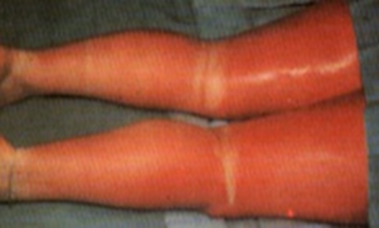
First-Aid measures for Minor Burns:
• Quickly remove the victim from the source of heat.
• Remove any jewelry or accessories.
• Immerse the burned area in cold water for 10 minutes or until the pain subsides.
• Generally, hospitalization is not needed, but if the burns are on large areas such as the hands, feet, face, thighs, buttocks, or major joints, medical attention should be sought immediately.
Patient Education on Home Care for First-Degree Burns: First-degree burns are treated at home as minor burns as follows:
- Cool the burned area by placing it under cold water, not ice-cold, like tap water, or submerge the burn area in a container with cold water, or apply cold compresses for 10-15 minutes or until the pain subsides.
- Cover the burn with a sterile gauze dressing, ensuring not to apply pressure on the burned area.
- Administer a pain reliever.
Notes: Cooling the burn site prevents swelling by halting the further spread of heat to the skin.
- Use cold water to cool the burn, not ice, as ice can worsen the burn and cause more damage to the skin.
- Cover the burn with sterile gauze and avoid using cotton or any fabric that could stick to the burn.
- Do not apply egg whites, butter, or toothpaste to the burn.
- Monitor the burn, as it often heals on its own. However, if any signs of infection such as increased pain, redness, swelling, or fever are noticed, seek medical advice.
2) Second-Degree Burns: These affect both the outer and inner layers of the skin, characterized by blisters, swelling, and the leakage of plasma beneath the skin. Healing occurs within 2-3 weeks.
Symptoms: Blisters, noticeable swelling, severe pain, and leakage of plasma through damaged skin layers.
First-Aid for Second-Degree Burns: • Move the victim away from the heat source. • Remove any clothing over the burn area. • Immerse the burned area in cold water to reduce pain (cooling the tissue this way reduces the heat from adjacent tissues). • Do not use ice or frozen water, as this can damage the tissue. • Dry the area and cover with sterile dressings or a cold cloth.
• Cover the burn with sterile gauze and a dry bandage, avoiding the removal of burned tissue or attempting to pop the blisters. • Change the dressing every 1-2 days or if the dressing becomes soaked with plasma. • Watch for signs of infection, such as fever, unexplained pain, or pus. • Second-degree burns on the face, neck, or larger than 3 cm require medical intervention.
3) Third-Degree Burns: These burns affect all layers of the skin and can also involve deeper tissues like muscles and bones. The victim may lose sensation in the burned area due to nerve damage, and the skin may char.
Symptoms: The burn area may appear waxy white or blackened. No pain is felt after the burn due to nerve damage.
• Do not remove clothing from the burned area as it may tear the skin. • Do not apply cold water or medication to the burn. • Place a clean, moist gauze over the area. • Rush the victim to the hospital. • If the burn is on a hand or foot, elevate it above heart level to reduce blood flow. • If the burn is on the face, monitor for breathing difficulties.
4) Fourth-Degree Burns: Fourth-degree burns involve damage to deeper tissues, including muscles and bones, and are caused by fires, explosions, or high-voltage electrical burns. These burns may require amputation of limbs or major reconstructive surgery for other body parts.
Causes of Burns:
Burns are skin injuries caused by exposure to heat, electricity, chemicals, or radiation, leading to severe pain and potentially life-threatening conditions that hinder functionality.
Main Causes of Burns:
- Exposure to heat: This can be from flames, hot materials, or heated surfaces.
- Electric current.
- Exposure to chemicals.
- Friction.
- Sunlight exposure.
- Radiation.
Classification of Burns:
- Minor Burns: Affect less than 10% of the body surface area in children and 15% in adults, without additional risk factors.
- Severe Burns: One or more of the following criteria: • More than 10% of the body surface area affected in children and more than 15% in adults. • Inhalation injury (smoke, hot air, particles, toxic gases, etc.). • Significant trauma (fractures, head injuries, etc.). • Location: face, hands, neck, genitals, or major joints (risk of functional disability). • Electrical, chemical, or explosion-related burns. • Age <3 years or >60 years or severe underlying conditions (e.g., epilepsy, malnutrition).
Diagnosis of Burns:
Burns are diagnosed by a specialist through:
- A clinical examination by the doctor.
- Blood tests to check for inflammation, electrolyte levels, and liver/kidney function to ensure no fluid loss in the bloodstream.
- An X-ray to assess the extent of the burn.
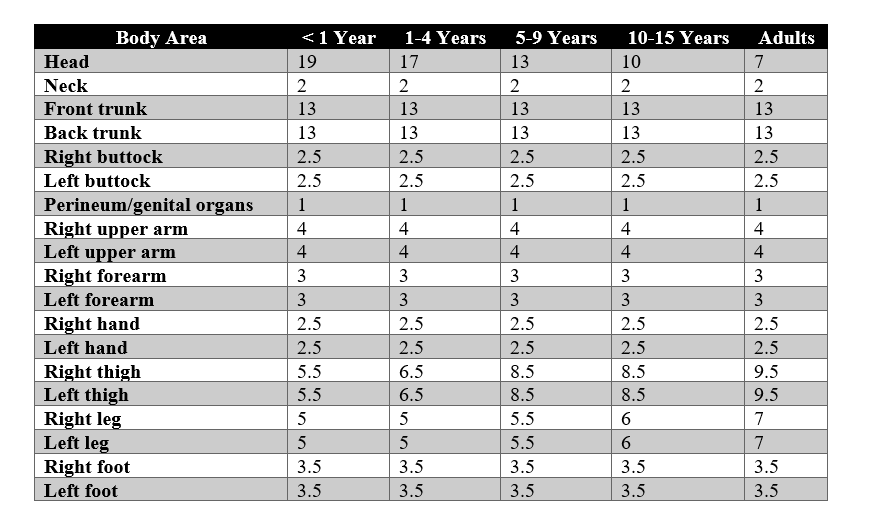
Burn Assessment
Extent of Burns
The Lund and Browder chart shows the percentage of body surface area based on
age. This chart helps in accurately calculating the percentage of the body
surface area affected based on the patient’s age.
For example, a burn on the face, front torso, inner forearm, and the peripheral
burn of the left upper arm in a 2-year-old child:
8.5 + 13 + 1.5 + 4 = 27% of the body surface area.
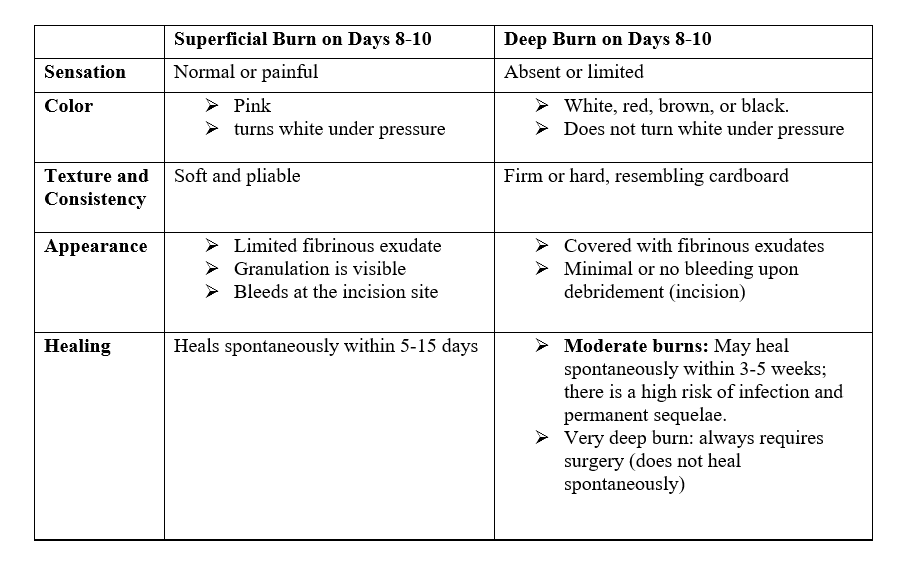
Depth of Burns
Except for first-degree burns (painful redness of the skin without blisters)
and very deep burns (third-degree burns, charring), the depth of burns cannot
be determined during the initial assessment. Differentiation is possible after
8-10 days.
Rule of Nines:
The body is divided into parts, and
each part is assigned a percentage of 9%, which helps in quickly estimating the
injury area at the site of the incident.
The body is divided as follows:
- Head = 9%
- Right arm = 9%
- Left arm = 9%
- Anterior torso = 18% (Chest = 9%, Abdomen = 9%)
- Posterior torso = 18% (Back = 9%, Buttocks = 9%)
- Anterior of each lower limb = 9%
- Posterior of each lower limb = 9%
- Genital area = 1%
Inhalation Injury Assessment :
- Dyspnea with retraction of the chest wall inward
- Bronchospasm
- Nasal or oral secretions
- Productive cough with black (sooty) sputum
- Hoarseness (raspy voice), etc.