Rabbit diseases diagnosis, prevention and control
- VIRAL Diseases of Rabbit
I. Viral Hemorrhagic Disease
Synonyms:
Viral Hemorrhagic Fever,
Viral Necrotizing Hepatitis
"rabbit calicivirus disease" (RCD)?
Why was "rabbit haemorrhagic disease" (RHD) renamed "rabbit calicivirus disease" (RCD)?
History:
The disease was first reported in China in 1984, and has since been reported in Europe, parts of Asia, Mexico and the United States.
In a three-year study at CSIRO
Australian Animal Health Laboratory, rabbits infected with rabbit calicivirus
disease did not die from hemorrhage. "Rabbit Hemorrhagic Disease" is
therefore an inaccurate name for the disease. The disease was renamed Rabbit
Calicivirus. Disease (RCD) because this virus belongs to the virus family
Caliciviridae.
Is rabbit calicivirus disease genetically engineered?
Rabbit calicivirus is not genetically engineered or made in a laboratory. It is a naturally occurring virus.Etiology: A calicivirus has been recovered from infected rabbits. Apparently strains of virus with varying degrees of virulence have been recovered from rabbits from different parts of the world.
Definition: It is a very contagious viral disease can be transmitted via direct and indirect contact and also by insect and fleas .It is caused by host specific calicivirus characterized by high mortality
Transmission:
1-RCD is highly contagious and is spread by contact between susceptible rabbits and an infected rabbit.2-Also by contact with excreta contaminated with the virus, The agent can be spread by direct contact.
3- Biting arthropods and fomites, including handling of infected rabbit meat and byproducts ( Mechanical transmission).
How long does rabbit calicivirus persist in the environment? Under experimental
conditions, the virus can survive up to 25 days at 42 degrees C (can live in tissue such as liver), but for only 2 days at 60 degrees C. It has been detected for 35 days at 20 degrees C. The virus can survive in pH range 3-8.
Pathogenesis: Incubation period: 3-4 Days.
Calicivirus predilection set for hepatocytes that replicate in cytoplasm that
leads to necrosis of liver and spleen
and coagulation of blood intravascular. Thrombi reach vital organ as lung,
kidney and heart internal hemorrhage occur leads to death and impairment in
liver function.
Calicivirus predilection set for hepatocytes that replicate in cytoplasm that leads to necrosis of liver and spleen and coagulation of blood intravascular. Thrombi reach vital organ as lung, kidney and heart internal hemorrhage occur leads to death and impairment in liver function.
Clinical Signs:
Per acute: sudden death may showed severe
hemorrhage.
Acute: There are no specific clinical signs. After about 18 hours of infection with rabbit calicivirus, adult rabbits become progressively quieter; within approximately 30-40 hours of being infected they die quietly with minimal apparent distress.
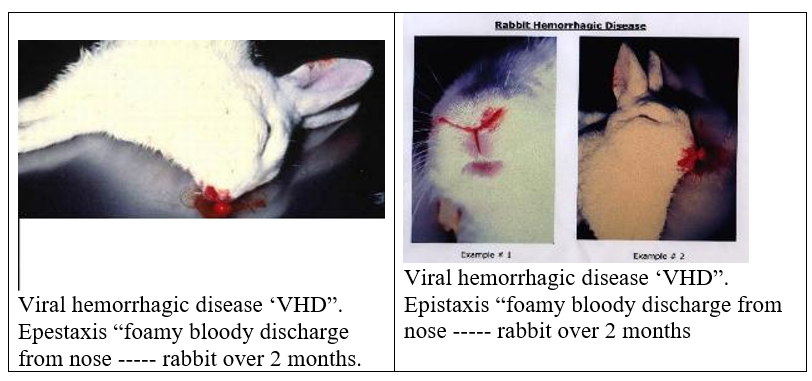
Some rabbits may appear listless and reluctant to move one day after infection and at this stage, some may have an increased temperature (from 39 degrees C up to 42 degrees C). A few hours prior to death, some rabbits have an increased respiratory rate. The incubation period ranges from 1 to 3 days, at which time one of three forms of the disease may be seen. temperature may be elevated from 40 to 41oC, but rapidly declines prior to death.In subacute disease, clinical disease progresses to include bloody nasal discharge,
opisthotonus and vocalization (nervous signs).Death occurs 2 to 3 hours after the onset of clinical signs. In colony settings, morbidity may reach 90% with 100% mortality.
P.M: A swollen, enlarged spleen; a swollen, friable liver with a lobular pattern
-Tracheal hemorrhages, small focal pulmonary hemorrhages that may join to form large, reddened areas. Occasionally, only two of these organs may be affected.-Myocardial (heart muscle) hemorrhages and renal infarcts(kidney scars) occur more rarely.
-Hematuria, diarrhea ,vaginal discharge or foamy exudates from nose
-Pale carcasses with internal hemorrhage which fail to coagulate.
Diagnosis:
-The disease is tentatively diagnosed based on the rapidly fatal infection and grossnecropsy findings.
-VHD-specific PCR is used to confirm the postmortem diagnosis.
-HA and HI -Eliza
- Frozen carcasses may be Saved for disease confirmation.
Treatment: There is no effective treatment.
Control: -Once the disease is recognized, elimination of all rabbits in the colony has been the only effective way of preventing infection.
- Vet.biosecurity, quarantine and
vaccinate newly introduced rabbit.
Vaccination: The vaccine is a "killed-vaccine", As a standard precaution, the vaccine
should not be used in any rabbit showing any kind of sickness.Vaccines are produced from virus grown in rabbits liver or spleen and the virus inactivated by Beta proprio-Lacton or Formalin.
In slight contaminated area:
Breeder Rabbits are immunized at
about eight to ten weeks of age with annual boosters. The virus is killed by
0.5% sodium hypochlorite.
In highly contaminated area:
Breeder Rabbits obtain primary dose
at 6 weeks and followed by boaster dose after 4 -6 weeks then revaccinated
every 6 months.
In fattening
-Vaccinated once at 4 weeks if
their dams not vaccinated.
-Young
rabbits from vaccinated dams are vaccinated at ten weeks of age, when most of
their maternal antibody has disappeared.
-The
virus is no longer notifiable. Maternal antibodies can be passed to young and
confer temporary immunity.
-Vaccination
of young will then provide permanent immunity. The timing of vaccination is
critical.
- Killed virus vaccines provide protection of native rabbits exposed to the disease,
How does VHD kill rabbits and don’t
kill young rabbit under 8 weeks?
VHD
causes the rapid development of blood clots in major organs such as lungs, heart
and kidneys. These clots block blood vessels and result in death from heart and
respiratory failure in about 30-40 hours. Why do young rabbits under 5 to 8
weeks survive? This is not known, but it is speculated that young kittens have
a relatively immature immune system, and cannot produce enough of the chemicals
that initiate clotting which causes death in older rabbits.