INFERTILITY IN PET ANIMALS
- Reproductive characteristics of bitches and queens
1. Age of puberty and maturity
In most bitches’ breeds, pubertal estrus occurs between the age of 6 and 14 months, with the mean age of onset being positively related to breed size while the first estrous cycle in cats occurs between the age of five and nine months.
The age of maturity that is suitable for breeding is mostly about 3monthes after reaching puberty.
2. Reproductive cycle
A. Reproductive cycle of bitches
⮚ Bitches are non-seasonal, monoestrous, polytocus, and spontaneous ovulators. The bitch's estrous cycle is divided into 4 phases (proestrus, estrus, metestrus, and anestrus).
⮚ The hormonal levels, clinical findings, and vaginal swabs should all be considered when determining the stages of the estrous cycle in bitches.
⮚ Ovulation is thought to happen 48–60 hours after the luteinizing hormone (LH) peak and canine oocytes are ovulated as primary oocytes so fertilization cannot be completed until about 48 to 72 hours after ovulation, when they undergo the first meiotic division to become secondary oocytes.
1. Proestrus
● It lasts 5–20 days.
● Characterized by a bloody vaginal discharge and edematous vulva that is slightly warm (Fig. 3). Females become restless with decreased food intake, and increased water consumption and urination.
● Hormonal levels during proestrus, estradiol inhibits follicle-stimulating hormone (FSH) and luteinizing hormone (LH) at the beginning, but, immediately after the estrogen peak and as progesterone level elevation at the end of proestrus, FSH and LH levels increase sharply.
● Estradiol begins to increase from 25-40 pg/ml to 70 pg/ml at the last two days of proestrus while progesterone level is low (1–2 ng/ml) during early proestrus then gradually increases at the end of this phase.
● Vaginal cytology: reveals a high percentage of parabasal cells accompanied by erythrocytes and variable numbers of neutrophils (Fig. 4).
● Vaginoscopy: edematous and round vaginal folds appear (Fig. 5).
High estrogen levels during proestrus lead to: -
1. Appearance of signs (enlarged vulva, proestrus bleeding).
2. Proestrus bleeding occurs due to the vasodilatation effect of high-level estrogen on the uterus with extravasation of blood.
3. Vaginal epithelium increases in thickness from a few cells in early proestrus to 20- 30 cells at the end of proestrus.
2. Estrus
● It lasts 5–15 days.
● Estrus is recognized by male acceptance, tail deviation with vulvar exposure and vulva becomes less edematous with watery discharges, and ends when the female refuses the male.
● Serum FSH/LH levels are maximal at the beginning of behavioral estrus, but peaks can occur 1–2 days earlier before and three days later.
● Estradiol level decreases fast to reach 18 pg/ml five days after the peak of LH while progesterone level increases to higher levels.
● By 10 days after the LH peak, progesterone level rises to around 20 ng/ml at diestrus.
● Vaginal cytology: reveal a high percent of large cornified cells, until the epithelium is completely cornified in estrus (Fig. 4).
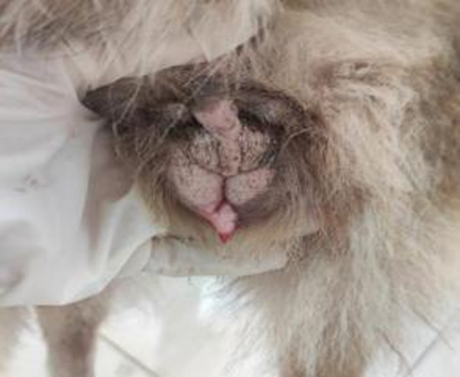
Fig. 3: Showing bloody vaginal discharge and
edematous vulva in proestrus bitch (taken in the clinic of pet animals, Fac.
Vet. Med., Benha University).
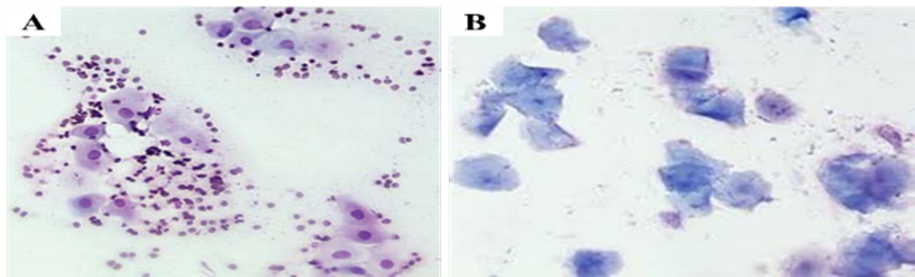
Fig. 4: Showing stained vaginal smear during proestrus (A) and estrus (B). A: high percent of parabasal cells accompanied by erythrocytes. B: high percent of large cornified cells (taken in the clinic of pet animals, Fac. Vet. Med., Benha University).
● Vaginoscopy: the edematous folds begin to flatten out and reduce under the influence of reducing estrogen and rising progesterone levels (crenulation) (Fig. 5).
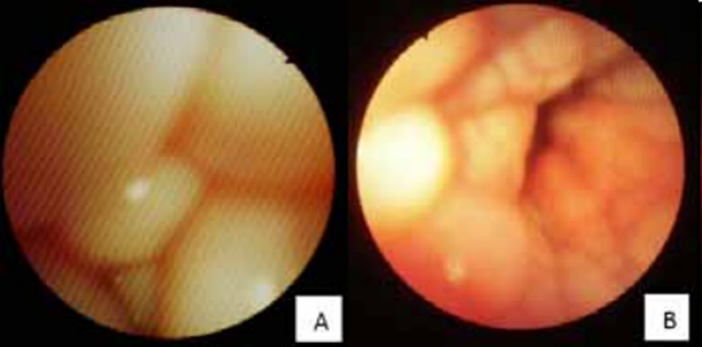
Fig. 5: Vaginoscopic
images during different phases of the estrous cycle in bitches. A. Proestrus
(edematous and round vaginal folds). B. Estrus (crenulation) , Mason (2018).
3. Diestrus phase
● It lasts about 50–80 days.
● In which vulva shrinks, no discharge, female not accept male.
● Progesterone level about 45-60 may reach to 120 ng/ml in bitch.
4. Anestrus
● It lasts about 80–240 days in bitch.
● Characterized by inactive
ovaries.
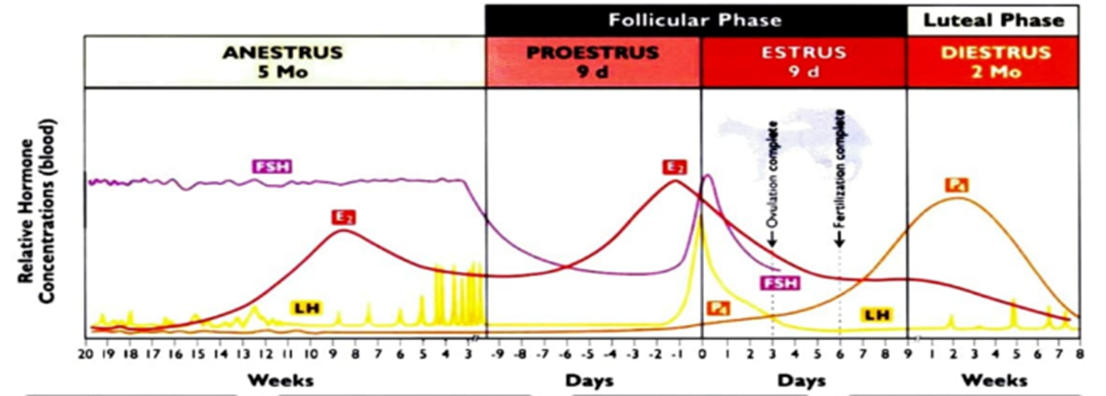
Fig. 6: The annual reproductive cycle of the bitch (Johnston et al., 2001).
The best time of breeding in bitches
⮚ 2-4 days after ovulation.
⮚ 4-6 days after LH surge.
⮚ At the time when secondary oocyte formed to two days after.
⮚ 2 days after serum progesterone level becomes 4-10 ng/ml.
B. Reproductive cycle of queens
Queens are seasonal polyestrous and induced ovulator animals that usually exhibit the estrous cycle from January or February until September in the northern hemisphere.
Ovulation
● Queens are induced ovulators.
● Ovulation occurs 24- 48 hours after coitus or artificial physical stimulation.
The estrous cycle of cats
⮚ Consists of five phases: proestrus, estrus, interestrus, diestrus and anestrus.
1. Proestrus
● Lasts from 12 hours to 3 days.
● Characterized by rapid ovarian follicular growth and estradiol synthesis.
● Proestrus signs: queens vocalize, and rub their faces against objects. Many queens stretch and squirm in lateral recumbency, opening and closing their paws, attracting toms but they are not sexually receptive to them.
2. Estrus phase
● The phase of sexual receptivity.
● Lasts 4 to 7 days in queens.
● During this period, serum estradiol levels increase sharply leading to the vulva becoming slightly edematous and hyperemic but remaining small and well-covered by hair. Vulvar discharge is scant and rarely observed because of the careful grooming habits of cats.
● During estrus, queens commonly vocalize, squat, and take a lordosis position, urine spraying, and marking.
3. Interestrus period
● It is the interval of sexual inactivity between waves of follicular function in cycling queens.
● Lasts from 3 days to 7 weeks.
● During this period, serum estradiol concentrations rapidly return to basal levels and all breeding behaviors cease.
4. Diestrus
● If ovulation occurs during estrus, diestrus follows and corpora lutea form within 24 to 48 hours of ovulation and begin secreting progesterone.
5. Anestrus
● It is the period of sexual rest that occurs between October and January in most free-roaming queens.
● Because breeding activity
ceases during this phase, it is behaviorally indistinguishable from anestrus or
interestrus.
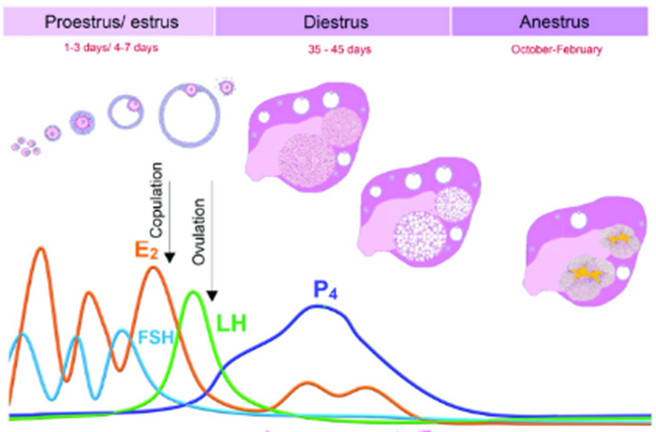
Fig. 7: Estrus cycle of queen (Santos et al., 2023).