Topogaraphical, clinical and therapeutic ophthalmology
- Frequency of administration
1- Periodic administration
2- Continuous or Intermittent Ocular Surface Lavage Systems
- In patient with painful eyes, a lavage system allows medications to be conveniently, safely, and frequently delivered into the conjunctival sac.
- Systems were placed within the nasolacrimal duct and medications were instilled in a retrograde fashion.
Subpalpebral administration to treat equine and feline:
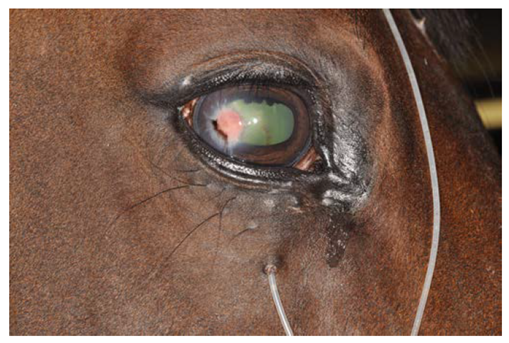
- Subpalpebral lavage systems placed in the medial aspect of the lower lid are associated with less common and less severe ocular complications than those placed centrally and dorsally, even when left in place and used by owners for up to 55 days later.
- The lavage tube leads back to the shoulder, where it is secured at the mane and where drugs can be administered with less risk of injury to the eye or the operator.
- Drugs are injected into the tube and either slowly propelled to the eye with a gently administered bolus of air from a syringe or continuously propelled by a gravity-fed bottle or small mechanical infusion pump connected to the tube.
- This method of therapy is usually reserved for horses with severe corneal or uveal disease.
- A protective eyecup can be applied over the lavage tube for protection of the eye and apparatus. Ointments (and some more viscous suspensions) cannot be applied through lavage systems.
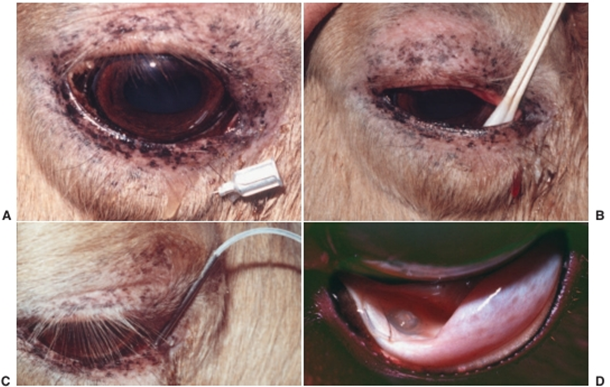
Fig.32: Placement of a subpalpebral lavage system in the medial aspect of a horse’s lower eyelid. A, A local (subcutaneous) injection of lidocaine is administered. B, The palpebral and fornicial conjunctival surfaces are anesthetized with proparacaine-soaked cotton-tipped applicators held in place for 1 or 2 minutes. C, A trocar is used to penetrate the lower lid from the conjunctival fornix, and the lavage tube is threaded through it. D, The trocar is removed, and the lavage tube is pulled down until it lies snugly in the ventral conjunctival fornix between the third eyelid and lower lid. (Budras et al.,2002).
|
Fig.33: Right eye of a horse with a subpalpebral lavage system inserted through the inferior eyelid. The footplate of the tube rests between palpebral conjunctiva and third eyelid to avoid corneal irritation (Budras et al.,2002). |