Most common viral diseases affecting shrimp in aquaculture systems
- Shrimp biology and farming requirements
Shrimp production, a significant sector in global aquaculture, plays vital role in food security, employment and economic growth, especially in coastal regions. With increasing demand for seafood, shrimp farming has expanded rapidly making it one of the most traded aquatic products in the world. Shrimps are playing crucial roles in marine and freshwater ecosystems.
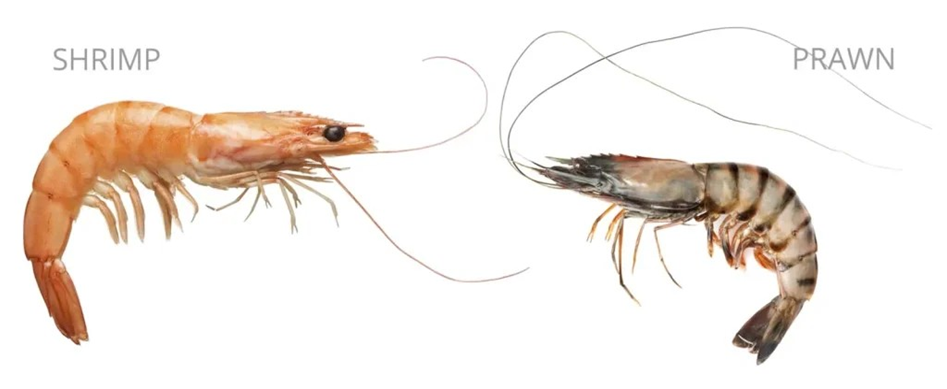
Biology: Shrimps belong to the sub-order Pleocyemata which includes most decapod crustaceans like crabs, lobsters, and shrimp. Shrimp body curved as their thorax overlaps their head and abdomen, allowing them to bend their bodies more than prawns, have two pairs of claw-like legs and plate-like gills; Shrimps will carry their fertilized eggs on the undersides of female's abdomen and females brooding eggs on their pleopods known as (berried) females. While, Prawns belong to the sub-order Dendrobranchiata; each segment overlaps the one below (head overlaps the thorax, and the thorax overlaps the abdomen) so their bodies are straight and unable to bend as shrimps do. Prawns also have three pairs of claw-like legs, and branching gills. The sexes are separate, and females tend to be larger than males. Prawns release their eggs into the water then leave them to grow on their own.
Reproduction biology: Sex is separate, reproduction is hormonally regulated, synthesis and release of hormones occur during season, Reproduction is controlled by hormones released from sinus gland and associated centers in eye stalk. The common technique used to induce reproduction is eyestalk ablation, usually unilateral by cutting off eye stalk to induce spermatogenesis and acceleration vitellogenesis in male and female respectively. In shrimp gonad maturation in female occur very rapidly within 3-4 days after ablation. At mating male insert spermatophores (sperm) into thelycum (a specialized external structure formed from modified sternal plates on the underside of a female shrimp’s thorax that receive and store sperm from male during mating) on the ventral surface of female shrimp. Fertilization occurs externally upon ovulation and passage of the oocyte through the gonadophore, the fertilized eggs are retained on female abdominal appendages (pleopods) until the larvae hatch, the newly hatched larvae each must undergo up to 12 molts to attain final form as a juvenile shrimp.
External anatomy of shrimp: Freshwater and saltwater have two body parts. The cephalothorax is part of the body that contains the head and thorax. It is protected by carapace plating. The cephalothorax has the rostrum, stalked eyes, carapace, first and second antennae, antennules, five sets of pereopods, maxillipeds, and mandibles. The abdomen has both upper and lower parts. Shrimp have swimmerets, which are also called pleopods. Shrimp’s tail is made up of three parts. Two are uropods, and the telson is the most pointed part in the middle. When swimming, pleopod tails work like airplane wings to steer. A thin membrane links six parts of the abdomen. The first through fifth segments are connected to five pairs of swimming legs. The sixth segment becomes a tail fan.
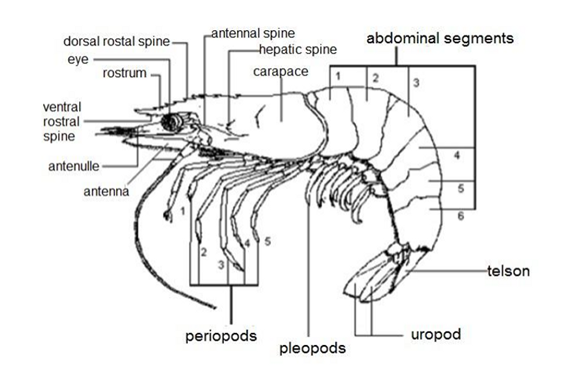
Internal anatomy of shrimp:
Most shrimps are omnivorous. The intestine appeared as dark line running down the back and along dorsal length of the abdomen; it is sometimes called the "mud vein"
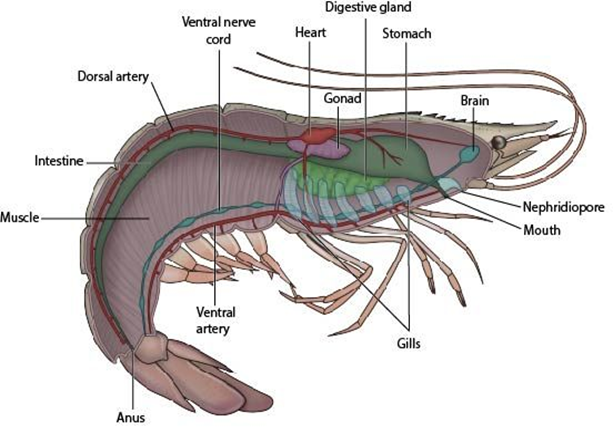
https://www.dfo-mpo.gc.ca/science/aah-saa/publications/figures/shrimp-crevette-eng.html
Difference between shrimp and prawn:
|
Difference between shrimps and prawns | Martak.com
|
||
|
Items
|
Shrimp |
Prawn |
|
Body |
Curved body as thorax overlaps their head and abdomen and the second abdominal segment overlaps the first and third segment. |
Straight bodies with segments overlapping front-to-back. |
|
Legs
|
Have two pairs of claw-like legs |
Have three pairs of claw-like legs |
|
Gills
|
Plate-like gills |
Branching gills
|
|
Reproduction
|
Females brooding eggs on their pleopods known as (berried ) females. |
Fertilized eggs release into the water |
|
Habitat
|
Most are marine |
Most are freshwater |
|
Most cultured shrimp worldwide |
|||
|
Species (Scientific Name) |
Common Name |
Key Features |
Culture Regions |
|
Penaeus monodon |
Black Tiger Shrimp |
Large size, high market value, hardy |
Widely farmed in Asia (India, Thailand, Philippines) |
|
Penaeus vannamei ذات الارجل البيضاء (الفانمي) |
Whiteleg Shrimp |
Fast growth, high survival, dominates global production |
Latin America, Asia (China, Vietnam, Indonesia) "Egypt" |
|
Penaeus indicus الهندي الأبيض |
Indian White Shrimp |
Adaptable to varied salinity, good for semi-intensive farming |
India, Middle East "Egypt" |
|
Penaeus japonicus |
Kuruma Shrimp |
High-value species, prefers sandy bottoms, sensitive to salinity |
Japan, Taiwan |
|
Penaeus merguiensis |
Banana Shrimp |
Short culture period, moderate size |
Southeast Asia |
|
Penaeus semisulcatus الجمبري السويسي |
Green Tiger Shrimp |
Hardy, moderate growth |
Middle East, South Asia "Egypt" |
|
Metapenaeus ensis |
Greasyback Shrimp |
Smaller size, local importance |
India, Southeast Asia |
|
Metapenaeus monoceros |
Speckled Shrimp |
Short culture cycle, moderate demand |
South Asia |
|
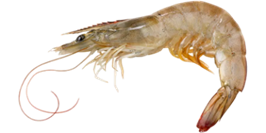
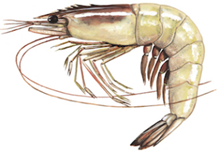
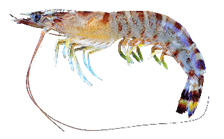
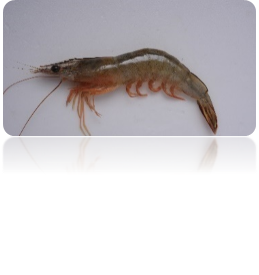
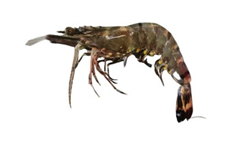
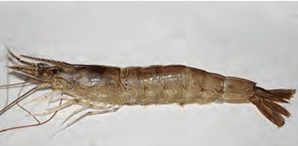
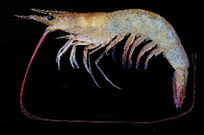
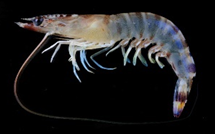
Penaeus pulchricaudatus الجمبري القزاز https://marinebiodiversity.org.bd/species/penaeus-pulchricaudatus/ |
Kuruma Shrimp Tiger prawn |
Short culture cycle Market size 30 gm (4 months) |
Indo-Pacific, Red Sea, and Mediterranean Wild-caught prawn in Egypt around Bardawil lagoon and the Mediterranean coast. |
|
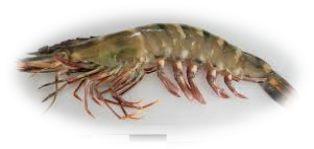
Freshwater prawn |
|||
|
Macrobrachium rosenbergii https://pescaflora.com/prawn جمبري المياة العذبة |
Giant river prawn |
Rearing period 6-8 months Market size 25-60 gm
|
Farming of Freshwater prawn: Integrated system: it cultured alongside freshwater fish using tilapia wastewater as nutrient source as well as efficient use of freshwater |
|
Central Institute of Freshwater Aquaculture. TNAU 2009-15 |
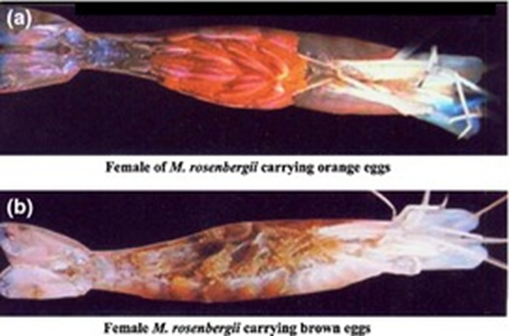
(a) Female of Macrobrachium rosenbergii carrying orange eggs. (b) Female M. rosenbergii carrying brown eggs. Madlen (2013) |
||
|
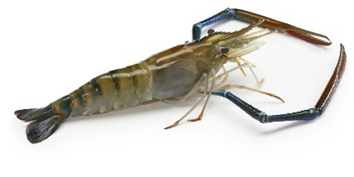
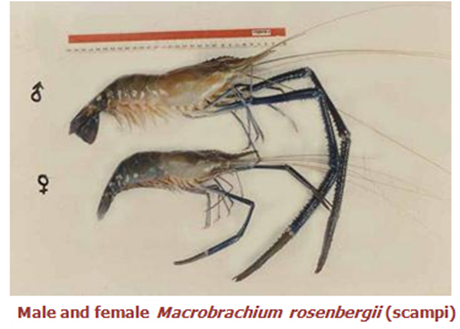
The Giant freshwater prawn, Macrobrachium rosenbergii is a valuable aquaculture species large market size , fast growth, tolerate wide range of environmental conditions, easily breeding under hatchery condition and higher survival from stocking to harvest (New, 2005), it found in freshwater estuarine areas and can culture in rice fields in brackish water with high water depth (0.5– 0.6m ) (Lan et al., 2023). Mature males are larger (about 25 cm) than the females (about 15 cm); second chelipeds are much larger and thicker, head is larger, and the abdomen is narrower. The head of the mature female and its second walking legs are much smaller than the adult male. A ripe or ‘ovigerous' female can easily be detected because the ovaries can be seen as large, orange-colored masses occupying a large portion of the dorsal and lateral parts of the cephalothorax. Mature prawn easily mates and spawns in captivity throughout the year with berried females (gravid females carrying ripe brown colored eggs) and successful mating can only take place between ripe females, which have just completed their pre-mating moult (usually at night) and are therefore soft-shelled, and hard-shelled males. |
|||
|
Life stages and corresponding feeding |
||
|
Stage |
Feeding Type |
Notes |
|
Egg |
None |
Embryo relies on yolk reserves until hatching |
|
Nauplius |
None (yolk-dependent) |
Non-feeding stage; lasts ~18–24 hours |
|
Protozoea |
Microalgae (Chaetoceros, Skeletonema) |
First feeding stage; requires clean water and stable salinity |
|
Mysis |
Microalgae + rotifers + Artemia nauplii |
Active swimmers need live feed for survival and growth |
|
Postlarva (PL) |
Artemia + formulated microdiet |
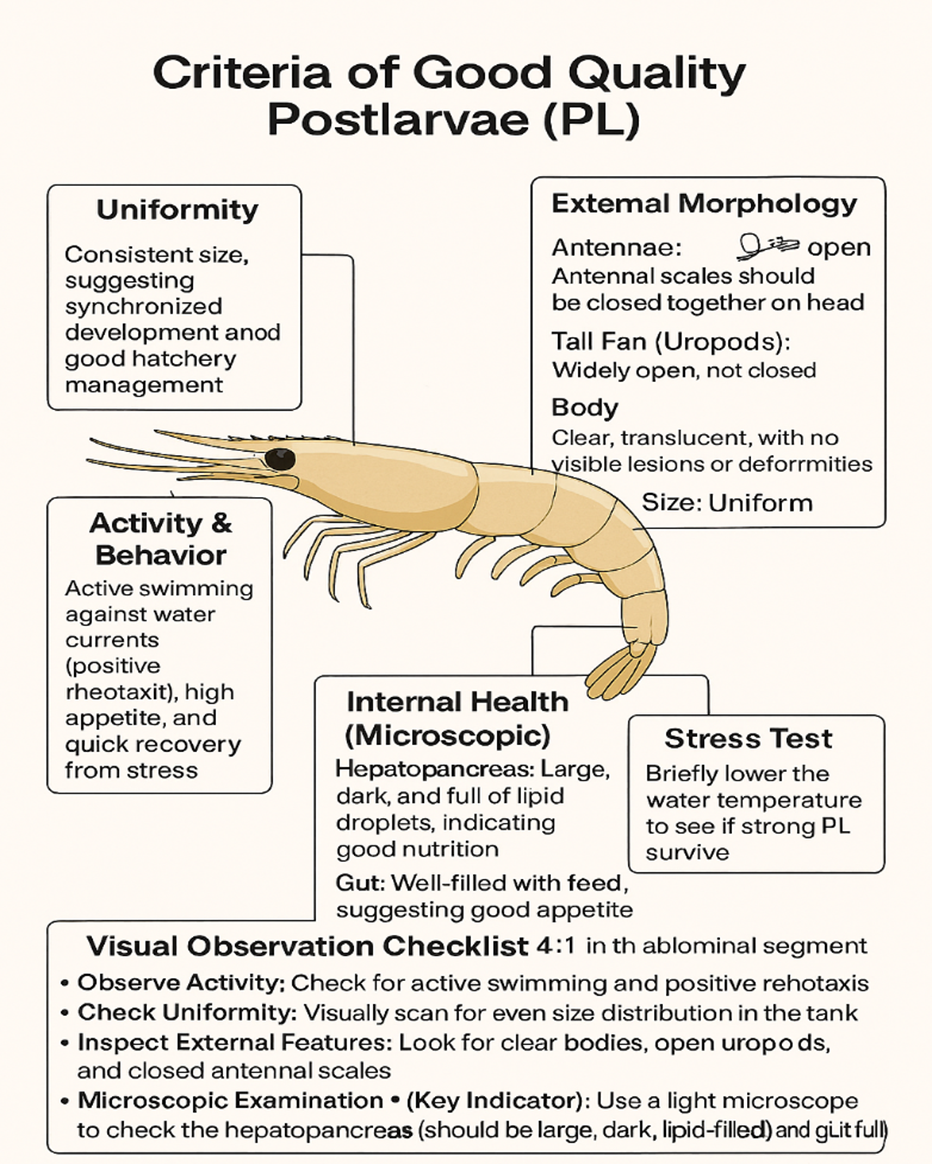
Transition to dry feed; monitor gut fill and hepatopancreas |
|
Juvenile |
Formulated pellet feed (40–45% protein) |
Feed 3–5 times/day; ensure uniform size and reduce competition |
|
Adult |
Pellet feed + supplements |
Optimize feed conversion ratio (FCR); avoid overfeeding |
Culturing systems
· Traditional/extensive pond culture: low yield in earthen pond with minimal input.
· Semi-intensive and recirculating system: controlled environment in tanks or pool to reduce water exchange
· Intensive pond culture: use aeration, higher stocking densities and formulated feeds for increased production.
· Closed system: land-based, recirculating system that treats and reuse water, needs high aeration and technology.
Management
· Water quality: maintaining optimal salinity, temperature, Dissolved oxygen and ammonia level.
· Stocking: acclimating post-larvae to pond conditions and adjusting stocking rate (30-50/ m2 in pond). Ideal stage for stocking is post-larvae 10-12 days old as they are potent enough for pond conditions.
· Feeding: using formulated diet to meet requirements
· Biosecurity: Practices should be applied to prevent introduction and spread of diseases.
· Harvesting: during spring tides to collect hardened-shell shrimp, using nets at pond outlets.