Biosecurity in Poultry Farms
1- Isolation
The principle of isolation refers to the confinement of animals within a controlled environment. A fence keeps your birds in, but it also keeps other animals out. Isolation also applies to the practice of separating birds by age group. In large poultry operations, all-in/all-out management styles allow simultaneous depopulation of facilities between flocks and allow time for periodic clean-up and disinfection to break the cycle of disease.
A- Time (time between push-out and refilling a poultry house or farm).
1. There should be ample time separating succeeding flocks on a premise to prevent the transmission of disease agents.
1. How long a house should be out of production? Depends on the risk to the new birds of becoming infected.
1. Some disease causing agents will persist in the environment longer than others.
2. All-in/all-out management allow simultaneous depopulation of facilities between flocks and allow time for periodic clean up and disinfection.
B- Distance between farms or houses on a farm.
1. Restrict access to your farm and your birds.
1. Consider fencing off the Area where your birds are to form a barrier between clean and dirty areas. The clean area is the immediate area surrounding your birds. The Dirty area must be considered infected with germs. A fence keeps your birds in, but it also keeps other animals out.
Isolation also applies to the practice of separating birds by age group.
* Allow only people who take care of your birds to come into contact with them and prevent visitors. If visitors have to gain access to your farm, be sure that they wash up first and clean their shoes.
1. Game birds and migratory waterfowls should not have contact with your flock because they carry germs and diseases.
2. The direction of prevailing winds and upstream contamination of any water on the premise should be considered when determining risk.
C- Physical barriers (fences, showers, foot baths)
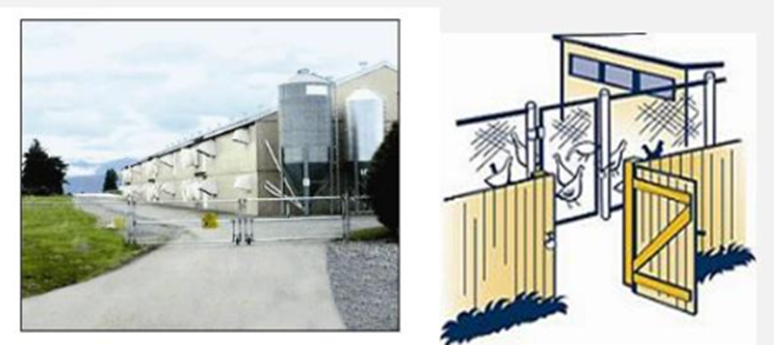
Barriers are very effective at limiting the spread of pathogens. Securing buildings, removing feed and harborage for pests, including stagnant water, and tall grasses will help to create a barrier around the flock.
1. Vertebrate vector control programs should focus on the control and exclusion of rodents and free-flying birds from the poultry house
2. Invertebrate vector control should focus on abatement from the poultry house and the immediate surrounding environment.
1. Barriers should be created to prevent the carriage of disease agents into poultry houses by humans. Disease agents are carried on clothing, hair and footwear.
1. A boot dipping station that includes a brush and a dip with a disinfectant agent can prevent the entry of disease agents on boots. Disinfectants in boot dips should be changed daily.
1. Every flock should have its own equipment.
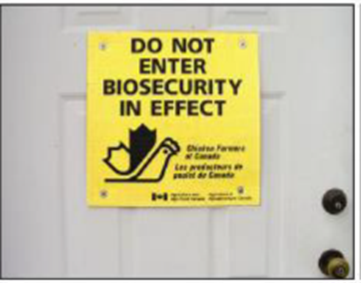
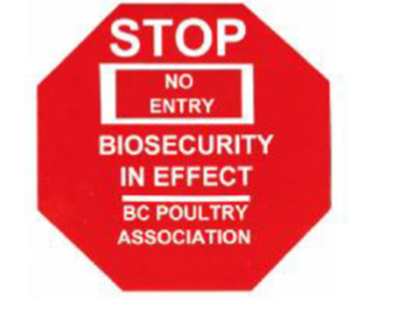
➡️Approved Signage:
Approved restricted access signs shall be posted at all barn entrances.
The barn entrance is a high disease transmission risk area and is the last line of defense in preventing disease transmission. It is therefore appropriate to post signs to limit non-essential access.
➡️Guidelines:
a. Entrance signs will identify that the area beyond the entrance is a restricted access zone.
b. Entrance signs must be readily visible, clean and legible.