Safe Hygienic Disposal of Animal and Poultry carcasses
| Site: | EHC | Egyptian Health Council |
| Course: | Vet. Public Health and Preventative Medicine Guidelines |
| Book: | Safe Hygienic Disposal of Animal and Poultry carcasses |
| Printed by: | Guest user |
| Date: | Sunday, 20 September 2026, 7:51 PM |
Description
"last update: 17 April 2024" Download Guideline
- Committee
We would like to acknowledge the committee of National Egyptian Guidelines for Veterinary Medical Interventions, Egyptian Health Council for adapting this guideline.
Executive Chief of the Egyptian Health Council: Prof. Dr Mohamed Mustafa Lotief.
Head of the Committee: Prof. Dr Ahmed M Byomi
The rapporteur of the Committee: Prof. Dr Mohamed Mohamedy Ghanem.
Scientific Group Members: Prof. Dr Nabil yassien, Prof. Dr Ashraf Aldesoky Shamaa, Prof. Dr Amany Abbas, Prof. Dr Dalia Mansour, Dr Essam Sobhy
Editor: Prof. Dr Ahmed M. Byomi
- Glossary
Dead animal: a domestic mammal or bird, or part of a domestic mammal or bird that has died from a cause other than having been slaughtered for human consumption, and inedible offal or condemned material from animals slaughtered for human consumption.
Carcass Disposal: Carcasses should be disposed of in a manner that protects susceptible animals from disease exposure, particularly from cross-contamination with carcasses from off-site or other processes. The disposal process should also prevent the attraction of wild animals or scavengers.
Cremation or burning: Burning of carcasses within a farm on pyres is also a common waste treatment practice that involves combustion of organic substances contained in waste material. It is not suitable for large volume of material.
- Scope
This guideline outlines disposal methods appropriate for the contagious animal diseases that are most readily transmitted by fomites (ie foot-and-mouth disease, Newcastle disease, and avian influenza) and zoonotic diseases. For this manual to become an effective document, it is important that the proposed strategies are incorporated into routine protocols and staff training.
- Introduction
Mortality is an inevitable consequence of livestock and poultry farming. The main objective of disposal of carcasses, animal products, materials and wastes is to prevent the dissemination of infectious agents and protection of animal and poultry populations from the risk of disease transmission. Disposal should be completed as soon as possible after death to minimise opportunities for dispersion of infectious agents. Carcasses are much easier to handle before decomposition has set in. Carcasses and other items awaiting disposal should be considered to prevent unauthorised access and to prevent domestic pets, wild animals and wild birds carrying potentially infectious material. Control of insects should be considered if there is a risk of passive transmission by insects to nearby susceptible species. If disposal is delayed, carcasses should be thoroughly sprayed with an approved disinfectant.
Personnel should be fully briefed about nature of the disease and any specific hygiene requirements associated with zoonotic diseases before starting work. Respirators should be supplied to personnel to avoid any risk to humans from the organism involved, or if large amounts of dust are generated.
Effective carcass management achieves two primary goals: 1) to contain pathogens to prevent further spread of disease to animals and humans; and 2) to protect drinking water, air and soil. Both of these goals relate to human, animal and ecosystem health, which are part of the One Health concept.
- Purpose
During an animal disease outbreak, the effective disposal of animal carcasses and related contaminated materials is a key component of a successful response. Proper disposal can help prevent or mitigate the further spread of pathogens. If any materials are potentially contaminated with an animal disease pathogen, they must undergo treatment or disposal to inactivate or contain the pathogen. Animal wastes requiring disposal following an animal disease outbreak include: carcasses; milk and meat products; eggs and wool; contaminated manure or slurry; litter and bedding; contaminated feed and feeding stuff; contaminated personal protective equipment (PPE); contaminated materials and equipment that cannot be cleaned and disinfected.
- The Target audience
The guideline is intended for all veterinarians who are responsible for animal and poultry farms as well as whose responsible for veterinary clinics, zoo parks and animals owners.
- Procedure
Carcass management can be performed onsite or offsite by a variety of methods; the selected method depends on the specific site conditions, including locally available resources and type and size of operation.
Selecting site-specific disposal options
Every farm should have a plan for how they would manage carcasses in case of an outbreak. The plan should provide details of how to implement all the disposal options that apply to the specific site and situation to facilitate flexibility for carcass management. The veterinarian chooses to use one or more of the different disposal methods, depending on the local circumstances.
Disposal on the infected premises (or
dangerous contact premises)
General factors to be considered are:
· Nature and amount of material for disposal.
· Availability of sites suitable for burial or cremation adjacent to the mortality site.
· Accessibility to disposal site by heavy transport vehicles.
· Nature of soil/ground geology in the available area.
· Level of ground water-table.
· Proximity to water channels and wells.
· Presence of underground services, eg water, gas, electricity, telephone lines, drainage, sewerage, other improvements or structures, including aerial lines;
· Proximity to built-up areas and dwellings (particularly in the case of cremation);
· Fire restrictions, hazards (in the case of cremation);
· Weather conditions including prevailing winds (it may be easier to cremate in excessively wet conditions);
· Availability of supplies of suitable fuel for cremation.
· Presence of overhead structures such as power lines; these must be avoided when selecting both burial and cremation sites.
· Quantities of carcasses and other material for disposal; and
· Subsequent plans for the use of the area, eg the soil may be unstable where burial pits are placed.
Disposal of animal carcasses and other infectious material may involve some adverse environmental consequences. It is important for the environmental aspects of proposed disposal activities to be properly considered, with advice from environmental agencies where possible, so as to ensure that the impact of such consequences be minimised. Consultation with relevant authorities, eg environmental protection agencies, will be necessary to obtain specific permission.
Disposal off the infected premises
Where burial or cremation is not considered practical or difficult to carry out on the infected premises, consideration could be given to transferal of carcasses and/or infectious materials to another site for disposal by burial or cremation. This may be necessary when considering the disposal of materials from laboratories and in situations where site limitations, such as available space or high water-table, effectively prevent on-site disposal. If infectious and dangerous contact premises are adjacent or in close proximity, a common disposal site may be used.
Transport should be in a leak-proof container, covered with tough polyethylene covers and sealed at the top.
All natural orifices of the carcasses should be plugged used cotton soaked in a suitable disinfectant.
Carcasses should not be slashed before loading.
Vehicles should travel slowly to avoid splashing of contaminated material. Staff should carry a supply of an approved disinfectant and basic equipment to deal with minor spills en route. All vehicles must be cleaned and disinfected before leaving the premises and after unloading.
Methods of disposal:
A- Burial
It includes disposing of the carcasses in graves, trenches or in open bottom containers called as mortality pits. This method has been banned in most of the developed countries because of the entry of infectious agents in the human food chain and the environmental pollutions. Large scale burial in different catastrophes and disasters may lead to contamination of ground and surface water with pathogens and the chemical products of decomposition.
Important considerations for burial site selection include.
· Access to the site — for both equipment to dig the burial pit and for the delivery of livestock, carcasses or other materials to be buried;
· Environmental — distance to watercourses, streams and wells; height of water-table; proximity to buildings, especially houses; proximity to neighbours or public lands including roads; slope of the land and drainage to and from the pit; permeability of soil; sufficient space for temporary storage of overburden; and direction of prevailing wind (odour);
· Construction considerations — avoid rocky areas (slows digging and increases costs) but select soils with good stability capable of withstanding the weight of equipment used to construct and fill the pits. Surface runoff should be prevented from entering the pit by the construction of diversion banks if required. Similar banks should be constructed to prevent any liquids escaping from the burial site. Fencing may be necessary to exclude animals until the site is safe for use.
Earthmoving equipment
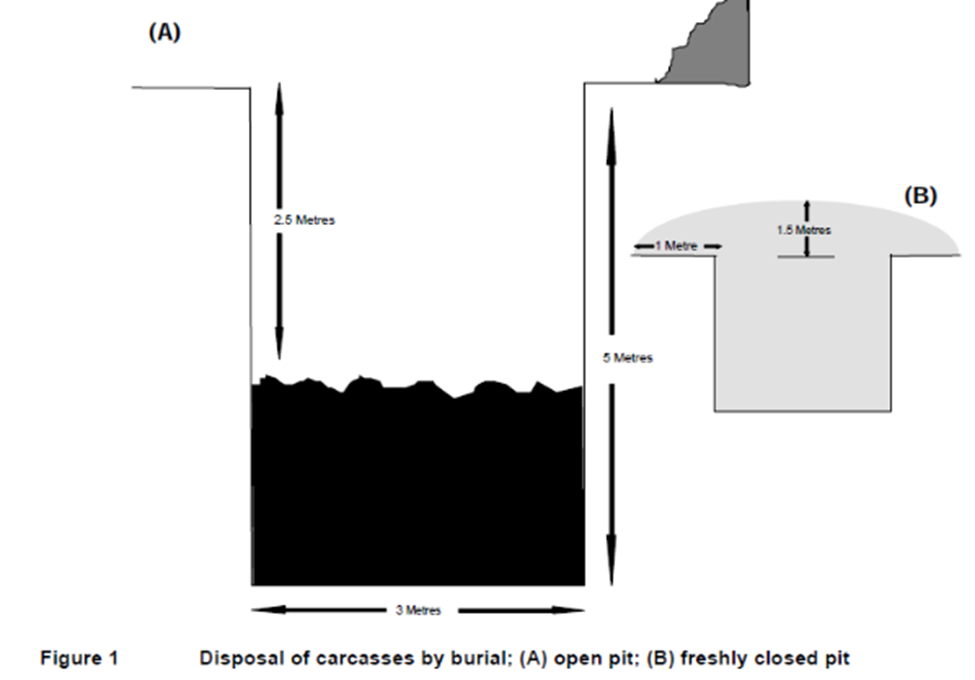
The preferred equipment for digging burial pits is an excavator. This equipment is the most efficient available for the construction of long, deep, vertically sided pits.
Burial pit construction
The dimensions of the burial pit will be dependent on the equipment used, site considerations and the volume of material to be buried. The preferred dimensions are for pits to be as deep as practically possible (reach of machinery, soil type and water-table level being the usual constraints), with vertical sides. The length of the pit will be determined by the volume of material to be buried.
The following guidelines may be of assistance in determining the pit volume required. The base of the pit must be at least 1 metre above the water-table. On average, allow a fill capacity of about 1.5 cubic metres for each adult cow or 5 adult sheep.
In addition, at least 2 metres of soil is required to cover carcasses to ground level. When closing the pit, surplus soil should be heaped over the pit as overfill. Quick lime should be added to pits under carcasses as well as above to prevent earthworms bringing contaminated material to the surface after pit closure.
Cremation or Burning
Burning of carcasses within a farm on pyres is a common practice in many countries particularly developing ones. The low-temperature combustion may not effectively inactivate all pathogens, and the significant air turbulence caused by the combustion process can transport active pathogens by air, potentially spreading the pathogenic agent.
Despite the potential for pollution to occur from the mass-burning of carcasses, evidence of groundwater contamination from ash burial, soil contamination from pyres, and air emissions from pyres did not significantly affect the environment beyond the immediate vicinity.
Complete combustion of carcass for safe disposal is achieved when sufficient labour, air and fuel is provided.
Incineration
Incineration is burning of animal carcasses at high temperatures (>850 ºC) to inorganic ash. Biological incinerators are a very efficient carcass disposal system, achieving safe and complete disposal.
However, their cost (establishment and operation) and lack of portability means they are unlikely to be readily available or easily accessible in most situations. Incinerators are usually only suited to disposal of small amounts of material. Special procedures must be followed in connection with the transportation of infected material off infected premises to the incinerators and the disinfection of containers and vehicles.
Advantages
The process destroys all infective agents. It is generally accepted that incineration destroys prion proteins more effectively than other methods of livestock disposal (with exception of alkaline hydrolysis. From a human and animal health perspective, the high temperature of incineration also completely destroys zoonotic and animal pathogens, including resilient spore-forming bacteria such as Bacillus anthracis (anthrax).
Ash represents only 1-5% of initial carcass volume, although this will depend on the incinerator type, process, fuel and animal species.
Disadvantages
The principal concern with incineration of carcasses is the gaseous emissions key pollutants represent 60.2% of the total air emissions. Other health concerns with incineration include the release of dioxins and furans released due to incomplete combustion and can settle in areas around carcass incinerators and could enter the food chain through grazing animals or through human consumption of contaminated crops.
Effluent
Small amounts of solid manure may be disposed of by burial or cremation.
Hatching eggs and hatchery waste
Before disposal of hatching eggs and hatchery waste into burial pits, all materials should be macerated to ensure extinction of all life.
- References
- Baba IA, Banday MT, Khan AA, et al. Traditional methods of carcass disposal: a review. J Dairy Vet Anim Res. 2017;5(1):21‒27. DOI: 10.15406/jdvar.2017.05.00128.
- Scudamore JM, Trevelyan GM, Tas MV, et al. Carcass disposal: lessons from Great Britain following the foot and mouth disease outbreaks of 2001. Rev Sci Tech. 2002;21(3):775‒787.
- Wafula MM, Patrick A, Charles T. Managing the 2004/05 anthrax outbreak in Queen Elizabeth and Lake Mburo National Parks. Uganda. African Journal of Ecology. 2008;46(1):24‒31.
- Lori Miller, Gary Flory.(2018). Carcass management for small- and medium-scale livestock farms - Practical considerations.FOCUS ON, No. 13, October 2018. Rome. FAO
- Animal Health Australia.: MANUAL ON PROCEDURES FOR DISEASE ERADICATION BY STAMPING OUT . Australian Veterinary Emergency Plan (AUSVETPLAN).2nd ed. Primary Industries Ministerial Council, Canberra, Australia; 1996.
- ALBERTA REGULATION 229/2000, Animal Health Act (2012): DESTRUCTION AND DISPOSAL OF DEAD ANIMALS REGULATION. www.qp.alberta.ca.
- United States Department of Agriculture. 2020. Animal and Plant Health Inspection Service.
Guidelines for the Emergency Use of Above Ground Burial to Manage Catastrophic Livestock
Mortality (Draft). Available upon request from lori.p.miller@aphis.usda.gov.