Complete denture maintenance and care
| Site: | EHC | Egyptian Health Council |
| Course: | Prosthodontics Guidelines |
| Book: | Complete denture maintenance and care |
| Printed by: | Guest user |
| Date: | Sunday, 20 September 2026, 7:51 PM |
Description
"last update: 20 January 2025" Download Guideline
- Executive summary
This guideline offers recommendations to provide healthcare professionals with practical guidance for the maintenance of removable prosthesis specially to enhance the quality of life of the geriatric patients.
|
Recommendations |
|
· Advise the patient to carefully remove the bacterial biofilm daily from both the oral cavity and the surfaces of the complete dentures. ( Strong recommendation). · Advise the patient to soak and brush the removable prosthesis outside the mouth using an effective, nonabrasive denture cleanser. After soaking and brushing, thoroughly rinse it with a denture-cleansing solution before reinserting it into the oral cavity (Conditional recommendation). · Advise the patient to have their removable prosthesis professionally cleaned by a dentist or dental professional annually. Ultrasonic cleansers should be used (if available) to minimize biofilm accumulation over time (Conditional recommendation). · Advise the patient to avoid soaking dentures in sodium hypochlorite bleach or any products containing sodium hypochlorite for more than 10 minutes (Strong recommendation). · Advise the patient to store the dentures immersed in water after cleaning, whenever they are not in the oral cavity (Good practice statement). · Advise the patient to avoid wearing dentures continuously to help reduce or minimize the risk of denture stomatitis (Good practice statement). · Advise the patient to apply denture adhesive in small, sufficient amounts (three or four pea-sized dollops) on each denture to enhance retention and stability of the prostheses (Conditional recommendation). · Advise the patient to completely remove denture adhesive from both the prosthesis and the oral cavity daily (Good practice statement). · Consider arrangement of three-month periodic visits to evaluate the fit and stability of the dentures if extended use of denture adhesives is required (Good practice statement). · Consider arrangement of an annual follow-up visit with a prosthodontist for maintenance of the removable prosthesis and evaluation of both soft and hard oral tissues (Good practice statement).
|
- Recommendations
Recommendations for the professionals and general practitioners for the maintenance and care of their complete denture:
▪️ Advise the patient to carefully remove the bacterial biofilm daily from both the oral cavity and the surfaces of the complete dentures. (2-4) (Strong recommendation- high grade evidence).
▪️ Advise the patient to soak and brush the removable prosthesis outside the mouth using an effective, nonabrasive denture cleanser. After soaking and brushing, thoroughly rinse it with a denture-cleansing solution before reinserting it into the oral cavity (5-7) (Conditional recommendation-Low grade evidence).
▪️ Advise the patient to have their removable prosthesis professionally cleaned by a dentist or dental professional annually. Ultrasonic cleansers should be used (if available) to minimize biofilm accumulation over time (8-9) (Conditional recommendation- Low grade evidence).
▪️ Advise the patient to avoid soaking dentures in sodium hypochlorite bleach or any products containing sodium hypochlorite for more than 10 minutes (10-16) (Strong recommendation- High grade evidence).
▪️ Advise the patient to store the dentures immersed in water after cleaning, whenever they are not in the oral cavity (Good practice statement).
▪️ Advise the patient to avoid wearing dentures continuously to help reduce or minimize the risk of denture stomatitis (Good practice statement).
▪️ Advise the patient to apply denture adhesive in small, sufficient amounts (three or four pea-sized dollops) on each denture to enhance retention and stability of the prostheses (17-27) (Conditional recommendation - Low grade evidence).
▪️ Advise the patient to completely remove denture adhesive from both the prosthesis and the oral cavity daily (20,22) (Good practice statement).
▪️ Consider arrangement of three-month periodic visits to evaluate the fit and stability of the dentures if extended use of denture adhesives is required (Good practice statement).
▪️ Consider arrangement of an annual follow-up visit with a prosthodontist for maintenance of the removable prosthesis and evaluation of both soft and hard oral tissues (Good practice statement).
- Acknowledgement
We would like to acknowledge the members of the Guideline Development Group (GDG) for developing these guidelines.
▪️ Chair of the GDG: Professor Randa Elsalawy, School of Dentistry, Newgiza University.
▪️ Members of the Guideline Development Group (GDG):
Dr Randa Ahmed Elsalawy Professor and Dean of school of dentistry New Giza University
Dr Karim Albattoty professor and Dean of school of dentistry Ain Shams University
Dr Ahmed Emad Fayyad Professor at school of dentistry Cairo University
Dr Ahmed Alzohery Professor at school of dentistry Cairo University
Dr Osama Alshahawy Professor at school of dentistry Cairo University
Dr Foad Sharaby Professor at school of dentistry Cairo University
Dr Mohamed Khalifa Zayet Professor at school of dentistry Cairo University
Dr Mohamed Ahmed Alsholkamy Professor at Suiz Canal University
Dr Mohamed Tarek Alhalawany Lecturer at Elalameen University
Dr Hussein Abdelhady Lecturer at Minia University
Dr Ahmed Amin Musselhy Associate professor at the Military Medical Academy
Dr Rafik Kamal Gerges Associate professor at the Military Medical Academy
- Abbreviations
ACP: American college of prosthodontics
ADA: American dental association
GDG: Guideline Development Group
NGOs: Non-governmental organizations
RCD: removable complete denture
- Introduction
Successful oral rehabilitation of edentulous patients with removable prosthesis with a long-term satisfactory prognosis demands careful adherence to a strict clinical as well as maintenance protocol.
The current rates of edentulism have been estimated to be more than 7 percent of the adult population internationally and this is more in the developing countries. While the incidence of edentulism continues to decline, rapid population growth coupled with current economic conditions suggest that edentulism and conventional denture use will continue at current or higher numbers. Unfortunately, there is only one evidence-based guidelines for the care and maintenance of removable complete denture (RCD) that was developed in 2009 by the American College of Prosthodontists (ACP). This guideline aims to simplify a maintenance protocol for better prognosis improving the patient’s quality of life.
- Scope and Purpose
The objectives of the present guidelines are:
▪️ To provide guidance for the professionals for a proper maintenance protocol that should be followed to prolong the life span of a removable prosthesis as well as educating the patient how to take care of his removable prosthesis.
▪️ Reducing malpractice that leads to frequent remake of the removable prosthesis that will lead to financial overload and wasting of the healthcare institutions resources.
▪️ To improve the quality of the dental healthcare services
- Target Audience
This guideline targets healthcare professionals, policy makers, as well as non-governmental organizations (NGOs) and other stakeholders to provide the most appropriate tools and materials for management patients having removable prosthesis.
- Methodology
A comprehensive search for guidelines was undertaken to identify the most relevant guidelines to consider for adaptation.
Inclusion/ exclusion criteria followed in the search and retrieval of guidelines to be adapted:
▪️ Selecting only evidence-based guidelines (guideline must include a report on systematic literature searches and explicit links between individual recommendations and their supporting evidence).
▪️ Selecting only national and/or international guidelines
▪️ Specific range of dates for publication (using Guidelines published or updated in 2015 and later)
▪️ Selecting peer reviewed publications only
▪️ Selecting guidelines written in English language
▪️ Excluding guidelines written by a single author, not on behalf of an organization to be valid and comprehensive, a guideline ideally requires multidisciplinary input
▪️ Excluding guidelines published without references as the panel needs to know whether a thorough literature review was conducted and whether current evidence was used in the preparation of the recommendations.
The following characteristics of the retrieved guidelines were summarized in:
- Developing organization/authors
- Date of publication, posting, and release
- Country/language of publication
- Date of posting and/or release
- Dates of the search used by the source guideline developers
All retrieved Guidelines were screened and appraised using AGREE II instrument (www.agreetrust.org) by at least three members. The panel decided on a cut-off point or ranked the guidelines (any guideline scoring above 50% on the rigor dimension was retained).
The GDG decided to adapt the American College of prosthodontics guidelines 2011 (ACP) for maintenance and care (1).
Evidence assessment
According to WHO Handbook for Guidelines, we used the GRADE (Grading of Recommendations, Assessment, Development and Evaluation) approach to assess the quality of a body of evidence, develop and report recommendations. GRADE methods are used by WHO because these represent internationally agreed standards for making transparent recommendations. Detailed GRADE information is available on the following sites:
▪️GRADE working group: http://www.gradeworkingroup.org
▪️ GRADE online training modules: http://cebgrade.mcmaster.ca/
▪️ GRADE profile software: http://ims.cochrane.org/revman/gradepro
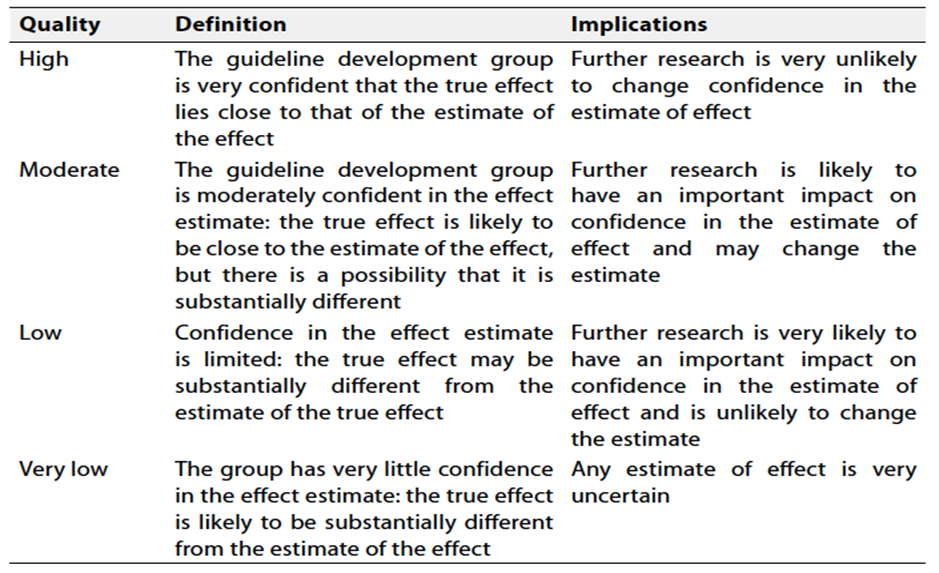
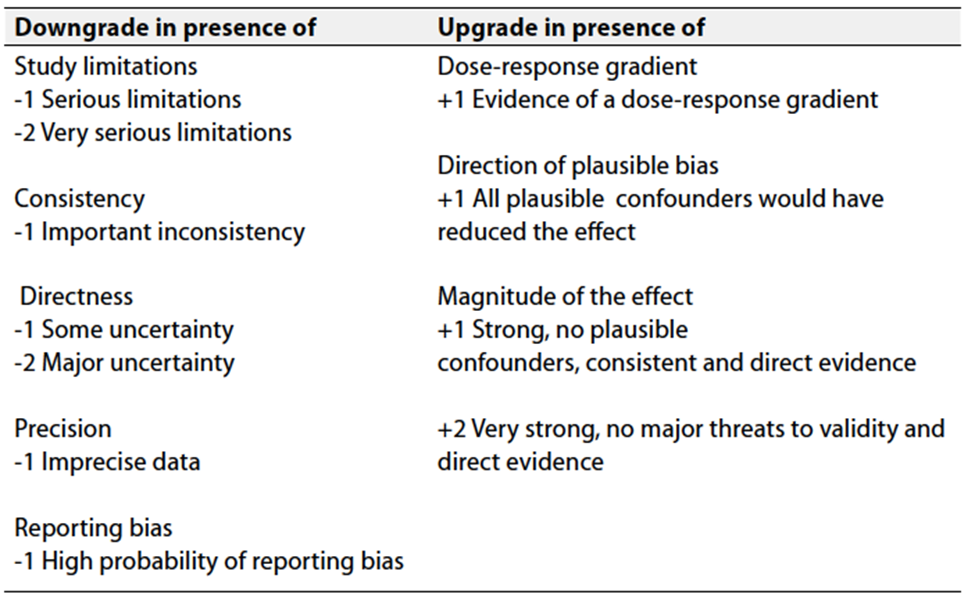
Table 2: Factors that determine How to upgrade or downgrade the quality of evidence
The strength of the recommendation
The strength of a recommendation communicates the importance of adherence to the recommendation.
Strong recommendations
With strong recommendations, the guideline communicates the message that the desirable effects of adherence to the recommendation outweigh the undesirable effects. This means that in most situations the recommendation can be adopted as policy.
Conditional recommendations
These are made when there is greater uncertainty about the four factors above or if local adaptation has to account for a greater variety in values and preferences, or when resource use makes the intervention suitable for some, but not for other locations. This means that there is a need for substantial debate and involvement of stakeholders before this recommendation can be adopted as policy.
When not to make recommendations
When there is lack of evidence on the effectiveness of an intervention, it may be appropriate not to make a recommendation.
Recommendations for the professionals and general practitioners for the maintenance and care of their complete denture:
▪️ Advise the patient to carefully remove the bacterial biofilm daily from both the oral cavity and the surfaces of the complete dentures. (2-4) (Strong recommendation- high grade evidence).
▪️ Advise the patient to soak and brush the removable prosthesis outside the mouth using an effective, nonabrasive denture cleanser. After soaking and brushing, thoroughly rinse it with a denture-cleansing solution before reinserting it into the oral cavity (5-7) (Conditional recommendation-Low grade evidence).
▪️ Advise the patient to have their removable prosthesis professionally cleaned by a dentist or dental professional annually. Ultrasonic cleansers should be used (if available) to minimize biofilm accumulation over time (8-9) (Conditional recommendation- Low grade evidence).
▪️ Advise the patient to avoid soaking dentures in sodium hypochlorite bleach or any products containing sodium hypochlorite for more than 10 minutes (10-16) (Strong recommendation- High grade evidence).
▪️ Advise the patient to store the dentures immersed in water after cleaning, whenever they are not in the oral cavity (Good practice statement).
▪️ Advise the patient to avoid wearing dentures continuously to help reduce or minimize the risk of denture stomatitis (Good practice statement).
▪️ Advise the patient to apply denture adhesive in small, sufficient amounts (three or four pea-sized dollops) on each denture to enhance retention and stability of the prostheses (17-27) (Conditional recommendation - Low grade evidence).
▪️ Advise the patient to completely remove denture adhesive from both the prosthesis and the oral cavity daily (20,22) (Good practice statement).
▪️ Consider arrangement of three-month periodic visits to evaluate the fit and stability of the dentures if extended use of denture adhesives is required (Good practice statement).
▪️ Consider arrangement of an annual follow-up visit with a prosthodontist for maintenance of the removable prosthesis and evaluation of both soft and hard oral tissues (Good practice statement).
- Research needs
▪️More randomized controlled clinical trials are needed on the long-term effect of using denture adhesives and its effect on the oral tissues.
- Monitoring and evaluating the impact of the guideline
▪️ Three-month periodic visit to evaluate the fit and stability of the dentures.
▪️ Annual follow-up visit with a prosthodontist for maintenance of the removable prosthesis and evaluation of both soft and hard oral tissues
- Updating of the guidelines
These guidelines will be updated whenever there is new evidence.
- References
1. Felton D, Cooper L, Duqum I, Minsley G, Guckes A, Haug S, Meredith P, Solie C, Avery D, Chandler ND: Evidence-Based Guidelines for the Care and Maintenance of Complete Dentures: A Publication of the American College of Prosthodontists .JADA 2011;142(2 suppl)
2. Zissis A, Yannikakis S, Harrison A. Comparison of denture stomatitis prevalence in two population groups. Int J Prosthodont 2006;19(6):621-625.
3. Ramage G, Tomsett K, Wickes BL, Lopez-Ribot JL, Redding SW. Denture stomatitis: a role for Candida biofilms. Oral Surg Oral Med Oral Pathol Oral Radiol Endod 2004;98(1):53-59.
4. Coco BJ, Bagg J, Cross LJ, Ramage G. Mixed Candida albicans and Candida glabrata populations associated with the pathogenesis of denture stomatitis. Oral Microbiol Immunol 2008;23(5):377-383.
5. Abelson DC. Denture plaque and denture cleansers: review of the literature. Gerodontics 1985;1(5):202-206.
6. Nikawa H, Hamada T, Yamashiro H, Kumagai H. A review of in vitro and in vivo methods to evaluate the efficacy of denture cleansers. Int J Prosthodont 1999;12(2):153-159.
7. de Souza RF, de Freitas Oliveira Paranhos H, Lovato da Silva CH, Abu-Naba’a L, Federowicz Z, Gurgan CA. Interventions for cleaning dentures in adults. Cochrane Database Syst Rev 2009;(4): CD007395.
8. Muqbil I, Burke FJ, Miller CH, Palenik CJ. Antimicrobial activity of ultrasonic cleaners. J Hosp Infect 2005;60(3):249-255.
9. Sheen SR, Harrison A. Assessment of plaque prevention on dentures using an experimental cleanser. J Prosthet Dent 2000;84(6): 594-601.
10. da Silva FC, Kimpara ET, Mancini MN, Balducci I, Jorge AO, Koga-Ito CY. Effectiveness of six different disinfectants on removing five microbial species and effects on the topographic characteristics of acrylic resin. J Prosthodont 2008;17(8):627-633.
11. Devine DA, Percival RS, Wood DJ, et al. Inhibition of biofilms associated with dentures and toothbrushes by tetrasodium EDTA. J Appl Microbiol 2007;103(6):2516-2524.
12. Ferreira MA, Pereira-Cenci T, Rodrigues de Vasconcelos LM, Rodrigues-Garcia RC, Del Bel Cury AA. Efficacy of denture cleansers on denture liners contaminated with Candida species. Clin Oral Invest 2009;13(2):237-242.
13. Hong G, Murata H, Li YA, Sadamori S, Hamada T. Influence of denture cleansers on the color stability of three types of denture base acrylic resins. J Prosthet Dent 2009;101(3):205-213.
14. Paranhos HF, Silva-Lovato CH, de Souza RF, et al. Effect of three methods for cleaning dentures on biofilms formed in vitro on acrylic resin. J Prosthodont 2009;18(5):427-431.
15. Nguyen CT, Masri R, Driscoll CF, Romberg E. The effect of denture cleansing solutions on the retention of pink Locator attach- ments: an in vitro study. J Prosthodont 2010;19(3):226-230.
16. Maeda Y, Kenny F, Coulter WA, et al. Bactericidal activity of denture-cleaning formulations against planktonic health care-associ- ated and community-associated methicillin-resistant Staphylococcus aureus. Am J Infect Control 2007;35(9):619-622.
17. Sato Y , Kaiba Y , Hayakawa I: Evaluation of denture retention and ease of removal from oral mucosa on a new gel-type denture adhesive. Nihon Hotetsu Shika Gakkai Zasshi 2008;52:175-182
18. Pradies G, Sanz I, Evans O, et al: Clinical study comparing the efficacy of two denture adhesives in complete denture patients. Int J Prosthodont 2009;22:361-367
19. Kulak Y, Ozcan M, Arikan A: Subjective assessment by patients of the efficiency of two denture adhesive pastes.J Prosthodont 2005;14:248-252
20. Uysal H, Altay OT, Alparslan N, et al: Comparison of four different denture cushion adhesives: a subjective study. J Oral Rehabil 1998;25:209-213
21. Kelsey CC, Lang BR, Wang RF: Examining patients’ responses about the effectiveness of five denture adhesive pastes. JADA 1997;128:1532-1538
22. Berg E: A clinical comparison of four denture adhesives. Int J Prosthodont 1991;4:449-456
23. Ghani F, Picton DC: Some clinical investigations on retention forces of maxillary complete dentures with the use of denture fixatives. J Oral Rehabil 1994;21:631-640
24. Lang A, Garcia T, Bohnenkamp DM, et al: Effects of denture adhesive on retention of mandibular complete dentures (abstract 0308). J Dent Res 2007;86(spec issue research A)
25. Kapur KK. A clinical evaluation of denture adhesives. J Prosthet Dent 1967;18:550-558
26. Grasso JE: Denture adhesives. Dent Clin North Am 2004;48:721-733
27. Chew CL, Boone ME, Swartz ML, et al: Denture adhesives: their effects on denture retention and stability. J Dent 1985;13:152-159