Care of patients with renal failure
| Site: | EHC | Egyptian Health Council |
| Course: | Nursing Procedures Guidelines for Hemodialysis |
| Book: | Care of patients with renal failure |
| Printed by: | Guest user |
| Date: | Sunday, 20 September 2026, 5:07 PM |
Description
"last update: 9 March 2025"
- Prepared by
Under supervision
- Prof. Dr. Mohamed Latif, CEO of the Egyptian Health Council
Dr. Kawthar Mahmoud, Head of the Egyptian Nursing Syndicate - Member of the Senate
Prepared by
|
Title |
Name |
NO. |
|
Dean Of Faculty Nursing, Professor of Medical and Surgical Nursing, Tanta University |
Dr Afaf Abdel Aziz Abdel Aziz Basal |
1 |
|
Professor Of Critical Care Nursing |
Prof.Dr/Zeinab Hussain Ali |
2 |
|
Professor And Head of the Department of Medical Surgical Nursing. Faculty-. Benha University |
Amal Said Taha Refaie |
3 |
|
Supervisor Of the Education Sector at Port Said University |
Amal Ahmed Khalil Morsy |
4 |
|
Professor Of Medical Surgical Nursing- Faculty of Nursing- Cairo University |
Dr. Hanan Ahmed Al Sebaee |
5 |
|
Head of central administration on secondment at MOHP |
Dr Neveen ab drab al0nabi Mohamed |
6 |
|
Director Of Primary Health Care Nursing Department at MOHP. |
Maysa Hosny Ahmed Tammam |
7 |
|
Supervisor Of Technical Education- EHA |
Nancy Alaa Eldeen Abd-Elbaset Ali |
8 |
|
Supervisor Of Nursing Services Development- EHA |
Sherien Mohamed Saad |
9 |
|
Assistant Professor of Maternity and Neonatal Health Nursing - Faculty of Nursing- Ain Shams University |
Assist.Perof. Dr./Heba Mahmoud Mohammed |
10 |
|
General manager of general administration of health institutes affairs |
Dr Mai Galal Ibrahim Al-Assal |
11 |
|
Participants |
||
|
member of the Nursing administration at EHA, port said branch |
Mr. Ahmed Zarq Al-Sayed |
12 |
|
member of the Nursing administration at EHA, ismailia branch |
Mrs. Radwa Al-Sayd Al-Nagdi
|
13 |
|
member of the Nursing administration at EHA, ismailia branch |
Mrs. Omnia Hassan Absi |
14 |
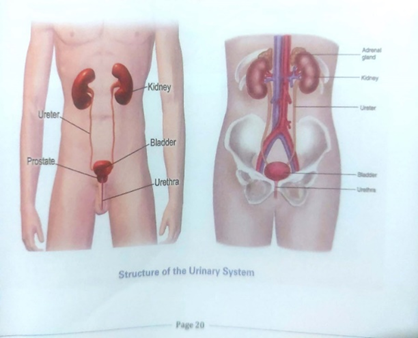
- Anatomy of the urinary system
➡️Components of the urinary
system:
The kidneys, which are excretory organs.
The ureters are the tubes that carry urine from the kidneys to the bladder.
The bladder, which is the place where urine is collected.
The urethra is the passage through which urine exits the body.
➡️The function of the
urinary system:
Formation and excretion of urine, and the elimination of toxins and excess
water from the body.
Description of the parts of the urinary system:
1- The Kidneys (The Kidney):
The human body contains two kidneys, each about 10-12 cm long, approximately 6
cm wide, and about 2.5 cm thick. Each kidney weighs about 150 grams in men and
130 grams in women. The right kidney is positioned lower than the left kidney
due to the presence of the liver above it. The kidneys resemble a bean in shape
and are dark brown in color. At the upper part of each kidney lies the adrenal
gland. Each kidney is composed of several units called nephrons, and each
kidney contains between one million to two million nephrons, with their number
decreasing with age or disease.
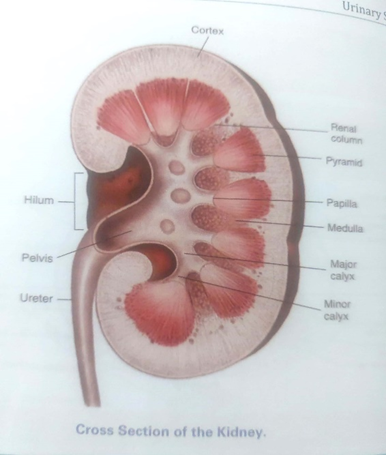
➡️The kidney is composed from the outside to the inside of:
- Bowman Wallet
- The crust layer
- Medulla layer
Each kidney contains about a million filtration units (nephrons), which are the
filters in the kidney responsible for purifying the blood. They are connected
by connective tissue, and each tubule begins in the cortex layer with a
crescent-shaped indentation called Bowman's capsule, which contains a bundle of
blood vessels that start from the afferent artery and end at the efferent
artery.
The Bowman’s capsule and the blood vessels inside tiny structures called
Malpighian corpuscles, of which there are thousands in the cortex.
A convoluted tubule exits Bowman's capsule, called the proximal convoluted
tubule, which heads towards the medulla, forming the descending limb, then
returns to the cortex, forming the ascending limb. In the cortex, it convolutes
upon itself to form the distal convoluted tubule. Finally, it returns to the
medulla, where it gathers to form collecting ducts that each open at the tips
of the Malpighian pyramids in the renal pelvis.
➡️The function of the
kidneys in the body:
The natural kidneys perform essential functions in the human body, which are:
Purifying the blood and eliminating any toxins in the body.
It maintains the balance of body fluids and minerals.
- Secretion of certain ions and regulation of blood pH balance such as (sodium
- potassium - calcium - phosphorus - chloride - phosphate - and hydrogen).
Hormonal function:
➡️The kidneys secrete
many hormones:
1-Renin hormone, which helps retain the amount of fluids and sodium by
regulating hormones.
Aldosterone is produced by the adrenal gland, so the secretion of renin
increases in cases of low sodium in the blood or dehydration. Therefore, renin
works to raise blood pressure, and consequently, the kidneys regulate blood
pressure in the human body.
2-Erythropoietin (secreted in response to low oxygen levels, such as in cases
of anemia) stimulates the bone marrow to produce red blood cells, thereby
maintaining the hemoglobin levels in the blood.
3-To activate vitamin D, which helps in the absorption and deposition of calcium
in the bones, the secretion of hormone (unknown).
2- The Ureter (الحالب):
It is a muscular tube that transports urine from the kidney to the bladder,
measuring 25 cm in length, and it contracts regularly from top to bottom to
push urine into the bladder.
3- The Urinary Bladder:
It is a muscular sac whose primary function is to store urine until it is time
to expel it from the body through the urethra.
4- Urethra:
It is the tube that carries urine from the bladder to outside the body, and it
differs in men and women; it measures 20 cm in men and only 4 cm in women.
➡️Urine formation in the
kidneys:
Urine is formed through three stages:
Filtration: where water, salts, and some other substances are filtered
from the blood.
Absorption: where some water and salts needed by the body are reabsorbed
into the bloodstream.
So that the components of the blood are not affected by the loss of all the
water and dissolved salts in it.
Secretion: It is carried out by the cells of the kidney tubules, which
have the ability to filter out substances that exceed their quantity.
The permissible natural limit in the body or in excess and is eliminated.
Urine formation occurs in healthy, unaffected kidneys.
➡️Urine characteristics:
Color: Yellow.
Specific gravity: from (1005) to (1025).
Concentration: Acid around (pH = 6).
The scent: (Aromatic).
Content: Water + urea + creatinine + urea (protein breakdown product) +
ammonium ions.
Inorganic substances: sodium - potassium - calcium - chloride -
phosphate - sulfate and oxalate + approximately 100 grams of protein (albumin)
/ 24 hours.
The amount of urine in 24 hours (from half a liter to one and a half liters)
depends on the fluids entering and leaving the human body in a day, as well as
the weather conditions, the individual's overall health, and the condition of
the kidneys in particular.
- Kidney failure
➡️Definition:
Kidney failure is a medical condition that occurs when the kidneys stop
functioning properly. The kidneys are vital organs responsible for filtering
waste and excess fluids from the blood, regulating the balance of chemicals in
the body, and contributing to blood pressure control. When a person suffers
from kidney failure, the kidneys cannot perform these functions adequately.
➡️Kidney failure can be:
Acute kidney failure: It occurs suddenly and is often due to direct kidney
injury or problems such as a sudden drop in blood pressure, poisoning, or
urinary tract obstruction.
Chronic kidney failure: It develops gradually over the years due to long-term
diseases such as diabetes or high blood pressure, leading to the destruction of
kidney tissues over time.
➡️Causes of kidney
failure:
1 - Causes related to the circulatory system (reduced blood flow to the
kidneys, leading to kidney failure).
Note:
The kidney will not function efficiently until 20% of the blood pumped from the
heart reaches it.
2 - Causes that occur within the kidneys, such as (nephritis).
3 - Causes related to post-renal parts such as (partial or complete obstruction
of the ureter or bladder due to the presence of a stone, which prevents urine
from passing, causing it to accumulate in the ureter and return to the kidney
again).
➡️Symptoms of acute
kidney failure:
1 - Nausea and vomiting
2 - Itching
3 - Spasms
4 - Swelling in the limbs
5 - Crystal clear effusion
6 - Urine output less than 400 cm³/day (normal is 1500 cm³/day)
➡️Symptoms of chronic
kidney failure:
Anemia
Fatigue speed
Increase in blood creatinine
Low specific gravity in urine
Swelling in the limbs
Bleeding rate
The patient needs dialysis in the following cases:
BUN
< 35 mg/dL
Creatinine < 800 micromol/L
bicarbonate > 12 mmol/L
➡️The purpose of
washing:
1. Removal of urea and creatinine from the blood
2. Maintaining the appropriate salt levels in the body
3. Removing excess fluids from the body's blood.
➡️Types of dialysis :
Peritoneal dialysis is done through the peritoneal membrane.
Blood washing is done through blood.
- Health education to prevent kidney failure
- Monitoring
urine, its quantity and color, and informing the doctor of any changes in the
color, quantity, or turbidity of the urine.
- Conducting urea tests.
- Monitoring the bladder to prevent urine accumulation because accumulation in
the bladder leads to stone formation.
- Monitoring and treating blood pressure because chronic hypertension is
considered one of the causes of kidney failure.
- Administering the patient a quantity of fluids no less than 2500 cm³/day.
- The speed of treating circulatory collapse.
- Treatment for any kidney infections.
- Discovering and breaking down stones.
- We must prevent medications that are excreted by the kidneys because this
leads to further destruction of kidney cells.
- Calculate the intake and output and inform the doctor.
- The patient's meal should be rich in carbohydrates and the amount of protein
in the meals should be reduced. A normal person needs 1 gram of protein per
kilogram of body weight, while a kidney failure patient needs 0.6 grams per
kilogram.
- Reducing salt in meals.
As for patients with
kidney failure, the following should be taken into consideration:
If the amount of fluid output is low, we must do the following:
1. Reducing fluids for the patient.
2. As for the patient's food, it should contain large amounts of carbohydrates,
with reduced protein and a complete ban on table salt in the patient's meals.
3. The patient's weight should be monitored daily, and if any increase is
observed, tests should be conducted to determine the levels of creatinine,
sodium, and potassium in the blood.
4. For a dialysis patient, viral tests must be conducted before the dialysis to
determine if they have hepatitis or AIDS.
5. We must allocate a special dialysis machine for hepatitis patients to
prevent the spread of the disease.
6. The dialysis machine must be sterilized after each patient.
7. Heparin should be administered to prevent blood clotting.
Giving the patient meal advice.
- References
▪️ Chronic kidney disease (CKD) surveillance system: 2021 Accessed September 30, 2021
▪️ Identification of incident CKD stage 3 in research studies Am J Kidney Dis, 64 (2022), pp. 214-221
▪️ KDIGO. KDIGO 2012 Clinical practice guideline for the evaluation and management of chronic kidney disease. Kidney Int Suppl. 2023;3(1):1-150.
▪️ Daugirdas JT, Greene T, Rocco MV, Kaysen GA, Depner TA, Levin NW, Chertow GM, Ornt DB, Raimann JG, Larive B. Kliger AS; FHN Trial Group. Effect of frequent hemodialysis on residual kidney function. Kidney Int. 2023;83(5):949–958.
▪️ International Council of Nurses. (2020) Guidelines on Advanced Practice Nursing 2020. Available from: https://www.icn.ch/system/files/documents/2020-04/ICN_APN%20Report_EN_WEB.pdf [Accessed 14th March 2022].
▪️ Spanner E, Suri R, Heidenheim A, Lindsay R. The impact of hemodialysis on nutrition. Am J Kidney Dis. 2023; 42 (Suppl): S30–S35.