Urinary Catheterization Procedural Guide
| Site: | EHC | Egyptian Health Council |
| Course: | Evidence of nursing procedures for internal sections |
| Book: | Urinary Catheterization Procedural Guide |
| Printed by: | Guest user |
| Date: | Sunday, 20 September 2026, 5:07 PM |
Description
"last update: 22 April 2025" تحميل الدليل
- Prepared by
Inpatient guide
Under supervision
- Prof. Dr. Mohamed Latif, CEO of the Egyptian Health Council
Dr. Kawthar Mahmoud, Head of the Egyptian Nursing Syndicate - Member of the Senate
Prepared by
|
Title |
Name |
NO. |
|
Dean Of Faculty Nursing, Professor of Medical and Surgical Nursing, Tanta University |
Dr Afaf Abdel Aziz Abdel Aziz Basal |
1 |
|
Professor Of Critical Care Nursing |
Prof.Dr/Zeinab Hussain Ali |
2 |
|
Professor And Head of the Department of Medical Surgical Nursing. Faculty-. Benha University |
Amal Said Taha Refaie |
3 |
|
Supervisor Of the Education Sector at Port Said University |
Amal Ahmed Khalil Morsy |
4 |
|
Professor Of Medical Surgical Nursing- Faculty of Nursing- Cairo University |
Dr. Hanan Ahmed Al Sebaee |
5 |
|
Head of central administration on secondment at MOHP |
Dr Neveen ab drab al0nabi Mohamed |
6 |
|
Director Of Primary Health Care Nursing Department at MOHP. |
Maysa Hosny Ahmed Tammam |
7 |
|
Supervisor Of Technical Education- EHA |
Nancy Alaa Eldeen Abd-Elbaset Ali |
8 |
|
Supervisor Of Nursing Services Development- EHA |
Sherien Mohamed Saad |
9 |
|
Assistant Professor of Maternity and Neonatal Health Nursing - Faculty of Nursing- Ain Shams University |
Assist.Perof. Dr./Heba Mahmoud Mohammed |
10 |
|
General manager of general administration of health institutes affairs |
Dr Mai Galal Ibrahim Al-Assal |
11 |
|
Participants |
||
|
Head of nursing administration at EHA, Ismailia branch |
Ms. Nahla Kamel Mostafa |
12 |
|
member of the Nursing administration at EHA, Ismailia branch |
Ms. Maha Mohamed Saad |
13 |
|
member of the Nursing administration at EHA, Ismailia branch |
Mr. Tharwat Abdel-Al Mohamed |
14 |
|
nursing specialist at the General Administration of Nursing - MOHP |
Mr. Mona Ali Abdul Rahman Al-Katami |
15 |
|
nursing specialist at the General Administration of Nursing - MOHP |
Ms. Sherine Abdel Hakim Abdel Hakim Khattab |
16 |
|
nursing specialist at the General Administration of Nursing - MOHP |
Mr. bahaa fuoad barsom |
17 |
- Professional oath
"I swear by Almighty God
That I will be sincere in my work and fear God in my profession, respect its
laws and regulations, and perform my duties with efficiency and dedication.
I will rely on the knowledge derived from the sciences of nursing in my
practice,
I will make every effort to care for those entrusted to me, preserve their
dignity, keep their secrets, defend their rights, and protect them from any
harm.
I will not fear any blame when telling the truth, and will provide a safe
environment for the patient, family, and community.
I will continue to develop myself, respect and honor those who taught me, and
cooperate with my colleagues in the profession for the sake of righteousness
and piety.
And God is my witness to what I say."
- Nursing Care Vision and Mission
Nursing Care Vision in the Internal Patients Unit
The nursing staff in the Internal Patients Unit strives to elevate the nursing profession and provide effective, safe, and quality nursing care to the unit’s patients according to Egyptian, national, and international standards.
Nursing Care Mission in the Internal Patients Unit
The nursing staff in the Internal Patients Unit is committed to improving the health status of patients and providing them with the best nursing care in alignment with the hospital's goals and procedures, as well as the nursing management. It also works on enhancing the scientific and practical level of all nursing staff in the unit and directs their focus toward modern approaches in nursing and medical sciences.
- Urinary Catheterization
Urinary catheterization is the insertion of a catheter into the bladder to drain urine. This is an invasive procedure that requires strict adherence to aseptic techniques, as failure to follow these methods can lead to hospital-acquired infections. Repeated catheterization can also cause tissue trauma, increasing the risk of infection. Therefore, urinary catheterization should only be performed when medically necessary. Urinary tract infections (UTIs) are one of the most common hospital-acquired infections, and the risk of such infections increases with the duration the catheter remains in place. Therefore, the best preventative measure is to avoid catheterization once it is no longer needed (ideally, it should be removed within 5 days of insertion).
Indications for Urinary Catheterization:
Therapeutic Indications:
- Urine drainage during labor, especially if the patient has received an epidural.
- Urine drainage before, during, and after certain surgical procedures.
- Delivery of specific medications directly into the bladder, such as chemotherapy for bladder cancer.
- Urine drainage in cases of urethral obstruction, such as in males due to prostate enlargement.
- Assisting patients with weakened bladder muscles or nerves that hinder their ability to urinate.
- Birth defects in the urinary system.
- Gallstones, bladder stones, or kidney stones.
- Tumors in the urinary system.
- Use in chronic urinary incontinence patients who have not responded to other treatments.
Diagnostic Indications:
- Monitoring and calculating urine output.
- Collecting a urine sample for laboratory analysis.
Steps for Inserting the Urinary Catheter:
- Ensure patient privacy.
- Explain the procedure to the patient and the medical reasons for catheter insertion.
- Gather all necessary tools for catheterization.
- Wash hands thoroughly.
- Wear sterile gloves and use aseptic technique.
- Attach the urine collection bag to the catheter, ensuring it is closed and suspended.
- Apply 3 ml of gel or any other lubricant to reduce friction.
- Introduce the sterile catheter into the urinary tract.
- Inflate the catheter balloon with the recommended sterile water.
After the Catheterization:
- Secure the catheter to the patient's thigh using medical adhesive.
- Place the urine collection bag below the level of the patient's bed and ensure it is on a stand to prevent backflow.
- Provide the patient with a special urinal to empty the collection bag.
- Dispose of waste in the designated red bag.
- Wash hands after removing gloves and dry thoroughly.
- Record the type of catheter, the time of insertion, and the physician who performed the procedure in the nursing notes.
- Observe and document the amount of urine and any abnormal changes such as blood or pus, and inform the doctor.
Infection Control Precautions for Urinary Catheterization:
- Hand hygiene: Wash hands with antiseptics such as povidone-iodine (7.5%) for at least 2 minutes or wash with soap and water, followed by rubbing hands with alcohol-based solution.
- Personal protective equipment: Use sterile gloves and a disposable plastic apron.
- Sterilized instruments and equipment: All tools must be sterilized.
- Cleaning the catheter insertion site: Clean the pubic area with water and soap or a foaming antiseptic (such as Betadine foam 7.5%) and dry it well, using a clean glove and a disposable plastic apron.
- Disinfect the insertion site using an appropriate antiseptic.
- Cover the insertion site with a sterile drape.
Steps for Collecting a Urine Sample: A sample is collected from the designated port on the catheter. If no such port exists, follow these steps:
- Perform routine hand hygiene and wear clean gloves.
- Disinfect the catheter collection port with alcohol solution.
- Use a new sterile syringe to collect the sample.
- Ensure the syringe is inserted at a higher point in the catheter where the urine exits.
Emptying the Urine Collection Bag:
- Empty the urine from the designated opening at the bottom of the collection bag into a designated container for single patient use.
- Reprocess and sterilize the container before reuse.
Types of Urinary Catheters: The two most common types of urinary catheters are:
- Foley catheter
- Silicone catheter
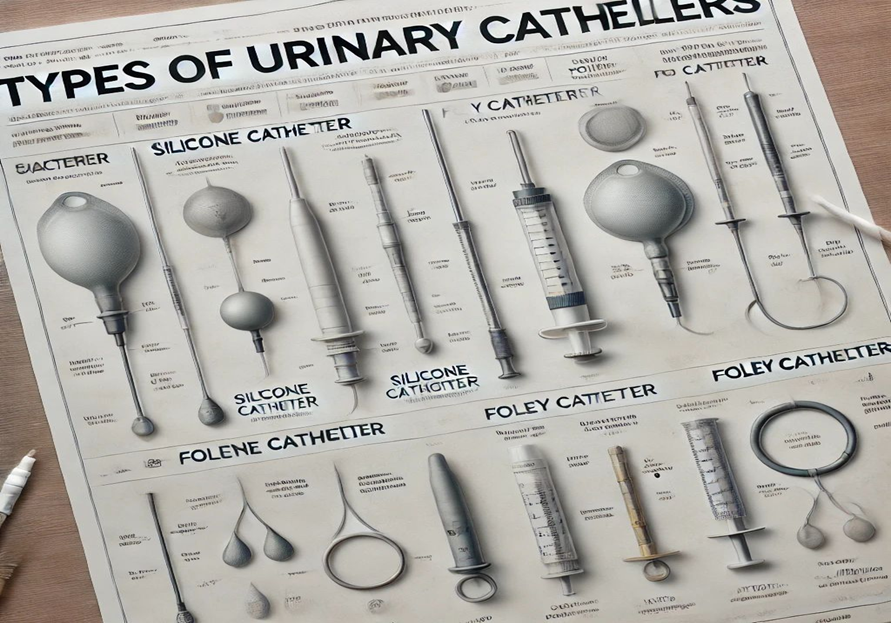
Urinary Catheterization:
Sometimes, the duration for which a urinary catheter remains in place depends on the manufacturer's instructions.
Sizes of the Urinary Catheter: Catheters are measured in French (Fr) and millimeters (mm).
- For children: 6, 8, or 10 French
- For males: 16–18 French
- For females: 12–14 French
- For clot retention: 20–22 French
Important Notes:
- A sterile lubricating gel (preferably single-use) is used during catheter insertion.
- After cleaning the insertion area, it is prohibited to touch the catheter or insertion site unless wearing sterile gloves.
- It is prohibited to disconnect the urine collection bag from the catheter for any reason (such as emptying or obtaining a urine sample).
- The collection bag should not be placed above the patient's level or in contact with the floor.
- The use of prophylactic antibiotics (either topical or systemic) to prevent catheter-associated urinary tract infections (CAUTI) is not recommended.
Preventive Measures to Prevent Catheter-Associated Urinary Tract Infections (CAUTI):
- Urinary catheter insertion should only be performed for a medical necessity.
- The procedure should be performed by a trained healthcare provider following the hospital's catheter insertion protocol.
- The closed urinary system should be maintained.
- Infection prevention techniques must be followed during catheter insertion:
- Hand hygiene.
- Use of sterile gloves.
- Cleaning and disinfecting the pubic area.
- Using a sterile drape for the pubic area.
- Using sterile lubricant (preferably single-use).
Post-Procedure Preventive Measures for Urinary Catheter Care:
- Evaluate the necessity of keeping the catheter in place daily.
- Empty the urine collection bag when it is 2/3 full and use a clean container for each patient.
- Secure the catheter properly to the patient's thigh.
- Collect urine samples only from the designated port.
- Practice hand hygiene and use personal protective equipment before and after catheter care.
Daily Care for Urinary Catheters:
- Secure the catheter firmly.
- Ensure there is no obstruction in the flow of urine through the catheter.
- Avoid placing the urine collection bag higher than the patient's level or in contact with the floor.
- Use a dedicated container for each patient to empty the collection bag.
- Review and evaluate daily whether the catheter can be removed once it is no longer needed.
- Keep the urinary collection system closed at all times.
Important Precautions:
- Ensure the urine collection bag is emptied completely to prevent microbial growth in the remaining urine.
- Bladder irrigation with antiseptics is not recommended.
- Prophylactic antibiotic use is not recommended when inserting the catheter.
- Routine cleaning of the urethral opening after catheter insertion is not necessary for preventing catheter-associated urinary tract infections.
- Always keep the urinary collection system closed (maintain a closed system).
- References
- Procedural Work Guide for the Internal Department, 2017.