The Planning Process in Nursing Management
| Site: | EHC | Egyptian Health Council |
| Course: | Management skills development guides for nursing leaders |
| Book: | The Planning Process in Nursing Management |
| Printed by: | Guest user |
| Date: | Sunday, 20 September 2026, 5:55 PM |
Description
"last update: 13 Feb.2025" تحميل الدليل
- Prepared by
Management skills development guide
Under supervision
- Prof. Dr. Mohamed Latif, CEO of the Egyptian Health Council
Dr. Kawthar Mahmoud, Head of the Egyptian Nursing Syndicate - Member of the Senate
Prepared by
|
Title |
Name |
NO. |
|
Dean Of Faculty Nursing, Professor of Medical and Surgical Nursing, Tanta University |
Dr Afaf Abdel Aziz Abdel Aziz Basal |
1 |
|
Professor Of Critical Care Nursing |
Prof.Dr/Zeinab Hussain Ali |
2 |
|
Professor And Head of the Department of Medical Surgical Nursing. Faculty-. Benha University |
Amal Said Taha Refaie |
3 |
|
Supervisor Of the Education Sector at Port Said University |
Amal Ahmed Khalil Morsy |
4 |
|
Professor Of Medical Surgical Nursing- Faculty of Nursing- Cairo University |
Dr. Hanan Ahmed Al Sebaee |
5 |
|
Head of central administration on secondment at MOHP |
Dr Neveen ab drab al0nabi Mohamed |
6 |
|
Director Of Primary Health Care Nursing Department at MOHP. |
Maysa Hosny Ahmed Tammam |
7 |
|
Supervisor Of Technical Education- EHA |
Nancy Alaa Eldeen Abd-Elbaset Ali |
8 |
|
Supervisor Of Nursing Services Development- EHA |
Sherien Mohamed Saad |
9 |
|
Assistant Professor of Maternity and Neonatal Health Nursing - Faculty of Nursing- Ain Shams University |
Assist.Perof. Dr./Heba Mahmoud Mohammed |
10 |
|
General manager of general administration of health institutes affairs |
Dr Mai Galal Ibrahim Al-Assal |
11 |
|
Participants |
||
|
Professor Of Nursing Administration - Faculty of Nursing- Tanta University |
Prof. Lubna Khamis Muhammad Ibrahim |
12 |
|
Member of board general authority for accreditation and regulation |
Dr. Iman El Shehat |
13 |
|
Member of nursing administration- EHA |
Mr. Ramy Tarek al ashry |
14 |
|
Head of nursing administration -branch Suez |
Ms. Thoraya hanfy Khalil |
15 |
- Introduction to Management Science
Management science is one of the modern human sciences, and it is concerned with the best way to do business in institutions It can be defined as a set of scientific rules and principles that are concerned with the most appropriate use of resources by institutions to achieve the institution’s goal with the least possible time, effort and cost
Nursing administration is concerned with the leadership functions of governance and decision-making within organizations that employ nurses
Nursing management includes performing some well-known administrative processes such as planning, organizing, staffing and directing It is common for registered nurses to seek further education, such as a Master of Nursing degree or a Doctor of Nursing Practice degree, in preparation for nursing leadership positions

Principles of Management Science
1. Organizing specializations at work Specialization allows workers to gain experience, continuously improve their skills and thus become more productive
2. Authority The right to issue orders with the importance of balancing responsibility with his work
3. Discipline The employee must obey, noting that employees will obey orders only if the management provides a good leader
4. Unity of source of command Employees must receive their orders from only one superior, without conflict in the chain of command
5. Unity of Directions People who are linked to the same pattern of activity should have the same single plan objectives Unity of command does not exist without unity of direction
6. Subordinating individual interests to general interests The interest of an individual or group in work should not overshadow the interests of the organization
7. Wages Wages paid must be satisfactory to both employees and employers And must be commensurate with the value of the employee to the organization
8. Centralization or decentralization This depends on the working conditions and the skills of the individuals
9. Chain of command It is called the formal lines of command or lines of communication and should not be long or consist of many levels
10. Order Both material and social demand are necessary, formal matters reduce wasted time and useless handling of raw materials
11. Justice In business management, integrating justice and equality is important, and treating employees well is important to achieve justice
12. Stability of individual positions Employees work better if they have security, as an unstable position and a high rate of job turnover affect the organization and vice versa
13. Initiative All individuals must be allowed to show their initiative as a source of strength for the organization
14. Professional spirit Management should enhance the morale of employees and encourage each individual without arousing jealousy or disturbing harmonious relationships
Definition of management
· There are several definitions of management You can acquire one or more of them Management is a science, an art, and a profession
Management is a science
It means that it relies on the scientific method when observing administrative problems, analyzing them, interpreting them, and arriving at results that can be generalized That is, it has principles, rules, schools, and theories that govern administrative work, and the application of these principles and theories leads to specific results
Management is an art that is, the manager needs experience, skill and intelligence in practicing his work and dealing with the human element to motivate him towards organizational goals, because not everyone who has studied management science is able to apply it The art of management is the ability to apply management in different fields
Management profession- Management is a profession, considered one of the most noble and sublime professions; because it places the person in a position of responsibility, and care for the affairs of employees and the institution, and management as a science, art and profession is closely and directly linked to society and people; because successful management is the basis for the development of society and people; it is linked to social, political, economic, educational affairs, and human resources management, and based on the skill of managers, society advances, and countries advance
Management is an art, a science and a profession together From all of the above, we can say that management is an art and a science together The administrator must rely on books and administrative theories in addition to the practical experience that is indispensable
· The process of setting goals, making the necessary decisions for the profession, and achieving them within a specific time through the optimal use of material and human capabilities
· The process of making decisions and finding alternatives to achieve the desired goal with the highest efficiency and lowest cost
· The process of achieving specific goals in a specific time by using the efforts of individuals and leading them and making use of available material resources, aiming for mastery, speed and economy as much as possible
• The origin of the word administration Latin meaning ( To Serve ), and administration thus means “service” on the basis that those who work in administration serve others
• Management means forecasting, planning, organizing, coordinating, issuing orders and controlling
Management is the process of planning, organizing, leading and controlling the activities and members of the organization, and using all organizational resources - human, financial, material and informational - for the purpose of achieving the organization's goals efficiently and effectively
· Effectiveness effectiveness
It refers to the extent to which the organization's goals are achieved
doing the right things, ie choosing the right goals
· Efficiency
It means the economical use of resources ie economical use of resources and making good use doing things the right way ie achieving the best results with the least effort, time
· Honesty, justice and sincerity in work
· Mental and intellectual qualities, ie he must be intelligent
· Physical attributes to handle the workload
· Technical qualities, ie he must be familiar with the specialty in which he works
· Cultural qualities so that he is familiar with other sciences
· Human qualities through which he can deal with the human element
· Experience-related qualities are qualities that arise as a result of practicing work
- Planning
Definition of planning
· It is setting the necessary plans to achieve the goals and it is the primary function on which the rest of the other management functions depend
· It is a mental process that depends on logic and order, in which an effort is made to clarify the goals that the administration wants and to search for the best means to achieve them, as well as to try to predict or anticipate the obstacles that may hinder it and how to overcome them
Therefore, planning is essential for time management and thus facilitates the implementation process The planning function also requires reaching answers to the following questions in a systematic manner
· What? Where? When? How much? How??
Since the planning function is a complex and diverse function, it is recommended that all team members participate in it by answering these questions
|
Determine the required activities |
|
|
Beginning and end of each activity |
|
|
Identify who is responsible for each part |
|
|
How it works |
|
|
The place where the nursery is to be built |
|
The importance of planning
The importance of planning is represented in the following points
- Focuses efforts on achieving desired goals
- Enables optimal use of human and material capabilities
- It helps workers cooperate, coordinate their efforts and achieve their production efficiency
- It is considered the basis for monitoring implementation, performance evaluation and the extent to which objectives are achieved
- It helps to detect problems before they occur and provides an opportunity to correct the course if necessary
Steps to make the plan
The plan process includes the following steps
- Define the goal and collect data on
- Current status
- Available possibilities
- Statistics and reports
- Develop a set of plans and alternatives to achieve the goal, specifying the cost and implementation period
- Study the steps, compare them and choose the best one
- Set priorities and put the plan into action
Preparing the action plan, which is summarized in the following table
|
Responsible for follow-up |
Evaluation Officer |
Task performance evaluation |
Time limit for implementation From - To |
Executive Officer |
Task to be done
|
|
|
|
|
|
|
|
|
|
|
|
|
|
|
|
|
|
|
|
|
|
Characteristics of a sound plan
A sound plan has the following characteristics
- Exploiting the available capabilities in implementation, which will lead to reducing the cost
- Choose a plan that achieves more than one goal
- Flexibility to allow for necessary adjustments in the event of difficulties or unexpected changes during implementation
- To be written and known to those who carry out the implementation
- To be integrated and consistent in its components and not to have any conflict in its parts
- Involvement of those who will implement it in the planning process, which helps in its efficient implementation
- To be based on realistic data and statistics
Planning obstacles
The most important obstacles facing the development of a sound plan are the following
- One person (top management) makes plans
- Freezing the planning process in formal templates makes it lose flexibility and simplicity
- Lack of interest in reviewing plans periodically to determine the level of the leader / according to the goals Sudden decisions are made outside the scope of the plan
- Management performs daily executive tasks and allocates less time for strategic planning
- Not caring about setting goals The facility
- Lack of involvement of executives in the planning process
- Not relying on plans as criteria for measuring and evaluating managers’ performance
Characteristics of successful planners
· Curiosity
· Creativity
· Competitiveness
· Self-confidence
· Perseverance
· Wisdom
· process (practical person)
Why don't we plan?
· instability and impatience
· Lack of conviction in the usefulness of planning
· Ignorance of planning and lack of knowledge Its importance
· Lack of familiarity with planning skills
· fear of the unknown
· Not knowing priorities and arranging them according to importance
Types of planning
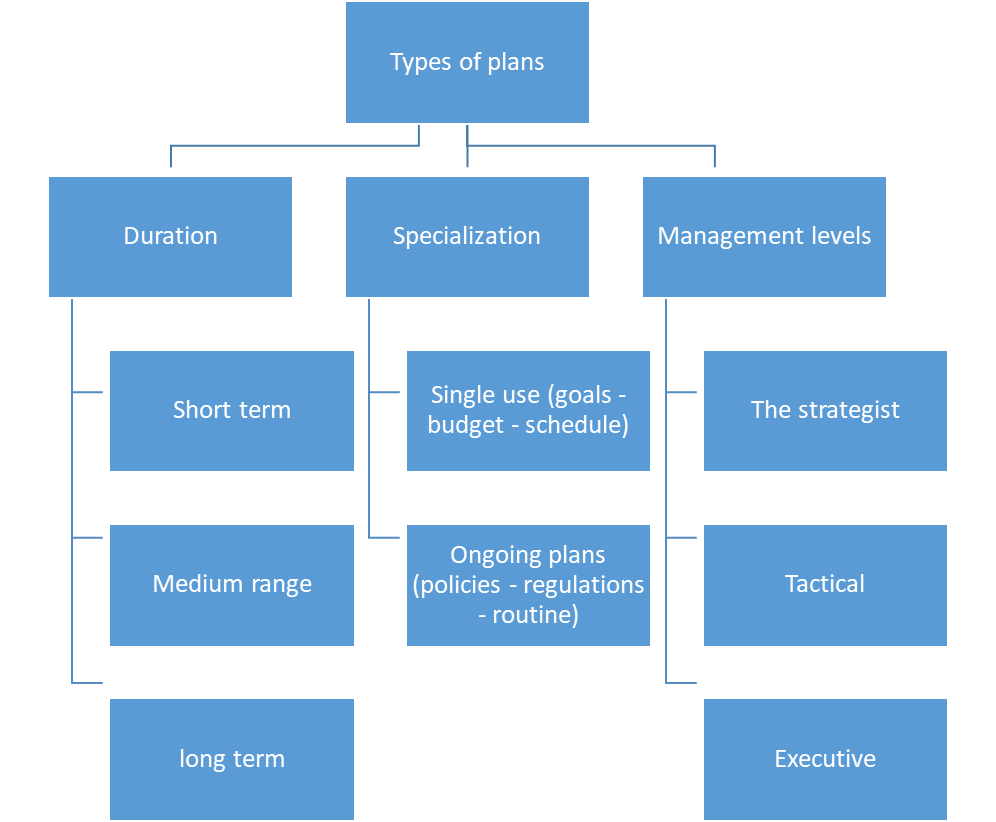
According to the administrative levels, it is divided as follows
1-Strategic planning
called long- term planning, which requires 5-10 years to achieve it also defines the general objectives of the organizatio It is
2- Tactical planning
He is primarily concerned with implementing strategic plans at the middle management level It is called medium term planning Which needs to be achieved by 1 - 5 Years
3- Operational planning
Focuses on planning the needs to accomplish the specific responsibilities of managers, divisions, or departments It is called short term planning Which needs from one day to 12 months to achieve
SWOT analysis
This means identifying the strengths and weaknesses in the internal environment of the organization , which it has control over, and the opportunities and threats in the external environment, which constitutes a pivotal element in the process of preparing the strategic plan, by providing a general framework for thinking about the internal and external environment of the organization
It is an analytical framework within the planning process for analysis
• Internal environment Strengths and weaknesses
• External environment Opportunities and Threats
Why do we use the approach SWOT in analysis?
Analysis points help in preparing a plan that takes into account many internal and external factors, and increases the possibility of taking advantage of the strengths and available opportunities And reduce the impact of weaknesses and threats
Necessary requirements before starting to conduct a SWOT analysis
• Clearly define the roles and tasks you must perform
• Internal or self- resource assessment
• Analyze and understand the external conditions related to the organization
The internal environment of the institution
· The internal environment is all the operational areas within the organization (financial management, human resources, programming, activities , etc)
· The organization must identify the strengths and weaknesses in implementing its functional and administrative performance ( since any organization will not It has equal relative powers in all its practical (functional ) areas
· This helps the organization prepare alternative strategies to take advantage of opportunities and avoid threats
Internal Environment Analysis Basics
Analysis process The internal environment of the organization helps to identify strengths and weaknesses
This process is based on the use of specific criteria that help in making comparisons, the most important of which are
• Past performance analysis
• Comparison of rates and ratios
• Analysis of the indicators of the work of this NGO compared to other organizations
• Compare the performance of this NGO with the ideal performance of other organizations
Strengths
Strengths are actually internal capabilities that exist in the organization and help to take advantage of available opportunities and combat threats
The questions
· What are you good at ?
· How are our competitors ?
· What are our resources?
Weaknesses
The presence of any factors or conditions Weakness prevents the organization from meeting its needs and taking advantage of available opportunities
Questions
What are our weaknesses ?
What are the most annoying things for our service users?
Opportunities
• They are any external conditions or specific situations that facilitate the achievement of general goals
The questions
• What external changes or conditions help in implementing the program?
Threats
Any conditions or situations that affect the efficiency of the organization
The questions
What external changes or conditions could affect the organization or program?
Practical planning skills
One of the most important skills of a successful leader is making decisions and solving problems
- Make a decision
introduction
▘ Some management scholars believe that decision-making is the basis and heart of management, and in many cases managers see the process as Decision making is their primary job because they must constantly choose what to do, who will do it, when, where and how Thus, decision making is by nature a continuous process that permeates the functions of planning, organizing, directing and controlling
· Definition of the word decision It is the most appropriate alternative and the one that contributes the most to achieving the goal or solving the problem
· The word decision means the final decision and specific will of the decision maker regarding what should and should not be done to reach a certain situation and a specific and final result
· Decision making process Choosing the best alternative to solve the problem after comparing the available and possible alternatives
· Decision making It refers to all the steps required for the decision to come into existence, and includes the steps of identifying and defining the problem, analyzing and evaluating the problem, collecting data, proposing appropriate solutions, evaluating each solution separately, and then choosing the best solution
· Decision making It is the process of thinking, analyzing, and comparing alternatives to form a specific decision formula in a specific case
· decision making It is the process of selecting a specific alternative, announcing it to the concerned parties, and documenting it in an official and transparent manner
Decision making steps
- Identify the problem (diagnose the problem)
- Collecting information
· Proposing alternatives and choosing the appropriate alternative
· Implement the solution
· Follow up on the implementation of the solution
Types of decisions
1-Programmed/unprogrammed decisions
Programmed decisions These are decisions that are repetitive, routine, and well-defined, and there are pre-procedures for solving them They are usually related to simple, repetitive, uncomplicated problems, and the manager has previous experience in dealing with them, so they do not require new information They can be programmed through the organization’s information systems, and it is easy to identify alternatives in them Such as decisions related to appointment, promotion, disbursement of incentives, employee training, and decisions to purchase the organization’s needs
Unprogrammed decisions These are decisions that are characterized by being non-recurring, non-routine, not well-defined, and there are no previously known procedures to solve them, and the manager does not have sufficient previous experience with them The effects or results of these decisions cannot be predicted, as they are related to complex and difficult problems, and require new information They also require study, analysis, development of alternatives and evaluation, and require a good information system and high skill from managers For example, producing and marketing a new product, merging with another organization, facing new economic, political or strategic conditions in the market In this type of decisions, there are no specific patterns for solving this type of problem, and therefore uncertainty prevails
2- Expected/unexpected decisions
Unexpected decisions These decisions are characterized by not giving the decision maker enough time to complete the decision-making process, and put the decision maker under pressure An example is sudden decisions to deal with a sudden crisis with some clients
Expected decisions These are decisions that are derived from the plan or as a result of converting the plan into a specific executive program The decision-maker is usually exposed to less pressure
3- Short/long term decisions
A Short-term decisions These are the decisions that are based on a high degree of certainty and certainty, where sufficient detailed information is available, and are linked to variables that can be controlled and controlled They are usually taken by managers at lower levels (middle, lower) and take a short period of time in the future (a week - a year) Examples include decisions on training programs, employee rewards, and purchasing the organization's needs
B Long-term decisions These are decisions that are based on high levels of uncertainty about the future and its variables (predicting the future), where there is difficulty in providing sufficient accurate information They are considered strategic decisions at the senior management level Example choosing a new branch location, changing work rules, expansion or merger
Factors affecting decision making
1- Personal factors Including the individual's experience in dealing with this situation and previous situations, the educational level and the amount of information he has, age, courage in making the decision, his relationship with others and his ability to make the decision and implement it through them, as well as convincing them of this decision
2- Professional factors The administrative level occupied by the decision-maker in the unit, as the individual’s ability to make and implement decisions is affected by the administrative position he occupies as well as the powers available to him
3- Factors related to the institution’s policies Such as the philosophy of this institution in involving nurses in decision-making, ie making it collectively, as well as the existence of clear and available regulations that help the head nurse make the decision easily and correctly, as well as the position of senior management in the same place in accepting and supporting the implementation of the decision taken and the methods of communication
4- Available resources The availability of the necessary resources of individuals, equipment, tools, money and sufficient time can contribute effectively to choosing and implementing the necessary decision or solution
5- Type of decision Is this decision vital and urgent or is it one of the routine decisions that are taken continuously and can be dealt with in a simple way?
6- Every decision must lead to a result that contributes to achieving the goal
7-You can't please everyone
8- Effective decision-making requires sufficient time
9- Recognizing the inevitability of change
10- Establish a system to follow up on each decision
11- Recognizing that the decision will result in a series of actions
Decision making qualities
- A decision is the result of a process through choosing available alternatives in order to achieve a goal
- Decision making is a mental process that involves creating, receiving, and using information
- Decision making is used in all institutions, whether healthy or unhealthy
- Decision-making is done in stages that are dependent and perpendicular to each other, and the result of any stage is considered an input to the next stage
Errors in decision making
• inefficient access to information
• time limit
• bad connection
• Other obstacles such as
1. Personal qualities
2. Lack of experience
3. Non-adaptation
4. Being influenced by an idea
5. Firmness of opinion
• Not realizing the problem
• Poor diagnosis of the problem due to not knowing the optimal situation
• Failure to generate new alternatives and acceptance of known traditional solutions
• Failure to accurately evaluate alternatives and failure to define criteria for selecting the best alternative
• The decision-maker’s weak ability to recognize social pressures, customs, and traditions, and poor management of creating a balanced situation between what the decision requires and the pressures, customs, and traditions imposed by society
• Failure to involve responsible decision makers and those involved in the problem with those who will be affected by the expected solutions to the problems
• Failure to develop an action plan to implement the decision or to follow up on the implementation of the decision
Decision making patterns
· The first pattern is “making decisions based on experience” The supervisor here relies on her intelligence, previous experience, and what is called “feeling” She usually makes the decision quickly and often cannot explain how and why this decision was made
· The second pattern “making a decision through study and analysis” The supervisor searches for facts by collecting information and organizing ideas to reach from causes to results, and finding relationships that explain phenomena (problems) She reaches a decision after balancing and reviewing the alternatives
· The third pattern “making decisions with a combination of experience and study” The supervisor combines the two previous patterns She does not stick to studying for the sake of studying, nor does she ignore real-world experience Rather, she mixes studying with the results of practical experience
Some behavioral concepts that affect decisions
There may be many behavioral concepts that affect the stages of decision-making or the effectiveness of making a sound decision The most important of these influential behavioral concepts are
- perception
- Ability to study information
- Values
Problems affecting administrative decision-making
• Job dissatisfaction
• Human relations in the health organization
• Lack of adequate services
• Work pressures
• Lack of technical and administrative competencies
• Environmental factors
• Lack of control and inspection
• Lack of management experience
• Poor distribution of workers
• Difference in specialization
• Poor planning and poor coordination
• Systems and laws
• Routine and length of procedures
- Problem solving
introduction
Solving administrative problems and making decisions are an integral part of the functions of the administrative process and can be considered as two basic activities that managers perform on an ongoing basis in their organizational units to confront undesirable situations or levels of performance that constitute an obstacle to achieving the specified goals efficiently and effectively
Charles says
• (When we write down the details of the problem, we have obtained half of its solution)
Problem definition
· A problem is a state of discrepancy or difference between a current or future reality and a goal we seek to achieve There are usually obstacles between reality and the target, and the obstacles may be known or unknown
· It is a state of dissatisfaction or tension arising from the perception of obstacles to achieving a goal or the expectation that better results can be obtained by making better and more efficient use of familiar processes and activities
· The problem can be defined from another perspective as an unsatisfactory or undesirable result that arises from the existence of one or more known or unknown causes that require studies to be conducted to identify them so that they can be affected Problems also differ in terms of their degree of severity or impact
Problem solving concept
It is a thinking process in which an individual uses his previously acquired knowledge and skills in order to respond to the requirements of an unfamiliar situation The response is to take action that aims to resolve the ambiguity or confusion contained in the situation
Problem solving steps
Practical steps to solve the problem
Identify and describe the problem
In solving the problem, it is defined, and this is done by reviewing the indicators, data and facts in the situation Here, management must distinguish between two things
· The real problem These include the main factors that prevent the facility from achieving a specific goal, and the goal cannot be achieved unless they are resolved
· Sub-problem It is a temporary symptom that arises as a result of the real problem and disappears when it disappears
Therefore, efforts to solve the problem should be directed to the real problem, not to its branches The first step in solving the problem is to feel its existence, and this is done by noticing a difference or deviation between the achieved results and the desired goals
Analysis of the facility's capabilities and resources
This important step is to determine the possibilities of applying solutions before thinking about them, and this is done by identifying the basic strengths and weaknesses related to the problem in the facility
Finding the causes of the problem
Problems do not arise from a vacuum, but rather have causes Usually, the causes that create a problem are multiple, and these causes may overlap and interact Therefore, supervisors must search for these causes and arrange their relative importance in causing the problem, as well as clarify the interconnected relationships between them
Develop alternative solutions
Any alternative solution should have the following characteristics
- To contribute to some degree to solving the problem, but not necessarily to solve it completely
- To be practically or financially applicable
- to be socially acceptable
- It does not create other problems even if it helps solve the main problem
After proposing alternative solutions, they must be compared This comparison focuses primarily on important elements that must be present in the most appropriate alternative, which are
- The extent to which each of the proposed solutions contributes to solving the problem
- The cost or burdens incurred in implementing each solution
- Special requirements to be met for each solution to be implemented
- The expected time frame for the solution to produce its effects
- Side effects that may arise from implementing each solution
Put the solution into an application
There is no doubt that choosing a solution does not solve the problem in itself, but it must be implemented correctly and completely to have its intended effect and eliminate or alleviate the problem Therefore, the process of solving problems is done in several important stages, each of which is a link in an integrated chain, each stage depends on the stage preceding it, meaning that the quality and effectiveness of solving problems as an administrative basis depends on the efficiency of all stages
Reasons for failure to solve problems
· Use one type of thinking
· Absence or limited participation of stakeholders
· Fear of failure, of innovation and of exchanging ideas
· Lack of information or poor analysis of the problem
· Failure to commit to solving the problem
· Misinterpretation of the problem
· Lack of knowledge of problem solving methods (techniques) and processes
· Inability to use methods effectively
· Not using the appropriate method for a particular problem
· Insufficient or incorrect information
Administrative problem solving methods
· You must realize that there is a problem and it must be identified quickly and you must decide to confront the problem and confront it
· You must understand that solving problems involves making a certain effort and you must relax and develop your mind before acting on the problem
· You should be convinced that making a decision is better than doing nothing and you should be determined to address the problem as early as possible
· You must appreciate the existence of a condition to define the problem before rushing to treat and eliminate it
· You need to make a list of the facts and information related to the problem as you see it This helps you understand the problem and allows you to determine what is really happening
· It is also important to identify the pros and cons of the available options and alternatives and their solutions
· You must know the possible chances of success and failure in certain proportions and know whether there is a solution to the problem after all that
· You must make a logical decision about the effectiveness of your decision and must consult with others who will be affected by this decision
· You should think carefully about the effectiveness of your decision
· It should be You should consider whether the problem needs a temporary or long-term solution, while ensuring that your decision has solved the problem permanently
The importance of developing the ability to solve problems
Developing your ability to solve problems is beneficial in many ways, as you will become able to
• Anticipate specific problems and take preventive action
• Solve problems quickly and with less effort • Reduce stress • Improve your work performance and relationships with colleagues • Create and exploit opportunities • Solve the most pressing problems • Exercise more control over major or vital aspects of your life • Achieve greater personal satisfaction
- Shift schedule
It is a time plan for distributing work in rotation and equally among nurses and arranging shifts
This table is used for three purposes
- Distributing work in excess of normal working hours fairly and equally among nurses, such as night shifts, weekly holidays, and overtime work
- Distributing difficult or undesirable tasks equally among nurses, such as home visits and births in health units
- Divide the extra duties among all employees
Shift schedule rules
There are two basic rules that must be respected when distributing different tasks in rotation among workers
- The shift work period must be equal in one schedule, and the work period may be a day, a week, or a month
- The number of nurses working in shifts must be equal to the number of work periods or the number of activities
When setting the shift schedule, the following must be taken into account
- The start date of the shift week is written in the column on the right
- The place of work or its period is written horizontally in the table
- Fill in from right to left and start each new line with the last name in the previous column
to remember
Planning is a mental process that depends on logic and order, in which an effort is made to clarify the goals that the management wants and to search for the best means to achieve them, as well as to try to predict or anticipate the obstacles that may hinder it and how to overcome them
All team members participate in planning by answering these questions
· What will happen?
· Identify required activities
· When will it start and when will it end?
· Beginning and end of each activity
· Who is responsible for implementing each part?
· Identify who is responsible for each part
· How each work is performed?
· How it works?
· Where is this work done?
· The place where the plan is to be made