The Organizing Process in Nursing Management
| Site: | EHC | Egyptian Health Council |
| Course: | Management skills development guides for nursing leaders |
| Book: | The Organizing Process in Nursing Management |
| Printed by: | Guest user |
| Date: | Monday, 21 September 2026, 7:04 PM |
Description
"last update: 13 Feb.2025" تحميل الدليل
- Prepared by
Management skills development guide
Under supervision
- Prof. Dr. Mohamed Latif, CEO of the Egyptian Health Council
Dr. Kawthar Mahmoud, Head of the Egyptian Nursing Syndicate - Member of the Senate
Prepared by
|
Title |
Name |
NO. |
|
Dean Of Faculty Nursing, Professor of Medical and Surgical Nursing, Tanta University |
Dr Afaf Abdel Aziz Abdel Aziz Basal |
1 |
|
Professor Of Critical Care Nursing |
Prof.Dr/Zeinab Hussain Ali |
2 |
|
Professor And Head of the Department of Medical Surgical Nursing. Faculty-. Benha University |
Amal Said Taha Refaie |
3 |
|
Supervisor Of the Education Sector at Port Said University |
Amal Ahmed Khalil Morsy |
4 |
|
Professor Of Medical Surgical Nursing- Faculty of Nursing- Cairo University |
Dr. Hanan Ahmed Al Sebaee |
5 |
|
Head of central administration on secondment at MOHP |
Dr Neveen ab drab al0nabi Mohamed |
6 |
|
Director Of Primary Health Care Nursing Department at MOHP. |
Maysa Hosny Ahmed Tammam |
7 |
|
Supervisor Of Technical Education- EHA |
Nancy Alaa Eldeen Abd-Elbaset Ali |
8 |
|
Supervisor Of Nursing Services Development- EHA |
Sherien Mohamed Saad |
9 |
|
Assistant Professor of Maternity and Neonatal Health Nursing - Faculty of Nursing- Ain Shams University |
Assist.Perof. Dr./Heba Mahmoud Mohammed |
10 |
|
General manager of general administration of health institutes affairs |
Dr Mai Galal Ibrahim Al-Assal |
11 |
|
Participants |
||
|
Professor Of Nursing Administration - Faculty of Nursing- Tanta University |
Prof. Lubna Khamis Muhammad Ibrahim |
12 |
|
Member of board general authority for accreditation and regulation |
Dr. Iman El Shehat |
13 |
|
Member of nursing administration- EHA |
Mr. Ramy Tarek al ashry |
14 |
|
Head of nursing administration -branch Suez |
Ms. Thoraya hanfy Khalil |
15 |
- Organization
It
is the organization's senior management drawing the dimensions of the
organizational structure of the organization, setting the goals and activities
to be achieved, distributing activities and work aspects to people according to
their jobs, and granting powers and authorities to a manager who is responsible
for the work groups Organization is also considered the second function of
management Organization can
also be defined as a framework that works to draw and define relationships
between jobs and duties in an effort to achieve the desired goals of the
organization This framework includes within it the human workers used to
achieve the goals in a specific manner and special style and through
cooperation between groups according to a plan drawn up by the organization's
senior management, and within different stages through which the process of
achieving the goals goes
Organization
steps
- Setting the organization's goals and plans to be achieved
- Drawing up the activities necessary to achieve the organization's goals and plans
- Delegating powers and responsibilities to activity and department managers
- Determine the dimensions of the relationship between departments and sections and work to link and coordinate between them
- Providing the appropriate possibility to achieve the desired goals in the hands of workers and departments, so that they can perform the work in the best possible way
The importance of organization
- The organization contributes to achieving the desired goals and achieving them within the highest available standards of efficiency by exploiting the available resources
- Motivating employees’ efforts and developing their loyalty to work by creating a suitable work environment
- Providing employees with job stability
- Ease of communication and contact between members of the organization, which helps facilitate the access of information and orders to all departments of the organization
- Encouraging employees to work as a team to achieve the desired goals
- Raising the efficiency of the organization’s management in achieving and accomplishing goals by taking advantage of advanced work performance methods
- Maintaining the continuity of information flow between key groups in the organization
- Documenting the importance of work and its progress according to a specific and precise system among the organization’s individuals and groups, in accordance with the systems and instructions set by senior management
- Relying on the method of distributing and specializing resources based on priorities and the importance of the objectives to be achieved Dividing powers among individuals in the organization according to the position held by the individual and in a manner consistent with the tasks assigned to him
Organizational determinants
· Administrative hierarchy and relationships between functional divisions
· Division of jobs according to specialization
· Organizational structure of the organization
· Determine the position of each person and the role assigned to him
Organizational principles
- Supervision
- Command and leadership
- Determine the type of administrative authority
- Delegation of authority
- Coordination
- Responsibility
Types of organization
Formal organization The project management divides the project into departments, from which descend the divisions that gather under its authority the departments entrusted with performing the functions and tasks and which serve as the lower management, ie the working class in the institution
Informal organization This type of organization depends on the organization’s employees taking responsibility for organizing their work affairs, and its membership is limited, and there is a common interest between them
Organizational objectives
The importance of organization increases with the increase in problems and their complexity, the size of the institution and the huge number of employees and the diversity of its activities Therefore, we find that organization shows human efforts to achieve the goals of the institution with the least costs, effort and time and with the greatest possible efficiency Our organization goals are
- Division of labor This is done by assigning a specific task to each individual so that he can focus his attention on performing it and not others
- Coordination and cooperation One of the most important goals of the organization is to achieve harmony and integration of humanitarian efforts It also helps to coordinate, technicalize and preserve available expertise
· Automatic management A good organization is one that requires the least amount of intervention to create interaction in existing relationships The primary goal of the manager is to provide organizational relationships with flexibility and effectiveness that makes the efforts of individuals flow towards the general goal in an automatic manner
- Developing individual effectiveness The greatest goal of an organization, indeed its greatest goal, is to provide the appropriate conditions for every individual in the organization to do his best at work ”
- Ease of driving One of the most important goals of the organization is also to form harmonious groups that allow its members to respond voluntarily to leadership, provided that the organization provides leadership in every position within it
- Stay The survival of the organization is one of the essential goals of good organization, as the efforts of individuals are recruited to provide the appropriate conditions for its survival
- Achieving stability The organization must work to achieve stability for the organization’s activities Planning organizational structures, defining relationships, and decision-making methods must work to minimize risks However, it may be appropriate to provide some allowances to confront rapid change as well as calculated risks
- Interact, participate or deal Participation, interaction or overlap are related to collective efforts, as individuals overlap and interact with each other through the dynamism provided by the formal structure of the organization, and effective organization must also provide the conditions or overlap in the informal relationships of individuals
- Organization is one of the most important training methods It works to highlight the talents of individuals and develop their knowledge to qualify them to occupy positions at higher levels in the organizational structure
Organization steps
are the same, but the degree of immersion in organization may vary according to the size of the projects and the nature and dimensions of their goals and purposes In general, the persistent and organized manager must follow the following steps if he wants to organize the activities of his department or section
1. Determining what should be done
The manager must study the task of his administrative unit in order to better understand the work and tasks that he must perform
2. Division of activities and distribution of work The next step is for the manager to decide how the work to be done will be divided
3. Report on how to achieve coordination Giving each subordinate an independent task creates the need to achieve coordination
4. Report on the extent (scope of control) By the extent of control for the manager we mean the number of subordinates directly reporting to the manager, and making a decision about the correct extent of control is an important matter
5. Report the necessary authority The fifth step is to decide how much authority the manager should delegate to subordinates
6. Develop an organizational chart Once the work is distributed and appointments are made, most managers add the formal form to their organization in the organizational chart This chart shows the organizational structure of the organization
Organizational elements
- Workers of all kinds
- Equipment, machines, machines, etc
- Materials used in production or service provision
- The skills and experiences of the workers and the experiences and capabilities of the administrators
- Links that allow transferring commands from top to bottom
- Transfer of information from bottom to top within the facility after its formation
- The organization, procedures, methods and steps necessary to perform the work or activities
Benefits of organization in the nursing department
Organization has many benefits, and in the nursing department, nursing helps to
- Determine the size and type of nursing work to facilitate the process of dividing and distributing it among nursing staff members
- Optimal use of the nurse's time and effort according to specialization and experience (ie putting the right person in the right place)
- Defining responsibilities and authorities through job descriptions for each member of the nursing staff, which facilitates the process of monitoring and evaluation
- Coordinating work between nursing staff and other administrative units within the hospital
- Determine and organize methods of communication between nursing staff and between them and staff in other units
- Developing and improving the work of the nursing staff, which leads to achieving a level of service at the lowest cost, least effort, in the fastest time and with the highest efficiency
to remember
Basic principles of organization
- unity of power
- Balance of power and responsibility
- Delegation of authority to lower management responsibilities
- Defining competencies and responsibilities
- Determine the scope of supervision
- Determine performance rates
Benefits of organization in the nursing department
It helps achieve the volume of nursing work and the optimal use of the nurse’s time, and determines the responsibilities and authorities of each member of the nursing staff, methods of communication between workers, and the development and advancement of nursing work at the lowest cost, least effort, fastest time, and highest efficiency
- Time management
What time is it?
- Time is an element of life It is unlimited and also a valuable resource, so it requires special skills to benefit from it and use it optimally
- Time management means making the best use of available time
Time management
It means Self-management and that the effective manager is the one who starts looking at his time Before starting his tasks and work, time is one of the most important resources If it is not managed, Nothing else will be managed We have said before that time is frozen and cannot be controlled save it
Or compensate for it or postpone it, and thus we realize its difference from the rest of the human resources and Natural and material So it is possible to summarize the definition of time management in other words that it is The good and correct use of the specified and permitted time to achieve a certain goal
Time management strategies
planning
· Set priorities to determine what actions to start
· Activity scheduling, which determines how much time is required for each activity
· Work on six important tasks and this can be done through a pocket agenda
· and effort it deserves
· Keep your plan written down and handy
· Survey the opinions of those around you and those who share your interests
· Make your plan on three levels (monthly, weekly and yearly plan)
Time management
- Preparing a daily to-do list
- Effective delegation
Business organization
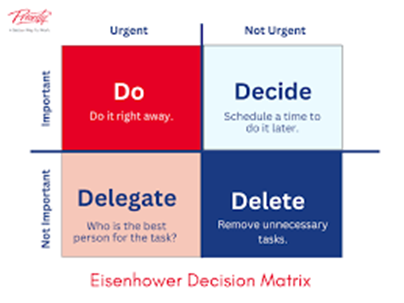
Organizing work is determining the tasks according to the importance of their completion Work can be divided as follows
· Urgent work These are tasks related to daily problems, such as shortages in the number of nursing staff and machines, emergency work, or important meetings
· Tasks that are due These are problems that are less important or have a specific deadline
· Non-performing works That is, they are not accomplished They are problems that are solved by themselves without intervention or can be solved by someone else through delegation
It is possible to use models that help organize time management, such as the Eisenhower Matrix
Control working time
Controlling work time aims to avoid overcrowding, as this leads to an increase in errors, as most administrators have a lot of work Therefore, it is important for the nursing manager to learn the steps for controlling time, which include
Time control steps
- Prioritize
- Complete the work you started and do not start other work before finishing the one you started
- Re-arrange the work and set priorities again based on what has been accomplished
- Controlling time consumers includes
- Telephone interruptions
- Meetings
- Not having enough information on any topic
- Lots of writing
- No follow up
- Inability to say "no"
- Act only in emergency situations
- Speed of decision making without study
- Frequency
- open door policy
- Neglecting to organize files
- Inefficiency of assistants
Reasons for not managing time well
- Laziness, tendency to rest and procrastination
- Lack of punctuality
- Not writing goals
- Overlapping appointments (poor organization)
- Lack of prioritization
- Lack of planning
- Surprise (mishandling of emergencies)
Time planning tips
- The nurse, especially the administrative one, must realize how time is wasted and also identify the time wasters and try to overcome them Therefore
◾ Do not always be available for everyone to interrupt you at work When you sit down to complete a task, it should be away from noise and interruptions It is best to be in a separate room If that is not available, then you should sit with your back to the door or the people in the place in order to reduce interruptions
◾ Avoid compliments at work
◾ If you notice that the guest is talking for a long time after finishing speaking, this indicates that the conversation has ended
◾ Schedule a long conversation with different excuses for anyone who wants to chat and set a time for it during a break
- Work stress management
Work stress management
It is a conflict process that spoils the individual's happiness and mental and physical health It occurs when an individual is asked to perform beyond his or her normal capabilities
Work stress concept
Work stress is called Job Stress , which is generally the variables surrounding workers that cause them to feel stressed
Work pressure is anything that has a material or moral impact and takes influential forms on the decision-maker’s behavior
Symptoms of work stress
Negative effects and consequences related to the organization
- Absence from work - being late - or even stopping work
- Job turnover, ie instability in a job for a long period of time
- Complaints from employees and customers
- Lack of attention to scheduling machines in the case of factories
- Many Work accidents
- A decrease in the degree of a person’s love for his work and his satisfaction with it
- Hesitation in decision making that affects production efficiency
- Low morale
- Low job motivation among employees
- Feeling dissatisfied with work
- Poor communication and human relations
- Error in decision making
- Negatively impact the quality of work relationships
Sources of work stress
- Sources related to the same work
- Sources related to the employee himself
- Family related resources
- Lifestyle reasons
Sources that refer to the same work
o The danger of decisions
o The need for constant concentration and exchange of information with others
o Performing atypical duties
o Promotion to a job with higher demands than a person's ability
o Non-routine requirements and work
o Dealing with different organizations
o Having relationships with complex environments
o The workload increased
o Performance evaluation
o No job guarantees
o Feeling of low job security
The most prominent strategies for dealing with work pressures are the following
1- Returning to religion for spiritual and emotional support, satisfaction and calm, and overcoming stressful situations by increasing acts of worship and continuous supplication to God Almighty, which bestows peace and tranquility on the soul
2- Medical examination, exercise and hobbies Continuous exposure to work pressures has negative effects on health, and therefore periodic medical examinations are the beginning of procedures to eliminate or reduce work pressures by treating its health consequences by taking appropriate medical procedures
3- Changing the behavioral pattern through training This is a strategy that seeks to modify the individual’s behavior in response to sources of stress Working through practice to achieve the desired change
For example
a) Rest and relaxation By getting appropriate rest periods during work hours, in addition to an official vacation away from the work environment and its pressures
b) Slow down and control your anger Trying to force yourself not to get emotional, wait for the right time, and not rush
c) Acceptance and surrender It is accepting reality, living it as it is, and acknowledging it
4- Social support This is represented in the individual’s search for social support, either to obtain information that helps in understanding the problem that causes pressure to find ways to solve it, or for emotional support that helps in bearing the wave of emotion by establishing close friendships with individuals with whom he feels comfortable and whose balance and sound judgment on matters he trusts
5- 5- Alternative job opportunities This strategy is used after all previous attempts have failed , when the individual believes that the work pressures he is under have exceeded the limit and are bringing him closer to a danger point Therefore, leaving the job and looking for another alternative job opportunity to change the entire situation is the solution
In the event of a conflict with others or a difference of opinion, do not make your goal to win everything
- Opening up areas for negotiation, exchanging views and reaching compromise solutions
- Distribute the burdens on your shoulders as much as possible
- Slow down and slow down your pace and rhythm of work and movement
- Training and career development
- Re-arrange your goals when there are some that are difficult to achieve
- Do not overestimate different situations, problems and their consequences
- Limit negative assumptions (what if)
- Increased ability to withstand difficulties and problems
- Do not over-generalize things (driving, not helping)
- Stop jumping to conclusions (not taking an invitation from a friend)
- Avoid unrealistic expectations
- Time management Set a time to complete the required tasks, prepare a daily and weekly plan
- Communicate with others
- Recording stressful situations and how to deal with them
- Forgive and tolerate those who wronged you
Its impact on decisions
Individuals may lose their ability to make effective decisions, especially when their self-confidence begins to collapse, and this affects the individual's health, family, and work alike
The decisions that an individual makes may be flawed decisions, and thus they lead to more disputes, accidents, and financial losses, and may even cause the person to lose his job
Causes of work stress
• Overlapping or unclear job descriptions
• Poor communication
• Unsuitable working conditions
• Lack of ventilation
• inefficient lighting
• Isolation inside the building
All of these things can contribute to high rates of illness and absenteeism
Types of stress
First Internal or psychological
like Ambitions and striving to reach the top, then competition intensifies and the individual is exposed to pressure, striving to excel over others at work
Second External
Environmental requirements, family pressure on the father to increase his income, social pressures (customs and traditions and societal discontent when they are not followed), work pressures distribution of work among nursing staff
- Distribution of work among nursing staff
Objectives of distributing work among the nursing staff
These objectives include the following
- Providing good and continuous nursing care to patients
- Use the skills and knowledge of each level of nursing staff
- Allow sufficient time for training and orientation for new nurses
- Raising the level of nursing performance according to work requirements, taking into account the development taking place
- Develop a master plan to distribute nursing staff to the hospital or unit based on an assessment of the needs of patients or beneficiaries of the service
- Boost employee morale
Factors affecting the distribution of work among the nursing staff
These factors include
- Constant change in patient numbers
- Absences, Vacations, and Holidays Among Nurses
- Poor distribution of nurses
- Nursing staff performing non-nursing tasks
- job dissatisfaction
Factors that help the head of nursing staff when distributing nursing work
When distributing nursing work among nursing staff members, factors specific to nurses, patients, tools, machines, and the work environment must be taken into account These factors include the following
- Full knowledge and understanding of the nature of the work
- Taking into account the individual differences and abilities of workers, for example when the nurse is new, she must be trained to develop skills
- Develop appropriate plans for work to develop and improve employees
- Clearly define each individual's responsibilities and distribute the work in writing, taking care not to overlap
- Arrange and organize the different parts of the work distribution plan in writing
- Ensure that everyone knows what they are doing
- Anticipate and Prepare for Emergencies
- Observing, guiding and evaluating employee performance
- Giving direct orders when needed and in emergencies
- Get the group's opinion to volunteer to do a certain job
- Giving directions in the form of a request, not an order
Work distribution methods
There are three ways to distribute work among nurses
1- Functional method
This method depends on assigning one or more specific nursing activities to each member of the nursing staff to implement for all patients, for example implementing treatment, changing wounds, etc
Advantages of this method
- You need fewer nurses
- Save time
- The nurse gains skill in this activity
Disadvantages of this method
- Fragmentation of nursing care for the patient among nurses
- Do not give the patient an opportunity to be observed and educated healthily
2- Status method
This is an ideal method as it provides complete nursing care to the patient by one nurse, and is often used with patients who need special care
Advantages of this method
- Strengthening the relationship between the patient and the nurse
- Facilitates observation of patient condition
- It helps to acquire multiple nursing skills
Disadvantages of this method
- expensive
- Need a large number of nurses
3- Team method
In this method, all patients are assigned to a number of nurses, and activities and tasks are distributed according to their scientific and practical abilities and according to the patients’ needs The team consists of a qualified nurse/nursing assistant/student, and the purpose here is to benefit from all experiences
Advantages of this method
- Take responsibility
- Create good working relationships between employees
- Give the opportunity to develop
- Efficient use of employee skills and abilities
- Facing different work situations
Disadvantages of this method
- Conflicts between team members
- Need more time to get the job done
- No limitation of liability