Health Education in Primary Care
| Site: | EHC | Egyptian Health Council |
| Course: | دلائل الإجراءات لتمريض الرعاية الاولية |
| Book: | Health Education in Primary Care |
| Printed by: | Guest user |
| Date: | Thursday, 5 November 2026, 2:39 AM |
Description
"last update: 19 Feb.2025" تحميل الدليل
- Prepared by
Primary healthcare guide
Under supervision
- Prof. Dr. Mohamed Latif, CEO of the Egyptian Health Council
Dr. Kawthar Mahmoud, Head of the Egyptian Nursing Syndicate - Member of the Senate
Prepared by
|
Title |
Name |
NO. |
|
Dean Of Faculty Nursing, Professor of Medical and Surgical Nursing, Tanta University |
Dr Afaf Abdel Aziz Abdel Aziz Basal |
1 |
|
Professor Of Critical Care Nursing |
Prof.Dr/Zeinab Hussain Ali |
2 |
|
Professor And Head of the Department of Medical Surgical Nursing. Faculty-. Benha University |
Amal Said Taha Refaie |
3 |
|
Supervisor Of the Education Sector at Port Said University |
Amal Ahmed Khalil Morsy |
4 |
|
Professor Of Medical Surgical Nursing- Faculty of Nursing- Cairo University |
Dr. Hanan Ahmed Al Sebaee |
5 |
|
Head of central administration on secondment at MOHP |
Dr Neveen ab drab al0nabi Mohamed |
6 |
|
Director Of Primary Health Care Nursing Department at MOHP. |
Maysa Hosny Ahmed Tammam |
7 |
|
Supervisor Of Technical Education- EHA |
Nancy Alaa Eldeen Abd-Elbaset Ali |
8 |
|
Supervisor Of Nursing Services Development- EHA |
Sherien Mohamed Saad |
9 |
|
Assistant Professor of Maternity and Neonatal Health Nursing - Faculty of Nursing- Ain Shams University |
Assist.Perof. Dr./Heba Mahmoud Mohammed |
10 |
|
General manager of general administration of health institutes affairs |
Dr Mai Galal Ibrahim Al-Assal |
11 |
|
Participants |
||
|
Member of nursing administration - EHA |
Mr. Mohamed Al-Sayed Abdel Hamid |
12 |
|
nursing specialist at the General Administration of Nursing - MOHP |
Mrs. Shaima Hassan gamal Mady |
13 |
|
nursing specialist at the General Administration of Nursing - MOHP |
Mrs. Salwa Nasser Fahim Attia |
14 |
|
nursing specialist at the General Administration of Nursing - MOHP |
Mr. tarek Ramadan Rashad El Gamal |
15 |
|
nursing specialist at the General Administration of Nursing - MOHP |
Mr. Mahmoud Muhammad Ali Afifi |
16 |
|
nursing specialist at the General Administration of Nursing - MOHP |
Mr. Ahmed Abdel Tawab Attia |
17 |
|
nursing specialist at the General Administration of Nursing - MOHP |
Mr. Muhammad Jamal Al-Shaar |
18 |
- Concept of Communication
Communication is a fundamental and essential process in our daily interactions, particularly in healthcare centers and institutions. It consists of verbal and non-verbal communication. Effective communication between the nurse and the patient has a positive impact on the therapeutic relationship, improves the patient's adherence to nursing care plans, and strengthens commitment to the prescribed treatments.
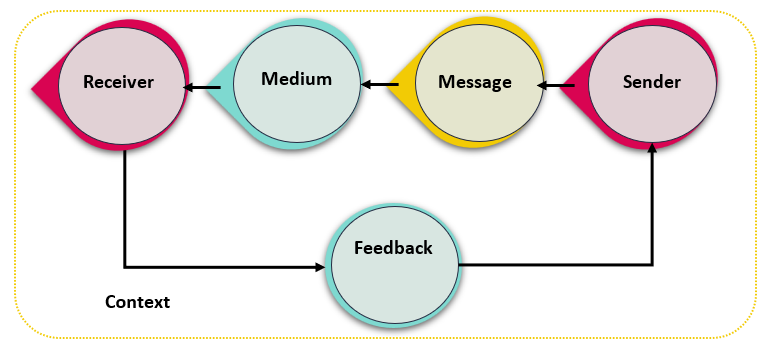
Components of Communication
1- Message.
2- Sender.
3- Receiver.
4- Communication media
5- Feedback
Objectives of Communication
- To identify the attitudes and ideas of others.
- To build relationships among people.
- To convey and exchange ideas, opinions, and meanings easily and effectively.
- To influence the thinking, feelings, behavior, and attitudes of others.
- To encourage a change or modification in behavior.
- To generate demand for high-quality services.
Types of Communication
A- Verbal B- Non-verbal
– Verbal communication: Communication through the exchange of words, whether in writing or conversation. It depends primarily on language, through which messages are exchanged, and is an important part of the nurse-patient relationship.
– Non-verbal communication: Also known as body language. It plays an important supplementary role in health-related situations. Information conveyed through body movements, gestures, facial expressions, eye contact, posture, and the volume and pace of speech is no less important than information exchanged through words, as it reflects our ideas, attitudes, and feelings.
Examples of non-verbal communication include posture. Standing upright indicates self-confidence; an alert or confrontational stance may suggest aggression; sitting in a relaxed manner may indicate boredom or indifference; fidgeting while seated may suggest nervousness or eagerness; and sitting on the edge of the chair may indicate interest and attentiveness.
- Characteristics of Effective Communication Characteristics of the Message
- A written message should be concise and clear. When communicating verbally, the voice should be clear, audible, and appropriate to the setting, and the tone should convey respect and concern.
- Use simple, unambiguous words that are easy to understand. Pause periodically to ensure that the listener has understood the message and allow time for questions and further clarification. Effective communication is a two-way process.
- Pictures and printed materials may be used whenever possible to improve understanding, for example by pointing to the part of the body being discussed.
- The timing of the message should be appropriate for both the sender and the receiver.
Characteristics of the Sender
The sender is the person who delivers the message to the receiver. To communicate effectively, the sender should develop communication skills, follow the basic principles of effective communication, and demonstrate the following characteristics:
- Speaking skills: Clearly define the purpose of the discussion and identify the topics to be covered.
- Observe the principles of verbal and non-verbal communication.
- Silence can be an effective behavior for conveying meaning in certain situations.
- Be sensitive to the listener's opinions and reactions, and do not continue speaking if the listener appears distressed or uncomfortable.
- Do not stand too close to the person; maintain appropriate personal space.
- Learn to be a good listener while speaking with others.
- Show complete respect for the recipient and recognize the recipient's rights. Do not treat the person merely as a medical case.
- Treat the recipient as a person with dignity, while respecting differences related to age, sex (male/female), marital status,
educational level, and cultural and religious background.
Characteristics of the Receiver:
The receiver is the person who receives the message and interprets it. The following factors should be present in the receiver:
- Psychological and physical readiness, including functioning of the five senses, to receive the message.
- The ability to understand the symbols and meanings contained in the message.
- Proficiency in communication skills.
Methods of Effective Communication:
1- Active Listening:
Active listening means listening carefully and responding to events related to the topic. It involves accurately hearing what is said and understanding its meaning. The nurse should listen attentively to both the content of the patient's message and the manner in which it is delivered, including the feelings expressed, and should avoid interrupting the patient.
Characteristics of a Good Listener:
- Has a genuine desire to listen and is psychologically and mentally prepared to concentrate.
- Reflects on the meaning of the message and asks the speaker for clarification when necessary.
- Observes signs of non-verbal communication.
- Responds to the message in a manner appropriate to its impact and intended purpose, whether immediately, such as showing joy or sadness or carrying out an instruction, or later, such as following advice or complying with the physician's instructions.
- Does not interrupt the speaker unless permission is obtained or the speaker has finished.
- Knows how to help the speaker express thoughts and opinions clearly and release suppressed feelings and emotions.
- Is flexible and has the ability to persuade and to be persuaded.
2- Asking Open-Ended Questions:
Open-ended questions help obtain information and understand the patient. Nurses should therefore use open-ended questions to encourage patients to speak freely about themselves so that appropriate help can be provided. Questions that can be answered only with yes or no should be avoided whenever possible.
3- Restating:
Restating means that the nurse repeats what the patient has said using the patient's own words. This is used to confirm accurate understanding and demonstrates attentive listening and comprehension.
4- Providing a Response That Reflects the Patient's Feelings:
Through careful observation and active listening, nurses can recognize what the patient may be feeling and respond in a way that reflects those feelings, for example: "You seem confused," or "It appears that you are feeling very angry."
5- Clarification:
During a conversation with a patient, the nurse may realize that some of what was said was not understood. The nurse should then request clarification in a manner that demonstrates genuine concern and a sincere effort to establish mutual understanding with the patient.
6- Summarization:
Summarization involves combining the many ideas discussed during the interview and the feelings expressed into a single concise statement after a topic has been discussed or at the end of the interview. This gives the patient an opportunity to review the information and add anything that may have been overlooked.
7- Providing Information:
The nurse guides the patient and provides the necessary explanation and description in a simple, clear, and accurate manner, using words that the patient can easily understand.
8- Silence:
Silence may be used to help the patient think about what has been said; however, the period of silence should not be so long that the patient becomes anxious or tense.
- Barriers to Communication
- Giving advice in the form of commands.
- False reassurance.
- Failure to accept what others say.
- Asking too many inappropriate questions.
- Assigning blame.
- Moving too quickly between different topics.
- Prolonged silence.
- Effective communication skills
– Changing the topic of conversation if it causes distress to the patient (you should help the patient address the sources of their distress, but without being intrusive).
– Do not attempt to offer your own personal opinion; instead, allow the patient to express their own views and form their own judgments.
– Respect the patient’s desire for silence; do not pressure them to speak, as this could cause them distress or exhaustion.
– Avoid failing to listen attentively or making irrelevant comments, as such behavior conveys a lack of interest.
– Trivialize the patient's complaint.
– Language barriers: The word may mean different things to individuals (choose the right pronunciation and make sure they understand what you mean)
– Psychological Barriers: Many individuals understand the information as they expect, so this should be taken into account.
– Obstacles arising from individual differences between human beings: "What you prefer may be hated by others and vice versa."
– Lack of reactions (not paying attention to the reaction to the message or asking the receiver how well they understand the message)
– Organizational obstacles from the employer: (failure to set goals or lack of communication sources).
–
- Health Education
Definition of Health Education
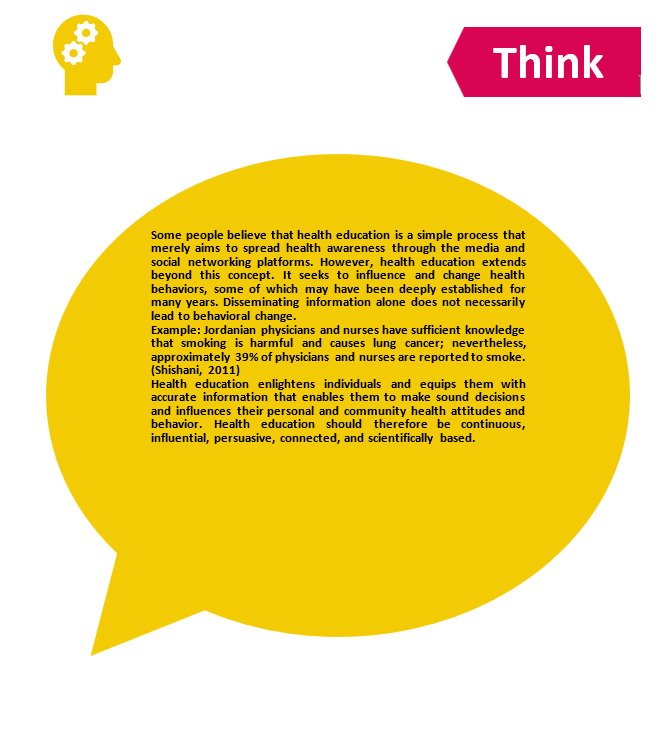
Health education can be defined as the process through which community members acquire health-related knowledge, awareness, and skills. It is a shared responsibility among all members of the care team and includes planned measures for delivering educational messages to the community in order to achieve specific learning objectives. Its purpose is to build a knowledge base that promotes correct health practices and changes inaccurate ideas and information adopted from culture, family, and society. The ultimate aim is to improve individual health, prevent disease, and support a healthy life. Health education may be formal and intentional, such as following a prepared educational plan with defined objectives, or informal, such as acquiring health information from other people, including healthcare providers or patients, without prior planning.
Health education is one of the services provided within primary healthcare and is delivered by designated health authorities according to the structure of each country's health system. These authorities may operate as separate departments. For example, in Libya and Jordan, health education directorates within the Ministry of Health plan and implement educational campaigns for different sectors of the population and in various settings through lectures, free medical days, television programs, workshops, and health meetings. Available educational methods are used for different community groups in coordination with qualified healthcare professionals, including physicians, nurses, health-promotion supervisors, and governmental and private sectors within local communities.
In general, health education aims to design and implement public-awareness campaigns through media such as television, radio, and social media, according to current health developments, identified needs, and the target population. It also includes designing printed materials in coordination with relevant organizations. Health education further aims to improve the quality of life in underserved communities, including villages, desert regions, and remote areas; raise the overall standard of these areas; improve and develop services through the participation of capable community members; and focus on health topics that concern individuals and rank among their priorities, such as disease prevention and health promotion.
- Importance of Health Education
Health education is important because individuals need accurate information in order to make sound health decisions and manage health problems when they arise. Its importance has also increased with the emergence of new diseases that threaten public health. Despite advances in medicine and diagnosis, the causes and treatments of certain diseases, such as AIDS and coronavirus disease, may remain incompletely understood. People have also adopted new lifestyles that are not necessarily healthy. Technological development, excessive pursuit of convenience, physical inactivity, frequent consumption of fast food, and modern patterns of comfort have contributed to increased health problems, including elevated blood glucose, hypertension, and heart disease. Technology may also promote products in misleading ways even when they do not meet quality standards, have little health value, or may be harmful. Health education therefore helps establish beneficial health behaviors, replace harmful practices, help individuals identify possible health problems, and determine their needs. Disseminating sound health concepts throughout the community is one of the most effective ways to improve quality of life and reduce injury and disease.
Levels of Health Education
Primary Health Education
Primary health education aims to increase health awareness and focuses on preventing disease before it occurs. It improves quality of life by targeting people who are free from disease and do not have risk factors that may predispose them to illness. For example, educating young people about the risks of drugs and addiction strengthens their awareness of health and discourages them from considering such behavior.
Secondary Health Education
Secondary health education targets individuals who have risk factors but have not yet developed disease. It aims to prevent disease through protective measures and practices. For example, an overweight person who has not yet developed cardiovascular disease may be advised to exercise and follow a weight-reduction diet.
Advanced Health Education
This level of health education supports and rehabilitates patients with disabilities or chronic diseases for which a cure is not expected. It helps limit progression of the problem, manage complications, live with and accept the illness, adapt to it, and achieve a degree of independence.

Elements of Health Education
- Health educational material: The health information provided should be clear, accurate, and based on scientific evidence. It should also take into account the educational, cultural, and social level of the recipient in order to achieve the intended objective.
- Health educator: The person who communicates information to others and provides education. The health educator may be a teacher, nurse, or physician and should possess adequate, accurate, and well-prepared knowledge, have appropriate training, and be able to use teaching methods effectively to communicate and reinforce information. The health educator should believe in and be confident about the information being conveyed in order to be persuasive.
- Recipient: The recipient's educational level and cultural background should be assessed before educational material is designed. The educator should also determine whether the recipient is motivated or willing to acquire new behaviors and modify existing practices, with particular attention to the recipient's health needs.
- Educational method: Different communication methods should be used to disseminate health information and prevent repetition and boredom. For learning to occur and for the recipient to benefit, more than one sense should be engaged so that the educational material is retained and easily understood. Educational methods may be auditory, such as lectures, seminars, panel discussions, and conferences; written, such as medical references, leaflets, booklets, brief health messages, and posters; or audiovisual, such as television programs, compact discs, plays, and video films.
|
Levels of Health Education |
|||
|
Individual Health Education |
Family Health Education |
Group Health Education |
Community Health Education |
|
Individuals are educated about nutrition, physical activity, causes of disease, methods of prevention, personal hygiene, and ways to manage psychological stress. |
This form of education establishes sound health concepts from an early age, including family nutrition, appropriate interaction with adolescents, and prevention of domestic violence. |
This form of education addresses groups whose members share characteristics such as sex, age, or occupation, as well as groups with common health problems, including people with diabetes, schoolchildren, smokers, or people with substance-use disorders. The entire group is educated together. |
This form of education uses various media, whether visual or auditory, to deliver health information to the largest possible number of people regardless of their level, such as television advertisements that encourage exercise and family planning. |
Settings for Health Education
- At home: Educating fathers, mothers, and children about the importance of proper upbringing, healthy nutrition, and management of illness.
- At school: Educating the younger generation about the importance of practicing healthy habits.
- In care facilities such as health centers, hospitals, addiction-treatment centers, and mental-health facilities.
- In workplaces such as factories, laboratories, and companies, in order to protect employees and provide health education.
Skills Required of a Health Educator
- Listening attentively to individuals, which demonstrates that their opinions are heard and makes their response to and interaction with the educational material more open and active.
- Paying attention to body language during health education, as it provides a clear indication of the recipient's level of understanding and feelings toward the information. Attention may be directed to eye movements, finger movements, sitting posture, and eyebrow expressions.
- Asking questions effectively, rephrasing them when necessary, and using open-ended questions that encourage the recipient to respond.
- Providing accurate explanations based on scientific principles in a simple manner that reaches the recipient regardless of educational level.
- Accepting the opinions of others and showing respect and flexibility.
- Providing feedback, as it encourages the recipient to participate and helps guide the course of health education.
Information to Be Known About the Recipient:
- Community customs and traditions.
- Economic and social circumstances.
- Educational level.
- Age and sex.
- Occupation.
- Health status.
The Health Message
- Clear and understandable.
- Easy to deliver.
- Appropriate for the recipient's age and sex.
- Realistic and based on accurate scientific principles.
- Objective and free from exaggeration or fear-based approaches.
Method
- Methods based on mass media.
- Methods based on personal interviews.
Health Education and Its Role in Behavior Modification
The overall objective of health education is to modify health behavior. Changing an individual's health behavior and adopting a new healthy behavior require several stages. The individual must understand that the process is not easy, takes time and effort, and requires psychological and physical readiness. Scientific theories describe the stages of change, including the Prochaska model. The stages are as follows:
- Awareness stage: The individual becomes aware of accurate health information and accepts it.
- Curiosity and interest stage: The individual develops interest and searches for further details about the desired health information, becoming eager to read, understand, or hear more about it.
- Comparison and evaluation stage: The positive and negative aspects of the new behavior and the expected benefits of adopting it are assessed. The individual then decides whether to adopt or reject the new behavior.
- Action stage: This is the trial stage, during which the individual decides to implement the change and practice the behavior. Psychological and social support from friends and relatives is needed to overcome difficulties during implementation.
- Adoption and maintenance stage: The individual follows and permanently adopts the new behavior until it becomes an established part of life.
Health Education and Consideration of the Prevailing Community Culture
First: The health educator should speak the recipients' language fluently to facilitate communication and understanding. Because language is the primary means of communication, recipients can understand and analyze information directly without translation. A shared language also has a positive psychological effect, increases attention and comfort during education, facilitates questions, and improves interaction.
Second: Use real examples from the community's culture and discuss them with recipients. When recipients share examples from their own environment, the discussion is enriched and they become active participants in the educational process. Discussion may also help change incorrect health practices.
Third: Discuss cultural practices that recipients have acquired from their families and communities, their effects on health, their perceived benefits, and how they may be changed. This supports the exchange of information and opinions and allows the positive and negative aspects of these practices to be examined.
Fourth: Design the educational material according to the recipient's culture, including language and commonly used expressions, clothing and accessories, and suggested foods and alternatives. The educator should consider the setting and avoid excessive display of clothing or jewelry, as this may create a social gap between educator and recipient and negatively affect the educational process. Using familiar expressions can bring the educator closer to the recipient, create a sense of familiarity and appropriate humor, and make the educational process more engaging.
Examples of Incorrect Culture-Based Health Beliefs in Egypt and Other Arab Countries That Affect Health and Provide Opportunities for Health Education:
Drinking Carbonated Beverages with High-Fat Meals
Some people drink cola or other carbonated beverages with high-fat meals. These drinks do not aid digestion; on the contrary, they contain high levels of sugar and acids and increase the likelihood of obesity and chronic disease. Cola may be replaced with water or green tea.
Applying Kohl to Children's Eyes
Some people apply kohl to the eyes of newborn infants in the belief that it strengthens vision, thickens the eyelashes, and increases eyebrow growth. In reality, kohl can seriously harm a child's eyes because it may contain high levels of lead, which can damage the eyes and cause poisoning. Lead exposure may result in severe neurological disorders and may be fatal.
Drinking Tea After Lunch
Many people drink tea after lunch to aid digestion or reduce the feeling of fullness. This practice is incorrect because tea can inhibit intestinal iron absorption and may contribute to anemia, reducing the nutritional benefit of the meal. The recommended practice is to drink tea two hours after eating or before the meal.
Excessive Smartphone Use
The use of mobile phones, originally intended for communication, has increased considerably. Some people use their phones continuously from the time they wake until they go to sleep and are unable to put them down even briefly. Scientists indicate that excessive smartphone use may cause neck and back pain, adversely affect eye function and vision, and expose the body to emitted radiation and waves. Moderate use is therefore important for maintaining health.
Drinking Water with Meals
Some people believe that drinking water or juice with meals is a healthy habit. However, drinking water or juice during meals reduces the movement of food through the intestines, which may cause indigestion and abdominal distension. The correct practice is to drink water approximately twenty minutes before the meal.
Applying Salt to a Newborn's Body
Some mothers rub the bodies of newborn infants with table salt or pour salt water over the infant during bathing and then leave the infant unbathed for several days, believing that salt strengthens and disinfects the skin and protects against germs. This belief poses a serious risk to the infant's life because salt may be absorbed through the dense network of blood vessels in the skin and enter the circulation, raising the blood sodium level. This may lead to cerebral hemorrhage and severe seizures that can affect mental and physical development. The appropriate practice is to bathe the newborn every two to three days according to the weather, using medically approved baby shampoo for cleansing and disease prevention.
Role of the Health Educator Within the Family
- Draw the attention of family members to health matters, disease prevention, and appropriate management of illness when it occurs.
- Guide parents to adopt healthy behaviors so that children can follow their example.
- Help family members adopt healthy practices in daily activities, such as maintaining correct posture while studying, practicing personal hygiene, handling harmful substances such as cleaning products safely, and ventilating the home.
- Link healthy behavior with accepted religious and social beliefs and prevailing positive norms. For example, there may be a community trend toward healthier eating and weight reduction.
- Assess the family's health-literacy level and develop a plan to increase knowledge about topics important to the family, such as nutrition and waste management.
- Counseling
Counseling is a direct communication process through which one or more persons provide guidance and support to an individual or group in identifying needs and making appropriate decisions, according to their circumstances and needs, that support the adoption of healthy behaviors.
Objectives of Counseling
- Clarify the options available to users of different health services.
- Deliver the intended messages to the target audience.
- Encourage individuals and groups to think about their problems.
- Help individuals and groups understand the causes of a problem and the factors that influence it.
- Help individuals and groups propose appropriate solutions.
- Enable service users to make sound, informed decisions that are appropriate for the family.
- Support individuals and groups in taking the necessary actions to solve their problems.
Basic Steps of Counseling
- Good interview (establishing a positive relationship with the woman).
- Questioning (collecting information and listening).
- Education (presenting and explaining information).
- Selecting the most appropriate alternatives (supporting decision-making).
- Implementation guidance (explaining how to carry out the decision).
- Counseling follow-up (planning the next steps).
Characteristics of an Excellent Counselor:
- Believes in the importance of health messages for all members of the community.
- Has knowledge of reproductive health, family planning, and sexually transmitted infections, as well as current trends and changes affecting families' needs for reproductive-health and family-planning services.
- Has the willingness and enthusiasm to help the client.
- Possesses communication skills, including active listening, non-verbal communication (body language), effective questioning, and clear presentation of information.
- Demonstrates appropriate attitudes and behaviors, including avoidance of premature judgments, patience, open-mindedness, suitable respect, and concern for the client's best interests.
- Maintains an ongoing commitment to self-directed learning, particularly learning from mistakes, and continually develops professional skills.
- Is open to different cultures and ways of life.
- Understands the culture, customs, and values of the populations targeted by the service.
Appropriate Environment for Conducting a Counseling Session in the Clinic:
The service provider should make the client feel comfortable and cared for and should provide an environment that ensures privacy. This allows the client to feel safe and discuss needs openly and comfortably.
- Counseling may be conducted in the medical examination room or in a designated counseling room, provided that sufficient privacy is available to ensure confidentiality for the woman or the couple.
- Ensure that the room contains adequate seating for the client, her husband, or a companion if requested, and arrange the furniture to facilitate communication between the counselor and the client.
Procedures for Conducting a Counseling Session:
· When meeting the client, show interest, offer an appropriate greeting, and introduce yourself by name and professional title.
· Reassure the client that all information disclosed will be treated as strictly confidential.
· Ask the client about the reason for the visit and identify her needs.
· Explain that the questions are being asked to help meet her needs.
· Focus the discussion only on the client's needs and avoid unrelated topics that are not important to her.
· Use clear language and words that the woman can understand easily.
· Use the educational aids available in the clinic, such as the educational-aids display, flip chart, and brochures.
· Encourage the client to speak freely and ask questions. Listen carefully and demonstrate attentiveness through positive body language.
· Maintain effective eye contact, while recognizing that direct eye contact may not be acceptable in some communities.
· Allow the client sufficient time to express her ideas and make her own decision.
· Respect periods of silence when the client is thinking deeply, and respond supportively.
· Be aware of known or possible cultural differences between you and the clients, and ask for clarification when additional information is required.
· Do not write and listen at the same time. Give full attention to listening, then record your notes.
· Answer clients' questions objectively.