Management of Environmental Safety and Cleaning in Hospitals
| Site: | EHC | Egyptian Health Council |
| Course: | Infection Prevention and Control Guidelines |
| Book: | Management of Environmental Safety and Cleaning in Hospitals |
| Printed by: | Guest user |
| Date: | Sunday, 20 September 2026, 4:42 AM |
Description
"last update: 20 March 2025" Download Guideline
- Executive Summary
Transmission of infectious microorganisms from the environment to patients may occur through direct contact with contaminated equipment or indirectly. Environmental surfaces can be safely decontaminated using less rigorous methods than those used on medical instruments and devices.
|
Recommendations |
|
Clean housekeeping surfaces (e.g., floors, tabletops) on a regular basis, when spills occur, and when these surfaces are visibly soiled (Good practice statement) |
|
Clean and disinfect environmental surfaces on a regular basis (e.g., daily, three times per week) and when surfaces are visibly soiled (Good practice statement) |
|
Follow manufacturers’ instructions for proper use of disinfecting (or detergent) products -such as recommended use-dilution, material compatibility, storage, shelf-life, and safe use and disposal (Good practice statement) |
|
Clean walls, blinds, and window curtains in patient-care areas when these surfaces are visibly contaminated or soiled. (Good practice statement) |
|
Prepare disinfecting (or detergent) solutions as needed and replace it with fresh solution frequently (e.g., replace floor mopping solution every three patient rooms or hourly), according to the facility’s policy (Strong recommendation) |
|
Decontaminate mop heads and cleaning cloths regularly to prevent contamination (e.g., launder and dry at least daily). (Good practice statement) |
|
Detergent and water are adequate for cleaning surfaces in nonpatient-care areas (e.g., administrative offices). (Good practice statement) |
|
Do not use high-level disinfectants/liquid chemical sterilant for disinfection of non-critical surfaces. (Strong recommendation) |
|
Disinfect noncritical surfaces with an EDA and/or MoHP -registered hospital disinfectant according to the label’s safety precautions and use directions(Conditional recommendation) |
|
Do not use disinfectants to clean infant bassinets and incubators while these items are occupied. If disinfectants are used for the terminal cleaning of infant bassinets and incubators, thoroughly rinse the surfaces of these items with water and dry them before these items are reused. (Strong recommendation) |
|
Promptly clean and decontaminate spills of blood and other potentially infectious materials. (Strong recommendation) |
|
For site decontamination of spills of blood or other potentially infectious materials (OPIM), implement the following procedures. Use protective gloves and other PPE (e.g., when sharps are involved use forceps to pick up sharps and discard these items in a puncture-resistant container) appropriate for this task. Disinfect areas contaminated with blood spills using an EDA and/or MoHP -registered tuberculocidal agent, (Conditional recommendation) |
|
If sodium hypochlorite solutions are selected use 1000 ppm to decontaminate nonporous surfaces after a small spill (e.g., <10 mL) of either blood or OPIM. If a spill involves large amounts (e.g., >10 mL) of blood or OPIM, or involves a culture spill in the laboratory, use 5000 ppm chlorine for the first application of hypochlorite solution before cleaning in order to reduce the risk of infection during the cleaning process in the event of a sharp injury. Follow this decontamination process with a terminal disinfection, using 1000 ppm of sodium hypochlorite. (Strong recommendation) |
|
If the spill contains large amounts of blood or body fluids, clean the visible matter with disposable absorbent material, and discard the contaminated materials in appropriate, labeled containment. (Conditional recommendation) |
|
Use protective gloves and other PPE appropriate for this task (site decontamination of spill). (Conditional recommendation) |
|
An EDA and/or MoHP-registered sodium hypochlorite product is preferred, but if such products are not available, generic versions of sodium hypochlorite solutions (e.g., household chlorine bleach) can be used. (Good practice statement) |
|
Do not perform disinfectant fogging for routine purposes in patient-care areas. These refer to spraying or fogging of chemicals (e.g., formaldehyde, phenol-based agents, or quaternary ammonium compounds) as a way to decontaminate environmental surfaces or disinfect the air in patient rooms. (Strong recommendation) |
|
Other Disinfection Methods |
|
Hydrogen peroxide vapour disinfection is not recommended as a routine adjunct in healthcare facilities as the evidence of added value compared with conventional cleaning and disinfection is not well established (Strong recommendation) |
|
Ultraviolet light disinfection, ultraviolet light in combination with sodium hypochlorite and other novel approaches to healthcare environment disinfection are not recommended as routine adjuncts in healthcare facilities as the evidence of added value compared with conventional cleaning and disinfection is not well established. (Strong recommendation) |
|
The use of surfaces, fittings or furnishings containing materials with antimicrobial properties in healthcare facilities is not recommended as the evidence of added value compared with conventional cleaning and disinfection is not well established. (Strong recommendation) |
- Recommendations
|
Recommendations |
|
Clean housekeeping surfaces (e.g., floors, tabletops) on a regular basis, when spills occur, and when these surfaces are visibly soiled (Good practice statement) |
|
Clean and disinfect environmental surfaces on a regular basis (e.g., daily, three times per week) and when surfaces are visibly soiled (Good practice statement) |
|
Follow manufacturers’ instructions for proper use of disinfecting (or detergent) products -such as recommended use-dilution, material compatibility, storage, shelf-life, and safe use and disposal (Good practice statement) |
|
Clean walls, blinds, and window curtains in patient-care areas when these surfaces are visibly contaminated or soiled. (Good practice statement) |
|
Prepare disinfecting (or detergent) solutions as needed and replace these with fresh solution frequently (e.g., replace floor mopping solution every three patient rooms or hourly), according to the facility’s policy (Strong recommendation, Moderate grade evidence) |
|
Decontaminate mop heads and cleaning cloths regularly to prevent contamination (e.g., launder and dry at least daily). (Good practice statement) |
|
Detergent and water are adequate for cleaning surfaces in nonpatient-care areas (e.g., administrative offices). (Good practice statement) |
|
Do not use high-level disinfectants/liquid chemical sterilant for disinfection of non-critical surfaces. (Strong recommendation, Moderate grade evidence) |
|
Disinfect noncritical surfaces with an EDA and/or MoHP -registered hospital disinfectant according to the label’s safety precautions and use directions (Conditional recommendation, Moderate grade evidence) |
|
Do not use disinfectants to clean infant bassinets and incubators while these items are occupied. If disinfectants are used for the terminal cleaning of infant bassinets and incubators, thoroughly rinse the surfaces of these items with water and dry them before these items are reused. (Strong recommendation, Moderate grade evidence) |
|
Promptly clean and decontaminate spills of blood and other potentially infectious materials. (Strong recommendation, Moderate grade evidence) |
|
For site decontamination of spills of blood or other potentially infectious materials (OPIM), implement the following procedures. Use protective gloves and other PPE (e.g., when sharps are involved use forceps to pick up sharps and discard these items in a puncture-resistant container) appropriate for this task. Disinfect areas contaminated with blood spills using an EDA and/or MoHP -registered tuberculocidal agent, (Conditional recommendation, Moderate grade evidence) |
|
If sodium hypochlorite solutions are selected use 1000 ppm to decontaminate nonporous surfaces after a small spill (e.g., <10 mL) of either blood or OPIM. If a spill involves large amounts (e.g., >10 mL) of blood or OPIM, or involves a culture spill in the laboratory, use 5000 ppm for the first application of hypochlorite solution before cleaning in order to reduce the risk of infection during the cleaning process in the event of a sharp injury. Follow this decontamination process with a terminal disinfection, using 1000 ppm of sodium hypochlorite. (Strong recommendation, Moderate grade evidence) |
|
If the spill contains large amounts of blood or body fluids, clean the visible matter with disposable absorbent material, and discard the contaminated materials in appropriate, labeled containment. (Conditional recommendation, Moderate grade evidence) |
|
Use protective gloves and other PPE appropriate for this task (site decontamination of spill). (Conditional recommendation, Moderate grade evidence) |
|
An EDA and/or MoHP-registered sodium hypochlorite product is preferred, but if such products are not available, generic versions of sodium hypochlorite solutions (e.g., household chlorine bleach) can be used. (Good practice statement) |
|
Do not perform disinfectant fogging for routine purposes in patient-care areas. These refer to spraying or fogging of chemicals (e.g., formaldehyde, phenol-based agents, or quaternary ammonium compounds) as a way to decontaminate environmental surfaces or disinfect the air in patient rooms. (Strong recommendation, Moderate grade evidence) |
|
Other Disinfection Methods |
|
Hydrogen peroxide vapour disinfection is not recommended as a routine adjunct in healthcare facilities as the evidence of added value compared with conventional cleaning and disinfection is not well established (Strong recommendation, , weak grade evidence) |
|
Ultraviolet light disinfection, ultraviolet light in combination with sodium hypochlorite and other approaches to healthcare environment disinfection are not recommended as routine adjuncts in healthcare facilities as the evidence of added value compared with conventional cleaning and disinfection is not well established. (Strong recommendation, weak grade evidence) |
|
The use of surfaces, fittings or furnishings containing materials with antimicrobial properties in healthcare facilities is not recommended as the evidence of added value compared with conventional cleaning and disinfection is not well established. (Strong recommendation, weak grade evidence) |
➡️Remarks
The determination of environmental cleaning procedures for patient care areas, including the cleaning frequency, method, and process, should be based on the risk of pathogen transmission.
This risk is a function of the:
● Probability of contamination: Heavily contaminated surfaces and items require more frequent and thorough environmental cleaning than moderately contaminated surfaces, which in turn require more frequent and rigorous environmental cleaning than lightly or non-contaminated surfaces and items.
● Vulnerability of the patients to infection: Surfaces and items in care areas containing vulnerable patients (e.g., immunosuppressed) require more frequent and rigorous environmental cleaning than surfaces and items in areas with less vulnerable patients.
● Potential for exposure (i.e., high-touch vs low-touch surfaces): High-touch surfaces (e.g., bed rails) require more frequent and rigorous environmental cleaning than low-touch surfaces (e.g., walls).
➡️Every facility should develop cleaning schedules, including:
▪️ Identifying the person responsible.
▪️ The frequency.
▪️ The method (product, process).
▪️ Detailed standard operating procedures for environmental cleaning of surfaces in every type of patient care area.
➡️General environmental cleaning techniques
▪️ For all environmental cleaning procedures, always use the following general strategies:
a. Proceed from cleaner to dirtier.
Proceed from cleaner to dirtier areas to avoid spreading dirt and microorganisms. Examples include:
▪️ During terminal cleaning, clean low-touch surfaces before high-touch surfaces.
▪️ Clean patient areas (e.g., patient zones) before patient toilets
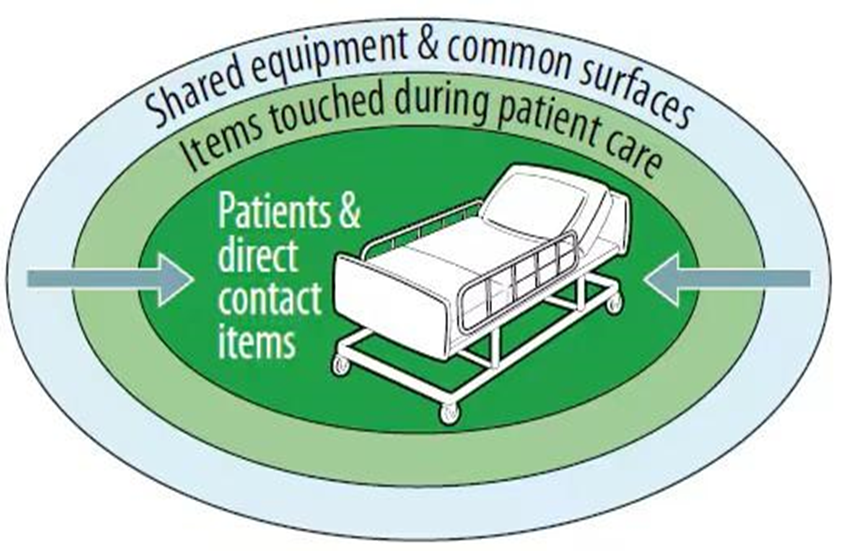
▪️ Within a specified patient room, terminal cleaning should start with shared equipment and common surfaces, then proceed to surfaces and items touched during patient care that are outside of the patient zone, and finally to surfaces and items directly touched by the patient inside the patient zone (annex 1.).
▪️ In other words, high-touch surfaces outside the patient zone should be cleaned before the high-touch surfaces inside the patient zone.
▪️Clean general patient areas not under transmission-based precautions before those areas under transmission-based precautions.
b. Proceed from high to low (top to bottom)
Proceed from high to low to prevent dirt and microorganisms from dripping or falling and contaminating already cleaned areas. Examples include:
● Cleaning bed rails before bed legs.
● Cleaning environmental surfaces before cleaning floors.
● Cleaning floors last to allow collection of dirt and microorganisms that may have fallen.
c. Proceed in a methodical, systematic manner.
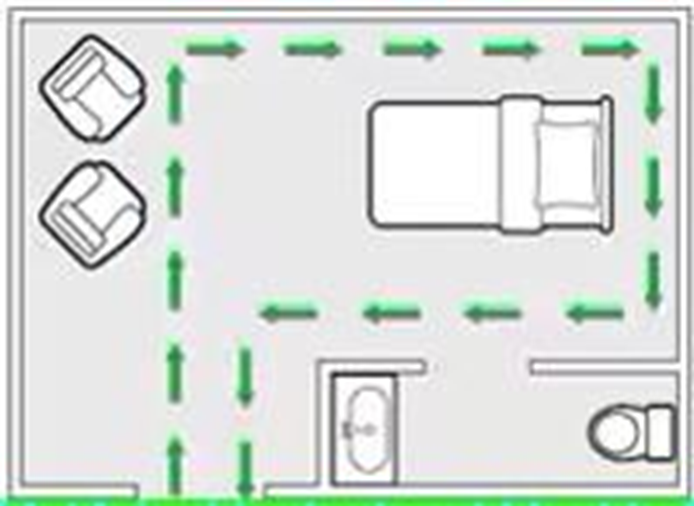
Proceed in a systematic manner to avoid missing areas—for example, left to right or clockwise (annex 2.). In a multi-bed area, clean each patient zone in the same manner—for example, starting at the foot of the bed and moving clockwise.
d. For all environmental cleaning procedures, these are the best practices for environmental cleaning of surfaces.
● Use fresh cleaning cloths at the start of each cleaning session (e.g., routine daily cleaning in a general inpatient ward).
● Change cleaning cloths when they are no longer saturated with solution.
● For higher-risk areas, change cleaning cloths between each patient zone (i.e., use a new cleaning cloth for each patient bed). For example, in a multi-bed intensive unit, use a fresh cloth for every bed/incubator.
● Ensure that there are enough cleaning cloths to complete the required cleaning session.
● Never double-dip cleaning cloths into portable containers (e.g., bottles, small buckets) used for storing environmental cleaning products (or solutions).
● Never shake mop heads and cleaning cloths-it disperses dust or droplets that could contain microorganisms.
● Never leave soiled mop heads and cleaning cloths soaking in buckets.
Recommended Frequency, Method and Process for Spills of
Blood or Body Fluids
· Area: Any spill in any patient or non-patient
area
· Frequency: Immediately, as soon as
possible
· Method of clean and disinfect:
o
Do not use combined detergent-disinfectant product.
o
Use intermediate level disinfectant.
· Process:
Additional ideal properties
For cleaning products:
●
Efficacious: Should remove dirt,
soil, and various organic substances.
●
Environmentally friendly: Should not cause environmental pollution upon disposal;
biodegradable.
Products
for environmental cleaning
●
Prepare cleaning and disinfectant
solutions according to manufacturer's instructions. Preparing higher-strength
concentrations or diluting beyond recommendations may pose unnecessary risk to
patients, staff, visitors, and the environment.
●
Ensure that environmental cleaning
products selected do not damage the surfaces and equipment to be cleaned and
disinfected.
●
Always prepare environmental
cleaning products in designated environmental cleaning services areas (i.e., a
dedicated, secured space not used for any other purposes).
●
Provide training and simple
instructions (e.g., standard operating procedures (SOPs)) for preparing
solutions according to manufacturer's instructions.
●
PPE might be required for
preparation of solutions, particularly for disinfectants (e.g., sodium
hypochlorite). Consult the product's safety data sheet (SDS) for the required
PPE.
●
Standardized containers (for
measuring solutions) and easy to use pictorial job aids (e.g., posters) should
be used for preparation of solutions
●
Solutions are generally batch
prepared in large containers, which are then transferred to smaller, portable
containers (e.g., bottles, buckets) for daily cleaning procedures. Solutions
can also be prepared directly into buckets for environmental cleaning of floors
if a standard-sized bucket is available.
●
All containers used for storing
solutions of environmental cleaning products should:
− Be clean, clearly labeled, and have
an expiration date based on the manufacturer's instructions for stability.
− Be thoroughly cleaned and dried
before refilling.
− Never be topped up—use them until
the indicated expiration date (after which it should be disposed) or until the
container is empty, whichever comes first.
Cleaning products
− Cleaning products include liquid
soap, enzymatic cleaners, and detergents. They remove organic material (e.g.,
dirt, body fluids) and suspend grease or oil. This is done by combining the cleaning
product with water and using mechanical action (i.e., scrubbing and friction).
− For most environmental cleaning
procedures, select neutral detergents (pH between 6 and 8) that are easily
soluble (in warm and cold water).
− Disinfectants are only for disinfecting
after cleaning and are not substitutes for cleaning unless they are a combined
(one step) detergent-disinfectant product by manufactures.
− Do not use a combined (one-step)
detergent-disinfectant product (instead use a two-step process) when performing
environmental cleaning for:
● C. difficile
● Spills of blood or bodily fluids
−
Before disinfecting, use a cleaning
product to remove all organic material and soil.
− Low-level disinfection is generally
adequate for environmental cleaning procedures, but there are specific cases
where intermediate-level disinfection
with sporicidal properties (e.g., C. difficile) is required.
− Common low- and intermediate-level
disinfectants that can be used for environmental surfaces in healthcare
settings include:
· Quaternary ammonium compounds.
· Alcohol (ethyl or isopropyl).
· Chlorine releasing agents (e.g., bleach).
· Improved hydrogen peroxide.
− Cleaning for C. difficile
(spore-forming): Two-step process required
o Rigorous mechanical cleaning process (e.g., using friction).
o Disinfectant with sporicidal properties, for example:
1.
Sodium hypochlorite solution (e.g.,
1,000ppm or 5,000ppm).
2.
Enhanced hydrogen peroxide at 4.5%.
Do
not use these cleaning supplies and equipment for disinfection of environmental
surfaces and noncritical patient care equipment:
● Brooms and dry mops.
● Fumigators (and fumigation) and
disinfectant fogging.
● Spray bottles: Use squeeze bottles
instead.
Reprocessing
of environmental cleaning supplies and equipment:
● Send all reusable supplies and
equipment (e.g., buckets, rubber gloves) for reprocessing:
o
Directly after use in a
transmission-based precaution area.
o
When soiled with blood or body
fluids.
● Thoroughly clean, disinfect, and
rinse equipment such as buckets and containers whenever solution is replaced
and daily. Store them upside down to allow complete drying.
● Launder mop heads, floor cloths,
and soiled cleaning cloths at least daily (e.g., at the end of the day) and
allow them to fully dry before storage and reuse.
● Reprocess all reusable supplies and
equipment in a dedicated area that is not used for other purposes (i.e.,
reprocessing of cleaning equipment should never be conducted in handwashing
sinks).
● Reprocess (e.g., launder) all
reusable supplies and equipment according to manufacturer's instructions.
● Manual reprocessing steps: If
manufacturer's instructions are not available, use this general process to
manually reprocess reusable supplies, equipment, and PPE:
o
Immerse in detergent solution and
use mechanical action (e.g., scrubbing) to remove soil.
o
Disinfect by:
▪ Fully immersing the items in
boiling water or
▪ Fully immersing the items in
disinfectant solution for the required contact time and rinsing with clean
water to remove residue.
o
Allow to fully dry:
▪ Lay items to dry in a clean and dry
area to prevent recontamination.
▪ Position mops with the head up to
allow the mop head to fully dry.
o
All reusable supplies and equipment
should be well maintained, clean, and in good repair. Regularly inspect and
replace or repair all reusable equipment when needed. Develop a facility
monitoring and maintenance schedule that clearly documents reusable supplies
and equipment, frequency of inspection, and responsible staff.
1.1 Indicators for Monitoring
key performance indicators (KPIs) for monitoring
environmental cleaning and disinfection in healthcare settings: These KPIs can
provide comprehensive insights into the effectiveness of cleaning and
disinfection practices and help identify areas for improvement in infection
prevention and control.
1.1.1 Audit
Score of Cleaning Quality
● Definition: Quality rating from regular
audits assessing thoroughness of cleaning.
● Measurement
Method: Routine
environmental cleanliness audits using standardized checklists.
1.1.2 Cleaning
Compliance Rate
● Definition: The percentage of cleaning
and disinfection tasks completed according to schedule.
● Formula: (Number of completed cleaning
tasks / Total scheduled cleaning tasks) x 100
1.1.3 High-Touch
Surface Compliance Rate
● Definition: The percentage of high-touch
surfaces (e.g., doorknobs, light switches) that receive cleaning and
disinfection at recommended frequencies.
● Formula: (Number of high-touch
surfaces cleaned / Total high-touch surfaces identified) x 100
1.1.4 Disinfection
Efficacy Rate
● Definition: The effectiveness of
disinfectants in reducing microbial load on surfaces.
● Measurement
Method: Use
of microbial culture testing or ATP (adenosine triphosphate) swabs before and
after cleaning.
1.1.5 Staff
Training Compliance Rate
● Definition: The percentage of cleaning
and disinfection staff who have completed required infection prevention and
control training.
● Formula: (Number of staff trained /
Total cleaning staff) x 100
1.1.6 Feedback
Score on Cleanliness (Patient and Staff Feedback)
● Definition: Score from patient and staff
satisfaction surveys regarding perceived cleanliness of the environment.
● Measurement
Method: Survey
analysis.
1.2 Plan to Update this National Clinical Guideline
This guideline will be reviewed and updated when new
evidence emerges that is likely to influence the recommendations.
o Wear appropriate PPE. (annex 3. ) towels, cloths, or absorbent granules (if available) that are spread over the spill to solidify the blood or body fluid (all should then be disposed as infectious waste).
o Clean thoroughly, using neutral detergent and warm water solution.
o Disinfect by using a facility-approved intermediate-level disinfectant:
o Confine the spill and wipe it up immediately with absorbent (paper) Typically, chlorine-based disinfectants 500- 5000 ppm free chlorine (1:100 or 1:10 dilution of 5% chlorine-bleach; depending on the size of the spill) are adequate for disinfecting spills (however, do not use chlorine-based disinfectants on urine spills).
o Take care to allow the disinfectant to remain wet on the surface for the required contact time (e.g., 10 minutes), and then rinse the area with clean water to remove the disinfectant residue (if required).
Ideal properties for environmental cleaning products
● For all products used for healthcare environmental cleaning:
o Nontoxic: It should not be irritating to the skin or mucous membranes of the user, visitors, and patients. Everything being equal, choose products with the lowest toxicity rating.
o Easy to use: Directions for preparation and use should be simple and contain information about PPE as required.
o Acceptable odor: It should not have offensive odors to users and patients.
o Solubility: It should be easily soluble in water (warm and cold).
o Economical/Low cost: It should be affordable.
For disinfectants:
● Broad spectrum: It should have a wide antimicrobial range, including those pathogens that are common causes of HAIs and outbreaks.
● Rapid action: It should be fast acting and have a short contact time.
● Remains wet: It should keep surfaces wet long enough to meet recommended contact times with a single application.
● Not affected by environmental factors: It should be active in the presence of trace quantities of organic matter (e.g., blood) and compatible with cleaning supplies (e.g., cloths) and products (e.g., detergents) and other chemicals encountered in use.
● Material compatibility: It should be proven compatible with common healthcare surfaces and equipment.
● Persistence: It should have residual antimicrobial effect on the treated surface.
● Cleaner: It should have some cleaning properties.
● Nonflammable: It should have a flash point of more than 65°C (150°F).
● Stability: It should be stable in concentration and use dilution.
- Acknowledgements
We would like to acknowledge the Infection Control Guidelines Committee for developing these guidelines.
Head of IPC Guidelines Committee
Professor Ghada Ismail (Professor of Clinical Pathology (Clinical Microbiology), Faculty of Medicine, Ain Shams University, Secretary of Supreme IPC Committee, SCUH, Member of WHO Global Guidelines Groups (GDG) for Infection Prevention)
Secretary of IPC Guidelines Committee
Professor Walaa Abd El-Latif (Professor of Medical Microbiology and Immunology, Faculty of Medicine Ain Shams University, IPC Consultant)
Members of the Committee
▪ Professor Amal Sayed (Deputy Manager of Environmental Affair, Infection Control Director, Cairo University Hospitals)
▪ Professor Amani El-Kholy (Clinical Pathology Department (Microbiology), Faculty of Medicine, Cairo University, Infection Control Consultant)
▪ Dr Asmaa Mohamed Abdelfatah Mohamed (Lecturer, Faculty of Nursing MTI University)
▪ Dr Gehan Mohamed Fahmy (Professor clinical microbiology ASUSH consultant infection control, Board member of IFIC EMERO region)
▪ Professor Hebatallah Gamal Rashed (Clinical Pathology Department (Microbiology), Faculty of Medicine, Assuit University, Infection Control Consultant)
▪ Dr Iman Afifi (Consultant Clinical Pathology (Microbiology) and IPC, Ain Shams University, Director IPC units of Ain Shams internal medicine and Geriatric hospitals
▪ Professor Maha El Touny (Department of internal medicine. Faculty of Medicine, Ain Shams University. Infection Control Consultant)
▪ Professor Nagwa Khamis (Emeritus Consultant Clinical Pathology (Microbiology) and IPC, ASU Director IPC Department and CEO Consultant IPC, CCHE-57357)
▪ Professor Nesrine Fathi Hanafi (Professor in Medical Microbiology and Immunology Faculty of Medicine Alexandria University, Head of Infection Prevention and Control, Alexandria University Hospitals)
▪ Dr. Reham Lotfy Abdel Aziz (Environmental Health Director, EEAA, Hazardous Waste Consultant, WMRA, Ministry of Environment)
▪ Professor Sherin ElMasry (Professor of Clinical Pathology, Ain Shams University, Chief Director of IPC ASU, Health Care Quality & Patient Safety Consultant)
▪ Dr Shimaa El-Garf (Coordinator): Clinical Pathology Specialist, Coordinator of HAI Surveillance and Audit Electronic System for University Hospitals, RLEUH- SCUH
- List of Abbreviations
1.1.1
CDC: Centers for Disease Control and Prevention
1.1.2
EDA: Egyptian Drug Authority
1.1.3
HAI: Health associated infections
1.1.4
HBV: Hepatitis B virus
1.1.5
HIV: Human Immunodeficiency Virus
1.1.6
IPC: Infection prevention and control
1.1.7
MoHP: Ministry of Health and Population
1.1.8
OPIM: Other potentially infectious materials
1.1.9
Ppm:
Parts per million
1.1.10
PPE : Personal Protective Equipment
1.1.11
SDS: Safety data sheet
1.1.12
SOPs: Standard operating procedures
1.1.13
UV: Ultraviolet
1.1.14
WHO: World Health Organization
- Glossary
● Cleaning products (also known as cleaning agents): Liquids, powders, sprays, or granules that remove organic material (e.g., dirt, body fluids) from surfaces and suspend grease or oil. Can include liquid soap, enzymatic cleaners, and detergents.
● Cleaning solution: A combination of water and cleaning product (e.g., detergent) in a ratio specified by the manufacturer.
● Contact time: The time that a disinfectant must be in contact with a surface or device to ensure that appropriate disinfection has occurred. For most disinfectants, the surface should remain wet for the required contact time.
● Detergent: A synthetic cleansing agent that can emulsify and suspend oil. Contains surfactant or a mixture of surfactants with cleaning properties in dilute solutions to lower surface tension and aid in the removal of organic soil and oils, fats, and greases.
● Disinfectant fogging: Misting or fogging a liquid chemical disinfectant to disinfect environmental surfaces in an enclosed space.
● High-touch surfaces: Surfaces, often in patient care areas, that are frequently touched by healthcare workers and patients (e.g. overbed table, IV pole, doorknobs, medication carts).
● Noncritical patient care equipment: Equipment, such as stethoscopes, blood pressure cuffs, and bedpans, that comes into contact with intact skin.
● Safety data sheet (SDS): A document by the supplier or manufacturer of a chemical product that contains information on the product's potential hazards (health, fire, reactivity, and environmental) and how to work safely with it. It also contains information on the use, storage, handling, and emergency procedures.
- Introduction
Routine environmental cleaning is
a cornerstone of infection prevention and control in healthcare settings. It's
a complex task that requires meticulous attention to details to ensure patient
safety.
The
Importance of Cleaning
● Reducing the Risk of HAIs:
Effective cleaning can significantly reduce the risk of healthcare-associated
infections, protecting both patients and healthcare workers.
● Improving Patient Outcomes: A
clean environment can contribute to faster patient recovery and better overall
outcomes.
● Maintaining a Positive Image: A clean and well-maintained facility can enhance the reputation
of a healthcare organization.
Cleaning
Procedures and Protocols
A well-structured cleaning program should include the
following key elements:
● Cleaning Agents and Disinfectants: Selecting appropriate cleaning agents and
disinfectants based on the specific needs of different areas within the healthcare
facility.
● Cleaning Techniques: Using proper cleaning techniques, such as wiping, and mopping, to
ensure effective removal of contaminants.
● High-Touch Surfaces: Prioritizing the cleaning of high-touch surfaces, such as
doorknobs, light switches, and bedside tables, which are more likely to harbor
microorganisms.
● Terminal Cleaning: Performing thorough terminal cleaning of patient rooms after
discharge to remove potential pathogens.
Routine Cleaning Schedules
A well-defined cleaning schedule is essential for
maintaining a clean environment. Key factors to consider when developing a
cleaning schedule include:
● Patient Room Cleaning: Frequent cleaning of patient rooms, especially after
patient discharge.
● Common Area Cleaning: Regular cleaning of common areas, such as hallways, waiting
rooms, and cafeterias.
● High-Touch Surface Cleaning: Frequent cleaning of high-touch surfaces throughout
the day.
Training
and Education
Effective cleaning requires well-trained staff. Key
areas of training include:
● Cleaning Techniques: Proper techniques for cleaning and disinfecting surfaces.
● Product Knowledge: Understanding the appropriate use of cleaning agents and
disinfectants.
● Infection Prevention and Control Principles: Knowledge of basic infection prevention and control
principles
Monitoring
and Evaluation
Regular monitoring and evaluation are essential to
ensure the effectiveness of the cleaning program. Key strategies include:
● Environmental Sampling: Collecting
samples from surfaces to assess microbial contamination in outbreak of
healthcare associated aspergillosis, airborne concentrations of Aspergillus
spores, commissioning newly constructed space in special care areas (i.e., ORs
and units for immunosuppressed patients) or assessing a change in housekeeping
practice.
● Audits and Inspections: Conducting regular audits and inspections to identify
areas for improvement.
● Staff Training and Competency Assessments: Assessing staff knowledge and skills through regular
training and competency assessments.
- Scope and Purpose
➡️Scope
of Environmental safety and Cleaning in
Hospitals
The scope of environmental cleaning typically
encompasses:
● Patient Rooms: Regular cleaning and disinfection of high-touch surfaces such as bed rails, bedside tables, light switches, and doorknobs.
● Common Areas: Cleaning and disinfection of shared spaces like waiting rooms, corridors, and restrooms.
● Clinical Areas: Thorough cleaning and disinfection of operating rooms, procedure rooms, and other clinical areas.
● Equipment Handling: Cleaning and disinfection of medical equipment to prevent cross-contamination.
● Air Quality: Maintaining adequate cleaning of ventilation and air filtration systems to reduce airborne pathogens.
Purpose of Environmental Safety and Cleaning in Hospitals
➡️The primary purpose of environmental cleaning is to:
● Prevent the Spread of Infection: By reducing the number of microorganisms on surfaces, cleaning helps to prevent the transmission of HAIs.
● Protect Patient Health: A clean environment contributes to patient safety and well-being.
● Comply with Regulatory Standards: Hospitals must adhere to specific cleaning and disinfection protocols to meet regulatory requirements.
● Enhance Patient Experience: A clean and well-maintained hospital environment can positively impact patient satisfaction.
➡️Management Considerations
● Cleaning and Disinfection Protocols: Developing and implementing standardized protocols for cleaning and disinfection, including specific cleaning agents and procedures.
● Staff Training: Providing regular training to cleaning staff on proper cleaning techniques, the importance of hand hygiene, and the use of personal protective equipment (PPE).
● Monitoring and Evaluation: Implementing a system to monitor cleaning practices and identify areas for improvement.
● Quality Assurance: Conducting regular audits to ensure compliance with cleaning protocols and standards.
● Resource Allocation: Allocating sufficient resources, including cleaning staff, cleaning agents, and equipment, to maintain a clean environment.
By effectively managing environmental cleaning, hospitals can significantly reduce the risk of HAIs and improve overall patient safety.
- Target Audience
1.1.1 Cleaning and Housekeeping Staff
1.1.2 All healthcare workers
1.1.3 Those responsible for infection-control policy and
practice.
1.1.4 Those responsible for
procurement of cleaning supplies.
- Methodology
A comprehensive search for guidelines was undertaken to identify the most relevant guidelines to consider for adaptation.
Inclusion/ exclusion criteria followed in the search and retrieval of guidelines to be adapted:
● Selecting only evidence-based guidelines (guideline must include a report on systematic literature searches and explicit links between individual recommendations and their supporting evidence)
● Selecting only national and/or international guidelines
● Specific range of dates for publication (using Guidelines published or updated in 2013 and later)
● Selecting peer reviewed publications only
● Selecting guidelines written in English language
● Excluding guidelines written by a single author, not on behalf of an organization to be valid and comprehensive, a guideline ideally requires multidisciplinary input.
● Excluding guidelines published without references as the panel needs to know whether a thorough literature review was conducted and whether current evidence was used in the preparation of the recommendations.
The following characteristics of the retrieved guidelines were summarized in:
● Developing organization/authors
● Date of publication, posting, and release
● Country/language of publication
● Date of posting and/or release
● Dates of the search used by the source guideline developers.
All retrieved Guidelines were screened and appraised using AGREE II instrument (www.agreetrust.org) by at least three members. The panel decided on a cut-off point or ranked the guidelines (any guideline scoring above 50% on the rigor dimension was retained). The committee decided to adapt from:
1. CDC Recommendations for Disinfection and Sterilization in Healthcare Facilities Guideline for Disinfection and Sterilization in Healthcare Facilities (2008) updated December 7, 2023
2. CDC Guideline for Isolation Precautions: Preventing Transmission of Infectious Agents in Healthcare Settings (2007) updated November 27, 2023
3. CDC AND HICPAC Recommendations guidelines for environmental infection control in health-care facilities (2023) updated December 14, 2023
4. Irish Infection Prevention and Control (IPC): National clinical guideline no. 30 May 2023 vol 1
➡️Evidence assessment
According to WHO Handbook for Guidelines, we used the GRADE (Grading of Recommendations, Assessment, Development and Evaluation) approach to assess the quality of a body of evidence, develop and report recommendations. GRADE methods are used by WHO because these represent internationally agreed standards for making transparent recommendations. Detailed GRADE information is available on the following sites:
● GRADE working group: https://www.gradeworkinggroup.org/
● GRADE online training modules: http://cebgrade.mcmaster.ca/
Table (1) Quality and Significance of the four levels of evidence in GRADE
|
Quality |
Definition |
Implications |
|
High |
The guideline development group is very confident that the true effect lies close to that of the estimate of the effect |
Further research is very unlikely to change confidence in the estimate effect |
|
Moderate |
The guideline development group is moderately confident in the effect estimate: the true effect is likely to be close to the estimate of the effect, but there is a possibly that it is substantially different |
Further research is likely to have an important impact on confidence in the estimate of the effect and may change the estimate |
|
Low |
Confidence in the effect estimate is limited: the true effect may be substantially different from the estimate of the true effect |
Further research is very likely to have an important on confidence in the estimate of effect and is unlikely to change the estimate |
|
Very low |
The group has very little confidence in the effect estimate: the true effect is likely to be substantially different from the estimate of the effect |
Any estimate of the effect is very uncertain |
Table (2) Factors that determine How to upgrade or downgrade the quality of evidence.
|
Downgrade in presence of |
Upgrade in presence of |
|
Study limitations. 1- Serious limitations 2- Very serious limitations |
Dose- response gradient. +1 Evidence of a dose-response gradient |
|
Consistency 1- Important inconsistency |
Direction of plausible bias + All plausible confounders would have reduced the effect |
|
Directness 1- Some uncertainty 2- Major uncertainty |
Magnitude of the effect +1 Strong, no plausible Confounder, consistent and direct evidence |
|
Precision 1- Imprecise data |
+2 very strong, no major threats to validity and direct evidence |
|
Reporting bias 1- High probability of reporting bias |
|
➡️The strength of the recommendations
The strength of a recommendation communicates the importance of adherence to the recommendation.
● Strong recommendations
With strong recommendations, the guideline communicates the message that the desirable effects of adherence to the recommendation outweigh the undesirable effects. This means that in most situations the recommendation can be adopted as policy.
● Conditional recommendations
These are made when there is greater uncertainty about the four factors above or if local adaptation has to account for a greater variety in values and preferences, or when resource use makes the intervention suitable for some, but not for other locations. This means that there is a need for substantial debate and involvement of stakeholders before this recommendation can be adopted as policy.
When not to make recommendations?
When there is lack of evidence on the effectiveness of an intervention, it may be appropriate not to make a recommendation.
- Annexes
Annex 1. from cleaner to dirtier (CDC, 2024)
Annex 2. Example of a cleaning strategy for environmental surfaces, moving in a systematic manner around the patient care area
Annex 3. Table (3): PPE for Cleaning by Task and Type.
|
Type of cleaning task |
Required personal protective equipment for cleaning staff |
|
Routine cleaning (standard precautions) |
None (unless spills or contamination risk—see below) |
|
Terminal cleaning (standard precautions) |
Reusable rubber gloves |
|
Blood and body fluid spills and high contamination risk areas (e.g., cleaning bed of an incontinent patient, labor and delivery wards) |
● Gown and/or plastic apron ● Reusable rubber gloves ● Face mask with either goggles or face shield (if splash risk or large spill) |
|
Droplet precautions (routine and terminal cleaning) |
● Gown and/or plastic apron ● Reusable rubber gloves ● Face mask with either goggles or face shield (if splash risk or large spill) |
|
Contact precautions (routine and terminal cleaning) |
● Gown and/or plastic apron ● Reusable rubber gloves |
|
Airborne precautions (routine and terminal cleaning) |
● Respirator (N95 or FPP2), fit tested ● Reusable rubber gloves |
|
Preparation of disinfectant products and solutions |
● According to specifications in SDS (manufacturer instructions) ● If SDS not available, then: o Chemical-resistant gloves (e.g., nitrile) o Gown and/or apron o Face mask with either goggles or face shield |
- References
● Association for Professionals in Infection Control and Epidemiology (APIC): APIC Text of Infection Control and Epidemiology, 4th Edition, 2014.
● Best Practices for Environmental Cleaning for Infection Prevention and Control: In All Health Care Settings, 3rd Edition, Public Health Ontario, 2018. Available at: https://www.publichealthontario.ca
● CDC AND HICPAC Recommendations guidelines for environmental infection control in health-care facilities (2023) updated December 14, 2023
● CDC Best Practices for Environmental Cleaning in Global Healthcare Facilities with Limited Resources (2024): Environmental Cleaning Procedures
● CDC Recommendations for Disinfection and Sterilization in Healthcare Facilities Guideline for Disinfection and Sterilization in Healthcare Facilities (2008) updated December 7, 2023
● Guideline for Isolation Precautions: Preventing Transmission of Infectious Agents in Healthcare Settings (2007) updated November 27, 2023
● IRISH Infection Prevention and Control (IPC): National clinical guideline no. 30 May 2023 vol 1
● Rutala, W. A., Weber, D. J., & the Healthcare Infection Control Practices Advisory Committee (HICPAC). “Guideline for Disinfection and Sterilization in Healthcare Facilities, 2008.” Infection Control and Hospital Epidemiology, 29(S1), S61-S62.
● The Joint Commission Standard EC.02.06.01: The Hospital Maintains a Safe, Functional Environment Available at: https://www.jointcommission.org/
● WHO Guidelines on Core Components of Infection Prevention and Control Programmes at the National and Acute Health Care Facility Level, 2016. Available at: https://apps.who.int/iris/handle/10665/251730