Metabolic disorders in Ruminant, Fat Cow Syndrome ,Fatty liver syndrome
| Site: | EHC | Egyptian Health Council |
| Course: | Large ruminant Medicine and surgery Guidelines |
| Book: | Metabolic disorders in Ruminant, Fat Cow Syndrome ,Fatty liver syndrome |
| Printed by: | Guest user |
| Date: | Sunday, 20 September 2026, 5:52 PM |
Description
"last update: 19 May 2026" Download Guideline
- Acknowledgment
We would like to acknowledge the committee of the National Egyptian Guidelines for Veterinary Medical Interventions, Egyptian Health Council for adapting this guideline.
Executive Chief of the Egyptian Health Council: Prof. Mohamed Mustafa Lotief.
Head of the Committee: Prof. Ahmed M Byomi
The rapporteur of the Committee: Prof. Mohamed Mohamedy Ghanem.
Scientific Group Members: Prof. Nabil Yassien, Prof. Ashraf Aldesoky Shamaa, Prof. Amany Abbas, Prof. Dalia Mansour, Dr Essam Sobhy Dr Mohamed Elsharkawy, Prof. Dr Gamal A. Sosa., Dr Naglaa Radwan, Dr Hend El Sheikh
Editor/Author: Prof. Mohamed Ghanem
- Definition
Fat Cow Syndrome (FCS), also known as fatty liver syndrome, is a severe metabolic disorder primarily observed in overconditioned dairy cows during the periparturient period. The condition results from excessive mobilization of body fat due to negative energy balance (NEB), leading to triglyceride accumulation in the liver, impaired hepatic function, and a cascade of clinical diseases. FCS is often underdiagnosed because it overlaps with periparturient disorders such as ketosis, milk fever, and displaced abomasum, but its economic impact and associated morbidity are substantial.
- Economic Impact
FCS contributes to:
- Reduced milk yield
- Delayed conception
- Increased veterinary costs
- Higher culling rates
- Losses due to secondary metabolic disorders
- Epidemiology
FCS is most common in:
- High-producing dairy cows
- Cows with Body Condition Score (BCS) > 4 at calving
- Multiparous cows
- Cows experiencing feed restriction prepartum
- Animals exposed to environmental or management stressors around calving
Incidence increases when cows gain excessive weight during the dry period or experience sudden decreases in dry‑matter intake (DMI) before calving.
- Etiology and Risk Factors
1- Overconditioning
Overfeeding during late lactation or the dry period leads to high Body Condition Scores (BCS > 4.0), storing excess fat. The primary risk factor is excessive adiposity at calving. Fat cows have:
- Reduced feed intake near parturition
- Greater susceptibility to NEB
- Increased fat mobilization compared to normal-weight cows
2- Negative Energy Balance (NEB)
Around calving, energy demand increases dramatically as milk production begins. When intake does not match demand, adipose tissue mobilizes non-esterified fatty acids (NEFAs), predisposing to fatty liver.
3- Hepatic lipidosis
Hepatic Lipidosis (Fatty Liver): The liver takes up these NEFAs but cannot process them all. They are esterified into triglycerides and stored, severely impairing liver function
4- Metabolic Crisis: The damaged liver fails in gluconeogenesis, causing fatal hypoglycemia and increasing ketone body production (ketosis).
3- Metabolic and Hormonal Changes
- Increased insulin resistance in late gestation
- Increased lipolytic activity
- Hepatic inability to export triglycerides as very low-density lipoproteins (VLDLs)
4- Concurrent Diseases
FCS frequently coexists with:
- Ketosis
- Milk fever
- Metritis
- Mastitis
- Displaced abomasum
These conditions reduce appetite, worsening energy deficit and fat mobilization.
- Pathogenesis
Fat Cow Syndrome involves a complex interplay of metabolic events:
1. Reduced feed intake occurs as calving approaches (due to hormonal changes and rumen compression).
2. NEFAs flood the bloodstream, derived from excessive adipose tissue mobilization.
3. The liver uptakes NEFAs but becomes overwhelmed.
4. Excess NEFAs are stored as triglycerides in hepatocytes, causing hepatic lipidosis.
5. Fat infiltration leads to:
- Impaired gluconeogenesis
- Reduced detoxification
- Lowered immune competence
- Decreased hepatic function overall
6. Secondary ketosis frequently develops due to reduced glucose production and enhanced fat metabolism.
Severe FCS can lead to liver rupture, hepatic failure, and death.
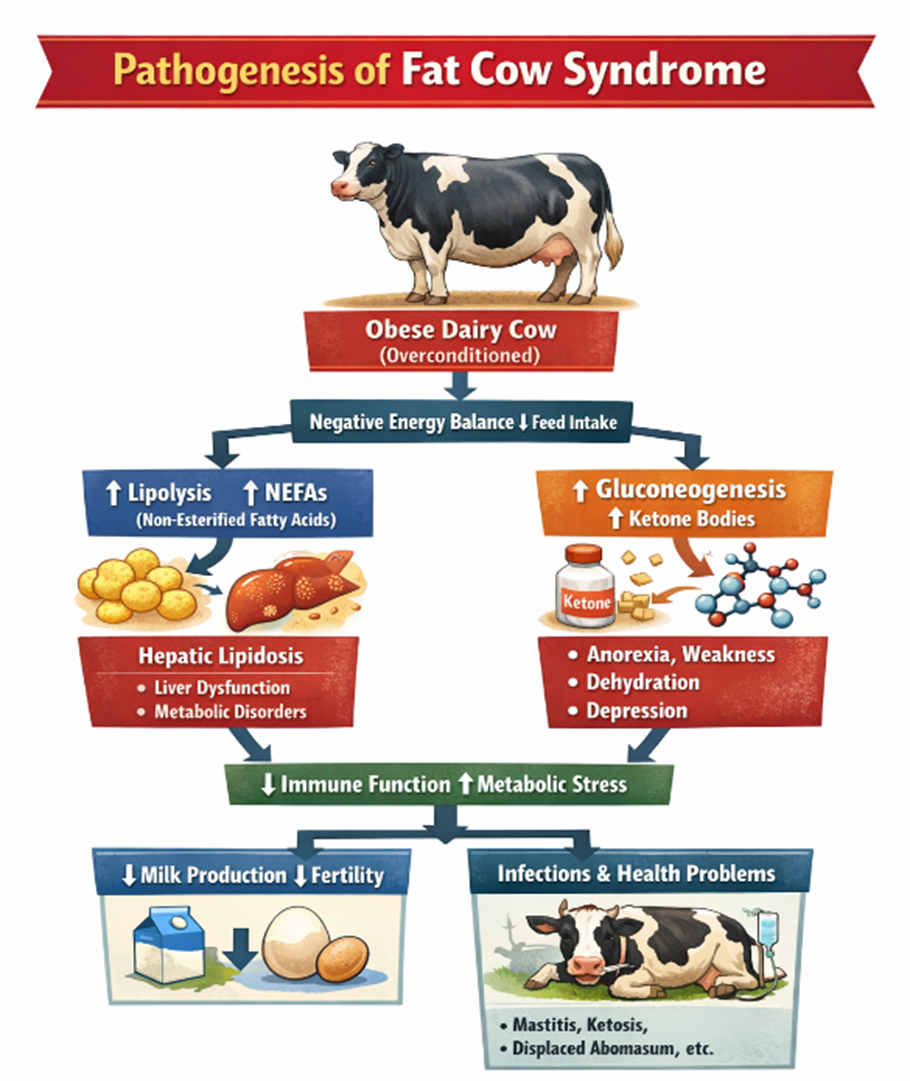
Pathogenesis of Fat cow syndrome (adapted from Herdt, 2000)
- Clinical Signs
1-Subclinical Fatty Liver
Often unnoticed but associated with:
- Reduced milk yield
- Poor fertility
- Increased disease susceptibility
2- Clinical Fat Cow Syndrome
- Anorexia or markedly reduced appetite
- Rapid weight loss
- Weakness and depression
- Ketonemia and ketonuria
- Constipation or reduced rumen motility
- Dull coat and dehydration
- Decreased milk production
- Abdominal discomfort
- Multifactorial periparturient diseases
In severe cases:
- Jaundice
- Neurological signs due to hypoglycemia
- Recumbency
- Possible hepatic rupture
- Diagnosis
1- Clinical History and Risk Assessment
Key indicators:
- Overconditioned cow prepartum
- Postpartum drop in dry matter intake (DMI)
- Concurrent metabolic disorders
2- Laboratory Findings
- Elevated NEFA prepartum (> 0.3 mEq/L)
- High NEFA postpartum (> 0.6 mEq/L)
- Elevated β‑hydroxybutyrate (BHBA)
- Elevated liver enzymes (AST, ALT)
- Low blood glucose level
- Bilirubinemia
- Increased non-protein nitrogen levels
3- Liver Biopsy
The gold standard for diagnosis:
· 10% fat: mild
- 10–30% fat: moderate
· 30% fat: severe fatty liver
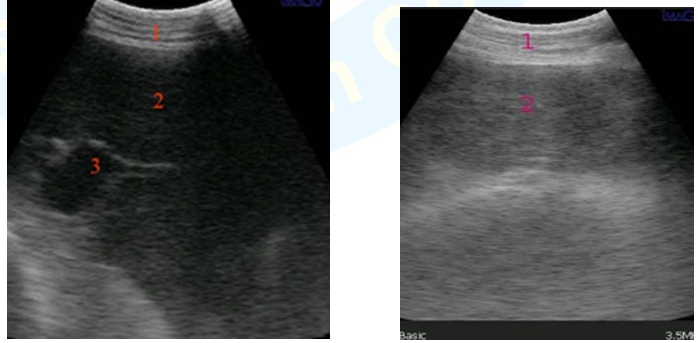
4-. Ultrasonography
Fatty infiltration appears as a hyperechoic, heterogeneous liver.
|
Hepatic ultrasonograms in control healthy cows showing normal gray echogenicity 1. Abdominal wall 2. Liver parenchyma 3. Portal vein. (Imaged through 11th ICS by convex transducer 3.5 MHz Imago). (Ghanem et al., 2016) |
Hepatic ultrasonogram in ketotic cows 1. Abdominal wall 2. Fatty infiltration (increased echogenicity, blurring of hepatic blood vessels) (Imaged through 11th ICS by convex transducer 3.5 MHz Imago) (Ghanem et al., 2016) |
- Treatment
1-Increase Energy Supply
- IV glucose (50% dextrose)
- Oral propylene glycol (300 mL/day for 3–5 days)
- High-energy diets
2- Reduce Fat Mobilization
- Insulin therapy (short-acting)
- Niacin supplementation
3- Improve Liver Function
- Choline, methionine, and rumen-protected amino acids
- Vitamin E and selenium (antioxidants)
- B‑complex vitamins to support metabolic pathways
4- Treatment of Concurrent Diseases Essential for recovery:
- Mastitis
- Metritis
- Hypocalcemia
- Ketosis
5- Supportive Therapy
- Fluid therapy
- Appetite stimulants
- Good-quality feed and frequent small meals
- Prevention
1- Proper Body Condition Scoring
Target
BCS at calving: 3.0–3.5
Avoid overconditioning during late lactation or the dry period.
2- Transition Cow Management
- Provide a balanced transition diet (high fiber, controlled energy)
- Introduce lactation rations gradually
- Reduce stress
3- Monitoring Programs
- Routine measurement of NEFAs and BHBA in pre- and postpartum cows
- Close monitoring of feed intake
4- Nutritional Strategies
- Controlled-energy dry cow diets
- Use of monensin to improve energy metabolism
- Supplement rumen-protected choline and methionine
- References
Constable, P. D., Hinchcliff, K. W., Done, S. H., & Grünberg, W. (2017). Veterinary medicine: A textbook of the diseases of cattle, horses, sheep, pigs and goats (11th ed.). Elsevier.
Ghanem M. M.; Mahmoud M. E.; Abd El-Raof Y. M.; El-Attar H. M.. "Alterations in biochemical parameters and hepatic ultrasonography with reference to oxidant injury in ketotic dairy cows", Benha Veterinary Medical Journal, 31, 2, 2016, 231-240. doi: 10.21608/bvmj.2016.31304
Locher, L.; Haussler, S.; Laubenthal, L.; Singh, S.P.; Winkler, J.; Kinoshita, A.; Kenéz, Á.; Rehage, J.; Huber, K.; Sauerwein, H.; et al. Effect of increasing body condition on key regulators of fat metabolism in subcutaneous adipose tissue depot and circulation of nonlactating dairy cows. J. Dairy Sci. 2015, 98, 1057–1068. [Google Scholar] [CrossRef]
Melendez, P., & Pinedo, P. (2024). Update on Fatty Liver in Dairy Cattle with Major Emphasis on Epidemiological Patterns, Pathophysiology in Relationship to Abdominal Adiposity, and Early Diagnosis. Dairy, 5(4), 672-687. https://doi.org/10.3390/dairy5040050
Melendez, P.; Whitney, M.; Williams, F.; Pinedo, P.; Manriquez, D.; Moore, S.G.; Lucy, M.; Pithua, P.; Poock, S. Technical note: Evaluation of fine needle aspiration cytology for the diagnosis of fatty liver in dairy cattle. J. Dairy Sci. 2018, 101, 4483–4490. [Google Scholar] [CrossRef]
Shen, Y.; Chen, L.; Yang, W.; Wang, Z. Exploration of serum sensitive biomarkers of fatty liver in dairy cows. Sci. Rep. 2018, 8, 13574. [Google Scholar] [CrossRef]