Three-Day Sickness (Bovine Ephemeral Fever) in Cattle
| Site: | EHC | Egyptian Health Council |
| Course: | Large ruminant Medicine and surgery Guidelines |
| Book: | Three-Day Sickness (Bovine Ephemeral Fever) in Cattle |
| Printed by: | Guest user |
| Date: | Sunday, 20 September 2026, 6:50 PM |
Description
"last update: 4 June 2026" Download Guideline
Table of contents
- - Acknowledgment
- - Definition
- - Economic importance
- - Etiology
- - Geographic Distribution
- - Transmission
- - Susceptible species
- - Seasonal Occurrence and risk facotors
- - Pathogenesis
- - Clinical Signs
- - Clinical Forms
- - Gross Lesions
- - Histopathological Lesions
- - Diagnosis
- - Laboratory Diagnosis
- - Differential Diagnosis
- - Treatment
- - Prevention and Control
- - Prognosis
- - References
- Acknowledgment
We would like to acknowledge the committee of the National Egyptian Guidelines for Veterinary Medical Interventions, Egyptian Health Council for adapting this guideline.
Executive Chief of the Egyptian Health Council: Prof. Mohamed Mustafa Lotief.
Head of the Committee: Prof. Ahmed M Byomi
The rapporteur of the Committee: Prof. Mohamed Mohamedy Ghanem.
Scientific Group Members: Prof. Nabil Yassien, Prof. Ashraf Aldesoky Shamaa, Prof. Amany Abbas, Prof. Dalia Mansour, Dr Essam Sobhy Dr Mohamed Elsharkawy, Prof. Dr Gamal A. Sosa., Dr Naglaa Radwan, Dr Hend El Sheikh
Editor/Author: Prof. Mohamed Ghanem
- Definition
Three-day sickness, also known as Bovine Ephemeral Fever (BEF), is an acute febrile viral disease affecting cattle and water buffalo. The disease is characterized by sudden onset of high fever, stiffness, lameness, muscle tremors, depression, nasal discharge, and a marked reduction in milk production. The disease is generally self-limiting, with most animals recovering within approximately three days, which explains the common name “three-day sickness.”
- Economic importance
Bovine Ephemeral Fever is considered one of the economically important arthropod-borne viral diseases of cattle in tropical and subtropical regions. Outbreaks may result in significant economic losses due to decreased milk yield, loss of body condition, reduced draft power, infertility, abortion in severe cases, and occasional mortality.
- Etiology
Bovine Ephemeral Fever is caused by the Bovine Ephemeral Fever Virus (BEFV), which belongs to:
Order: Mononegavirales. Family: Rhabdoviridae, Genus: Ephemerovirus
The virus is Enveloped, Bullet-shaped, Single-stranded negative-sense RNA virus
The virus is sensitive to: Heat, Lipid solvents, Detergents, and Disinfectants
However, it survives for short periods in blood and vectors.
- Geographic Distribution
The disease occurs mainly in Africa, Middle East, Australia, and Asia
Outbreaks are commonly associated with warm seasons and increased insect vector activity.
- Transmission
Vector-Borne Transmission
BEF is transmitted primarily through blood-feeding arthropods.
Important vectors include:
Mosquitoes (Culex and Aedes species) - Culicoides biting midges
Factors Favoring Transmission
Warm temperatures
High humidity
Heavy rainfall
Presence of standing water
Large vector populations
Direct transmission between animals is considered insignificant.
- Susceptible species
Cattle and water buffalo are the highly Susceptible
Sheep and goats are usually resistant.
Morbidity
Morbidity may range from 30–100%.
Mortality
Mortality is usually low (1–2%). Increasing mortalities could occur in:
· High-producing dairy cows
· Pregnant animals
· Bulls
- Seasonal Occurrence and risk facotors
The disease commonly occurs during summer and early autumn
Risk Factors for three-day sickness
· High vector density
· Introduction of susceptible cattle
· Climatic changes
· Lack of vaccination
- Pathogenesis
After inoculation through insect bites:
Virus enters bloodstream, viremia develops then virus localizes in muscles, joints, and lymphoid tissues. Inflammatory mediators are released, fever and muscle inflammation develop. Hypocalcemia may occur in severe cases.
The disease causes: myositis – polyarthritis - pulmonary edema in severe cases and immunosuppression
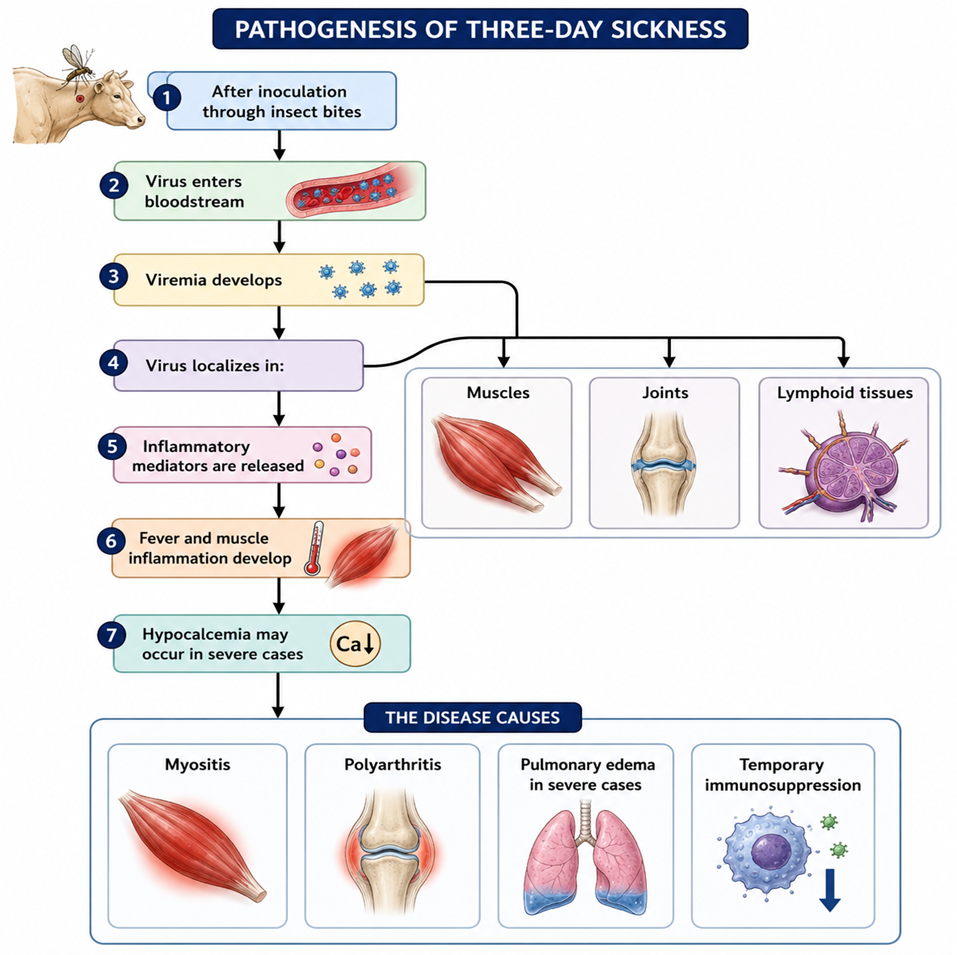
Pathogenesis of three-day sickness
- Clinical Signs
Incubation Period
Usually 2–4 days.
Peracute Signs
Sudden onset of fever (40–41.5°C)
Severe depression
Anorexia
Sudden drop in milk production
Acute Signs
General Signs
Stiffness, reluctance to move, muscle tremors, shifting lameness, arched back and recumbency
Respiratory Signs
Nasal discharge, Salivation, Tachypnea, Dyspnea
Musculoskeletal Signs
Swollen joints, Muscle pain, Difficulty rising, Paralysis in severe cases
Gastrointestinal Signs
Ruminal stasis, Constipation followed by diarrhea
Reproductive Effects
Temporary infertility, Occasional abortion
Recovery Phase
Most animals recover withi 1–3 days. Some animals may require several weeks for complete recovery.
- Clinical Forms
Mild Form
Transient fever- Mild stiffness- Quick recovery
Severe Form
Recumbency - Respiratory distress- Pulmonary emphysema -Secondary complications
Fatal Form
Rare but may occur due to respiratory failure, Secondary pneumonia
- Gross Lesions
Postmortem findings may include:
· Congestion of muscles
· Serofibrinous fluid in joints
· Pulmonary edema
· Emphysema
· Enlarged lymph nodes
· Congestion of internal organs
In many cases lesions are mild or absent.
- Histopathological Lesions
Microscopic lesions include:
· Degeneration of skeletal muscles
· Muscle fiber necrosis
· Edema
· Mononuclear cell infiltration
· Synovitis
· Pulmonary congestion
- Diagnosis
Tentative Diagnosis is based on:
Sudden fever, Lameness, Rapid recovery, Seasonal occurrence, Herd outbreaks
- Laboratory Diagnosis
Samples
· Blood during febrile stage
· Serum samples
· Tissue samples
Diagnostic Tests
1. RT-PCR
Most sensitive method for viral detection.
2. Virus Isolation
Performed in Cell culture - Suckling mice
3. Serological Tests
· ELISA
· Virus neutralization test
· Complement fixation test
4. Hematology: may show:
· Leukopenia
· Neutrophilia
· Hypocalcemia
- Differential Diagnosis
|
Disease |
Distinguishing Features |
|
Foot-and-Mouth Disease |
Vesicles in mouth and feet |
|
Milk Fever |
Hypocalcemia without fever |
|
Blackleg |
Crepitating muscle swelling |
|
Rabies |
Nervous signs and aggression |
|
Traumatic Reticuloperitonitis |
Pain localized to reticulum |
|
Bovine Respiratory Disease |
Severe respiratory involvement |
|
Ketosis |
Nervous signs and ketone odor |
- Treatment
There is no specific treatment.
Symptomatic and Supportive Therapy
1. Anti-inflammatory Drugs
· Flunixin meglumine, Ketoprofen, Meloxicam
to alleviate fever, pain and Inflammation
2. Calcium Therapy
Intravenous calcium borogluconate is beneficial in recumbent animals.
3. Fluid Therapy
Used in dehydrated animals.
4. Antibiotics
Used to prevent secondary bacterial infections.
5. Nursing Care
· Soft bedding
· Frequent turning of recumbent animals
· Easy access to feed and water
- Prevention and Control
Vector Control
· Insecticides
· Elimination of standing water
· Mosquito control programs
· Housing animals during peak vector activity
Vaccination
vaccination is considered the best preventive measure in endemic regions. different types of vaccines can be used including live attenuated vaccines- inactivated vaccines
Biosecurity Measures
· Restrict animal movement during outbreaks
· Quarantine new animals
· Surveillance programs
- Prognosis
Favorable Prognosis
Most animals recover completely within a few days.
Poor Prognosis usually associated with:
· Prolonged recumbency
· Respiratory complications
· Secondary infections
- References
Constable PD, Hinchcliff KW, Done SH, Grünberg W. Veterinary Medicine. 11th ed. Elsevier; 2017.
Quinn PJ, Markey BK, Leonard FC, FitzPatrick ES, Fanning S, Hartigan PJ. Veterinary Microbiology and Microbial Disease. 2nd ed. Wiley-Blackwell; 2011.
MacLachlan NJ, Dubovi EJ. Fenner’s Veterinary Virology. 5th ed. Academic Press; 2017.
OIE (World Organisation for Animal Health). Bovine Ephemeral Fever. Terrestrial Manual.
Walker PJ. Bovine ephemeral fever in Australia and the world. Current Topics in Microbiology and Immunology. 2005;292:57–80.
Aziz-Boaron O, Klausner Z, Shenkar J, et al. Circulation of bovine ephemeral fever in the Middle East. Veterinary Journal. 2012;194(3):304–309.
Burgess GW, Spradbrow PB. Arboviruses of Veterinary Importance. Academic Press; 1977.
Yeruham I, Van Ham M, Stram Y, Friedgut O, Yadin H, Mumcuoglu KY, Braverman Y. Epidemiological investigation of bovine ephemeral fever outbreaks in Israel. Veterinary Record. 2010;166(4):117–121.
Murphy FA, Gibbs EPJ, Horzinek MC, Studdert MJ. Veterinary Virology. 3rd ed. Academic Press; 1999.