Management of Steroid Sensitive Nephrotic Syndrome
| Site: | EHC | Egyptian Health Council |
| Course: | Pediatrics Guidelines |
| Book: | Management of Steroid Sensitive Nephrotic Syndrome |
| Printed by: | Guest user |
| Date: | Sunday, 20 September 2026, 9:43 PM |
Description
"last update: 9 September 2026" Download Guideline
Table of contents
- - Executive Summary
- - Recommendations
- - Acknowledgements
- - Abbreviation
- - Introduction
- - Purpose and Scope
- - Methods
- - Evidence
- - Evidence to recommendations: Considerations
- - Implementation Tools and Considerations
- - Limitations and suggestions for further research needs
- - Monitoring and evaluating the impact of the guideline
- - Updating of the guideline
- - References
- - Annexes
- Executive Summary
Nephrotic syndrome in children is usually primary (85–90%) showing glomerular involvement without an identifiable cause as infection, drugs, malignancy, or autoimmune disease. Evaluation might reveal an underlying systemic illness in 5–10% of patients. Most common histopathology is minimal change disease [1]. Most nephrotic children have steroid-sensitive nephrotic syndrome (SSNS) with MCD pathology, while 20% are steroid-resistant (SRNS), depending on the geographic area [2]. SRNS children show mostly focal segmental glomerulosclerosis (FSGS), minimal change disease (MCD), mesangial proliferative glomerulonephritis, and rarely membranoproliferative (MP) or membranous (MN) pathology [3]. SSNS outcome is satisfactory, 50% show frequent relapses or steroid dependence, and 3–10% show late steroid resistance [3]. A kidney biopsy is performed at disease onset only in children with atypical features and in all children with steroid resistance. Repeated kidney biopsy is indicated when prolonged (> 2 to 3 years) exposure to CNIs or in children with secondary steroid resistance. Egyptian children with idiopathic NS justified for biopsy showed MCD in 32.2%, FSGS in 45.2%, mesangio-proliferative in 9.7%, MP in 9.7%, and membranous in 3.2%. Indications for biopsy were SRNS in 79.5%, positive family history in 12.8%, age < 1 year in 2.5% or > 10 y in 10.3%, hypertension in 5.1%, and FR in 2.5% [4]. Genetic testing is not recommended in first presentation of the disease unless positive family history or syndromic or < 1y age. While it is of little value in SSNS, it is crucial in SRNS. IPNA clinical practice recommendations 2020, and KDIGO 2021 guidelines recommended routine evaluation of genetic mutations in children with SRNS if available [5–10]. Comorbidities of Idiopathic SSNS as infection, thrombosis, drug side effects are less marked than that observed in SRNS. The mainstay of treatment for IPNS is corticosteroids. Most children respond well to steroids within 4 weeks (SSNS); those who do not respond will be defined as SRNS patients at six weeks. Kidney outcomes in SSNS remain excellent, with < 5% risk of progression to chronic kidney diseases at 10 years after diagnosis [11]. In contrast, SRNS increased risk of progression to (ESRD) [5]. SSNS prognosis is correlated with morbidity of prolonged exposure to corticosteroids and steroid-sparing agents prescribed in frequently-relapsing or steroid-dependent disease. Idiopathic SSNS disease has a chronic, relapsing–remitting course, which tends to resolve spontaneously following puberty. However, in 15% to 25% of cases, it may progress to adulthood, maintaining the peculiar rapid response to corticosteroids in relapse. Small percentage of children may, become secondarily steroid-resistant with high chance both of progressing to kidney failure and to relapse after transplantation.
➡️Purpose and Scope
These guidelines have been developed to standardize the delivery of services and to implement the guidance on the diagnosis, evaluation, management and follow-up of nephrotic children for Steroid sensitive nephrotic syndrome (SSNS). It provides guidance to primary health care providers, pediatricians and specially trained nurses.
The guidelines aimed to aid in diagnosis, evaluation, management and follow-up of nephrotic SSNS.
This version of the guideline includes recommendations and good practice statements for
· Management and diagnosis, of nephrotic children for Steroid sensitive nephrotic syndrome in children
· Evaluation of nephrotic children for Steroid sensitive nephrotic syndrome in children
· Follow-up of nephrotic children for Steroid sensitive nephrotic syndrome in children
This guideline focuses on diagnosis, evaluation, management and follow-up of nephrotic children for (SSNS)
After reviewing all the inclusion and exclusion criteria and quality appraisal results, the GDG/ GAG recommended using the following source original clinical practice guidelines (CPGs):
1- IPNA clinical practice recommendations for the diagnosis and management of children with steroid-resistant nephrotic syndrome 2020,
2- KDIGO Clinical Practice Guideline on Glomerular Diseases2021
3- Evidence-Based Clinical Practice Guidelines for Nephrotic Syndrome JSPN 2014
We conducted Adolopment for these guidelines : (Adoption, Adaptation, and Development)
- Adoption for most of the guideline recommendations.
- Adaptation for 2 recommendations according to GRADE criteria to be suitable to our Economic implications (Evidence-to-Decision (EtD) table was done)
- Development of Good Practice Statements
This version of the CPG includes recommendations and good practice statements on the following four sub-sections:
A. Evaluation of nephrotic children for Steroid sensitive nephrotic syndrome
B. Diagnosis of nephrotic children for Steroid sensitive nephrotic syndrome
C. Management of nephrotic children for Steroid sensitive nephrotic syndrome
D. Follow-up of nephrotic children for Steroid sensitive nephrotic syndrome
We can summarize the guidelines’ recommendations for Steroid sensitive nephrotic syndrome in the following:
EPG recommends the following three practice points and R2 (1–5) to make a proper diagnosis for NS in children:
· R 2: At Primary health care settings, we recommend for primary diagnosis of NS:
(Good Practice Statement).
· Clinical assessment of oedema, blood pressure, urinary symptoms. Good history taking about: patient age at onset of disease, family history of similar complaints, previous infections, recent drugs, systemic disease) (Good Practice Statement).
· Basic laboratory assessment: Urine analysis for sediments (hematuria, proteinuria), Protein/creatinine ratio, and urine culture, GFR, serum albumin, s. LDL-Cholesterol, complete blood count. Nephrotic range proteinuria with low s albumin with and without oedema make a primary diagnosis of NS (Table 2 IPNA 2020 and KDIGO 2021: refer to the Appendix) (Good Practice Statement).
· R 2: We recommend referral of children with the primary diagnosis of NS to pediatric nephrologist, for proper extended diagnosis &management (
· R 2: (Good Practice Statement). 3) We recommend for pediatric nephrologists to extend their assessment as recommended by IPNA 20 to classify a nephrotic patient as steroid sensitive or steroid resistant, as each type will follow a separate guidance addressed to specific end users.SSNS Guidance is addressed to practitioners, pediatricians, and pediatric nephrologists. Whereas SRNS guidance will be addressed to pediatric nephrologists.
· R 2.1: We recommend for extended Clinical assessment to follow Table 2 (refer to the Appendix) IPNA 2020 and EPG flow-chart (Fig. 1), focusing on; age at onset of disease, consanguinity, positive family history of kidney disease, extra renal manifestations, disease severity, degree of oedema, hypertension.
· R 2.2: We recommend for extended laboratory assessment in atypical cases to follow EPG flowchart and Table 2 IPNA 2020 focusing on:
· C3, C4, Anti ds DNA, ASOT, APLR, ANCA (Strong recomendation).
· Infection screen (blood, urine culture, tuberculin test ©viral serology; HBsAg, HC, CMV, Epstein Bar, HIV, COVID Sars-2 antibodies conditional recomendation
· Imaging: abdominal and renal US, X-ray chest
R 2.3: Genetic tests for selected cases
R 2.3.1: Good Practice Statement: We recommend Early genetic testing not waiting for 4 weeks steroid response If: Familial (Conditional recomendation), Syndromic (Conditional recomendation), < 1 year age of onset (Conditional recomendation), extra renal involvement suggesting hereditary disease ( Conditional recomendation).
R 2.3.2: We recommend genetic testing after 4 weeks of start of oral prednisone, for all steroid resistant if possible (Strong Recomendation) IPNA or our high priority target groups (SR/FSGS or DMS, CNI resistant…. Refer to SRNS CPG to identify our target group).
IPNA 2020 recommends GT for infantile, familial syndromic and all SR, as early as possible in the transitional period (4–6 weeks) after steroid use with no response and before biopsy.
KDIGO 2021 also recommended GT in SRNS when congenital and infantile (< 1 year of age), with syndromic features, familial KDIGO 2021 (Fig. 43 Ps 152).
R 2.4: Renal biopsy for selected cases WHEN to do KIDNEY BIOPSY in the first episode?
Rationale: Since the prognosis for childhood NS is best predicted by patient response to steroid therapy &frequency of relapses in the first year after treatment, Therefore KDIGO 2021 recommend renal biopsy at first episode only for those with atypical presentation or steroid resistance PP: 4.2.1. KDIGO 2021.
R2.4.1: Good Practice Statement We recommend Early biopsy for atypical cases and not to wait for 4 weeks steroid therapy transitional period if:
· There is high index of suspicion for a different underlying pathology as macroscopic haematuria, hypertension, hypocomplementemia, etc.
· Children presenting with NS at age of > 12 years with hypertension and or haematuria.
· Early onset or rapid decline in GFR is not related to hypovolemia.
2.4.2: We recommend late biopsy as IPNA &KDIGO recommend for Good Practice Statement:
· Steroid resistant NS (4 weeks after steroid therapy).
· Late failure to respond after initial response to steroids (secondary SR).
· Decreasing kidney function in children while receiving CNIs or those with prolonged exposure (2–3 years).
R 2.5: WHO should manage nephrotic children? Referral Red Flags?
R 2.5.A (Good Practice Statement): EPG Work group panel recommend early referral of children with nephrotic syndrome to Pediatric Nephrologist at its first episode once diagnosed. Since Practitioners or pediatricians are commonly who make the primary diagnosis of Nephrotic syndrome; therefore, they should be informed about all criteria of referral. Early referral (upon diagnosis at its first episode) is better than late emergency referral of critical cases. Early referral helps in early classification as SSNS or SRNS, proper treatment of each type as well as management of complications cases by pediatric nephrologists.
Red flags justifying referral:
R 2.5.B (Good Practice Statement) Pre-treatment indications:
· Age < 1 year, > 12 years, familial clustering of similar cases, extrarenal features
· Macroscopic hematuria, Hypertension, complement consumption, renal impairment,
· Hypo-complementemia, high antibody titer (ANCA, ADNA, APL),
· Positive viral serology (hepatitis B SA, hepatitis, or HIV antibodies), (+ tuberculin test + Blood culture in congenital or rheumatic cardiac patients or hydrocephalous with shunts).
R 2.5.C: (Good Practice Statement) Post-treatment indications of cases difficult to manage:
· Failure to achieve partial or complete remission after 6-week standard dose steroids (primary SRNS).
· Secondary SRNS after initial response.
· Frequently relapsing or steroid dependent.
· Uncontrolled hypertension, infection, thrombosis.
· Steroid toxicity-renal impairment.
R 3 (1–6): Treatment of Initial Episode of NS? (Fig. 2A).
R 3.1: We suggest adopting KIDIGO 2021 recommendations as oral corticosteroids to be given for 8 weeks (4-week daily steroids followed with 4 weeks at alternate day) OR 6 weeks daily followed with 6 weeks at alternate day (Strong Recommendation). The standard dosing regimen for the initial treatment of NS is oral prednisone or prednisolone 60 mg/m2/day or 2 mg/kg/day (max 60 mg/day) for 4 weeks followed by alternate day 1.5 mg/kg/alternate day or 40 mg/m2 (maximum 50 mg/alternate day) for other 4 weeks or prednisone or prednisolone 6o mg/m2/day maximum 60 mg/day for 6 weeks followed with alternate day regimen 40 mg/m2/day max. 50 mg/d for other 6 weeks KDIGO 2021 PP: 4.3.1.1.
We add the following local practice points:
R 3.1.A: Good Practice Statement divided dose is accepted in children with gastric upset since single dose is preferred for better adherence and not superiority. (KDIGO 2021).
R 3.1.B: Good Practice Statement although dose calculation per surface area is more accurate in children. Per kg calculation may be accepted for simplification provided no under dosing [24,25,26,27].
R 3.1.C: 12-week total duration for steroids may be prolonged in late responders (KDIGO 2021 draft), therefore total steroid duration remains as open point of research Good Practice Statement.
R 3.2: HOW to maintain long remission on recurrence for:
Infrequently relapsing? Frequently relapsing, steroid dependent?
R 3.2 The initial approach for induction should include prednisone as a single daily dose of 60 mg/m2 or 2 mg/kg (maximum 60 mg/day) until the child remits completely for at least three days. KDIGO 21 PP: 4.3.2.1. Then:
R 3.2.1: Steroid maintenance for infrequently relapsing: after achieving complete 3 days remission with single daily dose of prednisone 60 mg/m2 or 2 mg/kg (maximum of 60 mg/day) KDIGO 21 PP:4.3.2.2. Children are suggested to have alternate days (40 mg/m2 per dose or 1.5 mg/kg per dose (maximum 50 mg/day) for at least 4 weeks. (Conditional recomendation).) KDIGO2021.
R 3.2.2. A: Frequently relapsing SSNS Children without steroid toxicity are suggested to be treated with the same glucocorticoid regimen in subsequent relapses. Prednisone is suggested to be given on alternate days in the lowest dose (Optimal dose ≤ 0.5 mg/kg) to maintain remission without major adverse effects PP: 4.3.2.4. KDIGO2021.
R 3.2.2. B: does not accept daily low-dose steroids on failure of alternate day low dose unless total weekly dose is kept the same but divided as daily dose Good Practise Statement . KDIGO 2021 suggests daily prednisone at the lowest dose to maintain remission in children without major adverse effects in FR/SSNS when alternate-day prednisone therapy is not effective (Conditional recomendation).
R 3.2.3: Steroid Dependent SSNS children: We accept low-dose steroids for low dose–dependent patients (alternate day dose ≤ 0.5 mg/kg) provided; no steroid toxicity, continuous patient monitoring with dose titration, patient preference and accept of potential harm (KDIGO 2012) [28] Good Practice statement. KDIGO2021 does not recommend low-dose steroids for SD as they recommend steroid-sparing drugs for all SD to avoid steroid toxicity. KDIGO 2021 (Strong Recomendation) PP 4.3.2.2.
R 3.3: We recommend for frequently relapsing or steroid dependents children who are currently on alternate-day prednisone or off glucocorticoids during episodes of the upper respiratory tract and other infections, daily prednisone (0.5 mg/kg) for 5 to 7 days to reduce the risk for relapse. (Strong Recomendation).
R 3.4: WHICH STEROID SPAIRING DRUGS to recommend for FR and SD?
Rationale:
It has been well accepted that corticosteroid-sparing agents were recommended to be prescribed for children with (FR) SSNS and (SD) SSNS, who develop steroid-related adverse effects. (Strong Recomendation) KDIGO 2012.
KDIGO 2021 Suggests low dose steroids (optimally alternate day dose ≤ 0.5 mg/kg) as maintenance only for FR who respond to the low glucocorticoid dose without serious toxicity PP: 4.3.2.4. (Strong Recomendation) KDIGO2021. Whereas all SD should use steroid-sparing drugs to avoid long-term use of steroids. (Strong Recomendation) KDIGO 2021, PP 4.3.2.2
· Patients should be ideally in remission with glucocorticoids prior to initiation of steroid-sparing drugs. Coadministration of glucocorticoids is recommended for 2 w following initiation of steroid-sparing drugs PP 4.3.2.5. KDIGO 2021
· Choosing the most appropriate drug is related to patient resources, adherence, tolerance, adverse effects, contraindications, and drug availability. PP: 4.3.2.6. KDIGO 2021
· For FR, levamisole and oral cyclophosphamides are preferred. For SD MMF, rituximab, cyclosporine, and to a lesser extent cyclophosphamides are suggested PP: 4.3.2.6. (Strong Recomendation). KDIGO 2021. Dose, duration, efficacy, and complications for each are summarized in Table 3 (refer to the Appendix. IPNA 2020 P 1541).
R 3.4: We suggest for frequently Relapsing (Fig. 2B) EPG-GPP, in case of resistance to low and safe steroid dose, to use levamisole as our first choice, to be replaced with cyclophosphamides considering its cumulative dose, or azathioprine. (Strong recomendation).
We suggest in steroid-dependent, Good Practice Statement. CNIs as our second choice after levamisole in children. Rituximab is an expensive drug, not covered by medical insurance and its use looks risky in countries endemic to hepatitis and other infectious diseases (conditional recomendation). Our limited experience in the use of Mizorbine unlike adults also restricts its common use in children (Good Practice Statement.).
R3.5: Management of complications (oedema, infections)
R. 3.5.1: EDEMA
Rationale
Patients with mild oedema do not require diuretic therapy. Corticosteroid therapy for relapse results in diuresis within 1 week, enabling loss of retained extracellular fluid. Patients are advised to limit sodium intake.
For patients with moderate oedema without hypovolemia
· We recommend oral furosemide as first-line therapy (2–4 mg/kg/day) (Strong Recomendation) Japanese 2014
· We suggest additional use of hydrochlorothiazide (2–4 mg/kg/day) or metolazone (0.1–0.2 mg/kg q12–24 h) to augment diuresis with Monitoring for hypovolemia, hypokalemia (Strong Recomendation) Japanese. Spironolactone has limited diuretic efficacy but a potassium-sparing agent in patients receiving high-dose furosemide. Use of amiloride is not advised. EPG-GPP [20]
· We suggest that patients with furosemide-refractory oedema be managed as follows: (i) combination of loop diuretics with thiazide and (ii) co-administration of human albumin with IV furosemide. (X) IPNA2020. Unresponsive to oral furosemides due to gut oedema indicates switching to IV therapy as 1–2 mg/kg q 8–12 h.
· Patients with severe oedema. We recommend loop diuretics furosemide unless hypovolemic to avoid thrombosis and AKI. IPNA 2020. Hypovolemia in NS results after vomiting, diarrhea, and diuresis.
· We suggest treating patients with severe and refractory oedema with hypovolemia, human albumin infusion (Conditional recommendation) IPNA 2020. Starting dose 20–25% albumin, 0.5–1 g/kg IV over 4–8 h, adding furosemide 1–2 mg/kg iv in the middle and at the end of infusion (Conditional recommendation) IPNA 2020. Blood pressure and heart rate monitoring with slowing infusion with any sign of overload. IPNA 2020.
R 3.5.2: Infection
· We suggest that serious bacterial infections associated with nephrotic syndrome be managed as indicated. IPNA2020. Referral to pediatric nephrologists is crucial. Good Practice Statement.
· Follow-up to prevent Infection with infection control measures and vaccinations.
· We suggest immune globulins for children with recurrent infections or low serum IgG levels (Conditional recommendation) IPNA2020.
· We do not recommend routine antibiotics. (Conditional recommendation)) IPNA2020 We suggest cotrimoxazole in patients on rituximab (5–10 mg/kg/day 3 times weekly 3–6 m) (Conditional recommendation) IPNA2020 We recommend receiving all vaccinations as recommended below.
Rationale:
Infections are the chief complication in patients with SSNS, accounting for most hospitalizations. Contributing factors include the use of immunosuppressive agents, anasarca, and urinary losses of IgG. Peritonitis is the most common severe infection, followed by pneumonia and cellulitis [26]. The diagnosis and treatment of severe infections should follow standard guidelines. Apart from vaccines, there is no evidence of routine antibiotics (Conditional recommendation) IPNA 2020.
Viral infections several viruses, including rhinovirus, adenovirus, influenza, parainfluenza, enterovirus, and respiratory syncytial and Epstein–Barr viruses, might trigger disease relapses. varicella, zoster, and influenza might cause serious morbidities KDIGO 2012/2021. Infections such as severe acute respiratory syndrome coronavirus 2 infection with severe acute respiratory syndrome coronavirus 2 (SARS COVID 2), the etiological agent of coronavirus disease (COVID-19) poses challenges in the management of patients with nephrotic syndrome [29, 30]. While children show mild disease, patients on immunosuppression constitute a high-risk group that is predisposed to adverse outcomes. Affected patients are at risk of AKI, particularly if associated with hypovolemia or aggressive use of diuretics [29]. Most expert groups advise reduction of immunosuppression or steroids to acceptable levels, limiting the use of biological agents, balancing the risk of disease relapse against infection.
R 3.5.3: Prevention of thrombosis
We recommend mobilization and avoiding central lines except for specific and transient need strong recommendation. Insufficient evidence for routine anticoagulant with no previous history or risk of thrombosis (not graded). We suggest low molecular weight heparin in those patients with: *previous history of thrombosis, central lines, hereditary thrombophilia predisposition, infection or dehydration (Conditional recommendation). We suggest thrombophilia screen for protein C, S, Anti thrombin, factor V genes in those with a positive family history of thrombophilic predisposition (Conditional recommendation) IPNA 2020.
R: 4.1: How to follow your patient?
· Diet: We recommend fat restricted diet (C1) Japanese 2014 balanced fluids uptake (Conditional recommendation) IPNA 2020, salt moderation IPNA 2020(Conditional recommendation) , and moderate exercise (Conditional recommendation) Japanese 2014.
· Family orientation with relapsing course of the disease, how to use uro-strips, adherence to steroid therapy and monitoring for its side effects.
· Blood pressure assessment and control.
· Laboratory testing to follow proteinuria, GFR, lipids profile, urine & blood glucose.
· Infection screen and drug monitoring for those under immunosuppressive.
· Vaccinations refer to (R 4.2) (Strong recomendation) Japanese 2014, IPNA 2020 (Strong recommendation).
· Growth follow-up.
· Vitamin D and calcium supplements, pump inhibitors (Conditional recommendation) IPNA 2020, KDIGO 2021 (Fig. 43 P.s152).
· In patients with SSNS and normal vit amin D levels, supplementation is not required. However, in FRNS or SDNS children with a known vitamin D deficiency, a reduction of bone mineral content can be prevented by oral supplementation of calcium and vitamin D.
· KDIGO 2021 reported absence of sufficient evidence to recommend prophylactic use of proton-pump inhibitors in children with NS in absence of risk factors as gastric symptoms.
· Management of complications (infection, thrombosis, steroid toxicity, immunosuppressive side effects) with immediate referral to Pediatric Nephrologists for urgent interference. (Good Practice Statement).
R 4.2: IMMUNIZATIONS IN CHILDREN WITH SSNS
R 4.2: To reduce the risk of serious infections in children with SSNS, IPNA 2020 suggest reviewing the child vaccination status at disease onset completing all vaccinations without delay especially for encapsulated bacteria (pneumococcal, meningococcal, Hemophilus influenza) and if possible, varicella-zoster virus
· Give pneumococcal, meningococcal, and varicella vaccination to the children (Strong recommendation) IPNA 2020.
· Give influenza vaccination annually to the children and their household contacts (Strong recommendation) IPNA 2020.
· Live vaccines are contraindicated in children receiving corticosteroid-sparing immunosuppressive agents (Strong recommendations) IPNA 2020.
· Immunize healthy household contacts with live vaccines to minimize the risk of transfer of infection to the immunosuppressed child but avoid direct exposure of the child to gastrointestinal, urinary, or respiratory secretions of vaccinated contacts for 3–6 weeks after vaccination.
· Following close contact with varicella infection, give nonimmune children on immunosuppressive agents, varicella zoster immune globulin, if available (Strong recommendation). Treatment with acyclovir 10 mg/kg/7 days (Good practice statement), varicella vaccine in remission (conditional) IPNA 2020.
➡️Guideline Registration
PREPARE (Practice guideline REgistration for transPAREncy), WHO Collaborating Center for Guideline Implementation and Knowledge Translation, EBM Center, University of Lanzhou, Lanzhou, China. Registration Number: ((submitted and in process)). Link: http://www.guidelines-registry.org/- Recommendations
Table 3. Recommendations
N
Health questions
Source Guideline
Recommendations
Quality of evidence
Strength of Recommendation
A1
Definitions
WHAT are the Common Definitions Related to Nephrotic Syndrome?
IPNA 2020 and KDIGO 2021
Definitions are summarized in IPNA 2020 and KDIGO 2021 (Table 1: refer to the Appendix).
Good practice statement
A2
Diagnosis. (EPG: Figs. 1 and 2A) How to make a proper diagnosis of NS at its first episode?
IPNA 2020 and KDIGO 2021
EPG recommends the following three practice points and R2 (1–5) to make a proper diagnosis for NS in children:
R 2: At Primary health care settings, we recommend for primary diagnosis of NS:
Clinical assessment of oedema, blood pressure, urinary symptoms. Good history taking about: patient age at onset of disease, family history of similar complaints, previous infections, recent drugs, systemic disease).
Basic laboratory assessment: Urine analysis for sediments (hematuria, proteinuria), Protein/creatinine ratio, and urine culture, GFR, serum albumin, s. LDL-Cholesterol, complete blood count. Nephrotic range proteinuria with low s albumin with and without oedema make a primary diagnosis of NS (Table 2 IPNA 2020 and KDIGO 2021: refer to the Appendix).
Good practice statement
We recommend referral of children with the primary diagnosis of NS to pediatric nephrologist, for proper extended diagnosis &management.
Good Practice statement
IPNA 2020
R 2: We recommend for pediatric nephrologists to extend their assessment as recommended by IPNA 20 to classify a nephrotic patient as steroid sensitive or steroid resistant, as each type will follow a separate guidance addressed to specific end users.
SSNS Guidance is addressed to practitioners, pediatricians, and pediatric nephrologists. Whereas SRNS guidance will be addressed to pediatric nephrologists
Good Practice statement
IPNA 2020
R 2.1: We recommend for extended Clinical assessment to follow Table 2 (refer to the Appendix) IPNA 2020 and EPG flow-chart (Fig. 1), focusing on; age at onset of disease, consanguinity, positive family history of kidney disease, extra renal manifestations, disease severity, degree of oedema, hypertension.
Good Practice Statement
IPNA 2020
R 2.2: We recommend for extended laboratory assessment in atypical cases to follow EPG flowchart (Fig. 1) and Table 2 IPNA 2020 (refer to the Appendix) focusing on:
· C3, C4, Anti ds DNA, ASOT, APLR, ANCA
Moderate
Strong
· Infection screen (blood, urine culture, tuberculin test ©viral serology; HBsAg, HC, CMV, Epstein Bar, HIV, COVID Sars-2 antibodies
· Imaging: abdominal and renal US, X-ray chest.
Low
Conditional
R 2.3
Genetic tests for selected cases
WHEN to ask for GENETIC TESTING in first episode?
R 2.3.1: We recommend Early genetic testing not waiting for 4 weeks’ steroid response
If: Familial (C), Syndromic (C), < 1 year age of onset (C), extra renal involvement suggesting hereditary disease (C).
Low
Good Practice Statement
Conditional
IPNA 2020
KDIGO 2021
R 2.3.2: We recommend genetic testing after 4 weeks of start of oral prednisone, for all steroid resistant if possible IPNA or our high priority target groups (SR/FSGS or DMS, CNI resistant…. Refer to SRNS CPG to identify our target group).
IPNA 2020 recommends GT for infantile, familial syndromic and all SR, as early as possible in the transitional period (4–6 weeks) after steroid use with no response and before biopsy.
KDIGO 2021 also recommended GT in SRNS when congenital and infantile (< 1 year of age), with syndromic features, familial KDIGO 2021
Moderate
Strong
R 2.4
Renal biopsy for selected cases WHEN to do KIDNEY BIOPSY in the first episode?
KDIGO 2021
Since the prognosis for childhood NS is best predicted by patient response to steroid therapy &frequency of relapses in the first year after treatment, Therefore KDIGO 2021 recommend renal biopsy at first episode only for those with atypical presentation or steroid resistance PP: 4.2.1. KDIGO 2021.
R2.4.1: We recommend Early biopsy for atypical cases and not to wait for 4 weeks’ steroid therapy transitional period if:
· There is high index of suspicion for a different underlying pathology as macroscopic haematuria, hypertension, hypocomplementemia, etc.
· Children presenting with NS at age of > 12 years with hypertension and or haematuria.
· Early onset or rapid decline in GFR is not related to hypovolemia.
Good Practice Statement
IPNA 2020
KDIGO 2021
We recommend late biopsy as IPNA &KDIGO recommend for:
· Steroid resistant NS (4 weeks after steroid therapy).
· Late failure to respond after initial response to steroids (secondary SR).
· Decreasing kidney function in children while receiving CNIs or those with prolonged exposure (2–3 years).
Good Practices Statement
R 2.5
WHO should manage nephrotic children? Referral Red Flags?
R 2.5.A : EPG Work group panel recommend early referral of children with nephrotic syndrome to Pediatric Nephrologist at its first episode once diagnosed. Since Practitioners or pediatricians are commonly who make the primary diagnosis of Nephrotic syndrome; therefore, they should be informed about all criteria of referral. Early referral (upon diagnosis at its first episode) is better than late emergency referral of critical cases. Early referral helps in early classification as SSNS or SRNS, proper treatment of each type as well as management of complications cases by pediatric nephrologists.
Good Practice Statement
Red flags justifying referral:
R 2.5.B Pre-treatment indications:
· Age < 1 year, > 12 years, familial clustering of similar cases, extrarenal features
· Macroscopic hematuria, Hypertension, complement consumption, renal impairment,
· Hypo-complementemia, high antibody titer (ANCA, ADNA, APL),
· Positive viral serology (hepatitis B SA, hepatitis, or HIV antibodies), (+ tuberculin test + Blood culture in congenital or rheumatic cardiac patients or hydrocephalous with shunts).
Good Practice Statement
R 3
R 3 (1–6): Treatment of Initial Episode of NS?
KIDIGO 2021
R 2.5.C: Post-treatment indications of cases difficult to manage:
· Failure to achieve partial or complete remission after 6-week standard dose steroids (primary SRNS).
· Secondary SRNS after initial response.
· Frequently relapsing or steroid dependent.
· Uncontrolled hypertension, infection, thrombosis.
· Steroid toxicity-renal impairment.
R 3.1: We suggest adopting KIDIGO 2021 recommendations as oral corticosteroids to be given for 8 weeks (4-week daily steroids followed with 4 weeks at alternate day) OR 6 weeks daily followed with 6 weeks at alternate day . The standard dosing regimen for the initial treatment of NS is oral prednisone or prednisolone 60 mg/m2/day or 2 mg/kg/day (max 60 mg/day) for 4 weeks followed by alternate day 1.5 mg/kg/alternate day or 40 mg/m2 (maximum 50 mg/alternate day) for other 4 weeks or prednisone or prednisolone 6o mg/m2/day maximum 60 mg/day for 6 weeks followed with alternate day regimen 40 mg/m2/day max. 50 mg/d for other 6 weeks KDIGO 2021
Moderate
Good Practice Statement
Strong
KDIGO 2021
We add the following local practice points:
R 3.1.A: divided dose is accepted in children with gastric upset since single dose is preferred for better adherence and not superiority. (KDIGO 2021).
R 3.1.B: although dose calculation per surface area is more accurate in children. Per kg calculation may be accepted for simplification provided no under dosing
R 3.1.C: 12-week total duration for steroids may be prolonged in late responders (KDIGO 2021 draft), therefore total steroid duration remains as open point of research
Good Practice Statement
R 3.2
HOW to maintain long remission on recurrence for:
Infrequently relapsing? Frequently relapsing, steroid dependent?
KDIGO 2021
R 3.2 The initial approach for induction should include prednisone as a single daily dose of 60 mg/m2 or 2 mg/kg (maximum 60 mg/day) until the child remits completely for at least three days
KDIGO2021
R 3.2.1: Steroid maintenance for infrequently relapsing: after achieving complete 3 days remission with single daily dose of prednisone 60 mg/m2 or 2 mg/kg (maximum of 60 mg/day) Children are suggested to have alternate days (40 mg/m2 per dose or 1.5 mg/kg per dose (maximum 50 mg/day) for at least 4 weeks.
Low
Conditional
KDIGO2021
R 3.2.2. A: Frequently relapsing SSNS Children without steroid toxicity are suggested to be treated with the same glucocorticoid regimen in subsequent relapses. Prednisone is suggested to be given on alternate days in the lowest dose (Optimal dose ≤ 0.5 mg/kg) to maintain remission without major adverse effects PP:
KDIGO2021
R 3.2.2. B: EPG-GPP does not accept daily low-dose steroids on failure of alternate day low dose unless total weekly dose is kept the same but divided as daily dose.
KDIGO 2021 suggests daily prednisone at the lowest dose to maintain remission in children without major adverse effects in FR/SSNS when alternate-day prednisone therapy is not effective
Very Low
Good Practice Statement
Conditional
KDIGO2021
R 3.2.3: Steroid Dependent SSNS children: We accept low-dose steroids for low dose–dependent patients (alternate day dose ≤ 0.5 mg/kg) provided; no steroid toxicity, continuous patient monitoring with dose titration, patient preference and accept of potential harm (KDIGO 2012) [28]. .
Good practice Statement
KIDIGO 2021
KDIGO2021 does not recommend low-dose steroids for SD as they recommend steroid-sparing drugs for all SD to avoid steroid toxicity.
moderate
Strong
KIDIGO 2021
R 3.3: We recommend for frequently relapsing or steroid dependents children who are currently on alternate-day prednisone or off glucocorticoids during episodes of the upper respiratory tract and other infections, daily prednisone (0.5 mg/kg) for 5 to 7 days to reduce the risk for relapse.
Low
Conditional
R 3.4:
WHICH STEROID SPAIRING DRUGS to recommend for FR and SD?
KDIGO 2012.
It has been well accepted that corticosteroid-sparing agents were recommended to be prescribed for children with (FR) SSNS and (SD) SSNS, who develop steroid-related adverse effects.
Moderate
Strong
KDIGO 2021
Suggests low dose steroids (optimally alternate day dose ≤ 0.5 mg/kg) as maintenance only for FR who respond to the low glucocorticoid dose without serious toxicity. Whereas all SD should use steroid-sparing drugs to avoid long-term use of steroids. KDIGO 2021
- Patients should be ideally in remission with glucocorticoids prior to initiation of steroid-sparing drugs. Co administration of glucocorticoids is recommended for 2 w following initiation of steroid-sparing drugs KDIGO 2021
- Choosing the most appropriate drug is related to patient resources, adherence, tolerance, adverse effects, contraindications, and drug availability.
Moderate
Strong
KDIGO 2021
For FR, levamisole and oral cyclophosphamides are preferred. For SD MMF, rituximab, cyclosporine, and to a lesser extent cyclophosphamides are suggested. Dose, duration, efficacy, and complications for each are summarized in Table 3
Moderate
Strong
R 3.4: We suggest for frequently Relapsing (Fig. 2B) in case of resistance to low and safe steroid dose, to use levamisole as our first choice, to be replaced with cyclophosphamides considering its cumulative dose, or azathioprine.
Good Practice Statement
We suggest in steroid-dependent, CNIs as our second choice after levamisole in children.
Rituximab is an expensive drug, not covered by medical insurance and its use looks risky in countries endemic to hepatitis and other infectious diseases
Low
Good Practice Statement
Conditional
Our limited experience in the use of Mizorbine unlike adults also restricts its common use in children.
Good Practice Statement
R3.5:
Management of complications (oedema, infections)
R. 3.5.1: EDEMA
Japanese 2014
Patients with mild oedema do not require diuretic therapy. Corticosteroid therapy for relapse results in diuresis within 1 week, enabling loss of retained extracellular fluid. Patients are advised to limit sodium intake.
For patients with moderate oedema without hypovolemia
- We recommend oral furosemide as first-line therapy (2–4 mg/kg/day)
Moderate
Strong
Japanese 2014
We suggest additional use of hydrochlorothiazide (2–4 mg/kg/day) or metolazone (0.1–0.2 mg/kg q12–24 h) to augment diuresis with Monitoring for hypovolemia, hypokalemia
Moderate
Strong
Spironolactone has limited diuretic efficacy but a potassium-sparing agent in patients receiving high-dose furosemide. Use of amiloride is not advised.
Good Practice Statement
IPNA2020
- We suggest that patients with furosemide-refractory oedema be managed as follows: (i) combination of loop diuretics with thiazide and (ii) co-administration of human albumin with IV furosemide. Unresponsive to oral furosemides due to gut oedema indicates switching to IV therapy as 1–2 mg/kg q 8–12 h.
Good Practice Statement
IPNA 2020
Patients with severe oedema. We recommend loop diuretics furosemide unless hypovolemic to avoid thrombosis and AKI. Hypovolemia in NS results after vomiting, diarrhea, and diuresis
Good Practice Statement
IPNA 2020.
We suggest treating patients with severe and refractory oedema with hypovolemia, human albumin infusion Starting dose 20–25% albumin, 0.5–1 g/kg IV over 4–8 h, adding furosemide 1–2 mg/kg iv in the middle and at the end of infusion
Low
Conditional
IPNA 2020.
Blood pressure and heart rate monitoring with slowing infusion with any sign of overload.
Good Practice Statement
R 3.5.2:
Infection
IPNA2020
We suggest that serious bacterial infections associated with nephrotic syndrome be managed as indicated.
Good Practice Statement
Referral to pediatric nephrologists is crucial.
Good Practice Statement
Follow-up to prevent Infection with infection control measures and vaccinations.
Good Practice Statement
IPNA2020
We suggest immune globulins for children with recurrent infections or low serum IgG levels
Very Low
Conditional
IPNA2020
IPNA 2020
KDIGO 2012/2021
We do not recommend routine antibiotics. We suggest cotrimoxazole in patients on rituximab (5–10 mg/kg/day 3 times weekly 3–6 m) We recommend receiving all vaccinations as recommended below.
Rationale:
Infections are the chief complication in patients with SSNS, accounting for most hospitalizations. Contributing factors include the use of immunosuppressive agents, anasarca, and urinary losses of IgG. Peritonitis is the most common severe infection, followed by pneumonia and cellulitis The diagnosis and treatment of severe infections should follow standard guidelines. Apart from vaccines, there is no evidence of routine antibiotics.
Viral infections several viruses, including rhinovirus, adenovirus, influenza, parainfluenza, enterovirus, and respiratory syncytial and Epstein–Barr viruses, might trigger disease relapses. varicella, zoster, and influenza might cause serious morbidities KDIGO 2012/2021. Infections such as severe acute respiratory syndrome coronavirus 2 infection with severe acute respiratory syndrome coronavirus 2 (SARS COVID 2), the etiological agent of coronavirus disease (COVID-19) poses challenges in the management of patients with nephrotic syndrome]. While children show mild disease, patients on immunosuppression constitute a high-risk group that is predisposed to adverse outcomes. Affected patients are at risk of AKI, particularly if associated with hypovolemia or aggressive use of diuretics Most expert groups advise reduction of immunosuppression or steroids to acceptable levels, limiting the use of biological agents, balancing the risk of disease relapse against infection.
Low
Low
Conditional
Conditional
R 3.5.3:
Prevention of thrombosis
We recommend mobilization and avoiding central lines except for specific and transient need strong recommendation.
Good Practice Statement
Insufficient evidence for routine anticoagulant with no previous history or risk of thrombosis (not graded).
Good Practice Statement
IPNA 2020
We suggest low molecular weight heparin in those patients with: *previous history of thrombosis, central lines, hereditary thrombophilia predisposition, infection or dehydration
Low
Conditional
Table 3. Recommendations
N
Health questions
Source Guideline
Recommendations
Quality of evidence
Strength of Recommendation
A1
Definitions
WHAT are the Common Definitions Related to Nephrotic Syndrome?
IPNA 2020 and KDIGO 2021
Definitions are summarized in IPNA 2020 and KDIGO 2021 (Table 1: refer to the Appendix).
Good practice statement
A2
Diagnosis. (EPG: Figs. 1 and 2A) How to make a proper diagnosis of NS at its first episode?
IPNA 2020 and KDIGO 2021
EPG recommends the following three practice points and R2 (1–5) to make a proper diagnosis for NS in children:
R 2: At Primary health care settings, we recommend for primary diagnosis of NS:
Clinical assessment of oedema, blood pressure, urinary symptoms. Good history taking about: patient age at onset of disease, family history of similar complaints, previous infections, recent drugs, systemic disease).
Basic laboratory assessment: Urine analysis for sediments (hematuria, proteinuria), Protein/creatinine ratio, and urine culture, GFR, serum albumin, s. LDL-Cholesterol, complete blood count. Nephrotic range proteinuria with low s albumin with and without oedema make a primary diagnosis of NS (Table 2 IPNA 2020 and KDIGO 2021: refer to the Appendix).
Good practice statement
We recommend referral of children with the primary diagnosis of NS to pediatric nephrologist, for proper extended diagnosis &management.
Good Practice statement
IPNA 2020
R 2: We recommend for pediatric nephrologists to extend their assessment as recommended by IPNA 20 to classify a nephrotic patient as steroid sensitive or steroid resistant, as each type will follow a separate guidance addressed to specific end users.
SSNS Guidance is addressed to practitioners, pediatricians, and pediatric nephrologists. Whereas SRNS guidance will be addressed to pediatric nephrologists
Good Practice statement
IPNA 2020
R 2.1: We recommend for extended Clinical assessment to follow Table 2 (refer to the Appendix) IPNA 2020 and EPG flow-chart (Fig. 1), focusing on; age at onset of disease, consanguinity, positive family history of kidney disease, extra renal manifestations, disease severity, degree of oedema, hypertension.
Good Practice Statement
IPNA 2020
R 2.2: We recommend for extended laboratory assessment in atypical cases to follow EPG flowchart (Fig. 1) and Table 2 IPNA 2020 (refer to the Appendix) focusing on:
· C3, C4, Anti ds DNA, ASOT, APLR, ANCA
Moderate
Strong
· Infection screen (blood, urine culture, tuberculin test ©viral serology; HBsAg, HC, CMV, Epstein Bar, HIV, COVID Sars-2 antibodies
· Imaging: abdominal and renal US, X-ray chest.
Low
Conditional
R 2.3
Genetic tests for selected cases
WHEN to ask for GENETIC TESTING in first episode?
R 2.3.1: We recommend Early genetic testing not waiting for 4 weeks’ steroid response
If: Familial (C), Syndromic (C), < 1 year age of onset (C), extra renal involvement suggesting hereditary disease (C).
Low
Good Practice Statement
Conditional
IPNA 2020
KDIGO 2021
R 2.3.2: We recommend genetic testing after 4 weeks of start of oral prednisone, for all steroid resistant if possible IPNA or our high priority target groups (SR/FSGS or DMS, CNI resistant…. Refer to SRNS CPG to identify our target group).
IPNA 2020 recommends GT for infantile, familial syndromic and all SR, as early as possible in the transitional period (4–6 weeks) after steroid use with no response and before biopsy.
KDIGO 2021 also recommended GT in SRNS when congenital and infantile (< 1 year of age), with syndromic features, familial KDIGO 2021
Moderate
Strong
R 2.4
Renal biopsy for selected cases WHEN to do KIDNEY BIOPSY in the first episode?
KDIGO 2021
Since the prognosis for childhood NS is best predicted by patient response to steroid therapy &frequency of relapses in the first year after treatment, Therefore KDIGO 2021 recommend renal biopsy at first episode only for those with atypical presentation or steroid resistance PP: 4.2.1. KDIGO 2021.
R2.4.1: We recommend Early biopsy for atypical cases and not to wait for 4 weeks’ steroid therapy transitional period if:
· There is high index of suspicion for a different underlying pathology as macroscopic haematuria, hypertension, hypocomplementemia, etc.
· Children presenting with NS at age of > 12 years with hypertension and or haematuria.
· Early onset or rapid decline in GFR is not related to hypovolemia.
Good Practice Statement
IPNA 2020
KDIGO 2021
We recommend late biopsy as IPNA &KDIGO recommend for:
· Steroid resistant NS (4 weeks after steroid therapy).
· Late failure to respond after initial response to steroids (secondary SR).
· Decreasing kidney function in children while receiving CNIs or those with prolonged exposure (2–3 years).
Good Practices Statement
R 2.5
WHO should manage nephrotic children? Referral Red Flags?
R 2.5.A : EPG Work group panel recommend early referral of children with nephrotic syndrome to Pediatric Nephrologist at its first episode once diagnosed. Since Practitioners or pediatricians are commonly who make the primary diagnosis of Nephrotic syndrome; therefore, they should be informed about all criteria of referral. Early referral (upon diagnosis at its first episode) is better than late emergency referral of critical cases. Early referral helps in early classification as SSNS or SRNS, proper treatment of each type as well as management of complications cases by pediatric nephrologists.
Good Practice Statement
Red flags justifying referral:
R 2.5.B Pre-treatment indications:
· Age < 1 year, > 12 years, familial clustering of similar cases, extrarenal features
· Macroscopic hematuria, Hypertension, complement consumption, renal impairment,
· Hypo-complementemia, high antibody titer (ANCA, ADNA, APL),
· Positive viral serology (hepatitis B SA, hepatitis, or HIV antibodies), (+ tuberculin test + Blood culture in congenital or rheumatic cardiac patients or hydrocephalous with shunts).
Good Practice Statement
R 3
R 3 (1–6): Treatment of Initial Episode of NS?
KIDIGO 2021
R 2.5.C: Post-treatment indications of cases difficult to manage:
· Failure to achieve partial or complete remission after 6-week standard dose steroids (primary SRNS).
· Secondary SRNS after initial response.
· Frequently relapsing or steroid dependent.
· Uncontrolled hypertension, infection, thrombosis.
· Steroid toxicity-renal impairment.
R 3.1: We suggest adopting KIDIGO 2021 recommendations as oral corticosteroids to be given for 8 weeks (4-week daily steroids followed with 4 weeks at alternate day) OR 6 weeks daily followed with 6 weeks at alternate day . The standard dosing regimen for the initial treatment of NS is oral prednisone or prednisolone 60 mg/m2/day or 2 mg/kg/day (max 60 mg/day) for 4 weeks followed by alternate day 1.5 mg/kg/alternate day or 40 mg/m2 (maximum 50 mg/alternate day) for other 4 weeks or prednisone or prednisolone 6o mg/m2/day maximum 60 mg/day for 6 weeks followed with alternate day regimen 40 mg/m2/day max. 50 mg/d for other 6 weeks KDIGO 2021
Moderate
Good Practice Statement
Strong
KDIGO 2021
We add the following local practice points:
R 3.1.A: divided dose is accepted in children with gastric upset since single dose is preferred for better adherence and not superiority. (KDIGO 2021).
R 3.1.B: although dose calculation per surface area is more accurate in children. Per kg calculation may be accepted for simplification provided no under dosing
R 3.1.C: 12-week total duration for steroids may be prolonged in late responders (KDIGO 2021 draft), therefore total steroid duration remains as open point of research
Good Practice Statement
R 3.2
HOW to maintain long remission on recurrence for:
Infrequently relapsing? Frequently relapsing, steroid dependent?
KDIGO 2021
R 3.2 The initial approach for induction should include prednisone as a single daily dose of 60 mg/m2 or 2 mg/kg (maximum 60 mg/day) until the child remits completely for at least three days
KDIGO2021
R 3.2.1: Steroid maintenance for infrequently relapsing: after achieving complete 3 days remission with single daily dose of prednisone 60 mg/m2 or 2 mg/kg (maximum of 60 mg/day) Children are suggested to have alternate days (40 mg/m2 per dose or 1.5 mg/kg per dose (maximum 50 mg/day) for at least 4 weeks.
Low
Conditional
KDIGO2021
R 3.2.2. A: Frequently relapsing SSNS Children without steroid toxicity are suggested to be treated with the same glucocorticoid regimen in subsequent relapses. Prednisone is suggested to be given on alternate days in the lowest dose (Optimal dose ≤ 0.5 mg/kg) to maintain remission without major adverse effects PP:
KDIGO2021
R 3.2.2. B: EPG-GPP does not accept daily low-dose steroids on failure of alternate day low dose unless total weekly dose is kept the same but divided as daily dose.
KDIGO 2021 suggests daily prednisone at the lowest dose to maintain remission in children without major adverse effects in FR/SSNS when alternate-day prednisone therapy is not effective
Very Low
Good Practice Statement
Conditional
KDIGO2021
R 3.2.3: Steroid Dependent SSNS children: We accept low-dose steroids for low dose–dependent patients (alternate day dose ≤ 0.5 mg/kg) provided; no steroid toxicity, continuous patient monitoring with dose titration, patient preference and accept of potential harm (KDIGO 2012) [28]. .
Good practice Statement
KIDIGO 2021
KDIGO2021 does not recommend low-dose steroids for SD as they recommend steroid-sparing drugs for all SD to avoid steroid toxicity.
moderate
Strong
KIDIGO 2021
R 3.3: We recommend for frequently relapsing or steroid dependents children who are currently on alternate-day prednisone or off glucocorticoids during episodes of the upper respiratory tract and other infections, daily prednisone (0.5 mg/kg) for 5 to 7 days to reduce the risk for relapse.
Low
Conditional
R 3.4:
WHICH STEROID SPAIRING DRUGS to recommend for FR and SD?
KDIGO 2012.
It has been well accepted that corticosteroid-sparing agents were recommended to be prescribed for children with (FR) SSNS and (SD) SSNS, who develop steroid-related adverse effects.
Moderate
Strong
KDIGO 2021
Suggests low dose steroids (optimally alternate day dose ≤ 0.5 mg/kg) as maintenance only for FR who respond to the low glucocorticoid dose without serious toxicity. Whereas all SD should use steroid-sparing drugs to avoid long-term use of steroids. KDIGO 2021
- Patients should be ideally in remission with glucocorticoids prior to initiation of steroid-sparing drugs. Co administration of glucocorticoids is recommended for 2 w following initiation of steroid-sparing drugs KDIGO 2021
- Choosing the most appropriate drug is related to patient resources, adherence, tolerance, adverse effects, contraindications, and drug availability.
Moderate
Strong
KDIGO 2021
For FR, levamisole and oral cyclophosphamides are preferred. For SD MMF, rituximab, cyclosporine, and to a lesser extent cyclophosphamides are suggested. Dose, duration, efficacy, and complications for each are summarized in Table 3
Moderate
Strong
R 3.4: We suggest for frequently Relapsing (Fig. 2B) in case of resistance to low and safe steroid dose, to use levamisole as our first choice, to be replaced with cyclophosphamides considering its cumulative dose, or azathioprine.
Good Practice Statement
We suggest in steroid-dependent, CNIs as our second choice after levamisole in children.
Rituximab is an expensive drug, not covered by medical insurance and its use looks risky in countries endemic to hepatitis and other infectious diseases
Low
Good Practice Statement
Conditional
Our limited experience in the use of Mizorbine unlike adults also restricts its common use in children.
Good Practice Statement
R3.5:
Management of complications (oedema, infections)
R. 3.5.1: EDEMA
Japanese 2014
Patients with mild oedema do not require diuretic therapy. Corticosteroid therapy for relapse results in diuresis within 1 week, enabling loss of retained extracellular fluid. Patients are advised to limit sodium intake.
For patients with moderate oedema without hypovolemia
- We recommend oral furosemide as first-line therapy (2–4 mg/kg/day)
Moderate
Strong
Japanese 2014
We suggest additional use of hydrochlorothiazide (2–4 mg/kg/day) or metolazone (0.1–0.2 mg/kg q12–24 h) to augment diuresis with Monitoring for hypovolemia, hypokalemia
Moderate
Strong
Spironolactone has limited diuretic efficacy but a potassium-sparing agent in patients receiving high-dose furosemide. Use of amiloride is not advised.
Good Practice Statement
IPNA2020
- We suggest that patients with furosemide-refractory oedema be managed as follows: (i) combination of loop diuretics with thiazide and (ii) co-administration of human albumin with IV furosemide. Unresponsive to oral furosemides due to gut oedema indicates switching to IV therapy as 1–2 mg/kg q 8–12 h.
Good Practice Statement
IPNA 2020
Patients with severe oedema. We recommend loop diuretics furosemide unless hypovolemic to avoid thrombosis and AKI. Hypovolemia in NS results after vomiting, diarrhea, and diuresis
Good Practice Statement
IPNA 2020.
We suggest treating patients with severe and refractory oedema with hypovolemia, human albumin infusion Starting dose 20–25% albumin, 0.5–1 g/kg IV over 4–8 h, adding furosemide 1–2 mg/kg iv in the middle and at the end of infusion
Low
Conditional
IPNA 2020.
Blood pressure and heart rate monitoring with slowing infusion with any sign of overload.
Good Practice Statement
R 3.5.2:
Infection
IPNA2020
We suggest that serious bacterial infections associated with nephrotic syndrome be managed as indicated.
Good Practice Statement
Referral to pediatric nephrologists is crucial.
Good Practice Statement
Follow-up to prevent Infection with infection control measures and vaccinations.
Good Practice Statement
IPNA2020
We suggest immune globulins for children with recurrent infections or low serum IgG levels
Very Low
Conditional
IPNA2020
IPNA 2020
KDIGO 2012/2021
We do not recommend routine antibiotics. We suggest cotrimoxazole in patients on rituximab (5–10 mg/kg/day 3 times weekly 3–6 m) We recommend receiving all vaccinations as recommended below.
Rationale:
Infections are the chief complication in patients with SSNS, accounting for most hospitalizations. Contributing factors include the use of immunosuppressive agents, anasarca, and urinary losses of IgG. Peritonitis is the most common severe infection, followed by pneumonia and cellulitis The diagnosis and treatment of severe infections should follow standard guidelines. Apart from vaccines, there is no evidence of routine antibiotics.
Viral infections several viruses, including rhinovirus, adenovirus, influenza, parainfluenza, enterovirus, and respiratory syncytial and Epstein–Barr viruses, might trigger disease relapses. varicella, zoster, and influenza might cause serious morbidities KDIGO 2012/2021. Infections such as severe acute respiratory syndrome coronavirus 2 infection with severe acute respiratory syndrome coronavirus 2 (SARS COVID 2), the etiological agent of coronavirus disease (COVID-19) poses challenges in the management of patients with nephrotic syndrome]. While children show mild disease, patients on immunosuppression constitute a high-risk group that is predisposed to adverse outcomes. Affected patients are at risk of AKI, particularly if associated with hypovolemia or aggressive use of diuretics Most expert groups advise reduction of immunosuppression or steroids to acceptable levels, limiting the use of biological agents, balancing the risk of disease relapse against infection.
Low
Low
Conditional
Conditional
R 3.5.3:
Prevention of thrombosis
We recommend mobilization and avoiding central lines except for specific and transient need strong recommendation.
Good Practice Statement
Insufficient evidence for routine anticoagulant with no previous history or risk of thrombosis (not graded).
Good Practice Statement
IPNA 2020
We suggest low molecular weight heparin in those patients with: *previous history of thrombosis, central lines, hereditary thrombophilia predisposition, infection or dehydration
Low
Conditional
IPNA 2020 | We suggest thrombophilia screen for protein C, S, Anti thrombin, factor V genes in those with a positive family history of thrombophilic predisposition | Low | Conditional | ||
R: 4.1: | How to follow your patient? | IPNA 2020 Japanese 2014 | Diet: We recommend fat restricted diet balanced fluids uptake ,salt moderation , and moderate exercise | Low | Conditional |
|
|
| Family orientation with relapsing course of the disease, how to use uro-strips, adherence to steroid therapy and monitoring for its side effects.
Blood pressure assessment and control.
Laboratory testing to follow proteinuria, GFR, lipids profile, urine & blood glucose.
Infection screen and drug monitoring for those under immunosuppressives
|
|
|
|
| Japanese 2014
IPNA 2020 | Vaccinations refer to (R 4.2) | High-Moderate | Strong |
|
|
| Growth follow-up |
| Good Practice Statement |
|
| IPNA 2020, KDIGO 2021 | Vitamin D and calcium supplements, pump inhibitors | Low | Conditional |
|
|
| In patients with SSNS and normal vitamin D levels, supplementation is not required. However, in FRNS or SDNS children with a known vitamin D deficiency, a reduction of bone mineral content can be prevented by oral supplementation of calcium and vitamin D |
|
|
|
| KDIGO 2021 | Reported absence of sufficient evidence to recommend prophylactic use of proton-pump inhibitors in children with NS in absence of risk factors as gastric symptoms. |
|
|
|
|
| Management of complications (infection, thrombosis, steroid toxicity, immunosuppressive side effects) with immediate referral to Pediatric Nephrologists for urgent interference. |
| Good Practice Statement |
| R 4.2: IMMUNIZATIONS IN CHILDREN WITH SSNS | IPNA 2020 | To reduce the risk of serious infections in children with SSNS, suggest reviewing the child vaccination status at disease onset completing all vaccinations without delay especially for encapsulated bacteria (pneumococcal, meningococcal, Hemophilus influenza) and if possible, varicella-zoster virus
Give pneumococcal, meningococcal, and varicella vaccination to the children |
High |
Strong |
|
| IPNA 2020 | Give influenza vaccination annually to the children and their household contacts | High | Strong |
|
| IPNA 2020 | Live vaccines are contraindicated in children receiving corticosteroid-sparing immunosuppressive agents |
| Good Practice Statement |
|
|
| Immunize healthy household contacts with live vaccines to minimize the risk of transfer of infection to the immunosuppressed child but avoid direct exposure of the child to gastrointestinal, urinary, or respiratory secretions of vaccinated contacts for 3–6 weeks after vaccination |
| Good Practice Statement |
|
| IPNA 2020 | Following close contact with varicella infection, give nonimmune children on immunosuppressive agents, varicella zoster immune globulin, if available | High | Strong |
|
|
| Treatment with acyclovir 10 mg/kg/7 days |
| Good Practice Statement |
|
|
| varicella vaccine in remission | Low | Conditional |
- Acknowledgements
|
Egyptian Pediatric Clinical Practice Guidelines Committee (EPG) Guideline Development/ Adaptation Group (Clinicians subgroup) |
|||||
|
Name |
Affiliation, Area of expertise / Country / Primary location [work] |
Contribution |
|||
|
Bahia Moustafa |
Department of Pediatrics, Pediatric Nephrology Division, Faculty of Medicine, Cairo University, Cairo, Egypt |
|
|||
|
Mahmoud M. El‑Kersh |
Department of Pediatrics, Pediatric Nephrology Division, Faculty of Medicine, Alexandria University, Alexandria, Egypt |
|
|||
|
Sherin Shalaby |
Department of Pediatrics, Pediatric Nephrology Division, Faculty of Medicine, Suez Canal University, Ismailia, Egypt |
|
|||
|
Nancy Abdel Salam |
Department of Pediatrics, Pediatric Nephrology Division, Faculty of Medicine, Alexandria University, Alexandria, Egypt |
|
|||
|
Sawsan Moselhy |
Department of Pediatrics, Pediatric Nephrology Division, Faculty of Medicine, Ain Shams University, Cairo, Egypt |
|
|||
|
Gamal Taha Soliman |
Department of Pediatrics, Faculty of Medicine, Port Said University, Port Fuad, Egypt |
|
|||
|
Abeer Selim |
Department of Pediatrics, Medical Research and Clinical Studies Institute, National Research Centre, Cairo, Egyp |
|
|||
|
Egyptian Pediatric Clinical Practice Guidelines Committee (EPG) Guideline Development/ Adaptation Group (Guideline Methodologists subgroup) |
|||||
|
Name |
Affiliation, Area of expertise / Country / Primary location [work] |
Contribution |
|||
|
Prof. Ashraf Abdel Baky |
Professor of Pediatrics Ain Shams University, Egypt Founder and Chair of EPG |
Overseeing the adolopment process of the guidelines, training and education of new members, revision of the final draft, and organizing online meetings of GDG |
|||
|
Dr. Yasser Sami Amer |
1. Pediatrics Department and Clinical Practice Guidelines and Quality Research Unit, Quality Management Department, King Saud University Medical City, Riyadh, Saudi Arabia; 2. Research Chair for Evidence-Based Health Care and Knowledge Translation, King Saud University, Riyadh, Saudi Arabia; 3. Chair, Adaptation Working Group, Guidelines International Network (GIN), Perth, Scotland 4. Department of Internal Medicine, Ribeirão Preto Medical School, University of São Paulo (FMRP-USP), Ribeirão Preto, São Paulo, Brazil. |
Overseeing the adolopment process of the guidelines, training and education of new members, participating in writing up the methodology of adaptation process, guideline appraisal, and revision of the final draft |
|||
|
- Assistant Professor of Evidence-based Practice, School of Life and Medical Sciences, University of Hertfordshire, Egypt. - Consultant at WHO/EMRO for the Clinical and Public Heath Guideline Adaptation Project in the EMR. - Head of Heath Economics and Value Unit, Children’s Cancer Hospital Egypt. |
Participating in multiple steps of the guideline adaptation process, Writing the methodology of adaptation process and revised the whole document. |
||||
|
Dr. Nahla Gamaleldin |
Lecturer of pediatrics, Faculty of Medicine, Modern University for Technology and Information (MTI), Egypt |
Participating in multiple steps of the guideline adaptation process, Writing the methodology of adaptation process and revised the whole document. |
|||
|
External Reviewers Group (ERG) |
|||||
|
External Reviewer(s) for Clinical Content |
|||||
|
|||||
|
Prof. Amr Sarhan |
Prof of Pediatrics and Pediatrics Nephrology, Faculty of Medicine Mansoura University |
||||
|
Prof. Neven Suliman |
Prof of Pediatrics and Pediatrics Nephrology, Faculty of Medicine Cairo University |
||||
|
Prof. Ihab Al Hakim |
Prof of Pediatrics and Pediatrics Nephrology, Faculty of Medicine Ain Shams University |
||||
|
International Peer Reviewers |
|||||
|
External Reviewer(s) for methodology |
|||||
|
Prof. Iván D. Flórez |
Department of Pediatrics, University of Antioquia, Medellín, Colombia, Department of Health Research Methods, Evidence, and Impact, McMaster University, Hamilton, Canada, Leader, AGREE Collaboration (Appraisal of Guidelines for Research & Evaluation) Director, Cochrane Colombia |
||||
|
Prof. Airton Tetelbom Stein
|
Professor Titular de Saúde Coletiva, Fundação Universidade Federal de Ciências da Saúde de Porto Alegre (UFCSPA), Porto Alegre, Brazil Professor Adjunto, Universidade Luterana do Brasil (Ulbra), Canoas, Brazil Coordenador de Diretrizes Clínicas, Grupo Hospitalar Conceição, Porto Alegre, Brazil 4. Member, Board of Trustees, Guidelines International Network (G-I-N) |
||||
· The GDG/ GAG acknowledge EPG for its help in completing this project.
· We acknowledge IPNA, KDIGO and Japanese guidelines (the source original guidelines) for their cooperation in providing the permission for adapting our guidelines.
· Finally, we wish the best for all our patients and their families who inspired us. It is for them this work is being finalized.
Funding
· This work is not related to any pharmaceutical or industrial company. The members of the GDG/ GAG and their institutes and universities volunteered their participation and contributions.
- Abbreviation
|
Adolopment |
Adoption-Adaptation-Development |
||
|
AGREE II |
Appraisal of Guidelines for Research and Evaluation Instrument |
||
|
CPG |
Clinical Practice Guideline |
||
|
DHS |
Demographic and Health Survey |
||
|
EPG |
Egyptian Pediatrics Clinical Practice Guidelines Committee |
||
|
EPG CPG |
EPG Clinical Practice Guideline |
||
|
ERG |
External Review Group |
||
|
GAG |
Guideline Adaptation Group |
||
|
GDG |
Guideline Development Group |
||
|
GPS |
Good Practice Statement |
||
|
GRADE |
Grading of Recommendations Assessment, Development and Evaluation |
||
|
PICO |
population, intervention, comparison, and outcomes |
||
|
Patient population, intervention, professionals, outcomes, and healthcare context |
||
|
RIGHT |
A Reporting Tool for Practice Guidelines in Health Care |
||
|
ANA |
ANA |
||
|
ANCA |
ANCA |
||
|
Antinuclear antibodies |
Antinuclear antibodies |
||
|
Anti‑neutrophil cytoplasmic antibody |
Anti‑neutrophil cytoplasmic antibody |
||
|
Anti‑ds DNA |
Anti‑ds DNA |
||
|
Anti‑double stranded‑DNA |
Anti‑double stranded‑DNA |
||
|
Anti‑PLA2R Anti‑phospholipase A2 receptor antibody |
Anti‑PLA2R Anti‑phospholipase A2 receptor antibody |
||
|
ASOT |
ASOT |
||
|
Anti‑streptolysin O titer |
Anti‑streptolysin O titer |
||
|
C1q |
C1q |
||
|
C3 |
C3 |
||
|
C4 |
C4 |
||
|
CNIs |
CNIs |
||
|
CPG |
CPG |
||
|
DMS |
DMS |
||
|
EPG |
EPG |
||
|
Complement component C1q |
Complement component C1q |
||
|
Complement 3 |
Complement 3 |
||
|
Complement 4 |
Complement 4 |
||
|
Calcineurin inhibitors |
Calcineurin inhibitors |
||
|
Clinical practice guideline |
Clinical practice guideline |
||
|
Diffuse mesangial sclerosis |
Diffuse mesangial sclerosis |
||
|
Egyptian Clinical Practice Guideline Committee |
Egyptian Clinical Practice Guideline Committee |
||
|
EPG‑GPP Egyptian Clinical Practice Guideline Committee‑Good Practice |
EPG‑GPP Egyptian Clinical Practice Guideline Committee‑Good Practice |
||
|
Point |
Point |
||
|
EPG‑WG Egyptian Clinical Practice Guideline Committee‑Work Group |
EPG‑WG Egyptian Clinical Practice Guideline Committee‑Work Group |
- Introduction
Nephrotic syndrome in children is usually primary (85–90%) showing glomerular involvement without an identifiable cause as infection, drugs, malignancy, or autoimmune disease. Evaluation might reveal an underlying systemic illness in 5–10% of patients. Most common histopathology is minimal change disease [1]. Most nephrotic children have steroid-sensitive nephrotic syndrome (SSNS) with MCD pathology, while 20% are steroid-resistant (SRNS), depending on the geographic area [2]. SRNS children show mostly focal segmental glomerulosclerosis (FSGS), minimal change disease (MCD), mesangial proliferative glomerulonephritis, and rarely membranoproliferative (MP) or membranous (MN) pathology [3]. SSNS outcome is satisfactory, 50% show frequent relapses or steroid dependence, and 3–10% show late steroid resistance [3]. A kidney biopsy is performed at disease onset only in children with atypical features and in all children with steroid resistance. Repeated kidney biopsy is indicated when prolonged (> 2 to 3 years) exposure to CNIs or in children with secondary steroid resistance. Egyptian children with idiopathic NS justified for biopsy showed MCD in 32.2%, FSGS in 45.2%, mesangio-proliferative in 9.7%, MP in 9.7%, and membranous in 3.2%. Indications for biopsy were SRNS in 79.5%, positive family history in 12.8%, age < 1 year in 2.5% or > 10 y in 10.3%, hypertension in 5.1%, and FR in 2.5% [4]. Genetic testing is not recommended in first presentation of the disease unless positive family history or syndromic or < 1y age. While it is of little value in SSNS, it is crucial in SRNS. IPNA clinical practice recommendations 2020, and KDIGO 2021 guidelines recommended routine evaluation of genetic mutations in children with SRNS if available [5–10]. Comorbidities of Idiopathic SSNS as infection, thrombosis, drug side effects are less marked than that observed in SRNS. The mainstay of treatment for IPNS is corticosteroids. Most children respond well to steroids within 4 weeks (SSNS); those who do not respond will be defined as SRNS patients at six weeks. Kidney outcomes In SSNS remain excellent, with < 5% risk of progression to chronic kidney diseases at 10 years after diagnosis [11]. In contrast, SRNS increased risk of progression to (ESRD) [5]. SSNS prognosis is correlated with morbidity of prolonged exposure to corticosteroids and steroid-sparing agents prescribed in frequently-relapsing or steroid-dependent disease. Idiopathic SSNS disease has a chronic, relapsing–remitting course, which tends to resolve spontaneously following puberty. However, in 15% to 25% of cases, it may progress to adulthood, maintaining the peculiar rapid response to corticosteroids in relapse. Small percentage of children may, become secondarily steroid-resistant with high chance both of progressing to kidney failure and to relapse after transplantation.
- Purpose and Scope
These guidelines have been developed to standardize the delivery of services and to implement the guidance on the diagnosis, evaluation, management and follow-up of nephrotic children for Steroid sensitive nephrotic syndrome (SSNS) in children. It provides guidance to primary health care providers, pediatricians and specially trained nurses.
The guidelines aimed t on the diagnosis, evaluation, management and follow-up of nephrotic children for Steroid sensitive nephrotic syndrome (SSNS) in children.
This version of the guideline includes recommendations and good practice statements for Steroid sensitive nephrotic syndrome (SSNS) in children.
- Methods
Methods of search:
A comprehensive search for guidelines was undertaken to identify the most relevant guidelines to consider for adaptation. Keywords used for search are:
nephrotic syndrome, children, Steroid sensitive nephrotic syndrome
Inclusion / exclusion criteria followed in the search and retrieval of guidelines to be adapted:
• Selecting only evidence-based guidelines (guideline must include a report on methodology of development including the systematic literature searches and explicit links between individual recommendations and their supporting evidence)
• Selecting national and/or international guidelines
• Specific range of dates for publication (using Guidelines published or updated 2013 and later or the last 5 years)
• Selecting peer-reviewed publications only
• Selecting guidelines written in English language
• Excluding guidelines written by a single author
The following three categories of databases and websites were searched:
1. CPG databases and libraries (e.g., GIN, ECRI, SIGN, DynaMed, BIGG-REC PAHO)
2. Bibliographic databases (e.g., PubMed, Google Scholar)
3. Specialized professional societies (related to the pediatric subspecialty)
All retrieved Guidelines were screened and appraised using AGREE II instrument (www.agreetrust.org) by at least two members. The panel decided a cut-off point or rank the guidelines (any guideline scoring above 60% on the rigor dimension was retained)
After reviewing all the previous criteria the GDG/ GAG recommended using 2 guidelines:
1- IPNA clinical practice recommendations for the diagnosis and management of children with steroid-resistant nephrotic syndrome 2020,
2- KDIGO Clinical Practice Guideline on Glomerular Diseases2021
3- Evidence-Based Clinical Practice Guidelines for Nephrotic Syndrome JSPN 2014
We did Adolopment for these guidelines: (Adoption, Adaptation, and Development)
- Adoption for most of the guideline recommendations.
- Development of Good Practice Statement
Contributors to the guideline development process:
Guideline Development Group (GDG)/ Guideline Adaptation Group (GAG):
The GDG/ GAG included two subgroups; the clinicians/ healthcare providers subgroup and the guideline methodologists’ subgroup.
Clinicians Subgroups
The clinicians’ subgroup or clinical panel for this guideline included experts with a range of knowledge, technical skills and diverse perspectives in the field of nephrology.
The main functions of the clinical panel were adolopment of IPNA clinical practice recommendations for the diagnosis and management of children with steroid-resistant nephrotic syndrome 2020, KDIGO Clinical Practice Guideline on Glomerular Diseases2021
Evidence-Based Clinical Practice Guidelines for Nephrotic Syndrome JSPN 2014… Guidelines, determining the scope of the guideline and guideline, reviewing the evidence, and formulating evidence-informed recommendations in case of changing strength of recommendations.
Guideline Methodologists Subgroup
There were 7 guideline methodologists with expertise in guidelines development, adaptation, GRADE and translation of evidence into recommendations. Methodologists provided orientation and overview of evidence-informed guideline development processes using the GRADE approach, guideline adaptation using the Adapted ADAPTE, provided AGREE II assessment of the source guidelines in collaboration with the clinicians subgroup, generation of the EtD frameworks whenever applicable.
External Review Group:
The External Review Group for this guideline comprises 3 clinical national experts who have interest and expertise in as well as eminent international reviewers……………………….
They were identified by Egyptian Pediatric Clinical Practice Guidelines Committee (EPG) as people who can provide valuable insights during the guideline development process.
The External Review Group was asked to comment on (peer review) the final guideline to identify any criticism on the content and to comment on clarity and applicability as well as issues relating to implementation, dissemination, ethics, regulations, or monitoring, but not to change the recommendations formulated by the GDG/ GAG. The members of the External Review Group were required to submit declarations of interest before the peer review process.
Guideline Development/ Adaptation Group meetings:
GDG/ GAG meetings were organized virtually (weekly/bimonthly). Due to the extensive scope of
the guideline, EPG was responsible for overseeing the adolopment process. the timetable and objectives of each meeting. GDG/ GAG meetings were also attended by members of the methodologists. Working rules for each contributor type were outlined by the chair at the start of each meeting, covering aspects such as vocal rights, voting, and evidence to decision and recommendation formulating processes.
Declarations of interests:
Prospective members of the GDG/ GAG were asked to fill in and sign the standard WHO declaration of interest and confidentiality undertaking forms. All guideline members and methodologists were also asked to fill in and sign the standard WHO declaration-of-interests.
Members of the external review group will be asked to fill in and sign the standard WHO declaration-of-interests form before the peer review process.
- Evidence
We used the GRADE system (Grading of Recommendations, Assessment, Development and Evaluation) for assigning the quality of evidence and strength of recommendations that includes the following definitions [13].
Description of the interpretation of the GRADE four levels of certainty of evidence:
Table 1. Classification of the Quality of Evidence
High | We are very confident that the true effect lies close to that of the estimate of the effect. |
Moderate | We are moderately confident in the effect estimate; the true effect is likely to be close to the estimate of the effect, but there is a possibility that it is substantially different. |
Low | Our confidence in the effect estimate is limited; the true effect may be substantially different from the estimate of the effect. |
Very Low | We have very little confidence in the effect estimate; the true effect is likely to be substantially different from the estimate of the effect. |
GRADE EtD’s contextual factors, criteria and considerations that link to the strength of recommendations:
Criteria and Considerations:
1. Benefits and harms: When a new recommendation is developed, desirable effects (benefits) need to be weighed against undesirable effects (risks/harms), considering any previous recommendation or another alternative. The larger the gap or gradient in favor of the desirable effects over the undesirable effects, the more likely that a strong recommendation will be made.
2. Certainty of the evidence about the effects: The higher the certainty of the scientific evidence base, the more likely that a strong will be made.
3. Values and preferences: If there is no important uncertainty or variability in how much people value the main outcomes, it is likely that a strong recommendation will be made. Uncertainty or variability around these values that could likely lead to different decisions, is more likely to lead to a conditional recommendation.
4. Economic implications: Lower costs (monetary, infrastructure, equipment or human resources) or greater cost-effectiveness are more likely to support a strong recommendation.
5. Equity and human rights: If an intervention will reduce inequities, improve equity or contribute to the realization of human rights, the greater the likelihood of a strong recommendation.
6. Feasibility: The greater the feasibility of an intervention to all stakeholders, the greater the likelihood of a strong recommendation.
7. Acceptability: If a recommendation is widely supported by health workers and program managers and there is widespread acceptance for implementation within the health service, the likelihood of a strong recommendation is greater.
Table 2. Classification of the Strengths of Recommendations
Strong | The desirable effects of an intervention clearly outweigh the undesirable effects (or vice versa), so most patients should receive the recommended course of action. |
Conditional | There is uncertainty about the trade-offs. The clinician and patient need to discuss the patient's values and preferences, and the decision should be individualized. |
Developing good practice statements:
The GDG/ GAG also developed good practice statements for this guideline, which are actionable messages relevant to the guideline questions. The justification for each good practice statement was carefully considered by the GDG/ GAG with an emphasis that they are clearly needed. Good practice statements were developed, guided by the following GRADE criteria:
1- Message is really necessary with regard to actual healthcare practice
2- Have large net positive consequence (relevant outcomes and downstream consequences) (GRADE EtD domains)
3- Collecting and summarizing the evidence is a poor use of time and resources
4- Include awell-documented, clear rationale connecting indirect evidence
5- Are clear and actionable statements.
The GDG/ GAG collectively drafted and finalized good practice statements with relevant justifications and remarks to help with their interpretation, with close support and input from the consultant and guideline methodologists.
We have used the Reporting Items for Practice Guidelines in Healthcare (RIGHT) extension for adapted guidelines (RIGHT-Ad@pt Tool) as a reporting checklist for this guideline adaptation process as recommended by the EQUATOR network.
- Evidence to recommendations: Considerations
The GDG/ GAG was guided by the results of the AGREE II appraisals of the eligible CPGs and thoroughly reviewed the recommendations of the original source WHO CPGs in consideration of local contextual factors related to the national Egyptian health system like burden of the disease, equity, acceptability, feasibility, and other relevant factors. The GDG decided through an informal consensus process to adopt most recommendations however, there was a need to change the strength of 2 recommendations (B2 and B3) as they lack feasibility. Also, GDG/ GAG develops group of good practice statements to improve acceptability and feasibility.
- Implementation Tools and Considerations
To improve healthcare provision, quality, safety, and patient outcome, evidence-based recommendations must not only be developed, but also disseminated and implemented at national and local levels and integrated into clinical practice.
Dissemination involves educating related healthcare providers to improve their awareness, knowledge and understanding of the guideline’s recommendations. It is one part of implementation, which involved translation of evidence-based guidelines into real life practice with improvement of health outcomes for the patients.
Implementation requires an evidence-based strategy involving professional groups and stakeholders and should consider the local cultural and socioeconomic conditions. Cost-effectiveness of implementation programs should be assessed.
Specific steps need to be followed before clinical practice recommendations can be integrated into local clinical practice, particularly in low resource settings.
Steps of implementing diagnosis, treatment, and prevention strategies into the Egyptian health system:
1. Develop a multidisciplinary working group.
2. Assess the status of nutritional care delivery, care gaps and current needs.
3. Select the material to be implemented, agree on the main goals, identify the key recommendations for diagnosis, treatment and prevention and adapt them to the local context or environment.
4. Identify barriers to, and facilitators of implementation.
5. Select an implementation framework and its component strategies.
6. Develop a step-by-step implementation plan:
· Select the target populations and evaluate the outcome.
· Identify the local resources to support the implementation.
· Set timelines.
· Distribute the tasks to the members.
· Evaluate the outcomes.
7. Continuously review the progress and results to determine if the strategy requires modification.
Guideline implementation strategies will focus on the following: -
1. For Practitioners
· Educational meetings: conferences, lectures, workshops, grand rounds, seminars, and symposia.
· Educational materials: printed or electronic information (software).
· Web-based education: computer-based educational activities.
· A trained person meets with providers in their practice setting to provide information with the intention of changing the provider’s practice. The information may include feedback on the performance of the provider(s).
· Reminders: the provision of information verbally, on papers or on a computer screen to prompt a health professional to recall information or to perform or avoid a particular action related to patient care.
· Optimize professional-patient interactions, through mass media campaigns, reminders, and education materials.
· Practice tools: tools designed to facilitate behavioral/practice changes, e.g., flow charts.
2. For Patients and care givers
· Patient education materials (Arabic booklet): Printed/electronic information aimed at the patient/consumer, family, caregivers, etc.
· Reminders: the provision of information verbally, on papers or electronically to remind a patient/consumer to perform a particular health-related behavior.
· Mass media campaigns.
3. For Nurses
· Educational meetings: lectures, workshops or traineeships, seminars, and symposia.
· Educational materials: printed.
· A trained person meets with nurses in their practice setting to provide information with the intention of changing the provider’s practice.
· Reminders: the provision of information verbally, on paper or on a computer screen to prompt them to recall information or to perform or avoid a particular action related to patient care.
· Practice tools: tools designed to facilitate behavioral/practice changes.
4. For Stakeholders
Plans have been made to contact with all the health sectors in Egypt including all sectors of the Ministry of Health and Population, National Nutrition Institute, University Hospitals, Ministry of Interior, Ministry of Defense, Non-Governmental Organizations, Private sector, and all Health Care Facilities.
· Information and communication technology: Electronic decision support, order sets, care maps, electronic health records, office-based personal digital assistants, etc.
· Any summary of clinical provision of health care over a specified period may include recommendations for clinical action. The information is obtained from medical records, databases, or observations by patients. Summary may be targeted at the individual practitioner or the organization.
· Administrative policies and procedures.
· Formularies: Drug safety programs, electronic medication administration records.
5. Other activities to assist the implementation of the adapted guideline’s recommendations include:
· International initiative: Dissemination of the presented adapted CPG internationally via sending the final adapted CPG to the Guidelines International Network (GIN) Adaptation Working Group and contacting the CPG developers.
· Gantt chart has been designed to manage the dissemination and implementation stages for the adapted CPG over an accurate time frame (Appendix).
Evidence to Decision Tables: (if any)
Guideline Implementation Tools
Educational materials based on this Adapted CPG for treatment of CAP in children have been made available in several forms including:
1. Manual for physician for diagnosis and algorithm for management of acute malnutrition
3. Arabic Educational materials for nurses and mothers
IPNA 2020 & KDIGO 2021 Tables
Table (1): Definitions related to Nephrotic Syndrome in Children.
(IPNA 2020 and KDIGO 2021)
|
Term |
Definitions |
|
Nephrotic-range proteinuria
|
UPCR ≥ 200 mg/mmol (2 mg/mg) in first morning void or 24 h urine sample ≥ 1000 mg/m2/day corresponding to 3+ or 4+ by urine dipstick. |
|
Nephrotic syndrome |
Nephrotic-range proteinuria and either hypoalbuminemia (serum albumin < 30 g/l) or edema when serum albumin level is not available. |
|
Complete remission
|
UPCR (based on first morning void or 24 h urine sample) ≤ 20 mg/mmol (0.2 mg/mg) or negative or trace dipstick on three or more consecutive occasions. |
|
Partial remission
|
UPCR (based on first morning void or 24 h urine sample) > 20 but < 200 mg/mmol and, if available, serum albumin ≥ 30 g/l. |
|
Relapse |
Relapse Recurrence of nephrotic-range proteinuria. * In children, relapse is commonly assessed by urine dipstick and is thus defined as dipstick ≥ 3+ on 3 consecutive days, or UPCR ≥ 200 mg/mmol (2 mg/mg) on a first morning urine sample, with or without reappearance of edema in a child who had previously achieved partial or complete remission. |
|
Confirmation Period
|
Time period between 4 and 6 weeks from PDN initiation during which response to further oral PDN and/or pulses of iv MPDN and RAASi are ascertained in patients achieving only partial remission at 4 weeks. * A patient achieving complete remission at 6 weeks is defined as a late responder. * A patient not achieving complete remission at 6 weeks although he had achieved partial remission at 4 weeks is defined as SRNS. |
|
SSNS |
Complete remission within 4 weeks of prednisone or prednisolone (PDN) at standard dose (60 mg/m2/day or 2 mg/kg/day, maximum 60 mg/day). |
|
Infrequent relapsing NS |
˂ 2 relapses per 6 months or ˂ 4 relapses per 12 months.
|
|
Frequent relapsing NS |
≤ 2 relapses per 6 months or ≤ 4 relapses per 12 months.
|
|
Steroid dependent NS |
Relapses during therapy with prednisone or prednisolone (either at full dose or during tapering) or within 15 days of prednisone or prednisolone discontinuation. |
|
SRNS |
Lack of complete remission within 4 weeks of treatment with PDN at standard dose. |
|
Late Responder NS |
Complete remission at 6 weeks.
|
|
CNI-resistant SRNS |
Absence of at least partial remission after 6 months of treatment with a CNI at adequate doses and/or levels. |
|
Multi-drug-resistant SRNS |
Absence of complete remission after 12 months of treatment with 2 mechanistically distinct steroid-sparing agents at standard doses (see text). |
|
Secondary steroid resistance |
Children with initial steroid-sensitivity who in subsequent relapses develop SRNS. |
|
|
|
|
Table abbreviations |
|
|
UPCR urine protein/creatinine ratio, SSNS steroid sensitive nephrotic syndrome, SRNS steroid-resistant nephrotic syndrome, PDN prednisolone or prednisone, MPDN methylprednisolone, RAASi renin-angiotensin-aldosterone system, CNI calcineurin inhibitor |
|
Reproduced with permission from IPNA 2020 and KIDIGO 2021.
Table 2: Initial workup and follow-up for a child with steroid-resistant nephrotic syndrome (IPNA 2020).
|
Table 2 Pediatr Nephrol (2020) 35:1529–1561 |
||
|
Investigations |
Initial work up |
Follow-up mentoring |
|
Clinical Evaluation |
|
|
|
Patient history – Including results of dipstick assessments at home, physical activity, fever episodes, pain, abdominal discomfort, swelling, fatigue, school attendance, adherence to medication, menstrual cycle in female adolescents - Search for risk factors for secondary causes As appropriate (sickle cell disease, HIV, SLE, HepB, malaria, parvovirus B19) - Check for tuberculosis in endemic areas before starting immunosuppressant drugs |
✓
✓ ✓ |
Every 3 months
As appropriate As appropriate |
|
Physical examination - Assessing fluid status including signs of edema (e.g., ascites, pericardial & pleural effusions), tetany, lymphadenopathy - Drug toxicity (e.g., eyes, skin) Every 3 months - - Skeletal status - Extrarenal features, e.g., dysmorphic features ambiguous genitalia - Full neurological examination & standardized assessment of cognitive status - Pubertal status: Tanner stage, testicular volume in boys ( in patients aged > 10 years)
- Vital parameters: blood pressure
- Anthropometry Growth chart: height/length, weight, Head circumference < 2 years Calculation of BMI and annual height velocity - Vaccination status Check and complete, especially for encapsulated bacteria— Pneumococcal, Meningococcal, Hemophilus Influenza, and Varicella-Zoster. - Family history. - Renal and extrarenal manifestations. - Consanguinity |
✓ ✓ ✓ ✓ ✓
|
As appropriate
Every 3 months Every 3 months Every 3 months As appropriate
Every 12 months or as appropriate
Every 12 months
Every 3 months; yearly 24h ambulatory BP monitoring hypertension, if feasible.
Every 3 months (monthly in infants) Every 12 month or as appropriate Every 12 month or as appropriate |
|
Biochemistry |
|
|
|
Urine Spot urine (first morning void) or 24 h urine: protein/creatinine Urinalysis including hematuria Spot urine: calcium/creatinine ratio, low molecular weight proteinuria (e.g., α1-microglobulin/creatinine ratio
Blood Complete blood count (CBC) Creatinine, BUN, or urea Electrolytes (including ionized calcium, potassium* and albumin corrected albumin if available) Serum albumin, total protein Blood gas analysis (HCO3) C-reactive protein Estimated GFRb ALP, PTH, 25(OH) vitamin D Lipid profile (LDL- and HDL-cholesterol, triglycerides)
Baseline coagulation tests (prothrombine time (INR), aPTT, fibrinogen, ATIII), detailed thrombophilic screening in patients with reported previous thrombotic events, central venous lines, persistent nephrotic range proteinuria and/or increased familial history for thrombotic events.
Thyroid function (T3, FT4, TSH)
Immunoglobulin G
Glucose/fasting glucose HbA1c C3, antinuclear antibodies ds-DNA, ENA, ANCA HBs-Ag, anti-HCV-IgG, syphilis, and HIV tests Vaccination status including blood titer tests |
✓ ✓ Conditional ✓
✓ ✓ ✓
✓ ✓ ✓
✓
✓
✓
✓
Conditional |
Essential Every 3 months (more frequently until remission) Every 6–12
Essential Every 3 months (more frequently until remission) and in CKD stage 4–5) Every day or every other day when using high dose diuretics
As required (clinical decision) Every 3 months (more frequently in CKD stage 4). Every 12 months (more frequently in patients with CKD stages( 3- 5) Every 12 months or as appropriate At diagnosis and then as appropriate, e.g., in case of relapses. Every 12 months or as appropriate especially in patients with prolonged proteinuria. In case of recurrent infections
Every 6 months or as appro Every 12 months or as appro As appropriate As appropriate Before prednisolone & as app Yearly or as appropriate |
|
Urine Spot urine (first morning void) or 24 h urine: protein/creatinine Urinalysis including hematuria Spot urine: calcium/creatinine ratio, low molecular weight proteinuria (e.g., α1-microglobulin/creatinine ratio
Blood Complete blood count (CBC) Creatinine, BUN, or urea Electrolytes (including ionized calcium, potassium* and albumin corrected albumin if available) Serum albumin, total protein Blood gas analysis (HCO3) C-reactive protein Estimated GFRb ALP, PTH, 25(OH) vitamin D Lipid profile (LDL- and HDL-cholesterol, triglycerides)
Baseline coagulation tests (prothrombine time (INR), aPTT, fibrinogen, ATIII), detailed thrombophilic screening in patients with reported previous thrombotic events, central venous lines, persistent nephrotic range proteinuria and/or increased familial history for thrombotic events.
Thyroid function (T3, FT4, TSH)
Immunoglobulin G
Glucose/fasting glucose HbA1c C3, antinuclear antibodies ds-DNA, ENA, ANCA HBs-Ag, anti-HCV-IgG, syphilis, and HIV tests Vaccination status including blood titer tests |
✓ ✓ Conditional ✓
✓ ✓ ✓
✓ ✓ ✓
✓
✓
✓
✓
Conditional |
Essential Every 3 months (more frequently until remission) Every 6–12
Essential Every 3 months (more frequently until remission) and in CKD stage 4–5) Every day or every other day when using high dose diuretics
As required (clinical decision) Every 3 months (more frequently in CKD stage 4). Every 12 months (more frequently in patients with CKD stages( 3- 5) Every 12 months or as appropriate At diagnosis and then as appropriate, e.g., in case of relapses. Every 12 months or as appropriate especially in patients with prolonged proteinuria. In case of recurrent infections
Every 6 months or as appro Every 12 months or as appro As appropriate As appropriate Before prednisolone & as app Yearly or as appropriate |
|
Genetics |
|
|
|
Next-generation sequencing (NGS)/Whole Exome Sequencing (WES) |
✓ |
Extended screening for patients with SRNS depending on new findings (Table 3); whole exome sequencing if indicated transplantation, if not previously performed. |
|
Drug-specific monitoring
|
|
|
|
CsA: and Tacrolimus: Drug trough levels
|
Weekly during titration (for 4 weeks) |
Thereafter every 3 months or as appropriate
|
|
MMF: mycophenolic acid kinetic (2 h) c
Rituximab – CD19 B cell count: baseline
Statins: creatinine kinase (CK) – If on statins, every 6 months Prolonged glucocorticoid therapy Conditional
Ophthalmological examination for cataract and intraocular pressure Bone mineral density by lumbar DEXA |
AUC after 4 weeks of treatment.
1 month after the first dose (nadir) every 6 months Conditional |
Thereafter every 6–12 months or as appropriate.
Every 1–3 months until B cell recovery
every 6 months
Conditional |
|
Imaging |
|
|
|
Renal ultrasound: renal echogenicity and size of kidneys
|
✓
|
At presentation (mandatory prerenal biopsy)
|
|
Ultrasound of abdomen & pleural space (ascites, effusions, thrombosis)
Cardiac ultrasound (left ventricular mass, effusions)
Chest X-ray
X-ray of the left wrist (bone age assessment in children aged > 5 years, mineralization) |
✓
✓
✓
✓ |
as appropriate
Every 12 months in hypertensive patients or in case of severe edema Optional If indicated
Every 12 months or as appropriate |
|
Histopathological Renal Biopsy |
|
|
|
|
✓
|
See text: at diagnosis, and subsequently if indicated: in case of unexplained drop in eGFR, unexplained increase in proteinuria, to rule out and/or to monitor CNI nephrotoxicity during prolonged (< 2 years) treatment. |
|
Dietary assessment |
|
|
|
Dietician review and advice by a dietician regarding salt, potassium, caloric and protein intake
|
✓ |
Every 3 months (more frequently in infants, malnourished patients, and patients with CKD stage 4–5) |
|
Assessment for extrarenal involvement |
|
|
|
Depending on underlying disease and clinically evident extrarenal features: - Brain MRI (e.g., microcephaly, psychomotor delay, mental retardation, myoclonic epilepsy, tremor, ataxia, hypotonia) Interdisciplinary evaluation by Ophthalmology (e.g., microcoria, cataract, glaucoma, optic atrophy, keratoconus, macular spots, lenticonus, nystagmus). Cardiology (e.g., congenital heart defects) |
✓
✓
✓ |
If indicated
If indicated |
Reproduced with permission from IPNA 2020.
Table 3- Steroid sparing therapy in SSNS (KDIGO 2021)
Table 3- Steroid sparing therapy in SSNS (KDIGO 2021)

Reproduced with permission from KDIGO 2021.
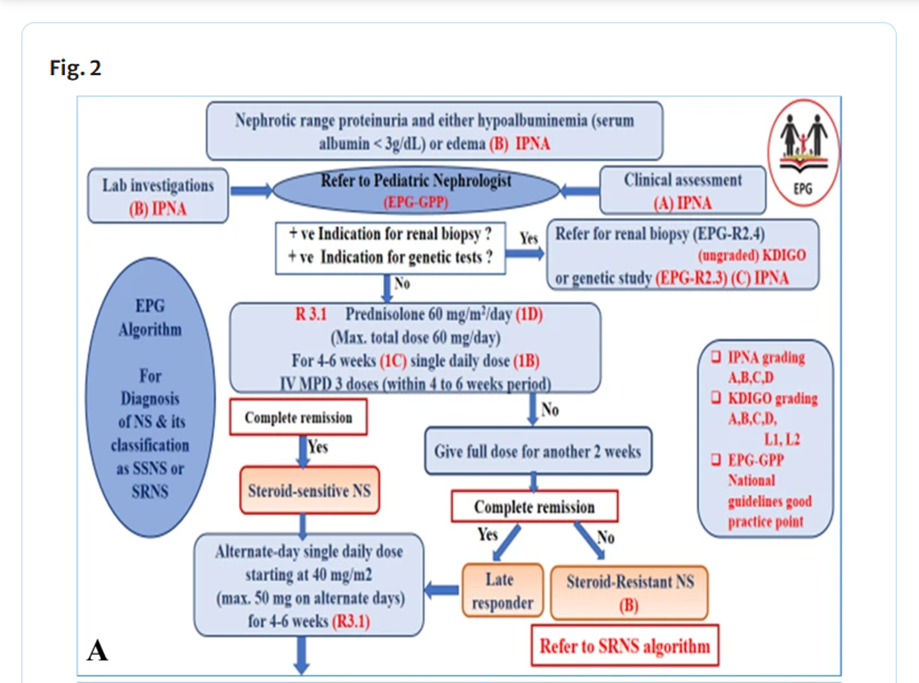
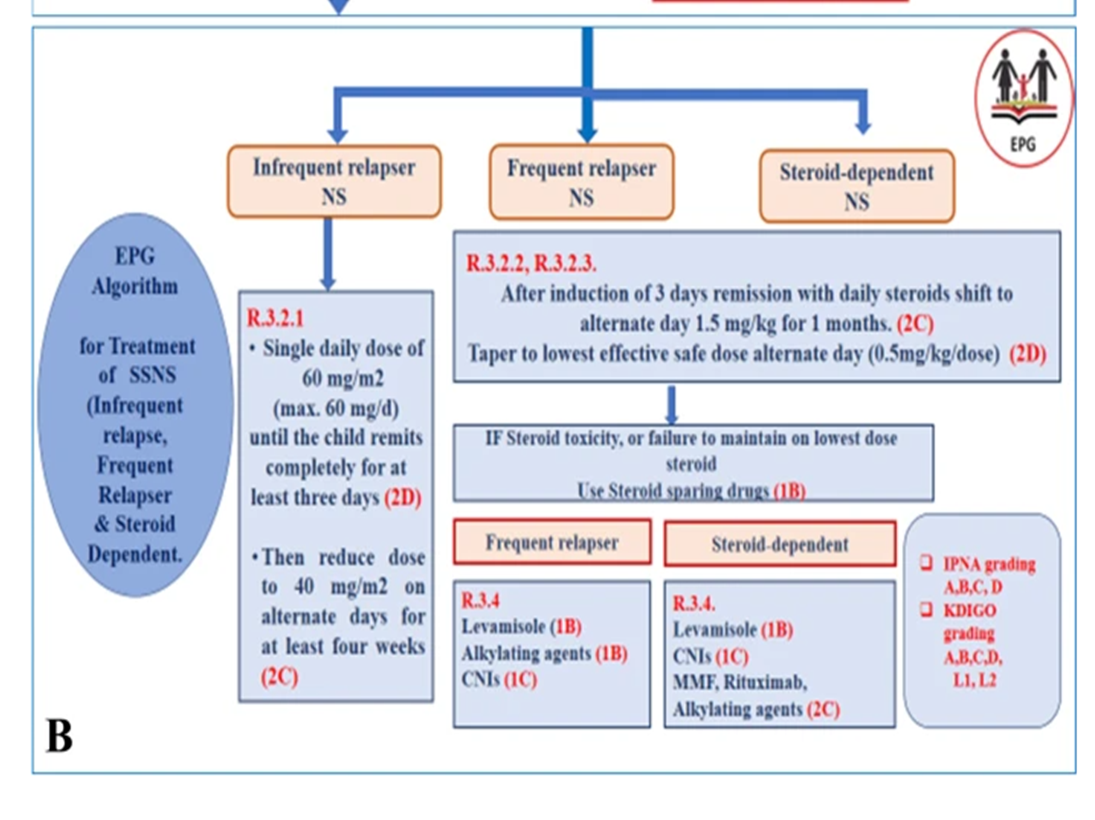
- Limitations and suggestions for further research needs
Future research recommendations for the management of Steroid Sensitive nephrotic syndrome in children in the Egyptian context could include:
· More randomized control trials. for drug dependent cases and difficulties in managing drug side effects
These recommendations aim to address specific challenges and characteristics of the Egyptian context, potentially leading to more effective prevention and management strategies for steroid sensitive nephrotic syndrome in children.
➡️Challenges
· Lack of robust randomized control trials subjective definitions for drug dependent cases and difficulties in managing drug side effects
Strengthen the evidence base of the next update of this guideline by generating GRADE summary of finding tables, evidence profiles, and EtD frameworks.
- Monitoring and evaluating the impact of the guideline
The following are three performance measures or indicators for implementing this adapted CPG for Steroid Sensitive Nephrotic Syndrome. in children:
1. Adherence to Guidelines
· Numerator: Number of children with steroid sensitive nephrotic syndrome. who received treatment as per guideline recommendations.
· Denominator: Total number of children diagnosed with nephrotic syndrome
· Data Source: Hospital or clinic patient records.
2. Duration of Hospital Stay
· Numerator: Total number of hospital stay days for children with steroid sensitive nephrotic syndrome
· Denominator: Total number of children admitted with nephrotic syndrome
· Data Source: Hospital admission and discharge records.
3. Rate of Readmission
· Numerator: Number of children readmitted with symptoms of steroid sparing nephrotic syndrome within a certain period (e.g., 30 days) after discharge.
· Denominator: Total number of children initially admitted with nephrotic syndrome.
· Data Source: Hospital readmission records.
These key performance indicators are designed to measure the effectiveness and adherence to the guidelines, the efficiency of the treatment in terms of resource utilization (hospital stay), and the success of the treatment in preventing further complications (readmissions).
- Updating of the guideline
The EPG Nephrology GAG has decided to conduct the next review of this adapted CPG for updates after five years. This should be carried out in 2029 after checking for updates in the source CPGs, consultation of expert opinion on the changes needed for updating according to the newest evidence and recommendations published in this area and the clinical audit and feedback from implementation efforts in the aforementioned local healthcare settings except if any breakthrough evidence- based recommendations are published before that date. The process will be guided by the Checklist for the Reporting of Updated Guidelines (CheckUp) Tool that is freely provided by the AGREE Enterprise and by the Reporting Items for Practice Guidelines in Healthcare (RIGHT) extension for adapted guidelines RIGHT-Ad@pt Checklist.
- References
1. Neeraja Yelugam and Supraja Jannu (2019) (Nov 12th). Causes and
Pathophysiology of Nephrotic Syndrome in Childhood, Renal Diseases,
Edward T. Zawada Jr. and Sohail Abdul Salim,-IntechOpen. https://
doi.org/10.5772/intechopen.86825. Available from: https://www.intec
hopen.com/books/renal-diseases/causes-and-pathophysiology-of-
nephrotic-syndrome-in-childhood.
2. McKinney PA, Feltbower RG, Brocklebank JT, Fitzpatrick MM (2001) Time
trends and ethnic patterns of childhood nephrotic syndrome in Yorkshire,
UK. Pediatr Nephrol 16:1040–1044
3. Tallus K, Webb H (2018) Bagga A Management of Steroid Resistant
Nephrotic children and adolescents Lancet. Child AdoleSC Health
2:880–890
4. Moustafa B, Tolba O (2016) Immunosuppressive therapy in children with
steroid resistant, frequently relapsing, and steroid dependent idiopathic
nephrotic syndrome: a single center experience. Electron Physician
8(2):2039–2047
5. Trautmann A, Vivarelli M, Samuel S et al (2020) IPNA clinical practice
recommendations for the diagnosis and management of children with
steroid-resistant nephrotic syndrome. Pediatr Nephrol 35:1529–15614
6. KDIGO 2021 d-kidney disease (2021) Improving Global Outcomes
(KDIGO) Glomerular Disease Work Group. KDIGO 2021 Clinical Practice
Guideline for the management of Glomerular Diseases. Kidney Int
100(45):51-S276 (https://kidigo.org/guidelines/gd/(acessed29/09/2021)
(KDIGO2021))
7. Sadowski CE, Lovric S, Ashraf S, Pabst WL, Gee HY, Kohl S, Engelmann S,
Vega-Warner V, Fang H, Halbritter J, Somers MJ, Tan W, Shril S, Fessi I, Lifton
RP, Bockenhauer D, El-Desoky S, Kari JA, Zenker M, Kemper MJ, Mueller D,
Fathy HM, Soliman NA, SRNS Study Group, Hildebrandt F (2015) A singlegene cause in 29.5% of cases of steroid-resistant nephrotic syndrome. J
Am Soc Nephrol 26(6):1279–89
8. Lovric S, Ashraf S, Tan W, Hildebrandt F (2016) Genetic testing in steroidresistant nephrotic.syndrome: when and how? Nephrol Dial Transplant
31(11):1802–1813. https://doi.org/10.1093/ndt/gfv355
9. Warejko JK, Tan W, Daga A, Schapiro D, Lawson JA, Shril S, Lovric S et al
(2018) Whole Exome Sequencing of Patients with Steroid-Resistant
Nephrotic Syndrome. Clin J Am Soc Nephrol 13(1):53–62
10. Lipska-Ziętkiewicz BS (2021) Genetic Steroid-Resistant Nephrotic
Syndrome Overview. In: Adam MP, Ardinger HH, Pagon RA (eds) Gene
Reviews ®. University of Washington, Seattle, Seattle (1993–2021)
11. Mendonca AC, Oliveira EA, Froes BP et al (2015) A predictive model of
progressive chronic kidney disease in idiopathic nephrotic syndrome.
Pediatr Nephrol 30:2011–2020
12. Abdel Baky A, Omar TEI, Amer YS; Egyptian Pediatric Clinical Practice Guidelines Committee (EPG). Adapting global evidence-based practice guidelines to the Egyptian healthcare context: the Egyptian Pediatric Clinical Practice Guidelines Committee (EPG) initiative. Bull Natl Res Cent. 2023;47(1):88. https://doi.org/10.1186%2Fs42269-023-01059-0
13. Alshehri A, Almazrou S, Amer Y. Methodological frameworks for adapting global practice guidelines to national context in the Eastern Mediterranean Region. Eastern Mediterranean Health Journal. 2023 Jul 1;29(7). https://www.emro.who.int/emhj-volume-29-2023/volume-29-issue-7/methodological-frameworks-for-adapting-global-practice-guidelines-to-national-context-in-the-eastern-mediterranean-region.html
14. Schünemann H, Brozek J, Guyatt G, Oxman A (editors). GRADE handbook: handbook for grading the quality of evidence and the strength of recommendations using the GRADE approach. Grading of Recommendations Assessment, Development and Evaluation (GRADE) Working Group; 2013 (Online updated version: https://gdt.gradepro.org/app/handbook/handbook.html Accessed 16/8/2024)
15. Klugar M, Lotfi T, Darzi AJ, et al. GRADE Guidance 39: Using GRADE-ADOLOPMENT to adopt, adapt or create contextualized recommendations from source guidelines and evidence syntheses. Journal of Clinical Epidemiology. 2024 Aug 6:111494. https://doi.org/10.1016/j.jclinepi.2024.111494 (in press)
16. Amer YS, Elzalabany MM, Omar TI, Ibrahim AG, Dowidar NL. The ‘Adapted ADAPTE’: an approach to improve utilization of the ADAPTE guideline adaptation resource toolkit in the A lexandria C enter for E vidence‐B ased C linical P ractice G uidelines. Journal of evaluation in clinical practice. 2015 Dec;21(6):1095-106. https://doi.org/10.1111/jep.12479
17. Brouwers MC, Kho ME, Browman GP, Burgers JS, Cluzeau F, Feder G, Fervers B, Graham ID, Grimshaw J, Hanna SE, Littlejohns P, Makarski J, Zitzelsberger L; AGREE Next Steps Consortium. AGREE II: advancing guideline development, reporting and evaluation in health care. CMAJ. 2010 Dec 14;182(18):E839-42. https://doi.org/10.1503%2Fcmaj.090449
18. Agree II (2022) AGREE Enterprise website. Available at: https://www.agreetrust.org/resource-centre/agree-ii/ (Accessed: 16/8/2024).
19. Song Y, Alonso-Coello P, Ballesteros M, et al. A Reporting Tool for Adapted Guidelines in Health Care: The RIGHT-Ad@pt Checklist[J]. Annals of Internal Medicine, 2022, 175(5):710-719. https://doi.org/10.7326/M21-4352 (Official RIGHT Statement Website: http://www.right-statement.org/extensions/13 Accessed 16/8/2024)
- Annexes
Annex Table 1.
Declaration of Conflict of Interests
The members of the guideline development/ adaptation group and the external review group have no academic, financial, or competing interests to declare and none of them were involved in the development of the original source guideline(s).
Any identified potential COI has been reported below.
|
Egyptian Pediatric Clinical Practice Guidelines Committee (EPG) Guideline Adaptation Group (Clinical subgroup) |
|||
|
Name |
Affiliation, Area of expertise / Role, Country / Primary location [work] |
Declaration of interests |
|
|
Interest identified |
Management plan & decision |
||
|
Bahia Moustafa |
Department of Pediatrics, Pediatric Nephrology Division, Faculty of Medicine, Cairo University, Cairo, Egypt |
None |
Not Applicable |
|
Mahmoud M. El‑Kersh |
Department of Pediatrics, Pediatric Nephrology Division, Faculty of Medicine, Alexandria University, Alexandria, Egypt |
|
|
|
Sherin Shalaby |
Department of Pediatrics, Pediatric Nephrology Division, Faculty of Medicine, Suez Canal University, Ismailia, Egypt |
|
|
|
Nancy Abdel Salam |
Department of Pediatrics, Pediatric Nephrology Division, Faculty of Medicine, Alexandria University, Alexandria, Egypt |
|
|
|
Sawsan Moselhy |
Department of Pediatrics, Pediatric Nephrology Division, Faculty of Medicine, Ain Shams University, Cairo, Egypt |
|
|
|
Gamal Taha Soliman |
Department of Pediatrics, Faculty of Medicine, Port Said University, Port Fuad, Egypt |
|
|
|
Abeer Selim |
Department of Pediatrics, Medical Research and Clinical Studies Institute, National Research Centre, Cairo, Egyp |
|
|
|
Guideline Adaptation Group (Methodology Subgroup) |
|||
|
Prof. Ashraf Abdel Baky |
Professor of Pediatrics Ain Shams University, Egypt Founder and Chair of EPG |
None |
Not Applicable |
|
Dr. Yasser Sami Amer |
1. Pediatrics Department and Clinical Practice Guidelines and Quality Research Unit, Quality Management Department, King Saud University Medical City, Riyadh, Saudi Arabia; 2. Research Chair for Evidence-Based Health Care and Knowledge Translation, King Saud University, Riyadh, Saudi Arabia; 3. Chair, Adaptation Working Group, Guidelines International Network (GIN), Perth, Scotland 4. Department of Internal Medicine, Ribeirão Preto Medical School, University of São Paulo (FMRP-USP), Ribeirão Preto, São Paulo, Brazil. |
None |
Not Applicable |
|
Dr. Nahla Gamaleldin |
Lecturer of pediatrics, Faculty of Medicine, Modern University for Technology and Information (MTI), Egypt |
None |
Not Applicable |
|
External Review Group |
|||
|
Prof. Amr Sarhan |
Prof of Pediatrics and Pediatrics Nephrology, Faculty of Medicine Mansoura University |
None |
Not Applicable |
|
Prof. Neven Suliman |
Prof of Pediatrics and Pediatrics Nephrology, Faculty of Medicine Cairo University |
None |
Not Applicable |
|
Prof. Ihab Al Hakim |
Prof of Pediatrics and Pediatrics Nephrology, Faculty of Medicine Ain Shams University |
None |
Not Applicable |
Web annexes
The following annexes can be added as a package of standalone supplementary documents.
Keywords: The MeSH terms for " nephrotic syndrome, children, steroid-resistant nephrotic syndrome
Annex Table 2. Results of the AGREE II assessment of the three source guidelines for:
Annex Table 2. Results of the AGREE II assessment of the three source guidelines
|
AGREE II / CPGs |
IPNA clinical practice recommendations (SRNS in children) |
JSPN 2014 Nephrotic Syndrome Guideline |
KDIGO Glomerular Diseases Guideline |
|
Domain 1 (Scope) |
84% |
82% |
77% |
|
Domain 2 (Stakeholder) |
82% |
79% |
75% |
|
Domain 3 (Rigour) |
80% |
81% |
77% |
|
Domain 4 (Clarity) |
79% |
83% |
75% |
|
Domain 5 (Applicability) |
77% |
84% |
74% |
|
Domain 6 (Independence) |
80% |
85% |
73% |
|
Overall assessment |
80% |
83% |
76% |
|
Recommend for use (Overall assessment) |
Yes with modifications |
Yes with modifications |
Yes with modifications |
Annex Table 3. Annex Nurses and Parents Educational Guide in Arabic
Appendix
Table 4. The RIGHT-Ad@pt checklist |
|||||
|
7 sections, 27 topics, and 34 items |
Assessment |
Page(s)* |
Note(s) |
||
|
BASIC INFORMATION |
|||||
|
Title/subtitle |
|||||
|
1 |
Identify the report as an adaptation of practice guideline(s), that is include "guideline adaptation", "adapting", "adapted guideline/recommendation(s)", or similar terminology in the title/subtitle. |
☒ Yes ☐ No ☐ Unclear |
|
|
|
|
2 |
Describe the topic/focus/scope of the adapted guideline. |
☒ Yes ☐ No ☐ Unclear |
|
|
|
|
Cover/first page |
|||||
|
3 |
Report the respective dates of publication and the literature search of the adapted guideline. |
☒ Yes ☐ No ☐ Unclear |
|
|
|
|
4 |
Describe the developer and country/region of the adapted guideline. |
☒ Yes ☐ No ☐ Unclear |
|
|
|
|
Executive summary/abstract |
|||||
|
5 |
Provide a summary of the recommendations contained in the adapted guideline. |
☒ Yes ☐ No ☐ Unclear |
|
|
|
|
Abbreviations and acronyms |
|||||
|
6 |
Define key terms and provide a list of abbreviations and acronyms (if applicable). |
☒ Yes ☐ No ☐ Unclear |
|
|
|
|
Contact information of the guideline adaptation group |
|||||
|
7 |
Report the contact information of the developer of the adapted guideline. |
☒ Yes ☐ No ☐ Unclear |
|
|
|
|
SCOPE |
|||||
|
Source guideline(s) |
|||||
|
8 |
Report the name and year of publication of the source guideline(s), provide the citation(s), and whether source authors were contacted. |
☒ Yes ☐ No ☐ Unclear |
|
|
|
|
Brief description of the health problem(s) |
|||||
|
9 |
Provide the basic epidemiological information about the problem (including the associated burden), health systems relevant issues, and note any relevant differences compared to the source guideline(s).
|
☒ Yes ☐ No ☐ Unclear |
|
|
|
|
Aim(s) and specific objectives |
|||||
|
10 |
Describe the aim(s) of the adapted guideline and specific objectives, and note any relevant differences compared to the source guideline(s). |
☒ Yes ☐ No ☐ Unclear |
|
|
|
|
Target population(s) |
|||||
|
11 |
Describe the target population(s) and subgroup(s) (if applicable) to which the recommendation(s) is addressed in the adapted guideline, and note any relevant differences compared to the source guideline(s). |
☒ Yes ☐ No ☐ Unclear |
|
|
|
|
End-users and settings |
|||||
|
12 |
Describe the intended target users of the adapted guideline, and note any relevant differences compared to the source guideline(s). |
☒ Yes ☐ No ☐ Unclear |
|
|
|
|
13 |
Describe the setting(s) for which the adapted guideline is intended, and note any relevant differences compared to the source guideline(s). |
☒ Yes ☐ No ☐ Unclear |
|
|
|
|
RIGOR OF DEVELOPMENT |
|||||
|
Guideline adaptation group |
|||||
|
14 |
List all contributors to the guideline adaptation process and describe their selection process and responsibilities. |
☒ Yes ☐ No ☐ Unclear |
|
|
|
|
Adaptation framework/methodology |
|||||
|
15 |
Report which framework or methodology was used in the guideline adaptation process. |
☒ Yes ☐ No ☐ Unclear |
|
|
|
|
Source guideline(s) |
|||||
|
16 |
Describe how the specific source guideline(s) was(were) selected. |
☒ Yes ☐ No ☐ Unclear |
|
|
|
|
Key questions |
|||||
|
17 |
State the key questions of the adapted guideline using a structured format, such as PICO (population, intervention, comparator, and outcome), or another format as appropriate. |
☒ Yes ☐ No ☐ Unclear |
|
|
|
|
18 |
Describe how the key questions were developed/modified, and/or prioritized. |
☐ Yes ☒ No ☐ Unclear |
|
|
|
|
Source recommendation(s) |
|||||
|
19 |
Describe how the recommendation(s) from the source guideline(s) was(were) assessed with respect to the evidence considered for the different criteria, the judgements and considerations made by the original panel. |
☐ Yes ☒ No ☐ Unclear |
|
|
|
|
Evidence synthesis |
|||||
|
20 |
Indicate whether the adapted recommendation(s) is/are based on existing evidence from the source guideline(s), and/or additional evidence. |
☐ Yes ☒ No ☐ Unclear |
|
|
|
|
21 |
If new research evidence was used, describe how it was identified and assessed. |
☐ Yes ☒ No ☐ Unclear |
NA |
|
|
|
Assessment of the certainty of the body of evidence and strength of recommendation |
|||||
|
22 |
Describe the approach used to assess the certainty/quality of the body/ies of evidence and the strength of recommendations in the adapted guideline and note any differences (if applicable) compared to the source guideline(s). |
☐ Yes ☒ No ☐ Unclear |
NA |
|
|
|
Decision-making processes |
|||||
|
23 |
Describe the processes used by the guideline adaptation group to make decisions, particularly the formulation of recommendations.
|
☒ Yes ☐ No ☐ Unclear |
|
|
|
|
RECOMMENDATIONS |
|||||
|
Recommendations |
|||||
|
24 |
Report recommendations and indicate whether they were adapted, adopted, or de novo. |
☒ Yes ☐ No ☐ Unclear |
|
|
|
|
25 |
Indicate the direction and strength of the recommendations and the certainty/quality of the supporting evidence and note any differences compared to the source recommendations(s) (if applicable). |
☒ Yes ☐ No ☐ Unclear |
|
|
|
|
26 |
Present separate recommendations for important subgroups if the evidence suggests important differences in factors influencing recommendations and note any differences compared to the source recommendations(s) (If applicable). |
☒ Yes ☐ No ☐ Unclear |
|
|
|
|
Rationale/explanation for recommendations |
|||||
|
27 |
Describe the criteria/factors that were considered to formulate the recommendations or note any relevant differences compared to the source guideline(s) (if applicable). |
☒ Yes ☐ No ☐ Unclear |
|
|
|
|
EXTERNAL REVIEW AND QUALITY ASSURANCE |
|||||
|
External review |
|||||
|
28 |
Indicate whether the adapted guideline underwent an independent external review. If yes, describe the process. |
☒ Yes ☐ No ☐ Unclear |
|
|
|
|
Organizational approval |
|||||
|
29 |
Indicate whether the adapted guideline obtained organizational approval. If yes, describe the process. |
☒ Yes ☐ No ☐ Unclear |
SNS & NEBMC |
|
|
|
FUNDING, DECLARATION, AND MANAGEMENT OF INTEREST |
|||||
|
Funding source(s) and funder role(s) |
|||||
|
30 |
Report all sources of funding for the adapted guideline and source guideline(s), and the role of the funders. |
☒ Yes ☐ No ☐ Unclear |
|
|
|
|
Declaration and management of interests |
|||||
|
31 |
Report all conflicts of interest of the adapted and the source guideline(s) panels, and how they were evaluated and managed. |
☒ Yes ☐ No ☐ Unclear |
|
|
|
|
OTHER INFORMATION |
|||||
|
Implementation |
|||||
|
32 |
Describe the potential barriers and strategies for implementing the recommendations (if applicable). |
☒ Yes ☐ No ☐ Unclear |
|
|
|
|
Update |
|||||
|
33 |
Briefly describe the strategy for updating the adapted guideline (if applicable). |
☒ Yes ☐ No ☐ Unclear |
|
|
|
|
Limitations and suggestions for further research |
|||||
|
34 |
Describe the challenges of the adaptation process, the limitations of the evidence, and provide suggestions for future research. |
☐ Yes ☒ No ☐ Unclear |
-- |
|
|