Surgical Management of Rectal Prolapse
| Site: | EHC | Egyptian Health Council |
| Course: | General surgery Guidelines |
| Book: | Surgical Management of Rectal Prolapse |
| Printed by: | مستخدم ضيف |
| Date: | Thursday, 5 November 2026, 3:38 AM |
Description
"last update: 29 September 2026" Download Guideline
- Executive summary
This guideline offers evidence-based recommendations on the targeted levels of clinical practice guidelines and provides healthcare professionals with practice guidance on the surgical management of rectal prolapse.
· The initial evaluation of a patient with rectal prolapse should include a complete history and physical examination with focus on the prolapse, on anal sphincter structure and function, and on concomitant symptoms and underlying conditions, (Strong recommendation).
· Before surgical management of rectal prolapse, we recommend colonoscopy to identify other important coexisting pathology, (Strong recommendation).
· We advise additional testing, such as a fluoroscopy or MRI defecography, barium enema, and urodynamics, to be used selectively to refine the diagnosis and identify other important coexisting pathology, (Conditional recommendation).
· We advise performing anal physiologic testing to assess and treat coexisting functional disorders associated with rectal prolapse, such as constipation or fecal incontinence, (Conditional recommendation).
· Although rectal prolapse cannot be corrected non-operatively, we may advise medical palliation of some of the symptoms associated with this condition, such as fecal incontinence, pain, and constipation, (Conditional recommendation).
· We advise non-operative management in external rectal prolapse as preoperative treatment for the reducible form, (Good practice statement).
· We advise non-operative management for poor surgical candidates and those refusing surgery, (Good practice statement).
· We recommend rectopexy as a key component in the abdominal approach to rectal prolapse, (Strong recommendation).
· We recommend mobilization of rectum with mesh fixation of the posterior rectal wall to the sacral promontory for treatment of rectal prolapse, (Strong recommendation).
· We recommend against posterior rectal mobilization without a rectopexy (with or without a concomitant anterior resection), as it is associated with higher recurrence rates and complications, (Strong recommendation).
· We advise performing sigmoid resection with posterior suture rectopexy in patients with prolapse and preoperative constipation, (Conditional recommendation).
· We advise against division of the lateral stalks during posterior rectal dissection because it worsens postoperative constipation, (Conditional recommendation).
· We advise performing a minimally invasive approach to rectal prolapse by experienced surgeons as it is associated with improved morbidity and comparable recurrences compared with open surgery and should be considered when technically feasible, (Conditional recommendation).
· We recommend for patients with a short segment of full-thickness rectal prolapse, (<5cm) to be treated with mucosal sleeve resection (Delorme procedure), (Strong recommendation).
· We recommend perineal rectosigmoidectomy (Altemeier procedure), when the abdominal approach is not feasible. (Conditional recommendation).
· Perineal stapled prolapse resection may be performed as an alternative to other perineal procedures, (Good practice statement).
· We advise that anal encirclement, (Thiersch procedure) or mucosal plication is reserved for selected patients, (children, old patients with contraindication to major surgery, etc.), (Good practice statement).
- Recommendations
Section 1: Evaluation of rectal prolapse:
· The initial evaluation of a patient with rectal prolapse should include a complete history and physical examination with focus on the prolapse, on anal sphincter structure and function, and on concomitant symptoms and underlying conditions, (Strong recommendation, low certainty evidence, (1)).
· Before surgical management of rectal prolapse, we recommend colonoscopy to identify other important coexisting pathology, (Strong recommendation, moderate certainty evidence, (1)).
· We advise additional testing, such as a fluoroscopy or MRI defecography, barium enema, and urodynamics, to be used selectively to refine the diagnosis and identify other important coexisting pathology, (Conditional recommendation, moderate certainty evidence, (1)).
· We advise performing anal physiologic testing to assess and treat coexisting functional disorders associated with rectal prolapse, such as constipation or fecal incontinence, (Conditional recommendation, low certainty evidence, (1)).
Section 2: Non-operative management:
· Although rectal prolapse cannot be corrected non-operatively, we may advise medical palliation of some of the symptoms associated with this condition, such as fecal incontinence, pain, and constipation, (Conditional recommendation, low certainty evidence, (1)).
· We advise non-operative management in external rectal prolapse as preoperative treatment for the reducible form, (Good practice statement).
· We advise non-operative management for poor surgical candidates and those refusing surgery, (Good practice statement).
Section 3: Abdominal surgical procedures for rectal prolapse:
· We recommend rectopexy as a key component in the abdominal approach to rectal prolapse, (Strong recommendation, high certainty evidence, (1)).
· We recommend mobilization of rectum with mesh fixation of the posterior rectal wall to the sacral promontory for treatment of rectal prolapse, (Strong recommendation, low certainty evidence, (1)).
· We recommend against posterior rectal mobilization without a rectopexy (with or without a concomitant anterior resection), as it is associated with higher recurrence rates and complications, (Strong recommendation, moderate certainty evidence, (1)).
· We advise performing sigmoid resection with posterior suture rectopexy in patients with prolapse and preoperative constipation, (Conditional recommendation, moderate certainty evidence, (1)).
· We advise against division of the lateral stalks during posterior rectal dissection because it worsens postoperative constipation, (Conditional recommendation, moderate certainty evidence, (1)).
· We advise performing a minimally invasive approach to rectal prolapse by experienced surgeons as it is associated with improved morbidity and comparable recurrences compared with open surgery and should be considered when technically feasible, (Conditional recommendation, moderate certainty evidence, (1)).
Section 4: Perineal Operations for Rectal Prolapse:
· We recommend for patients with a short segment of full-thickness rectal prolapse, (<5cm) to be treated with mucosal sleeve resection (Delorme procedure), (Strong recommendation, low certainty evidence, (1)).
· We recommend perineal rectosigmoidectomy (Altemeier procedure), when the abdominal approach is not feasible. (Conditional recommendation, high certainty evidence, (1)).
· Perineal stapled prolapse resection may be performed as an alternative to other perineal procedures, (Good practice statement).
· We advise that anal encirclement, (Thiersch procedure) or mucosal plication is reserved for selected patients, (children, old patients with contraindication to major surgery, etc.), (Good practice statement).
- Acknowledgement
We would like to acknowledge the Guideline Development Group, (GDG) committee for developing this guideline.
Chair of GDG: Mostafa Abdel-Hamed Soliman, Professor of Surgery, Cairo University.
Moderator of GDG: Mohamed Ali Mohamed Nada, Professor of Surgery, Ain Shams University.
Members of GDG (Alphabetically):
Abdel-Wahab Mohamed Ezzat, Professor of Surgery, Ain Shams University.
Ahmed Abdel-Raouf Elgeidie, Professor of Digestive Surgery, Mansoura University.
Alaa Abdallah, Professor of Surgery, Ain Shams University.
Atef Abdel-Ghani Salem, Professor of Surgery, Benha University.
Hesham Abdel-Raouf El-Akkad, Professor of Surgery, Ain Shams University.
Ibrahim El-Zayat, Head of Surgery Department, Aswan University.
Khaled Abdallah El-Fiky, Professor of Surgery, Ain Shams University.
Khaled Amer, Professor of Surgery, Military Medical Academy.
Khaled Safwat, Professor of Surgical Oncology and Endoscopy, Zagazig University.
Mohamed Ibrahim Abdel-Hamed Al-Said, Professor of Surgery, Zagazig University.
Tarek Ibrahim, Professor of Surgery, National Liver Institute, Menofia University.
- Abbreviations
|
AGREE II |
Appraisal of Guidelines for Research and Evaluation II. |
|
GRADE |
Grade of Recommendations, Assessment, Development and Evaluation. |
|
GDG |
Guideline Development Group. |
|
ICU |
Intensive care unit |
|
MRI |
Magnetic Resonance Imaging. |
|
WHO |
World Health Organization. |
- Introduction
Complete rectal prolapse is a disorder characterized by a full-thickness intussusception of the rectal wall, which protrudes externally through the anus. It is associated with a spectrum of coexisting anatomic abnormalities, such as diastasis of the levator ani, an abnormally deep cul-de-sac, a redundant sigmoid colon, a patulous anal sphincter, and loss or attenuation of the rectal sacral attachments. Some have hypothesized that the condition is associated with (and preceded by) internal rectal intussusception or a traumatic solitary rectal ulcer, although these associations have never been clearly proven, (1).
Although rectal prolapse is a benign condition, it can be debilitating because of the discomfort of prolapsing tissue both internally and externally, associated drainage of mucus or blood, and the common occurrence of concomitant symptoms of fecal incontinence, constipation, or both, (2).
- Scope and purpose
The scope of these guidelines is to establish national guidelines for patients complaining of complete rectal prolapse as regard surgical treatment of the disease and type of surgery to achieve a best outcome as much as we can.
The main purposes of these guidelines are to minimize malpractice and poor surgical decision, to improve the quality of medical care and surgical service, to provide the best clinical practice to our patients, and finally to reduce the cost of medical service.
- Target audience
The principle targeted audiences are the practicing surgeons, however, gastroenterologists, ICU specialists, radiologists and nursing staff may be included as well.
- Methods
A comprehensive search for guidelines was undertaken to identify the relevant guidelines to consider for adaptation.
Inclusion/ exclusion criteria followed in the search and retrieval of guidelines to be adapted:
• Selecting only evidence-based guidelines (guideline must include a report on systematic literature searches and explicit links between individual recommendations and their supporting evidence)
• Selecting only national and/or international guidelines
• Specific range of dates for publication (using Guidelines published or updated in last ten years)
• Selecting peer reviewed publications only
• Selecting guidelines written in English language
• Excluding guidelines written by a single author, not on behalf of an organization to be valid and comprehensive, a guideline ideally requires multidisciplinary input
• Excluding guidelines published without references as the panel needs to know whether a thorough literature review was conducted and whether current evidence was used in the preparation of the recommendations
The following characteristics of the retrieved guidelines were summarized in:
• Developing organization/authors
• Date of publication, posting, and release
• Country/language of publication
• Date of posting and/or release
• Dates of the search used by the source guideline developers
All retrieved Guidelines were screened and appraised using AGREE II instrument (www.agreetrust.org) by at least three members. The panel decided on a cut-off point (any guideline scoring above 50% on the rigor dimension was retained). The GDG decided to adapt Clinical Practice Guidelines for the Treatment of Rectal Prolapse, 2017, (1).
Evidence assessment
According to WHO Handbook for Guidelines, we used the GRADE (Grading of Recommendations, Assessment, Development and Evaluation) approach to assess the quality of a body of evidence, develop and report recommendations. GRADE methods are used by WHO because these represent internationally agreed standards for making transparent recommendations. Detailed GRADE information is available on the following sites:
• GRADE working group: https://www.gradeworkinggroup.org/
• GRADE online training modules: http://cebgrade.mcmaster.ca/
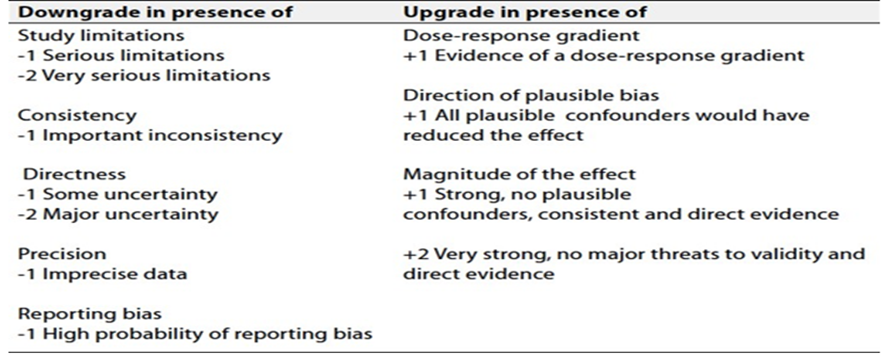
Specifically, the quality of evidence was graded as ‘High’, ‘Moderate’, ‘Low’ or ‘Very low’, (table 1& 2).
The strength of the recommendation
The strength of a recommendation communicates the importance of adherence to the recommendation.
Strong recommendations
With strong recommendations, the guideline communicates the message that the desirable effects of adherence to the recommendation outweigh the undesirable effects. This means that in most situations the recommendation can be adopted as policy.
Conditional recommendations
these are made when there is greater uncertainty about the four factors above or if local adaptation has to account for a greater variety in values and preferences, or when resource use makes the intervention suitable for some, but not for other locations. This means that there is a need for substantial debate and involvement of stakeholders before this recommendation can be adopted as policy.
When not to make recommendations
When there is lack of evidence on the effectiveness of an intervention, it may be appropriate not to make a recommendation.
- Research needs
1. The prevalence of rectal prolapse in Egypt.
2. The incidence of sexual complications after abdominal approach for treatment of rectal prolapse.
- Clinical indicators for monitoring
1. Documentation of the clinical symptoms and signs.
2. Colonoscopy.
3. Documentation of other investigations.
4. Documentation of the type of treatment, (medical, surgical).
- Updating of the guideline
The GDG committee for guidelines development is responsible for the continuous evaluation of evidence available about surgical management of rectal prolapse. The present guideline will be updated in case of significant changes based on new evidence.
- Annexes
Table 1: Quality and Significance of the four levels of evidence in GRADE:
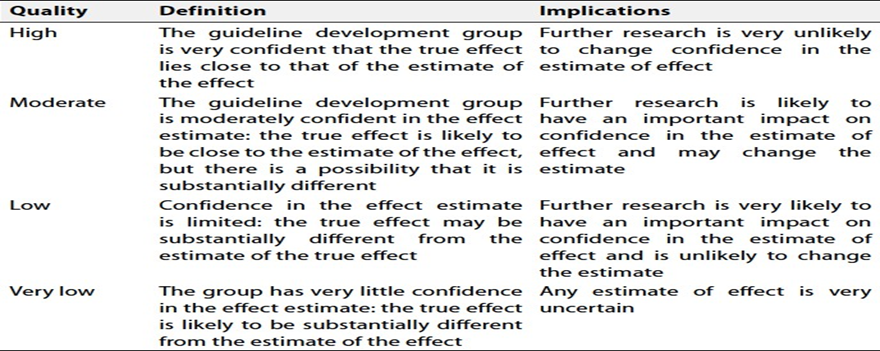
Table 2: Factors that determine How to upgrade or downgrade the quality of evidence
- References
1. Liliana Bordeianou, Ian Paquette, Eric Johnson, Stefan D. Holubar, Wolfgang Gaertner, Daniel L. Feingold, Scott R. Steele. Clinical Practice Guidelines for the Treatment of Rectal Prolapse. Dis Colon Rectum 2017; 60: 1121–1131.
2. Bordeianou L, Hicks CW, Kaiser AM, Alavi K, Sudan R, Wise PE. Rectal prolapse: an overview of clinical features, diagnosis, and patient-specific management strategies. J Gastrointest Surg 2014; 18: 1059–1069.