Bronchial Asthma
| Site: | EHC | Egyptian Health Council |
| Course: | Pulmonology Guidelines |
| Book: | Bronchial Asthma |
| Printed by: | Guest user |
| Date: | Thursday, 5 November 2026, 5:54 AM |
Description
"last update: 1 Novamber 2026" Download Guideline
- Executive Summary
This guideline offers evidence-based recommendations on the management and follow-up of bronchial asthma in adults and adolescents (12 years and older). It is intended to give healthcare professionals practical, guideline-driven guidance that improves asthma control, reduces exacerbations and limits treatment-related harm, while remaining applicable across the differing service levels of the Egyptian health system.
Section 1: Diagnosis of Asthma in Adults and Adolescents
1.1.1 We recommend beginning the diagnostic assessment of every patient with suspected asthma with a thorough history, documenting typical respiratory symptoms (wheeze, shortness of breath, chest tightness or cough) that vary over time and in intensity, are often worse at night or on waking, and are triggered by viral infections, exercise, allergen exposure, changes in weather or laughter. (Good practice statement)
1.2.1 We recommend a physical examination for every patient with suspected asthma, recognizing that the examination is often normal. (Good practice statement)
1.3.1 We recommend confirming excessive variability in expiratory lung function, preferably by spirometry with bronchodilator responsiveness testing, and documenting it before controller treatment is started; any one of the criteria described in this section confirms it. (Good practice statement)
1.4.1 We recommend using Type 2 biomarkers (FeNO, blood eosinophil count and, where available, induced-sputum eosinophils) and allergy tests to support, but not to exclude, a diagnosis of Type 2 (eosinophilic and/or allergic) asthma in patients with typical symptoms. (Strong recommendation)
1.5.1 We do not recommend routine chest imaging for the diagnosis of asthma, or for predicting treatment outcomes or lung-function decline. (Good practice statement)
1.6.1 We recommend that, in patients already taking ICS-containing treatment, confirmation of the diagnosis of asthma be guided by the patient’s symptoms and lung function, following the pathway described in this section. (Good practice statement)
Section 2: Assessment of Asthma in Adults and Adolescents
2.1.1 We recommend assessing, for every patient, symptom control and risk factors on current treatment, treatment issues (particularly inhaler technique and adherence), multimorbidity, and the patient’s goals and preferences. (Good practice statement)
2.1.2 We recommend investigating for impaired perception of airflow limitation when there are few symptoms but low lung function, and for alternative diagnoses when there are frequent symptoms despite good lung function. (Good practice statement)
2.2.1 We recommend assessing symptom control over the previous 4 weeks (and over the whole period since the last review) at every visit, using a validated tool such as the GINA symptom control tool, the ACQ-5 or the ACT, and selecting the initial treatment step according to the ACT score (see Section 4 and Annex 1). (Strong recommendation)
2.4.1 We recommend, at every review, observing the patient using their inhaler and correcting and re-checking technique if necessary, assessing medication adherence and barriers to adherence (including adherence to other interventions such as smoking cessation), and reviewing and updating the written asthma action plan if the level of asthma control or treatment has changed. (Strong recommendation)
2.5.1 We advise assessing for multimorbidity – rhinitis, rhinosinusitis, gastroesophageal reflux, obesity, obstructive sleep apnea, depression and anxiety – which can contribute to symptoms and poor quality of life, and sometimes to poor asthma control (see Section 6.1). (Conditional recommendation)
2.6.1 We recommend measuring FEV₁ and bronchodilator responsiveness during follow-up to help predict the risk of exacerbations. (Strong recommendation)
2.7.1 We recommend routinely prescribing ICS-containing treatment to reduce the patient’s risk of severe exacerbations, and treating any modifiable risk factors or comorbidities using pharmacological or non-pharmacological strategies. (Strong recommendation)
2.8.1 We recommend that patients with poor symptom control and/or exacerbations despite ICS-containing treatment be assessed systematically, in the order described in this section, before treatment is stepped up further. (Good practice statement)
2.10.1 We advise adding FeNO measurement as an adjunct to the evaluation of adults and adolescents in whom the diagnosis of asthma remains uncertain after history, clinical findings, clinical course and spirometry (including bronchodilator responsiveness testing), or in whom spirometry cannot be performed. (Conditional recommendation)
2.10.2 We advise adding FeNO measurement, as part of an ongoing asthma monitoring and management strategy that includes frequent assessments, in adults and adolescents with persistent allergic asthma when there is uncertainty in choosing, monitoring or adjusting anti-inflammatory therapy based on history, clinical findings and spirometry. (Conditional recommendation)
2.10.3 We do not recommend using FeNO measurement alone to assess asthma control, predict future exacerbations or assess exacerbation severity; FeNO should be used for these purposes only as part of an ongoing asthma monitoring and management strategy. (Strong recommendation)
2.11.1 We advise against allergen mitigation interventions as part of routine asthma management in patients who are not sensitized to specific indoor allergens or who have no symptoms related to exposure to specific indoor allergens. (Conditional recommendation)
2.11.2 We advise a multicomponent, allergen-specific mitigation intervention for patients whose symptoms are related to exposure to identified indoor allergens, confirmed by history taking or allergy testing. (Conditional recommendation)
2.11.3 We advise integrated pest management, alone or as part of a multicomponent allergen-specific mitigation intervention, for patients who are sensitized to, or have symptoms related to exposure to, pests (cockroach and rodent). (Conditional recommendation)
2.11.4 We advise impermeable pillow and mattress covers for patients who are sensitized to, or have symptoms related to exposure to, house dust mite only as part of a multicomponent allergen mitigation intervention, not as a single-component intervention. (Conditional recommendation)
Section 3: Principles of Asthma Management in Adults and Adolescents
3.1.1 We recommend establishing an effective patient–healthcare provider partnership using communication strategies that include eliciting the patient’s understanding of and concerns about asthma, shared decision-making about treatment options, checking the patient’s understanding of the asthma management plan, and asking about the patient’s goals and preferences. (Strong recommendation)
3.2.1 We recommend that the long-term goal of asthma management for every patient be to achieve the best possible long-term outcomes, which include:
• long-term asthma symptom control, with few or no asthma symptoms, no sleep disturbance due to asthma and unimpaired physical activity;
• long-term asthma risk minimization, with no exacerbations, improved or stable personal best lung function, no requirement for maintenance oral corticosteroids and no medication side-effects. (Strong recommendation)
3.2.2 We recommend recognizing that the patient’s personal goals for their asthma may differ from these medical goals, and negotiating individualized treatment targets in partnership with the patient. (Strong recommendation)
3.3.1.1 We recommend that patients with asthma:
• avoid active smoking and be supported to stop smoking;
• avoid exposure to second-hand (environmental) tobacco smoke;
• avoid e-cigarette use and vaping exposure. (Strong recommendation)
3.3.1.2 We advise that allergen avoidance strategies be tailored to the individual patient on the basis of confirmed sensitization; they are most effective when combined with ICS treatment. General advice includes:
• house dust mite avoidance measures: washing bed linen weekly in hot water, use of allergen-impermeable mattress and pillow covers, and removal of bedroom carpeting;
• pet allergen avoidance: removing the pet from the home or keeping it out of the bedroom;
• workplace allergen avoidance: identifying and removing occupational exposure. (Conditional recommendation)
3.3.1.3 We recommend that patients with asthma and obesity be offered weight reduction programs (through diet, exercise or behavioral modification), as weight reduction can improve asthma control and reduce exacerbation risk. (Strong recommendation)
3.3.1.4 We recommend that patients with asthma be encouraged to engage in regular physical activity and exercise, as it improves fitness and overall health; patients with exercise-induced bronchoconstriction should use appropriate pre-exercise medication. (Strong recommendation)
3.3.1.5 We advise exclusive breastfeeding for at least the first 3–4 months, which may have modest protective effects against the development of asthma in children at high risk of atopy. (Conditional recommendation)
3.3.1.6 We recommend assessment and treatment of gastroesophageal reflux disease (GERD), if present, as uncontrolled GERD can contribute to asthma symptoms and exacerbations. (Strong recommendation)
Section 4: Pharmacological Treatment and Treatment Regimens for Adults and Adolescents
4.1 We recommend, at Step 1, as-needed low-dose ICS-formoterol or as-needed low-dose ICS-SABA. (Strong recommendation)
4.2 We recommend, at Step 2, low-dose maintenance ICS. (Strong recommendation)
4.3 We recommend, at Step 3, low-dose maintenance ICS-LABA. (Strong recommendation)
4.4 We recommend, at Step 4, medium-dose maintenance ICS-LABA plus add-on LAMA plus add-on theophylline or LTRA. (Strong recommendation)
4.5 We recommend, at Step 5, high-dose maintenance ICS-LABA plus add-on LAMA plus add-on theophylline or LTRA. (Strong recommendation)
4.6 We advise, at Step 5 if the patient remains uncontrolled, three short courses of oral corticosteroids per year, each for 5–7 days at a maximum dose of prednisolone 20 mg, taking into account the side-effects of oral corticosteroids. (Conditional recommendation)
4.7 We recommend, at Step 5 if the patient remains uncontrolled after the above, assessment of phenotyping for biologic therapy, with referral to a severe asthma clinic to diagnose and prescribe treatment for committee approval. (Strong recommendation)
4.8 We recommend, as the reliever at Steps 2–5, as-needed low-dose ICS-formoterol or as-needed low-dose ICS-SABA. When low-dose ICS-formoterol is used as the reliever, the maintenance medication should be the same molecule, medication and device. (Strong recommendation)
4.9 We advise adding a leukotriene receptor antagonist (LTRA) or theophylline at Steps 4–5 if the patient has multiple allergic rhinitis or exercise-induced asthma, and monitoring regularly for side-effects. (Conditional recommendation)
4.10 We advise that allergen immunotherapy is an available option in mild and moderate asthma when the patient has one or two perennial allergies, especially to house dust mite. (Conditional recommendation)
4.11.1 We recommend that all healthcare providers assess asthma control, adherence and inhaler technique at every visit, not only when the patient presents because of their asthma. (Strong recommendation)
4.11.2 We recommend that patients be seen 1–3 months after starting treatment and every 3–12 months thereafter, with the frequency of visits determined by the patient’s initial level of control, response to treatment and level of engagement in self-management. (Strong recommendation)
4.11.3 We recommend scheduling a review visit within 1 week after an exacerbation. (Strong recommendation)
4.12.1 We recommend day-to-day adjustment using an anti-inflammatory reliever (AIR): for patients whose reliever inhaler is budesonide-formoterol or beclometasone-formoterol (with or without maintenance ICS-formoterol), the patient adjusts the number of as-needed doses of ICS-formoterol from day to day according to their symptoms. This strategy reduces the risk of a severe exacerbation requiring oral corticosteroids within the next 3–4 weeks. (Strong recommendation)
4.12.2 We recommend a short-term step-up (an increase in maintenance ICS dose for 1–2 weeks) where necessary, for example during viral infections or seasonal allergen exposure. This may be initiated by the patient according to their written asthma action plan, or by the healthcare provider. (Strong recommendation)
4.12.3 We recommend that a sustained step-up (for at least 2–3 months) be considered only after confirming that the symptoms are due to asthma, that inhaler technique and adherence are satisfactory, and that modifiable risk factors such as smoking have been addressed. Any step-up should be regarded as a therapeutic trial; if there is no response after 2–3 months, treatment should be reduced to the previous level and alternative treatments or referral considered. (Strong recommendation)
4.13.1 We recommend considering stepping down treatment once good asthma control has been achieved and maintained, and lung function has been stable, for 3 months or more. If the patient has risk factors for exacerbations (for example, a history of exacerbations in the past year or persistent airflow limitation), step down only with close supervision. (Strong recommendation)
4.13.2 We recommend choosing an appropriate time to step down (no respiratory infection, patient not travelling, not pregnant). (Strong recommendation)
4.13.3 We recommend approaching each step-down as a therapeutic trial: engage the patient in the process; document their asthma status (symptom control, lung function and risk factors); provide clear instructions and a written asthma action plan; ensure that the patient has sufficient medication to resume the previous dose if necessary; monitor symptoms and/or PEF; and schedule a follow-up visit. (Strong recommendation)
4.13.4 We recommend stepping down ICS doses by 25–50% at 3-month intervals, which is feasible and safe for most patients. Options for stepping down by current step are given in Annex 4. (Strong recommendation)
4.13.5 We do not recommend complete cessation of ICS in adults and adolescents, as the risk of exacerbations is increased with SABA-only treatment. (Strong recommendation)
4.13.6 We do not recommend stepping down too far or too quickly, as exacerbation risk may increase even if symptoms remain reasonably controlled. (Strong recommendation)
4.14.1 We advise that allergen-specific immunotherapy may be a treatment option where allergy plays a prominent role, including asthma with allergic rhinoconjunctivitis. Two approaches are available: subcutaneous immunotherapy (SCIT) and sublingual immunotherapy (SLIT). (Conditional recommendation)
4.14.2 We advise that, compared with pharmacological and avoidance options, the potential benefits of SCIT be weighed against the risk of adverse effects and the inconvenience and cost of the prolonged course of therapy, including the minimum half-hour wait required after each injection. (Conditional recommendation)
4.14.3 We advise that, for adult patients with allergic rhinitis who are sensitized to house dust mite and have persisting asthma symptoms despite low- to medium-dose ICS-containing therapy, adding SLIT be considered, but only if FEV₁ is >70% predicted. (Conditional recommendation)
4.14.4 We advise that, as for any treatment, the potential benefits of SLIT for the individual patient be weighed against the risk of adverse effects and the cost to the patient and the health system. (Conditional recommendation)
4.14.5 We advise against allergen immunotherapy in patients sensitized to mold, as there is insufficient evidence about its safety and efficacy in this group. (Conditional recommendation)
Section 5: Guided Asthma Self-Management Education and Skills Training
5.1.1 We recommend demonstrating correct inhaler technique to every patient at the initial prescription and at every follow-up visit, as poor technique significantly reduces treatment efficacy; technique should be assessed using a device-specific checklist. (Strong recommendation)
Section 6: Managing Asthma with Multimorbidity and in Specific Populations
6.1.1 We recommend screening all patients with asthma for comorbidities that may contribute to respiratory symptoms or poor asthma control, including:
• allergic rhinitis;
• chronic rhinosinusitis;
• gastroesophageal reflux disease (GERD);
• obstructive sleep apnea;
• obesity;
• anxiety/depression;
• confirmed food allergy. (Strong recommendation)
6.1.2.1 We recommend assessing all patients with asthma for symptoms of allergic rhinitis (itching, sneezing, nasal congestion), as allergic rhinitis is a risk factor for exacerbations. Treatment options include:
• intranasal corticosteroids (preferred);
• antihistamines (oral or nasal);
• allergen avoidance;
• allergen immunotherapy (in selected cases). (Strong recommendation)
6.1.2.2 We recommend integrated management of asthma and allergic rhinitis, as treatment of rhinitis can improve asthma control and reduce exacerbations. (Strong recommendation)
6.1.3.1 We recommend assessing for chronic rhinosinusitis (facial pain/pressure, nasal congestion, post-nasal drip) and nasal polyps (especially in patients with severe asthma), as these are risk factors for exacerbations. (Strong recommendation)
6.1.3.2 We recommend treatment with intranasal corticosteroids for chronic rhinosinusitis and nasal polyps. For patients with severe asthma and chronic rhinosinusitis with nasal polyps (CRSwNP), biologic therapy (omalizumab, dupilumab) may be beneficial for both conditions and should be considered. (Strong recommendation)
6.1.3.3 We advise considering CT of the paranasal sinuses for patients with suspected chronic rhinosinusitis with nasal polyps, as the findings may help guide the choice of biologic therapy in severe asthma. (Conditional recommendation)
6.1.4.1 We recommend considering GERD as a possible cause of dry cough in patients with confirmed asthma, and treating symptomatic reflux (e.g., with a trial of a proton pump inhibitor such as omeprazole 20–40 mg daily, or equivalent). (Strong recommendation)
6.1.4.2 We do not recommend routine testing for GERD (e.g., 24-hour pH monitoring) in patients with uncontrolled asthma who have no reflux symptoms, or anti-reflux therapy to improve asthma control in patients without symptomatic reflux. (Strong recommendation)
6.1.4.3 We recommend counseling on GERD management, including:
• elevating the head of the bed;
• avoiding large meals, late-evening eating and trigger foods;
• weight reduction if obese;
• avoiding medications that relax the lower esophageal sphincter (anticholinergics, LABAs and beta-blockers may worsen reflux in some patients). (Strong recommendation)
6.1.5.1 We recommend screening for symptoms of obstructive sleep apnea (OSA) (loud snoring, witnessed apneas, daytime sleepiness, unrefreshing sleep) in patients with:
• uncontrolled asthma despite optimization;
• severe asthma;
• obesity;
• risk factors for OSA. (Strong recommendation)
6.1.5.2 We advise referring patients with suspected OSA for a sleep study (polysomnography) and, if OSA is confirmed, offering continuous positive airway pressure (CPAP) or other treatment, as treatment of OSA can improve asthma control. (Conditional recommendation)
6.1.6.1 We recommend assessing body mass index (BMI) and counseling on weight management for all patients with asthma and obesity, as obesity is a risk factor for:
• uncontrolled asthma;
• exacerbations;
• impaired lung function. (Strong recommendation)
6.1.6.2 We recommend offering structured weight reduction programs involving diet modification, regular physical activity and behavioral support, as weight loss can significantly improve asthma control and reduce symptoms and exacerbations. (Strong recommendation)
6.1.7.1 We recommend screening for anxiety and depression in patients with asthma, particularly those with:
• uncontrolled asthma;
• frequent exacerbations;
• poor quality of life;
• risk factors for mental health disorders. (Strong recommendation)
6.1.7.2 We advise referring patients with anxiety or depression to mental health specialists for assessment and treatment (cognitive behavioral therapy, pharmacotherapy), as treatment of psychological comorbidities can improve asthma control. (Conditional recommendation)
6.1.8.1 We advise considering AERD (also called NSAID-exacerbated respiratory disease) in patients with asthma, chronic rhinosinusitis and nasal polyps who react to NSAIDs or aspirin; the diagnosis is confirmed by an aspirin challenge test under controlled conditions. (Conditional recommendation)
6.1.8.2 We recommend that the management of AERD include:
• avoidance of NSAIDs and aspirin (unless high-dose aspirin desensitization has been performed);
• use of paracetamol (acetaminophen) or COX-2 inhibitors (if aspirin desensitization has not been performed);
• optimized asthma treatment;
• treatment of rhinosinusitis;
• an LTRA (montelukast), which may be beneficial;
• biologic therapy (anti-IL-5, omalizumab, dupilumab) if asthma is severe. (Strong recommendation)
6.1.9.1 We recommend that regular ICS-containing treatment be optimized as the cornerstone of managing exercise-induced bronchoconstriction (EIB), since breakthrough EIB usually signals poorly controlled asthma; an adequate warm-up before exercise further reduces the frequency and severity of EIB. (Strong recommendation)
6.1.10.1 We recommend considering ABPA in patients with asthma who have recurrent fleeting pulmonary opacities, bronchiectasis, expectoration of brownish mucus plugs or a markedly elevated total serum IgE, and confirming the diagnosis using composite criteria (immediate hypersensitivity to Aspergillus fumigatus, total serum IgE, specific IgG to A. fumigatus, radiological features and blood eosinophil count). (Strong recommendation)
6.1.10.2 We recommend regular chest physiotherapy and daily airway clearance in patients with ABPA and bronchiectasis, with referral for specialist investigation and care. (Strong recommendation)
6.2.1.1 We recommend counseling women with asthma who are planning pregnancy about:
• the importance of asthma control during pregnancy;
• the safety of asthma medications in pregnancy;
• the potential for asthma to improve, worsen or remain stable during pregnancy;
• the risk of gestational complications (preeclampsia, gestational diabetes) when asthma is poorly controlled. (Strong recommendation)
6.2.1.2 We recommend that pregnant women with asthma continue their asthma medications, as the benefits of asthma control far outweigh any risks from the medications. Recommended medications include ICS, β₂-agonists, montelukast and theophylline, which are not associated with an increased incidence of fetal abnormalities. (Strong recommendation)
6.2.1.3 We recommend optimizing asthma control during pregnancy using the same management approach as for non-pregnant patients, as uncontrolled asthma carries a greater risk to mother and fetus than asthma medications. (Strong recommendation)
6.2.1.4 We do not recommend bronchial provocation testing during pregnancy, as it may precipitate exacerbations. (Strong recommendation)
6.2.1.5 We advise against stepping down asthma medications during pregnancy, even if asthma appears well controlled, as the risk of exacerbations and poor fetal outcomes with uncontrolled asthma is greater than the risk from medications. (Conditional recommendation)
6.2.1.6 We recommend treating asthma exacerbations in pregnancy promptly and aggressively with:
• a SABA;
• early administration of systemic corticosteroids;
• oxygen;
• monitoring and appropriate management of respiratory infections, as inadequately treated exacerbations pose risks to mother and fetus. (Strong recommendation)
6.2.2.1 We recommend smoking cessation for all patients with asthma who smoke, as smoking:
• reduces ICS responsiveness;
• increases the risk of exacerbations;
• impairs lung function recovery;
• increases mortality risk. (Strong recommendation)
6.2.2.2 We recommend carefully evaluating patients with a smoking history and respiratory symptoms to distinguish between asthma alone, COPD alone and asthma–COPD overlap, as this distinction is important for treatment decisions. (Strong recommendation)
6.2.2.3 We recommend assessing for asthma–COPD overlap using:
• a detailed history (symptom onset, smoking history, occupational exposures, childhood respiratory symptoms);
• post-bronchodilator spirometry (FEV₁/FVC <0.7);
• evidence of variable airflow (bronchodilator responsiveness, PEF variability);
• DLCO testing, if available. (Strong recommendation)
6.2.2.4 We advise that patients with asthma–COPD overlap generally require ICS (for the asthma component) together with LABA/LAMA bronchodilators (for the COPD component), often as triple ICS-LABA-LAMA therapy; treatment should address both asthma and COPD features, recognizing that the prognosis is worse than for asthma or COPD alone. (Conditional recommendation)
6.2.3.1 We recommend confirming the diagnosis of asthma objectively in patients with obesity and respiratory symptoms, as respiratory symptoms can be mimicked by obesity-related factors; symptoms should not be assumed to be due solely to obesity. (Strong recommendation)
6.2.3.2 We recommend offering structured weight reduction programs (diet, exercise, behavior modification) to patients with asthma and obesity, as weight loss can significantly improve asthma control and reduce exacerbations. (Strong recommendation)
6.2.4.1 We recommend systematically asking all patients with newly diagnosed adult-onset asthma about occupational exposures, as occupational asthma accounts for approximately 5–20% of new adult asthma cases; the essential screening question is “Do your symptoms improve when you are away from work?” (Strong recommendation)
6.2.4.2 We recommend referring patients with suspected occupational asthma to a specialist for diagnosis. (Strong recommendation)
6.2.4.3 We recommend that the management of occupational asthma include:
• reduction or elimination of workplace exposure (first priority);
• early diagnosis to prevent permanent airway changes;
• use of appropriate respiratory protective equipment if exposure cannot be eliminated;
• continuation of ICS-based asthma treatment. (Strong recommendation)
6.2.5.1 We advise considering perimenstrual (catamenial) asthma in women whose asthma reliably worsens in the premenstrual phase; in addition to optimizing standard asthma treatment, oral contraceptives and/or a leukotriene receptor antagonist may be helpful. (Conditional recommendation)
6.2.6.1 We recommend that, before elective surgery, asthma control be optimized, with particular attention to patients with severe asthma, current symptoms, a recent exacerbation or persistent airflow limitation, and that ICS-containing therapy be continued throughout the peri-operative period. (Strong recommendation)
6.2.7.1 We advise that patients optimize asthma control before air travel and carry all asthma medications, the spacer (if used) and a copy of their written asthma action plan in the cabin for immediate access (including in case checked luggage is delayed or mislaid). (Conditional recommendation)
Section 7: Difficult-to-Treat and Severe Asthma in Adults and Adolescents
7.1 We recommend defining severe asthma as asthma that requires treatment with high-dose ICS and LABA (± LTRA or theophylline) ± systemic corticosteroids for ≥50% of the previous year to prevent it from becoming uncontrolled, or that remains uncontrolled despite this therapy, together with any one of the following:
• poor symptom control: ACQ >1.5 or ACT <20;
• frequent severe exacerbations: ≥2 bursts of systemic corticosteroids (>3 days each) in the previous year;
• serious exacerbations: ≥1 hospitalization, ICU stay or mechanical ventilation in the previous year;
• airflow limitation: FEV₁ <80% predicted after appropriate bronchodilator withholding, with FEV₁/FVC below the lower limit of normal;
• controlled asthma that worsens on tapering of treatment (see Annex 5). (Strong recommendation)
7.2 We recommend distinguishing difficult-to-treat asthma (uncontrolled despite high-intensity treatment because of poor adherence, psychosocial factors, persistent exposure to environmental allergens, triggers and amplifiers, or untreated comorbidities) from severe asthma, which remains uncontrolled despite high-intensity treatment with good adherence, exclusion of differential diagnoses, optimally treated comorbidities and removal of aggravating factors (see Annex 6). (Strong recommendation)
7.3 We recommend assessing the panel of Type 2 biomarkers to fully characterize patients with Type 2 inflammation before selecting biologic therapy; clinically allergen-driven disease is defined by specific IgE or a positive skin prick test for relevant allergens (see Annex 7). (Strong recommendation)
7.4 We recommend that the biologic agents available for severe asthma in Egypt be prescribed according to their licensed age and indication: omalizumab (anti-IgE, ≥6 years, severe allergic asthma); benralizumab (anti-IL-5Rα, ≥12 years, severe eosinophilic/Type 2 asthma); and dupilumab (anti-IL-4Rα, ≥6 years, severe eosinophilic/Type 2 asthma or dependence on maintenance oral corticosteroids). Local eligibility criteria for specific biologic therapies must be checked (see Annex 8). (Strong recommendation)
7.5 We recommend selecting the biologic agent according to the blood eosinophil stratum and the presence of Type 2 comorbidities, noting that the response to biologic treatment improves with increasing blood eosinophil levels; in patients with blood eosinophils >1500 cells/µL, other hematological conditions must be ruled out first (see Annex 9). (Strong recommendation)
7.6 We recommend referring all candidates for biologic therapy to a severe asthma clinic, where the diagnosis is confirmed and treatment is prescribed for committee approval. (Strong recommendation)
Section 8: Worsening Asthma and Exacerbations
8.1 We recommend that every patient presenting with worsening asthma be assessed for three things: (1) whether it is an asthma exacerbation; (2) whether there are risk factors for asthma-related death; and (3) the severity of the exacerbation (see Annex 10). (Strong recommendation)
8.2 We recommend identifying risk factors for asthma-related death, which include: any history of near-fatal asthma requiring intubation and ventilation; hospitalization or emergency care for asthma in the last 12 months; not currently using ICS, or poor adherence with ICS; current or recent use of oral corticosteroids; over-use of SABAs, especially more than one canister per month; a history of psychiatric disease or psychosocial problems; poor adherence with asthma medications; lack of a written asthma action plan; and confirmed food allergy. (Strong recommendation)
8.3 We recommend classifying the severity of the exacerbation as mild or moderate, severe, or life-threatening, according to the stated characteristics; because some patients have features of more than one level of severity, the patient should, for safety, be classified at the higher level and managed accordingly (see Annex 11). (Strong recommendation)
8.4 We recommend immediate admission to an ICU with ventilation facilities for patients with a life-threatening exacerbation (drowsiness, confusion, silent chest, bradycardia), notifying senior staff and ventilating if required. (Strong recommendation)
8.5 We recommend controlled oxygen therapy immediately, targeting SpO₂ >92% in adults and adolescents and >95% in pregnancy or concomitant heart disease; lack of pulse oximetry should not prevent the use of oxygen. (Strong recommendation)
8.6 We recommend inhaled bronchodilator therapy immediately, and systemic corticosteroids within minutes, at the doses stated for each severity level in the exacerbation treatment table (Section 8 and Annex 12). (Strong recommendation)
8.7 We recommend intravenous magnesium sulfate 1–2 g over 20 minutes and high-dose nebulized corticosteroids within the first hour in severe exacerbations not responding to initial treatment, and in life-threatening exacerbations. (Strong recommendation)
8.8 We advise that intravenous aminophylline and subcutaneous epinephrine be used only after consultation with senior medical staff, and that the aminophylline loading dose be withheld if the patient has taken any aminophylline that day. (Conditional recommendation)
8.9 We do not recommend the routine prescription of antibiotics for patients with acute asthma; antibiotics are indicated only when there are signs of infection. (Strong recommendation)
Section 9: Primary Prevention of Asthma
9.1.1 We advise maintaining good indoor air quality to reduce the risk of asthma:
• minimize damp and mold in the home;
• reduce allergen exposure (house dust mite, pet allergens) if there is a family history of atopy;
• avoid exposure to air pollution when possible;
• avoid exposure to second-hand smoke. (Conditional recommendation)
9.1.2 We advise that decisions about pet exposure be individualized, because:
• the evidence is mixed as to whether early pet exposure increases or decreases the risk of asthma;
• for families with a strong history of atopy or asthma, avoiding high-allergen pets may be prudent, particularly if the child already shows atopic features;
• family preference should guide the decision. (Conditional recommendation)
9.1.3 We recommend that pregnant women and families of children at risk of asthma avoid:
• active maternal/parental smoking;
• maternal smoking during pregnancy (associated with an increased risk of asthma in the offspring);
• postnatal tobacco smoke exposure. (Strong recommendation)
9.1.4 We advise against maternal allergen avoidance during pregnancy as a primary prevention strategy for asthma, because:
• the evidence for effectiveness is weak;
• some studies suggest that early allergen exposure may be protective. (Conditional recommendation)
9.1.5 We recommend the following measures in populations at high risk of occupational asthma (exposed to workplace allergens or irritants):
• use of appropriate respiratory protective equipment;
• control or reduction of workplace exposure;
• early detection and diagnosis of work-related respiratory symptoms;
• smoking cessation (smoking increases the risk of occupational asthma);
• pre-placement lung function testing to establish a baseline. (Strong recommendation)
9.1.6 We recommend that adults without asthma who smoke stop smoking to reduce their risk of asthma, as smoking is associated with an increased risk of developing asthma in adulthood. (Strong recommendation)
9.1.7 We recommend weight management (maintaining a healthy BMI) to reduce the risk of asthma in adults, as obesity is associated with an increased incidence of asthma. (Strong recommendation)
- RECOMMENDATIONS
Section 1: Diagnosis of Asthma in Adults and Adolescents
There is no single gold-standard test that can confirm or exclude asthma. The diagnosis is therefore made clinically, after a structured assessment that documents a history of typical variable respiratory symptoms and confirms variable expiratory airflow limitation.1–4
1.1 HISTORY OF VARIABLE RESPIRATORY SYMPTOMS
1.1.1 We recommend beginning the diagnostic assessment of every patient with suspected asthma with a thorough history, documenting typical respiratory symptoms (wheeze, shortness of breath, chest tightness or cough) that vary over time and in intensity, are often worse at night or in the early morning, and are triggered by viral infections, exercise, allergen exposure, changes in weather or laughter.1,3,4 (Good practice statement)
Remarks:
• Cough or dyspnea triggered by irritants such as car exhaust fumes, smoke or strong smells may also be due to cough hypersensitivity or inducible laryngeal obstruction.5
• Symptoms that develop or worsen with exercise support asthma, whereas shortness of breath due to other causes (e.g., cardiopulmonary deconditioning, COPD, cardiac failure or inducible laryngeal obstruction) decreases once the patient rests.
• A history of respiratory symptoms in childhood, of allergic rhinitis or eczema, and a family history of asthma or allergy support the diagnosis.1
1.2 PHYSICAL EXAMINATION
1.2.1 We recommend a physical examination for every patient with suspected asthma, recognizing that the examination is often normal.1,4 (Good practice statement)
Remarks:
• The most frequent abnormal finding is expiratory wheeze (rhonchi) on auscultation, especially on forced expiration.
• Wheeze may be absent during severe exacerbations (“silent chest”), when other signs of respiratory failure are present.
• Wheeze may also be caused by inducible laryngeal obstruction, COPD, respiratory infection, tracheomalacia or an inhaled foreign body.
• Examine the nose for signs of allergic rhinitis or nasal polyps.
1.3 EVIDENCE OF VARIABLE EXPIRATORY AIRFLOW LIMITATION
1.3.1 We recommend confirming excessive variability in expiratory lung function, preferably by spirometry with bronchodilator responsiveness testing, and documenting it before controller treatment is started; any one of the criteria described in this section confirms it.3,6 (Good practice statement)
Remarks:
• Significant bronchodilator responsiveness: an increase in FEV₁ or FVC of ≥12% and ≥200 mL from the pre-bronchodilator value, measured 10–15 minutes after 200–400 mcg salbutamol or equivalent (or an increase in PEF of ≥20% if spirometry is not available).7,8
• Excessive average daily diurnal variability in PEF over 2 weeks: >10%, calculated as ([day’s highest − day’s lowest] / mean of day’s highest and lowest) × 100.
• Significant response to ICS-containing treatment: an increase in FEV₁ of ≥12% and ≥200 mL (or in PEF of ≥20%) after 4 weeks of treatment, compared with measurements recorded before treatment was started.
• Positive bronchial provocation test with inhaled methacholine, histamine, exercise, eucapnic voluntary hyperventilation or inhaled mannitol. These tests are moderately sensitive for a diagnosis of asthma but have limited specificity.9,10
• Excessive variation in lung function between visits: a change in FEV₁ of ≥12% and ≥200 mL (or in PEF of ≥20%).6
1.4 TYPE 2 BIOMARKERS AND ALLERGY TESTS
1.4.1 We recommend using Type 2 biomarkers (FeNO, blood eosinophil count and, where available, induced-sputum eosinophils) and allergy tests to support, but not to exclude, a diagnosis of Type 2 (eosinophilic and/or allergic) asthma in patients with typical symptoms.3,11,12 (Strong recommendation, High level of evidence)
Remarks:
• FeNO: in patients with typical symptoms in whom spirometry or PEF is not available or testing is negative, an elevated FeNO supports a diagnosis of Type 2 asthma (FeNO reflects interleukin (IL)-4/IL-13-driven airway inflammation). Suggested thresholds are >50 ppb in ICS-naïve adults and adolescents, ≥25 ppb on medium-dose ICS and ≥20 ppb on high-dose ICS.11
• Blood eosinophil count above the national/regional reference range supports a diagnosis of Type 2 asthma but may also be due to non-asthma conditions.13,14
• Induced-sputum eosinophil count above the reference range supports a diagnosis of Type 2 asthma, but the test is not generally available in clinical practice.12
• Lower levels of FeNO or blood eosinophils do not rule out asthma. Both vary substantially with sex, age, time of day, FeNO device and clinical site; blood eosinophils are higher, and FeNO is lower, in the morning.
• Allergy tests: an elevated serum total IgE or allergen-specific IgE (or a positive skin prick test, which is inexpensive and highly sensitive) in a patient with an established diagnosis of asthma is consistent with allergic asthma.3
• Where FeNO, sputum eosinophils or specific IgE testing is not available, refer according to the referral ladder (Table 4).
1.5 IMAGING
1.5.1 We do not recommend routine chest imaging for the diagnosis of asthma, or for predicting treatment outcomes or lung-function decline.1 (Good practice statement)
Remarks:
• High-resolution CT of the chest may be used to exclude comorbid conditions or alternative diagnoses (e.g., bronchiectasis, emphysema or lung nodules); airway wall thickening, lung distension and air trapping may also be seen.
• CT of the paranasal sinuses may be used to identify chronic rhinosinusitis with or without nasal polyps, which may influence the choice of biologic therapy.
1.6 CONFIRMING THE DIAGNOSIS IN PATIENTS ALREADY TAKING ICS-CONTAINING TREATMENT
1.6.1 We recommend that, in patients already taking ICS-containing treatment, confirmation of the diagnosis of asthma be guided by the patient’s symptoms and lung function, following the pathway described in this section.15 (Good practice statement)
Remarks:
• Typical variable respiratory symptoms and variable expiratory airflow: the diagnosis of asthma is confirmed; assess the level of asthma control and review ICS-containing treatment.
• Typical variable respiratory symptoms but no variable expiratory airflow: repeat spirometry (or PEF if spirometry is not available) after withholding bronchodilators (SABA ≥4 hours; long-acting bronchodilators 24–48 hours) or during symptoms, and check between-visit variability of FEV₁ and bronchodilator responsiveness. If still normal, consider other diagnoses. If FEV₁ is >70% predicted, consider stepping down ICS-containing treatment and reassess in 2–4 weeks, then consider a bronchial provocation test or repeat bronchodilator responsiveness testing. If FEV₁ is <70% predicted, consider stepping up maintenance ICS-containing treatment for 1–2 months, then reassess symptoms and lung function; if there is no response, resume the previous ICS dose and refer the patient for diagnosis and investigation.
• Biomarkers: in patients with typical asthma symptoms, an elevated FeNO (>50 ppb) or a blood eosinophil count above the national/regional reference range supports a diagnosis of Type 2 asthma but may also be due to non-asthma conditions (see 1.4.1).
• Few (but typical) respiratory symptoms, normal lung function and no variable expiratory airflow: repeat bronchodilator responsiveness testing after withholding bronchodilators or during symptoms; if normal, investigate for alternative diagnoses. Otherwise, consider stepping down ICS-containing treatment: if symptoms emerge and lung function falls, asthma is confirmed and treatment should be stepped up to the previous lowest effective dose; if there is no change in symptoms or lung function at the lowest maintenance ICS dose, consider stopping maintenance ICS-containing treatment or switching to as-needed-only ICS-formoterol, and monitor the patient closely for at least 12 months.
• Persistent shortness of breath and persistent airflow limitation: consider stepping up ICS-containing treatment for 1–2 months, then reassess symptoms and lung function. If there is no response, resume the previous ICS dose and refer the patient for further investigation and management, or manage as for patients with features of both asthma and COPD (see 6.2.2).
• Trial of a lower ICS dose – Assess: document symptom control, risk factors and lung function, and provide a written asthma action plan with instructions to resume the previous dose if asthma worsens after stepping down.
• Trial of a lower ICS dose – Adjust: reduce the ICS dose by 25–50%, or stop other maintenance medication (e.g., LABA), and schedule a review visit in 2–4 weeks.
• Trial of a lower ICS dose – Review response: the diagnosis of asthma is confirmed if symptoms increase and excessive variation in expiratory airflow is demonstrated.15
Section 2: Assessment of Asthma in
Adults and Adolescents
2.1 GENERAL PRINCIPLES
2.1.1 We recommend assessing, for every patient, symptom control and risk factors on current treatment, treatment issues (particularly inhaler technique and adherence), multimorbidity, and the patient’s goals and preferences.1 (Good practice statement)
2.1.2 We recommend investigating for impaired perception of airflow limitation when there are few symptoms but low lung function, and for alternative diagnoses when there are frequent symptoms despite good lung function.16 (Good practice statement)
2.2 SYMPTOM CONTROL
2.2.1 We recommend assessing symptom control over the previous 4 weeks (and over the whole period since the last review) at every visit, using a validated tool such as the GINA symptom control tool, the ACQ-5 or the ACT, and selecting the initial treatment step according to the ACT score (see Section 4 and Annex 1).2,17,18 (Strong recommendation, High level of evidence)
Remarks:
• GINA symptom control tool: in the past 4 weeks, daytime symptoms more than twice a week, any night waking due to asthma, any activity limitation due to asthma and, for patients using a SABA reliever, SABA use more than twice a week. None of these = well controlled; 1–2 = partly controlled; 3–4 = uncontrolled.17
• Poor symptom control is burdensome to patients and increases the risk of exacerbations, but patients with good symptom control can still have severe exacerbations.
• Asthma APGAR tool (Activities, Persistent triGgers, Asthma medications, Response to therapy): five domains covering activity limitation, daytime and night-time symptom frequency, triggers, adherence, and patient-perceived response to treatment.19
• Asthma Control Questionnaire (ACQ): scores range from 0 to 6 (higher is worse) and are the mean of all items. ACQ ≤0.75 indicates well-controlled asthma, 0.75–1.5 a “grey zone” and ≥1.5 poorly controlled asthma; a score of 1.0 was later identified as the approximate cut-off between well-controlled and not well-controlled asthma.
• Asthma Control Test (ACT): scores range from 5 (worst control) to 25 (best control). ACT ≥20 = well controlled; 16–19 = partly (not well) controlled; <16 = uncontrolled (5–15 = very poorly controlled). The ACT comprises four symptom/reliever questions plus the patient’s self-assessed control; the minimal clinically important difference is 3 points. It has not been validated in patients using an ICS-formoterol or ICS-SABA reliever.18,20
• Initial treatment by ACT score (national Protocol): ACT ≥20 → Step 1 (as-needed low-dose ICS-formoterol or ICS-SABA); ACT 16–19 → Step 2 (low-dose maintenance ICS); ACT <16 → Step 3 (low-dose maintenance ICS-LABA), escalating to Step 4 (medium-dose ICS-LABA plus LAMA plus LTRA or theophylline) and Step 5 (high-dose ICS-LABA plus LAMA plus LTRA or theophylline) if asthma remains uncontrolled. At Step 5, three short courses of OCS per year may be added; if asthma is still uncontrolled, phenotype and refer to a severe asthma clinic for biologic therapy.2
• Health status can be assessed with the Chronic Airways Assessment Test (CAAT), a simple, standardized eight-item tool that includes questions on sputum and energy not covered by other asthma tools; higher CAAT scores are associated with worse symptom control and greater exercise limitation.21
2.3 RISK FACTORS FOR POOR ASTHMA OUTCOMES
Risk factors should be assessed at diagnosis and periodically thereafter, including after any exacerbation (see 2.1.1). Lung function should be measured at diagnosis or at the start of treatment, 3–6 months after starting ICS-containing treatment, and then every 1–2 years, more often in high-risk patients and in those with severe asthma.1
Risk factors for exacerbations
• Uncontrolled asthma symptoms: an important risk factor for exacerbations in its own right1
• SABA over-use: ≥3 × 200-dose canisters per year22
• Inadequate ICS: not prescribed, poor adherence or incorrect inhaler technique
• Other medical conditions: obesity, chronic rhinosinusitis, GERD, confirmed food allergy, pregnancy
• Exposures: smoking, e-cigarettes, allergen exposure if sensitized, air pollution23
• Psychosocial: major psychological or socioeconomic problems24
• Lung function: low FEV₁ (especially <60% predicted), high bronchodilator responsiveness
• Type 2 inflammatory markers: raised blood eosinophils, high FeNO25,26
• Exacerbation history: ever intubated or admitted to ICU for asthma; ≥1 severe exacerbation in the last year
Risk factors for developing persistent airflow limitation
• History: preterm birth, low birth weight and greater infant weight gain; frequent productive cough27
• Medications: lack of ICS treatment in patients with a history of severe exacerbation
• Exposures: tobacco smoke, noxious chemicals, occupational or domestic exposures
• Investigation findings: low initial FEV₁; sputum or blood eosinophilia
Risk factors for medication side-effects
• Systemic: frequent OCS; long-term, high-dose and/or potent ICS; concomitant cytochrome P450 inhibitors
• Local: high-dose or potent ICS; poor inhaler technique
2.4 TREATMENT ISSUES
2.4.1 We recommend, at every review, observing the patient using their inhaler and correcting and re-checking technique if necessary, assessing medication adherence and barriers to adherence (including adherence to other interventions such as smoking cessation), and reviewing and updating the written asthma action plan if the level of asthma control or treatment has changed.28–30 (Strong recommendation, High level of evidence)
2.5 MULTIMORBIDITY
2.5.1 We advise assessing for multimorbidity – rhinitis, rhinosinusitis, gastroesophageal reflux, obesity, obstructive sleep apnea, depression and anxiety – which can contribute to symptoms and poor quality of life, and sometimes to poor asthma control (see Section 6.1).31 (Conditional recommendation, Low level of evidence)
2.6 ROLE OF LUNG FUNCTION IN ASSESSING ASTHMA CONTROL
2.6.1 We recommend measuring FEV₁ and bronchodilator responsiveness during follow-up to help predict the risk of exacerbations.1,32,33 (Strong recommendation, Low level of evidence)
Remarks:
• A low FEV₁ percent predicted, especially <60%, identifies patients at risk of exacerbations and of lung-function decline, independent of symptom level.
• A normal FEV₁ in a patient with frequent respiratory symptoms should prompt consideration of alternative causes for the symptoms (e.g., cardiac disease, or cough due to post-nasal drip or gastroesophageal reflux disease).
• Persistent bronchodilator responsiveness despite ICS-containing treatment suggests uncontrolled asthma, particularly poor adherence and/or incorrect inhaler technique.
• If lung function is declining faster than expected, a short-term (e.g., 3-month) trial of higher-dose ICS or ICS-LABA may be appropriate to see whether FEV₁ can be improved.
• The minimal important difference for improvement or worsening of FEV₁, based on patient perception of change, has been reported to be about 10%.
• Short-term PEF monitoring may be used to assess response to treatment, to evaluate triggers (including at work) for worsening symptoms, or to establish a baseline for the action plan; excessive variation in PEF suggests suboptimal asthma control and increases the risk of exacerbations.
• Long-term PEF monitoring should be considered for patients with severe asthma, or with impaired perception of airflow limitation (e.g., few symptoms despite low initial lung function).16
2.7 ASSESSING ASTHMA SEVERITY
2.7.1 We recommend routinely prescribing ICS-containing treatment to reduce the patient’s risk of severe exacerbations, and treating any modifiable risk factors or comorbidities using pharmacological or non-pharmacological strategies.34,35 (Strong recommendation, High level of evidence)
Remarks:
• Severe asthma is asthma that remains uncontrolled despite optimized treatment with high-dose ICS-LABA, or that requires high-dose ICS-LABA or biologic therapy to prevent it from becoming uncontrolled (see Section 7 and Annex 5). For patients who have responded well to biologic therapy, a description such as “severe eosinophilic asthma, well controlled on [therapy]” indicates that the biologic therapy is needed to maintain their improved status.36
• Moderate asthma is asthma that is well controlled with Step 3 or Step 4 treatment (e.g., low- or medium-dose ICS-LABA).
• Mild asthma is asthma that is well controlled with low-intensity treatment (as-needed low-dose ICS-formoterol, or low-dose ICS plus an as-needed reliever). The term “mild asthma” should generally be avoided in clinical practice: patients with infrequent symptoms can still have severe or fatal exacerbations if treated with SABA alone, a risk that is reduced by one-half to two-thirds with ICS-containing treatment, and the term may lead patients and clinicians to assume, mistakenly, that the risk is low and that ICS treatment is not needed.34
• “Difficult-to-treat” asthma is uncontrolled asthma in which modifiable factors are present, such as incorrect inhaler technique, poor adherence or untreated comorbidities (treatable traits, e.g., chronic rhinosinusitis or obesity); asthma may become well controlled when these issues are addressed.
• Treatment should be based on the large evidence base for the efficacy and effectiveness of as-needed ICS-formoterol or daily ICS, together with an individualized assessment of the patient’s symptom control, exacerbation risk, predictors of response and preferences.35
2.8 POOR SYMPTOM CONTROL AND/OR EXACERBATIONS DESPITE ICS-CONTAINING TREATMENT
2.8.1 We recommend that patients with poor symptom control and/or exacerbations despite ICS-containing treatment be assessed systematically, in the order described in this section, before treatment is stepped up further.28,37,38 (Good practice statement)
Remarks:
• Inhaler technique: watch the patient use their inhaler(s) and check against a device-specific checklist; show the correct method and re-check, up to three times; re-check at every visit.
• Adherence: hold an empathic discussion to identify poor adherence with maintenance treatment, e.g., “Many patients don’t use their inhaler as prescribed. In the last 4 weeks, how many days a week have you taken it?” and “Do you find it easier to remember your inhaler in the morning or in the evening?” Ask about beliefs, cost of medications and refill frequency.
• Diagnosis: if there is no evidence of variable expiratory airflow limitation on spirometry or other testing, consider halving the ICS dose and repeating lung function after 2–3 weeks (check that the patient has an action plan); consider Type 2 biomarkers.
• Modifiable risk factors: remove potential risk factors where possible. In adults and adolescents, ICS-formoterol maintenance-and-reliever therapy (MART), if available, reduces exacerbations and simplifies the regimen. Check for and address inducers such as smoking, beta-blockers, NSAIDs, and occupational or domestic allergen exposure.39
• Comorbidities: check for and manage conditions (e.g., rhinitis, obesity, GERD, obstructive sleep apnea, depression/anxiety) that may be contributing to symptoms or exacerbations.
• Short-term step-up: consider stepping up to the next treatment level, or to an alternative option at the present level, for 3–6 months, using shared decision-making and balancing potential benefits and risks.
• Referral: if asthma remains uncontrolled after 3–6 months on higher-dose ICS-LABA, or risk factors persist, refer for expert advice. Refer earlier if asthma is very severe or difficult to manage, if the diagnosis is in doubt, or if occupational asthma is suspected.
2.9 USE OF TYPE 2 BIOMARKERS IN CLINICAL PRACTICE
The following points summarize how the blood eosinophil count (BEC) and FeNO should be interpreted in clinical practice.12,14,40
Initial diagnosis of asthma
• In adults with typical symptoms of asthma but normal or obstructive spirometry without a positive bronchodilator responsiveness test, a high BEC may support a diagnosis of Type 2 asthma, but non-asthma causes of elevated BEC (e.g., parasitic infection, eosinophilic bronchitis, EGPA) should be considered. A low BEC does not rule out asthma.
• In a patient with typical asthma symptoms, a high FeNO may support a diagnosis of Type 2 asthma, but there are non-asthma causes of elevated FeNO, and a low FeNO does not rule out asthma.
• Given the many sources of variation, BEC and FeNO should be interpreted with caution, especially when compared with fixed threshold values; visits and biomarker measurements should be standardized for time of day.
• Cough-variant asthma must be distinguished from non-asthmatic eosinophilic bronchitis, in which patients have cough and sputum eosinophilia but normal spirometry and normal airway responsiveness, and may also have an elevated FeNO.
Phenotyping of asthma (established mild-to-moderate asthma)
• A high BEC is consistent with eosinophilic asthma; a high FeNO is consistent with Type 2 asthma.
• One or more positive tests for clinically relevant allergen-specific IgE (or skin prick tests) is consistent with allergic asthma when consistent with a history of symptoms triggered by exposure to the specific aeroallergen(s).
• To identify Type 2-high severe asthma in patients taking high-dose ICS-containing therapy, BEC and FeNO may need to be repeated up to three times. In patients taking OCS, biomarkers should be measured, if possible, at least 1–2 weeks after a burst of OCS or on the lowest possible maintenance dose; a 2-day pause in maintenance OCS can allow the BEC to increase.
Prognosis (patients with ≥1 exacerbation in the previous year)
• A high BEC and/or FeNO is associated with a higher risk of future exacerbations, particularly in patients taking medium/high-dose ICS or OCS; BEC and FeNO provide complementary prognostic information.25
Selecting treatment or predicting response
• Adults with mild asthma taking low-dose ICS or no ICS: the reduction in severe exacerbations with as-needed-only ICS-formoterol (AIR-only), compared with as-needed SABA or daily ICS plus as-needed SABA, is independent of baseline BEC and FeNO.
• Adults with uncontrolled moderate asthma despite Step 3 or Step 4 treatment: patients with a low BEC have a significant reduction in severe exacerbations with MART compared with SABA-based regimens, and the benefit increases with higher BEC. If BEC/FeNO is high, first check adherence and inhaler technique, then consider switching to anti-inflammatory reliever therapy with ICS-formoterol or (if the reliever is a SABA) increasing the ICS dose. If both BEC and FeNO are low, in the stable state or during exacerbations, consider other treatment options (pharmacological and non-pharmacological) before increasing the ICS dose.
• Adults with severe asthma and exacerbations despite high-dose ICS-LABA: a high BEC predicts a better response to all biologics licensed for asthma. In patients with a high FeNO, first check adherence: FeNO suppression with directly observed administration of corticosteroid identifies poor adherence in two-thirds of patients with persistently high FeNO despite high-dose ICS-LABA.37,41
• A high FeNO predicts a better response to dupilumab, omalizumab and tezepelumab; the efficacy of anti-IL-5 (mepolizumab, reslizumab) and anti-IL-5Rα (benralizumab) therapy is independent of FeNO. Patients treated with dupilumab or tezepelumab have the best response when both BEC and FeNO (pre-biologic) are high.42
2.10 FRACTIONAL EXHALED NITRIC OXIDE (FeNO) TESTING
FeNO is a marker of Type 2 (eosinophilic) airway inflammation, measured with a dedicated device during a standardized expiratory maneuver. FeNO results should not be used alone to diagnose asthma; FeNO is an adjunct test, to be performed when a thorough clinical assessment, including other appropriate tests, is inconclusive and after other conditions that may influence FeNO levels have been considered. Recommendations 2.10.1–2.10.3 and 2.11.1–2.11.4 are adapted from the 2020 NAEPP focused update.43
2.10.1 We advise adding FeNO measurement as an adjunct to the evaluation of adults and adolescents in whom the diagnosis of asthma remains uncertain after history, clinical findings, clinical course and spirometry (including bronchodilator responsiveness testing), or in whom spirometry cannot be performed.43,44 (Conditional recommendation, Moderate level of evidence)
Remarks:
• FeNO >50 ppb is consistent with elevated Type 2 inflammation and supports a diagnosis of asthma; patients with Type 2 inflammation are more likely to respond to corticosteroid treatment. Suggested thresholds for high FeNO are >50 ppb (ICS-naïve), ≥25 ppb (medium-dose ICS) and ≥20 ppb (high-dose ICS or daily OCS).
• Consider repeating blood eosinophils and FeNO up to three times (e.g., when asthma worsens, before giving OCS, at least 1–2 weeks after a course of OCS, or on the lowest possible OCS dose). In patients with severe asthma being assessed for Type 2-directed biologic therapy, if blood eosinophils and/or FeNO are not initially above the target threshold, they should be measured at least three times.
• FeNO is higher in males than in females, in the afternoon than in the early morning, in allergic diseases (e.g., atopic dermatitis, allergic rhinitis) and approximately 24 hours after allergen exposure in sensitized individuals. FeNO is lower in current smokers, during bronchoconstriction and with lower lung function, during the early allergic response, and with inhaled (dose-dependent), oral or nasal corticosteroids.
• The cost of FeNO equipment and testing may limit its availability to specialist (secondary or tertiary) care. Where FeNO is not available and the diagnosis remains uncertain, refer according to the referral ladder (Table 4).43
2.10.2 We advise adding FeNO measurement, as part of an ongoing asthma monitoring and management strategy that includes frequent assessments, in adults and adolescents with persistent allergic asthma when there is uncertainty in choosing, monitoring or adjusting anti-inflammatory therapy based on history, clinical findings and spirometry.43,45–47 (Conditional recommendation, Low level of evidence)
Remarks:
• Patients in whom FeNO monitoring may be useful include those with uncontrolled persistent asthma taking ICS or ICS-LABA, montelukast or omalizumab; those whose symptoms suggest a need for additional anti-inflammatory therapy; those with atopy; and those treated by providers who agree that frequent (every 2–3 months) assessments of asthma control over the course of a year are warranted.
• FeNO-guided adjustment of anti-inflammatory therapy was associated with a meaningful reduction in exacerbations, whereas the average benefit for asthma control and quality of life did not reach the minimal important difference (MID).44
• FeNO levels respond to changes in anti-inflammatory medication, including inhaled corticosteroids, montelukast and omalizumab.
2.10.3 We do not recommend using FeNO measurement alone to assess asthma control, predict future exacerbations or assess exacerbation severity; FeNO should be used for these purposes only as part of an ongoing asthma monitoring and management strategy.43,44 (Strong recommendation, Low level of evidence)
2.11 INDOOR ALLERGEN MITIGATION
2.11.1 We advise against allergen mitigation interventions as part of routine asthma management in patients who are not sensitized to specific indoor allergens or who have no symptoms related to exposure to specific indoor allergens.43,48 (Conditional recommendation, Low level of evidence)
2.11.2 We advise a multicomponent, allergen-specific mitigation intervention for patients whose symptoms are related to exposure to identified indoor allergens, confirmed by history taking or allergy testing.43,48 (Conditional recommendation, Low level of evidence)
2.11.3 We advise integrated pest management, alone or as part of a multicomponent allergen-specific mitigation intervention, for patients who are sensitized to, or have symptoms related to exposure to, pests (cockroach and rodent).43,48,49 (Conditional recommendation, Low level of evidence)
2.11.4 We advise impermeable pillow and mattress covers for patients who are sensitized to, or have symptoms related to exposure to, house dust mite only as part of a multicomponent allergen mitigation intervention, not as a single-component intervention.43,48,50 (Conditional recommendation, Moderate level of evidence)
Section 3: Principles of Asthma Management in Adults and Adolescents
These principles frame every treatment decision: a genuine partnership with the patient, clear long-term goals, and a continuous assess–adjust–review cycle personalized to the individual.
3.1 THE PATIENT–HEALTHCARE PROVIDER PARTNERSHIP
3.1.1 We recommend establishing an effective patient–healthcare provider partnership using communication strategies that include eliciting the patient’s understanding of and concerns about asthma, shared decision-making about treatment options, checking the patient’s understanding of the asthma management plan, and asking about the patient’s goals and preferences.1,2,51 (Strong recommendation, High level of evidence)
3.2 LONG-TERM GOAL OF ASTHMA MANAGEMENT
3.2.1 We recommend that the long-term goal of asthma management for every patient be to achieve the best possible long-term outcomes, which include:
• long-term asthma symptom control, with few or no asthma symptoms, no sleep disturbance due to asthma and unimpaired physical activity;
• long-term asthma risk minimization, with no exacerbations, improved or stable personal best lung function, no requirement for maintenance oral corticosteroids and no medication side-effects.1,2 (Strong recommendation, Moderate level of evidence)
3.2.2 We recommend recognizing that the patient’s personal goals for their asthma may differ from these medical goals, and negotiating individualized treatment targets in partnership with the patient.1,51 (Strong recommendation, High level of evidence)
3.3 NON-PHARMACOLOGICAL STRATEGIES
3.3.1 GENERAL NON-PHARMACOLOGICAL STRATEGIES
3.3.1.1 We recommend that patients with asthma:
• avoid active smoking and be supported to stop smoking;
• avoid exposure to second-hand (environmental) tobacco smoke;
• avoid e-cigarette use and vaping exposure.1,2,52,53 (Strong recommendation, High level of evidence for smoking; Moderate level of evidence for e-cigarettes and vaping)
3.3.1.2 We advise that allergen avoidance strategies be tailored to the individual patient on the basis of confirmed sensitization; they are most effective when combined with ICS treatment. General advice includes:
• house dust mite avoidance measures: washing bed linen weekly in hot water, use of allergen-impermeable mattress and pillow covers, and removal of bedroom carpeting;
• pet allergen avoidance: removing the pet from the home or keeping it out of the bedroom;
• workplace allergen avoidance: identifying and removing occupational exposure.1,50 (Conditional recommendation, Moderate level of evidence)
3.3.1.3 We recommend that patients with asthma and obesity be offered weight reduction programs (through diet, exercise or behavioral modification), as weight reduction can improve asthma control and reduce exacerbation risk.54–56 (Strong recommendation, Moderate level of evidence)
3.3.1.4 We recommend that patients with asthma be encouraged to engage in regular physical activity and exercise, as it improves fitness and overall health; patients with exercise-induced bronchoconstriction should use appropriate pre-exercise medication.57,58 (Strong recommendation, Moderate level of evidence)
3.3.1.5 We advise exclusive breastfeeding for at least the first 3–4 months, which may have modest protective effects against the development of asthma in children at high risk of atopy.59,60 (Conditional recommendation, Moderate level of evidence)
3.3.1.6 We recommend assessment and treatment of gastroesophageal reflux disease (GERD), if present, as uncontrolled GERD can contribute to asthma symptoms and exacerbations.61,62 (Strong recommendation, Moderate level of evidence)
Section 4: Pharmacological Treatment and Treatment Regimens for Adults and Adolescents
The treatment summary chart is reproduced in Annex 1. Doses are as specified in the national Protocol; low, medium and high daily ICS doses are listed in Annex 13.
|
Step (ACT) |
Maintenance (controller) |
Add-on |
Reliever |
|
Step 1 |
As-needed low-dose ICS-formoterol; OR as-needed low-dose ICS-SABA* |
— |
As-needed low-dose ICS-formoterol OR ICS-SABA* |
|
Step 2 |
Low-dose maintenance ICS |
— |
As-needed low-dose ICS-formoterol** OR ICS-SABA* |
|
Step 3 |
Low-dose maintenance ICS-LABA |
— |
As-needed low-dose ICS-formoterol** OR ICS-SABA* |
|
Step 4 |
Medium-dose maintenance ICS-LABA |
Add-on LAMA + add-on theophylline or LTRA*** |
As-needed low-dose ICS-formoterol** OR ICS-SABA* |
|
Step 5 |
High-dose maintenance ICS-LABA |
Add-on LAMA + add-on theophylline or LTRA*** If still uncontrolled: three short courses of oral corticosteroids per year (5–7 days per course; maximum dose prednisolone 20 mg)**** If still uncontrolled: assess phenotyping for biologic therapy — refer to a severe asthma clinic to diagnose and prescribe treatment for committee approval |
As-needed low-dose ICS-formoterol** OR ICS-SABA* |
* Maximum dose of ICS-SABA reliever: if the device is used more than twice a week, seek medical advice. ** When low-dose ICS-formoterol is used as the reliever, the maintenance medication should be the same molecule, medication and device. *** Steps 4–5: add an LTRA or theophylline if the patient has multiple allergic rhinitis or exercise-induced asthma, and monitor regularly for side-effects. **** Consider the side-effects of oral corticosteroids.
4.1 We recommend, at Step 1, as-needed low-dose ICS-formoterol or as-needed low-dose ICS-SABA.1,2,63–65 (Strong recommendation, High level of evidence)
4.2 We recommend, at Step 2, low-dose maintenance ICS.1,2,66 (Strong recommendation, High level of evidence)
4.3 We recommend, at Step 3, low-dose maintenance ICS-LABA.1,2,67 (Strong recommendation, High level of evidence)
4.4 We recommend, at Step 4, medium-dose maintenance ICS-LABA plus add-on LAMA plus add-on theophylline or LTRA.1,2,68,69 (Strong recommendation, Moderate level of evidence)
4.5 We recommend, at Step 5, high-dose maintenance ICS-LABA plus add-on LAMA plus add-on theophylline or LTRA.1,2,68,69 (Strong recommendation, Moderate level of evidence)
4.6 We advise, at Step 5 if the patient remains uncontrolled, three short courses of oral corticosteroids per year, each for 5–7 days at a maximum dose of prednisolone 20 mg, taking into account the side-effects of oral corticosteroids.1,2,70 (Conditional recommendation, Low level of evidence)
4.7 We recommend, at Step 5 if the patient remains uncontrolled after the above, assessment of phenotyping for biologic therapy, with referral to a severe asthma clinic to diagnose and prescribe treatment for committee approval.1,2,36 (Strong recommendation, Moderate level of evidence)
4.8 We recommend, as the reliever at Steps 2–5, as-needed low-dose ICS-formoterol or as-needed low-dose ICS-SABA. When low-dose ICS-formoterol is used as the reliever, the maintenance medication should be the same molecule, medication and device.1,2,39 (Strong recommendation, High level of evidence)
Remarks:
• Safety: only ICS-formoterol may be used as both maintenance and reliever (MART) or as an anti-inflammatory reliever (AIR). Other ICS-LABA combinations (e.g., fluticasone-salmeterol, fluticasone-vilanterol) must never be used as a reliever, and a SABA must never be prescribed as the only treatment.1
4.9 We advise adding a leukotriene receptor antagonist (LTRA) or theophylline at Steps 4–5 if the patient has multiple allergic rhinitis or exercise-induced asthma, and monitoring regularly for side-effects.1,2,58,71 (Conditional recommendation, Low level of evidence)
4.10 We advise that allergen immunotherapy is an available option in mild and moderate asthma when the patient has one or two perennial allergies, especially to house dust mite.1,2,72,73 (Conditional recommendation, Moderate level of evidence)
4.11 REVIEWING RESPONSE AND ADJUSTING TREATMENT
How often should asthma be reviewed?
For most controller medications, improvement in symptoms and lung function begins within days of starting treatment, but the full benefit may only be reached after 3–4 months. In severe and chronically under-treated disease, it may take longer.
4.11.1 We recommend that all healthcare providers assess asthma control, adherence and inhaler technique at every visit, not only when the patient presents because of their asthma.1,2 (Strong recommendation, Moderate level of evidence)
4.11.2 We recommend that patients be seen 1–3 months after starting treatment and every 3–12 months thereafter, with the frequency of visits determined by the patient’s initial level of control, response to treatment and level of engagement in self-management.1,2 (Strong recommendation, Moderate level of evidence)
4.11.3 We recommend scheduling a review visit within 1 week after an exacerbation.1,2 (Strong recommendation, Low level of evidence)
Stepping up asthma treatment
4.12.1 We recommend day-to-day adjustment using an anti-inflammatory reliever (AIR): for patients whose reliever inhaler is budesonide-formoterol or beclometasone-formoterol (with or without maintenance ICS-formoterol), the patient adjusts the number of as-needed doses of ICS-formoterol from day to day according to their symptoms. This strategy reduces the risk of a severe exacerbation requiring oral corticosteroids within the next 3–4 weeks.1,39,74 (Strong recommendation, High level of evidence)
4.12.2 We recommend a short-term step-up (an increase in maintenance ICS dose for 1–2 weeks) where necessary, for example during viral infections or seasonal allergen exposure. This may be initiated by the patient according to their written asthma action plan, or by the healthcare provider.1,2,75 (Strong recommendation, Moderate level of evidence)
4.12.3 We recommend that a sustained step-up (for at least 2–3 months) be considered only after confirming that the symptoms are due to asthma, that inhaler technique and adherence are satisfactory, and that modifiable risk factors such as smoking have been addressed. Any step-up should be regarded as a therapeutic trial; if there is no response after 2–3 months, treatment should be reduced to the previous level and alternative treatments or referral considered.1,2 (Strong recommendation, Moderate level of evidence)
Stepping down treatment when asthma is well controlled
4.13.1 We recommend considering stepping down treatment once good asthma control has been achieved and maintained, and lung function has been stable, for 3 months or more. If the patient has risk factors for exacerbations (for example, a history of exacerbations in the past year or persistent airflow limitation), step down only with close supervision.1,2,76 (Strong recommendation, Moderate level of evidence)
4.13.2 We recommend choosing an appropriate time to step down (no respiratory infection, patient not travelling, not pregnant).1,2 (Strong recommendation, Low level of evidence)
4.13.3 We recommend approaching each step-down as a therapeutic trial: engage the patient in the process; document their asthma status (symptom control, lung function and risk factors); provide clear instructions and a written asthma action plan; ensure that the patient has sufficient medication to resume the previous dose if necessary; monitor symptoms and/or PEF; and schedule a follow-up visit.1,2 (Strong recommendation, Low level of evidence)
4.13.4 We recommend stepping down ICS doses by 25–50% at 3-month intervals, which is feasible and safe for most patients. Options for stepping down by current step are given in Annex 4.1,2,76 (Strong recommendation, Moderate level of evidence)
4.13.5 We do not recommend complete cessation of ICS in adults and adolescents, as the risk of exacerbations is increased with SABA-only treatment.1,2,77 (Strong recommendation, High level of evidence)
4.13.6 We do not recommend stepping down too far or too quickly, as exacerbation risk may increase even if symptoms remain reasonably controlled.1,2,77 (Strong recommendation, Moderate level of evidence)
4.14 OTHER THERAPIES – ALLERGEN IMMUNOTHERAPY
4.14.1 We advise that allergen-specific immunotherapy may be a treatment option where allergy plays a prominent role, including asthma with allergic rhinoconjunctivitis. Two approaches are available: subcutaneous immunotherapy (SCIT) and sublingual immunotherapy (SLIT).1,2,72,78 (Conditional recommendation, Low level of evidence)
4.14.2 We advise that, compared with pharmacological and avoidance options, the potential benefits of SCIT be weighed against the risk of adverse effects and the inconvenience and cost of the prolonged course of therapy, including the minimum half-hour wait required after each injection.1,78 (Conditional recommendation, Low level of evidence)
4.14.3 We advise that, for adult patients with allergic rhinitis who are sensitized to house dust mite and have persisting asthma symptoms despite low- to medium-dose ICS-containing therapy, adding SLIT be considered, but only if FEV₁ is >70% predicted.1,73 (Conditional recommendation, Moderate level of evidence)
4.14.4 We advise that, as for any treatment, the potential benefits of SLIT for the individual patient be weighed against the risk of adverse effects and the cost to the patient and the health system.1,72 (Conditional recommendation, Low level of evidence)
4.14.5 We advise against allergen immunotherapy in patients sensitized to mold, as there is insufficient evidence about its safety and efficacy in this group.1,2 (Conditional recommendation, Low level of evidence)
Section 5: Guided Asthma Self-Management Education and Skills Training
Inhaler competence, shared device choice, adherence support and a written action plan are treated as core therapy, not optional extras.
5.1 SKILLS TRAINING FOR EFFECTIVE USE OF INHALER DEVICES
5.1.1 We recommend demonstrating correct inhaler technique to every patient at the initial prescription and at every follow-up visit, as poor technique significantly reduces treatment efficacy; technique should be assessed using a device-specific checklist.1,29,30 (Strong recommendation, High level of evidence)
Section 6: Managing Asthma with Multimorbidity and in Specific Populations
Recognizing and treating coexisting conditions, and tailoring care for pregnancy, smokers, obesity, occupational exposure, surgery and air travel.
6.1 MANAGING MULTIMORBIDITY
6.1.1 We recommend screening all patients with asthma for comorbidities that may contribute to respiratory symptoms or poor asthma control, including:
• allergic rhinitis;
• chronic rhinosinusitis;
• gastroesophageal reflux disease (GERD);
• obstructive sleep apnea;
• obesity;
• anxiety/depression;
• confirmed food allergy.1,31,79,80 (Strong recommendation, Moderate level of evidence)
6.1.2 ALLERGIC RHINITIS
6.1.2.1 We recommend assessing all patients with asthma for symptoms of allergic rhinitis (itching, sneezing, nasal congestion), as allergic rhinitis is a risk factor for exacerbations. Treatment options include:
• intranasal corticosteroids (preferred);
• antihistamines (oral or nasal);
• allergen avoidance;
• allergen immunotherapy (in selected cases).71 (Strong recommendation, Moderate level of evidence)
6.1.2.2 We recommend integrated management of asthma and allergic rhinitis, as treatment of rhinitis can improve asthma control and reduce exacerbations.71,81 (Strong recommendation, Moderate level of evidence)
6.1.3 CHRONIC RHINOSINUSITIS AND NASAL POLYPS
6.1.3.1 We recommend assessing for chronic rhinosinusitis (facial pain/pressure, nasal congestion, post-nasal drip) and nasal polyps (especially in patients with severe asthma), as these are risk factors for exacerbations.79,82 (Strong recommendation, Moderate level of evidence)
6.1.3.2 We recommend treatment with intranasal corticosteroids for chronic rhinosinusitis and nasal polyps. For patients with severe asthma and chronic rhinosinusitis with nasal polyps (CRSwNP), biologic therapy (omalizumab, dupilumab) may be beneficial for both conditions and should be considered.82–84 (Strong recommendation, Moderate level of evidence)
6.1.3.3 We advise considering CT of the paranasal sinuses for patients with suspected chronic rhinosinusitis with nasal polyps, as the findings may help guide the choice of biologic therapy in severe asthma.82,85 (Conditional recommendation, Moderate level of evidence)
6.1.4 GASTROESOPHAGEAL REFLUX DISEASE (GERD)
6.1.4.1 We recommend considering GERD as a possible cause of dry cough in patients with confirmed asthma, and treating symptomatic reflux (e.g., with a trial of a proton pump inhibitor such as omeprazole 20–40 mg daily, or equivalent).1,61,62 (Strong recommendation, High level of evidence)
6.1.4.2 We do not recommend routine testing for GERD (e.g., 24-hour pH monitoring) in patients with uncontrolled asthma who have no reflux symptoms, or anti-reflux therapy to improve asthma control in patients without symptomatic reflux.1,61 (Strong recommendation, High level of evidence)
6.1.4.3 We recommend counseling on GERD management, including:
• elevating the head of the bed;
• avoiding large meals, late-evening eating and trigger foods;
• weight reduction if obese;
• avoiding medications that relax the lower esophageal sphincter (anticholinergics, LABAs and beta-blockers may worsen reflux in some patients).62 (Strong recommendation, Moderate level of evidence)
6.1.5 OBSTRUCTIVE SLEEP APNEA
6.1.5.1 We recommend screening for symptoms of obstructive sleep apnea (OSA) (loud snoring, witnessed apneas, daytime sleepiness, unrefreshing sleep) in patients with:
• uncontrolled asthma despite optimization;
• severe asthma;
• obesity;
• risk factors for OSA.1,86,87 (Strong recommendation, Moderate level of evidence)
6.1.5.2 We advise referring patients with suspected OSA for a sleep study (polysomnography) and, if OSA is confirmed, offering continuous positive airway pressure (CPAP) or other treatment, as treatment of OSA can improve asthma control.86 (Conditional recommendation, Moderate level of evidence)
6.1.6 OBESITY
6.1.6.1 We recommend assessing body mass index (BMI) and counseling on weight management for all patients with asthma and obesity, as obesity is a risk factor for:
• uncontrolled asthma;
• exacerbations;
• impaired lung function.88,89 (Strong recommendation, Moderate level of evidence)
6.1.6.2 We recommend offering structured weight reduction programs involving diet modification, regular physical activity and behavioral support, as weight loss can significantly improve asthma control and reduce symptoms and exacerbations.90,91 (Strong recommendation, Moderate level of evidence)
6.1.7 ANXIETY AND DEPRESSION
6.1.7.1 We recommend screening for anxiety and depression in patients with asthma, particularly those with:
• uncontrolled asthma;
• frequent exacerbations;
• poor quality of life;
• risk factors for mental health disorders.92,93 (Strong recommendation, Moderate level of evidence)
6.1.7.2 We advise referring patients with anxiety or depression to mental health specialists for assessment and treatment (cognitive behavioral therapy, pharmacotherapy), as treatment of psychological comorbidities can improve asthma control.93,94 (Conditional recommendation, Moderate level of evidence)
6.1.8 ASPIRIN-EXACERBATED RESPIRATORY DISEASE (AERD)
6.1.8.1 We advise considering AERD (also called NSAID-exacerbated respiratory disease) in patients with asthma, chronic rhinosinusitis and nasal polyps who react to NSAIDs or aspirin; the diagnosis is confirmed by an aspirin challenge test under controlled conditions.95,96 (Conditional recommendation, Moderate level of evidence)
6.1.8.2 We recommend that the management of AERD include:
• avoidance of NSAIDs and aspirin (unless high-dose aspirin desensitization has been performed);
• use of paracetamol (acetaminophen) or COX-2 inhibitors (if aspirin desensitization has not been performed);
• optimized asthma treatment;
• treatment of rhinosinusitis;
• an LTRA (montelukast), which may be beneficial;
• biologic therapy (anti-IL-5, omalizumab, dupilumab) if asthma is severe.97–99 (Strong recommendation, Moderate level of evidence)
6.1.9 EXERCISE-INDUCED BRONCHOCONSTRICTION (EIB)
6.1.9.1 We recommend that regular ICS-containing treatment be optimized as the cornerstone of managing exercise-induced bronchoconstriction (EIB), since breakthrough EIB usually signals poorly controlled asthma; an adequate warm-up before exercise further reduces the frequency and severity of EIB.58,100 (Strong recommendation, Moderate level of evidence)
Remarks:
• As-needed low-dose ICS-formoterol taken before exercise is non-inferior to regular daily ICS plus pre-exercise SABA, and avoids the need for a separate SABA.100
• A pre-exercise SABA or LABA prevents EIB, but tolerance to the protective effect develops with regular (more than once-daily) use.58
• For breakthrough EIB, check inhaler technique and adherence, then step up ICS-containing treatment.
6.1.10 ALLERGIC BRONCHOPULMONARY ASPERGILLOSIS (ABPA)
6.1.10.1 We recommend considering ABPA in patients with asthma who have recurrent fleeting pulmonary opacities, bronchiectasis, expectoration of brownish mucus plugs or a markedly elevated total serum IgE, and confirming the diagnosis using composite criteria (immediate hypersensitivity to Aspergillus fumigatus, total serum IgE, specific IgG to A. fumigatus, radiological features and blood eosinophil count).101,102 (Strong recommendation, Moderate level of evidence)
6.1.10.2 We recommend regular chest physiotherapy and daily airway clearance in patients with ABPA and bronchiectasis, with referral for specialist investigation and care.102 (Strong recommendation, Moderate level of evidence)
6.2 MANAGING ASTHMA IN SPECIFIC
POPULATIONS
6.2.1 ASTHMA AND PREGNANCY
6.2.1.1 We recommend counseling women with asthma who are planning pregnancy about:
• the importance of asthma control during pregnancy;
• the safety of asthma medications in pregnancy;
• the potential for asthma to improve, worsen or remain stable during pregnancy;
• the risk of gestational complications (preeclampsia, gestational diabetes) when asthma is poorly controlled.103–105 (Strong recommendation, Moderate level of evidence)
6.2.1.2 We recommend that pregnant women with asthma continue their asthma medications, as the benefits of asthma control far outweigh any risks from the medications. Recommended medications include ICS, β₂-agonists, montelukast and theophylline, which are not associated with an increased incidence of fetal abnormalities.1,105 (Strong recommendation, High level of evidence)
6.2.1.3 We recommend optimizing asthma control during pregnancy using the same management approach as for non-pregnant patients, as uncontrolled asthma carries a greater risk to mother and fetus than asthma medications.1,104,105 (Strong recommendation, High level of evidence)
6.2.1.4 We do not recommend bronchial provocation testing during pregnancy, as it may precipitate exacerbations.105,106 (Strong recommendation, Low level of evidence)
6.2.1.5 We advise against stepping down asthma medications during pregnancy, even if asthma appears well controlled, as the risk of exacerbations and poor fetal outcomes with uncontrolled asthma is greater than the risk from medications.103,105,106 (Conditional recommendation, Moderate level of evidence)
6.2.1.6 We recommend treating asthma exacerbations in pregnancy promptly and aggressively with:
• a SABA;
• early administration of systemic corticosteroids;
• oxygen;
• monitoring and appropriate management of respiratory infections, as inadequately treated exacerbations pose risks to mother and fetus.103,105,107 (Strong recommendation, Moderate level of evidence)
6.2.2 ASTHMA IN SMOKERS AND EX-SMOKERS
6.2.2.1 We recommend smoking cessation for all patients with asthma who smoke, as smoking:
• reduces ICS responsiveness;
• increases the risk of exacerbations;
• impairs lung function recovery;
• increases mortality risk.1,52,108,109 (Strong recommendation, High level of evidence)
6.2.2.2 We recommend carefully evaluating patients with a smoking history and respiratory symptoms to distinguish between asthma alone, COPD alone and asthma–COPD overlap, as this distinction is important for treatment decisions.1,110 (Strong recommendation, Moderate level of evidence)
6.2.2.3 We recommend assessing for asthma–COPD overlap using:
• a detailed history (symptom onset, smoking history, occupational exposures, childhood respiratory symptoms);
• post-bronchodilator spirometry (FEV₁/FVC <0.7);
• evidence of variable airflow (bronchodilator responsiveness, PEF variability);
• DLCO testing, if available.110,111 (Strong recommendation, Moderate level of evidence)
6.2.2.4 We advise that patients with asthma–COPD overlap generally require ICS (for the asthma component) together with LABA/LAMA bronchodilators (for the COPD component), often as triple ICS-LABA-LAMA therapy; treatment should address both asthma and COPD features, recognizing that the prognosis is worse than for asthma or COPD alone.110,112,113 (Conditional recommendation, Moderate level of evidence)
6.2.3 ASTHMA IN PATIENTS WITH OBESITY
6.2.3.1 We recommend confirming the diagnosis of asthma objectively in patients with obesity and respiratory symptoms, as respiratory symptoms can be mimicked by obesity-related factors; symptoms should not be assumed to be due solely to obesity.1,89,114 (Strong recommendation, Moderate level of evidence)
6.2.3.2 We recommend offering structured weight reduction programs (diet, exercise, behavior modification) to patients with asthma and obesity, as weight loss can significantly improve asthma control and reduce exacerbations.90,91 (Strong recommendation, Moderate level of evidence)
6.2.4 OCCUPATIONAL ASTHMA
6.2.4.1 We recommend systematically asking all patients with newly diagnosed adult-onset asthma about occupational exposures, as occupational asthma accounts for approximately 5–20% of new adult asthma cases; the essential screening question is “Do your symptoms improve when you are away from work?”115–117 (Strong recommendation, Moderate level of evidence)
6.2.4.2 We recommend referring patients with suspected occupational asthma to a specialist for diagnosis.116,118 (Strong recommendation, Moderate level of evidence)
6.2.4.3 We recommend that the management of occupational asthma include:
• reduction or elimination of workplace exposure (first priority);
• early diagnosis to prevent permanent airway changes;
• use of appropriate respiratory protective equipment if exposure cannot be eliminated;
• continuation of ICS-based asthma treatment.1,116–118 (Strong recommendation, High level of evidence)
6.2.5 PERIMENSTRUAL (CATAMENIAL) ASTHMA
6.2.5.1 We advise considering perimenstrual (catamenial) asthma in women whose asthma reliably worsens in the premenstrual phase; in addition to optimizing standard asthma treatment, oral contraceptives and/or a leukotriene receptor antagonist may be helpful.119 (Conditional recommendation, Low level of evidence)
6.2.6 SURGERY AND ASTHMA (PERI-OPERATIVE MANAGEMENT)
6.2.6.1 We recommend that, before elective surgery, asthma control be optimized, with particular attention to patients with severe asthma, current symptoms, a recent exacerbation or persistent airflow limitation, and that ICS-containing therapy be continued throughout the peri-operative period.120,121 (Strong recommendation, Moderate level of evidence)
Remarks:
• Patients on long-term high-dose ICS, or who have received oral corticosteroids for more than 2 weeks in the previous 6 months, should receive peri-operative hydrocortisone to prevent adrenal crisis.
• For emergency surgery, weigh the risk of proceeding without optimal asthma control against the urgency of the operation.
6.2.7 AIR TRAVEL AND ASTHMA
6.2.7.1 We advise that patients optimize asthma control before air travel and carry all asthma medications, the spacer (if used) and a copy of their written asthma action plan in the cabin for immediate access (including in case checked luggage is delayed or mislaid).122 (Conditional recommendation, Moderate level of evidence)
Section 7: Difficult-to-Treat and Severe Asthma in Adults and Adolescents
7.1 We recommend defining severe asthma as asthma that requires treatment with high-dose ICS and LABA (± LTRA or theophylline) ± systemic corticosteroids for ≥50% of the previous year to prevent it from becoming uncontrolled, or that remains uncontrolled despite this therapy, together with any one of the following:
• poor symptom control: ACQ >1.5 or ACT <20;
• frequent severe exacerbations: ≥2 bursts of systemic corticosteroids (>3 days each) in the previous year;
• serious exacerbations: ≥1 hospitalization, ICU stay or mechanical ventilation in the previous year;
• airflow limitation: FEV₁ <80% predicted after appropriate bronchodilator withholding, with FEV₁/FVC below the lower limit of normal;
• controlled asthma that worsens on tapering of treatment (see Annex 5).1,2,36 (Strong recommendation, Moderate level of evidence)
7.2 We recommend distinguishing difficult-to-treat asthma (uncontrolled despite high-intensity treatment because of poor adherence, psychosocial factors, persistent exposure to environmental allergens, triggers and amplifiers, or untreated comorbidities) from severe asthma, which remains uncontrolled despite high-intensity treatment with good adherence, exclusion of differential diagnoses, optimally treated comorbidities and removal of aggravating factors (see Annex 6).1,2,123 (Strong recommendation, Moderate level of evidence)
7.3 We recommend assessing the panel of Type 2 biomarkers to fully characterize patients with Type 2 inflammation before selecting biologic therapy; clinically allergen-driven disease is defined by specific IgE or a positive skin prick test for relevant allergens (see Annex 7).1,2,85 (Strong recommendation, High level of evidence)
7.4 We recommend that the biologic agents available for severe asthma in Egypt be prescribed according to their licensed age and indication: omalizumab (anti-IgE, ≥6 years, severe allergic asthma); benralizumab (anti-IL-5Rα, ≥12 years, severe eosinophilic/Type 2 asthma); and dupilumab (anti-IL-4Rα, ≥6 years, severe eosinophilic/Type 2 asthma or dependence on maintenance oral corticosteroids). Local eligibility criteria for specific biologic therapies must be checked (see Annex 8).1,2,85 (Strong recommendation, Moderate level of evidence)
7.5 We recommend selecting the biologic agent according to the blood eosinophil stratum and the presence of Type 2 comorbidities, noting that the response to biologic treatment improves with increasing blood eosinophil levels; in patients with blood eosinophils >1500 cells/µL, other hematological conditions must be ruled out first (see Annex 9).1,2,42 (Strong recommendation, Moderate level of evidence)
7.6 We recommend referring all candidates for biologic therapy to a severe asthma clinic, where the diagnosis is confirmed and treatment is prescribed for committee approval.1,85 (Strong recommendation, Moderate level of evidence)
Section 8: Worsening Asthma and Exacerbations
Early recognition, written action plans, and graded management of flare-ups from self-care to emergency care, with oral-corticosteroid stewardship and structured discharge and follow-up.
8.1 We recommend that every patient presenting with worsening asthma be assessed for three things: (1) whether it is an asthma exacerbation; (2) whether there are risk factors for asthma-related death; and (3) the severity of the exacerbation (see Annex 10).1,2,124 (Strong recommendation, Moderate level of evidence)
8.2 We recommend identifying risk factors for asthma-related death, which include: any history of near-fatal asthma requiring intubation and ventilation; hospitalization or emergency care for asthma in the last 12 months; not currently using ICS, or poor adherence with ICS; current or recent use of oral corticosteroids; over-use of SABAs, especially more than one canister per month; a history of psychiatric disease or psychosocial problems; poor adherence with asthma medications; lack of a written asthma action plan; and confirmed food allergy.1,2,125 (Strong recommendation, Moderate level of evidence)
8.3 We recommend classifying the severity of the exacerbation as mild or moderate, severe, or life-threatening, according to the stated characteristics; because some patients have features of more than one level of severity, the patient should, for safety, be classified at the higher level and managed accordingly (see Annex 11).1,2,124 (Strong recommendation, Moderate level of evidence)
8.4 We recommend immediate admission to an ICU with ventilation facilities for patients with a life-threatening exacerbation (drowsiness, confusion, silent chest, bradycardia), notifying senior staff and ventilating if required.1,2,124 (Strong recommendation, High level of evidence)
Treatment of exacerbations by severity and time interval is summarized below and reproduced in Annex 12.
|
Time |
Line of treatment |
Mild or Moderate — treat in ER |
Severe — treat in ER |
Life-threatening — treat in ICU |
|
IMMEDIATELY |
Controlled oxygen |
Target SpO₂ >92% (adults and adolescents); >95% (pregnancy or concomitant heart disease). Via mask or nasal prongs. Lack of pulse oximetry should not prevent the use of oxygen. |
Via mask or nasal prongs. |
High-flow 100% O₂ via a non-rebreather mask with reservoir bag. Notify senior staff and ventilate if required. |
|
IMMEDIATELY |
Inhaled bronchodilator |
Nebulizer (oxygen-driven): salbutamol 5 mg every 20 min for 1 h, then every 2 h according to response. OR metered-dose inhaler with large-volume spacer: 4–10 puffs (salbutamol 100 mcg/puff) every 20 min for 1 h, then every 2–4 h according to response. |
Salbutamol 5 mg plus ipratropium bromide 0.5 mg nebulization in 3 mL normal saline every 10–20 min for 1 h, then every 1 h according to response. OR continuous nebulization with ipratropium plus salbutamol 10 mg/h if there is inadequate response to initial treatment. N.B. Use an oxygen-driven nebulizer in severe asthma. |
As for severe, using an appropriate nebulizer device in life-threatening asthma. |
|
WITHIN MINUTES |
Corticosteroids |
Prednisolone 50 mg PO STAT. |
Prednisolone 50 mg daily PO STAT, OR hydrocortisone 200 mg IV STAT then 100–200 mg IV/6 h. |
Hydrocortisone 200 mg IV STAT then 100–200 mg/6 h, OR methylprednisolone 80–125 mg IV STAT then 40 mg/8 h. |
|
WITHIN FIRST HOUR |
Magnesium sulfate |
— |
Magnesium sulfate 1–2 g IV infusion over 20 min if no response to initial bronchodilators. |
Magnesium sulfate 1–2 g IV infusion over 20 min. |
|
WITHIN FIRST HOUR |
High-dose inhaled corticosteroids |
— |
e.g., budesonide nebulizer inhalation suspension 0.5 mg, 3 consecutive doses each 30 min apart, if no response to initial management. |
e.g., budesonide nebulizer inhalation suspension 0.5 mg, 3 consecutive doses each 30 min apart. |
|
WITHIN FIRST HOUR |
Other therapies |
— |
— |
IV aminophylline: loading 5 mg/kg by very slow intravenous infusion over 30 min, provided the patient has not taken any aminophylline that day; maintenance 0.5 mg/kg/hour. Only following consultation with senior medical staff. Epinephrine 0.2–0.5 mg SC, repeated if necessary 2–3 times at 30 min intervals for 3 doses; 1:1,000 (1 mg/mL). Only following consultation with senior medical staff. Routine prescription of antibiotics is NOT indicated for patients with acute asthma — only with signs of infection. |
8.5 We recommend controlled oxygen therapy immediately, targeting SpO₂ >92% in adults and adolescents and >95% in pregnancy or concomitant heart disease; lack of pulse oximetry should not prevent the use of oxygen.1,2,126 (Strong recommendation, High level of evidence)
8.6 We recommend inhaled bronchodilator therapy immediately, and systemic corticosteroids within minutes, at the doses stated for each severity level in the exacerbation treatment table (Section 8 and Annex 12).1,2,127 (Strong recommendation, High level of evidence)
8.7 We recommend intravenous magnesium sulfate 1–2 g over 20 minutes and high-dose nebulized corticosteroids within the first hour in severe exacerbations not responding to initial treatment, and in life-threatening exacerbations.1,2,128 (Strong recommendation, Moderate level of evidence)
8.8 We advise that intravenous aminophylline and subcutaneous epinephrine be used only after consultation with senior medical staff, and that the aminophylline loading dose be withheld if the patient has taken any aminophylline that day.2,124,129 (Conditional recommendation, Low level of evidence)
8.9 We do not recommend the routine prescription of antibiotics for patients with acute asthma; antibiotics are indicated only when there are signs of infection.1,2,130 (Strong recommendation, Moderate level of evidence)
Section 9: Primary Prevention of Asthma
What can and cannot be advised to reduce the risk of asthma developing.
9.1 PRIMARY PREVENTION OF ASTHMA
9.1.1 We advise maintaining good indoor air quality to reduce the risk of asthma:
• minimize damp and mold in the home;
• reduce allergen exposure (house dust mite, pet allergens) if there is a family history of atopy;
• avoid exposure to air pollution when possible;
• avoid exposure to second-hand smoke.131,132 (Conditional recommendation, Moderate level of evidence)
9.1.2 We advise that decisions about pet exposure be individualized, because:
• the evidence is mixed as to whether early pet exposure increases or decreases the risk of asthma;
• for families with a strong history of atopy or asthma, avoiding high-allergen pets may be prudent, particularly if the child already shows atopic features;
• family preference should guide the decision.1,133,134 (Conditional recommendation, Moderate level of evidence)
9.1.3 We recommend that pregnant women and families of children at risk of asthma avoid:
• active maternal/parental smoking;
• maternal smoking during pregnancy (associated with an increased risk of asthma in the offspring);
• postnatal tobacco smoke exposure.1,52,135 (Strong recommendation, High level of evidence)
9.1.4 We advise against maternal allergen avoidance during pregnancy as a primary prevention strategy for asthma, because:
• the evidence for effectiveness is weak;
• some studies suggest that early allergen exposure may be protective.1,136 (Conditional recommendation, Low level of evidence)
9.1.5 We recommend the following measures in populations at high risk of occupational asthma (exposed to workplace allergens or irritants):
• use of appropriate respiratory protective equipment;
• control or reduction of workplace exposure;
• early detection and diagnosis of work-related respiratory symptoms;
• smoking cessation (smoking increases the risk of occupational asthma);
• pre-placement lung function testing to establish a baseline.1,116,118 (Strong recommendation, Moderate level of evidence)
9.1.6 We recommend that adults without asthma who smoke stop smoking to reduce their risk of asthma, as smoking is associated with an increased risk of developing asthma in adulthood.1,52 (Strong recommendation, Moderate level of evidence)
9.1.7 We recommend weight management (maintaining a healthy BMI) to reduce the risk of asthma in adults, as obesity is associated with an increased incidence of asthma.88 (Strong recommendation, Moderate level of evidence)
- Acknowledgement
We would like to acknowledge the Asthma Scientific Committee for adapting these guidelines.
We would also like to acknowledge the Egyptian Society of Chest Diseases and Tuberculosis for its contribution to adapting these guidelines.
The GDG decided to adapt:
• Global Initiative for Asthma (GINA). Global Strategy for Asthma Management and Prevention: 2026 Report.
• Global Initiative for Asthma (GINA). Difficult-to-treat & Severe Asthma, Diagnosis and Management: 2025.
Chair of the GDG
Prof. Mohamed Awad Tag ElDin
Presidential Advisor for Health and Preventive Affairs; Head of the Committee
Members of the Guideline Development Group (GDG)
|
Name |
Affiliation |
|
Prof. Ashraf Hatem |
Professor of Pulmonology, Cairo University |
|
Prof. Hossam Hosni |
Professor of Pulmonology, Cairo University |
|
Prof. Samiha Ashmawi |
Professor of Pulmonology, Ain Shams University |
|
Prof. Yasser Mostafa |
Professor of Pulmonology, Ain Shams University |
|
Prof. Gamal Agamy |
Professor of Pulmonology, Assiut University |
|
Prof. Maha Ghanem |
Professor of Pulmonology, Assiut University |
|
Prof. Mohamed Metwally |
Professor of Pulmonology, Assiut University |
|
Prof. Aiman Farghaly |
Consultant Pulmonology, Military Medical Academy |
|
Prof. Gehan El Assal |
Professor of Pulmonology, Ain Shams University |
|
Prof. Mohamed Hantira |
Professor of Pulmonology, Tanta University; Vice Dean for Postgraduate Studies & Research |
|
Prof. Amany Abouzeid |
Professor of Pulmonology, Cairo University |
|
Prof. Youssef Amin |
Professor of Pulmonary Medicine, Kasr Al Ainy, Cairo University |
|
Prof. Reem El Korashy |
Professor of Pulmonology, Cairo University |
|
Prof. Hamid Abdel Hafiz |
Professor of Pulmonology, Cairo University |
|
Prof. Safy Zahid Kaddah |
Professor of Pulmonology, Cairo University |
|
Prof. Mohamed Helmy Zidan |
Professor of Pulmonology, Alexandria University |
|
Prof. Amr Awad Tageldin |
Chest Consultant, Abbassia Chest Hospital |
|
Prof. Hesham Mohamed Fahmy El Samadony |
Consultant of Pulmonology, Abbassia Chest Hospital, MOH; Lecturer, New Giza University |
|
Prof. Wagdy Amin |
Director of Chest Diseases, MOHP |
|
Prof. Hebatallah Mohamed Shalaby |
Assistant Professor of Pulmonology, Faculty of Medicine, Ain Shams University |
|
Dr. Karim Hossameldin Abdelfattah |
Lecturer of Pulmonology, Faculty of Medicine, Ain Shams University |
|
Dr. Bahaa Ahmed Farouq |
Lecturer of Pulmonology, Faculty of Medicine, Ain Shams University |
- Abbreviations
|
Abbreviation |
Meaning |
|
ABPA |
Allergic bronchopulmonary aspergillosis |
|
ACQ |
Asthma Control Questionnaire |
|
ACQ-5 |
Five-item Asthma Control Questionnaire |
|
ACT |
Asthma Control Test |
|
AERD |
Aspirin-exacerbated respiratory disease |
|
AGREE II |
Appraisal of Guidelines for Research and Evaluation II |
|
AIR |
Anti-inflammatory reliever: as-needed low-dose ICS-formoterol (ICS-formoterol only) |
|
APGAR |
Asthma APGAR tool: Activities, Persistent triGgers, Asthma medications, Response to therapy |
|
BEC |
Blood eosinophil count |
|
BMI |
Body mass index |
|
CAAT |
Chronic Airways Assessment Test |
|
COPD |
Chronic obstructive pulmonary disease |
|
COX-2 |
Cyclooxygenase-2 |
|
CPAP |
Continuous positive airway pressure |
|
CRSwNP |
Chronic rhinosinusitis with nasal polyps |
|
CT |
Computed tomography |
|
DLCO |
Diffusing capacity of the lung for carbon monoxide |
|
DPI |
Dry-powder inhaler |
|
ED |
Emergency department |
|
EGPA |
Eosinophilic granulomatosis with polyangiitis |
|
EIB |
Exercise-induced bronchoconstriction |
|
ER |
Emergency room |
|
ESSB |
Egyptian Scientific Society of Bronchology |
|
FeNO |
Fractional concentration of exhaled nitric oxide |
|
FEV₁ |
Forced expiratory volume in 1 second |
|
FVC |
Forced vital capacity |
|
GERD |
Gastroesophageal reflux disease |
|
GINA |
Global Initiative for Asthma |
|
GRADE |
Grading of Recommendations Assessment, Development and Evaluation |
|
HFA |
Hydrofluoroalkane propellant |
|
HRCT |
High-resolution computed tomography |
|
ICS |
Inhaled corticosteroid |
|
ICS-LABA |
Combination of an inhaled corticosteroid and a long-acting β₂-agonist |
|
ICU |
Intensive care unit |
|
IgE |
Immunoglobulin E |
|
IL-4 |
Interleukin-4 |
|
IL-4Rα |
Interleukin-4 receptor alpha |
|
IL-5 |
Interleukin-5 |
|
IL-5Rα |
Interleukin-5 receptor alpha |
|
IL-13 |
Interleukin-13 |
|
IV |
Intravenous |
|
LABA |
Long-acting β₂-agonist |
|
LAMA |
Long-acting muscarinic antagonist |
|
LTRA |
Leukotriene receptor antagonist |
|
MART |
Maintenance-and-reliever therapy (with combination ICS-formoterol) |
|
mcg |
Microgram |
|
MID |
Minimal important difference |
|
MoH, MoHP |
Ministry of Health and Population (Egypt) |
|
NAEPP |
National Asthma Education and Prevention Program (USA) |
|
NSAIDs |
Non-steroidal anti-inflammatory drugs |
|
O₂ |
Oxygen |
|
OCS |
Oral corticosteroids |
|
OSA |
Obstructive sleep apnea |
|
PEF |
Peak expiratory flow |
|
PICO |
Population, Intervention, Comparator, Outcomes |
|
pMDI |
Pressurized metered-dose inhaler |
|
PO |
By mouth (per os) |
|
ppb |
Parts per billion |
|
PPI |
Proton pump inhibitor |
|
SABA |
Short-acting β₂-agonist |
|
SC |
Subcutaneous |
|
SCIT |
Subcutaneous immunotherapy |
|
SLIT |
Sublingual immunotherapy |
|
SpO₂ |
Peripheral oxygen saturation measured by pulse oximetry |
|
STAT |
Immediately |
|
WHO |
World Health Organization |
- Glossary
|
Term |
Definition |
|
Asthma |
A heterogeneous disease usually characterized by chronic airway inflammation, defined by a history of respiratory symptoms (wheeze, shortness of breath, chest tightness, cough) that vary over time and in intensity, together with variable expiratory airflow limitation (GINA 2026). |
|
Asthma control |
The extent to which asthma symptoms, reliever need, activity limitation and night waking are reduced or removed by treatment, assessed over the previous four weeks. |
|
Difficult-to-treat asthma |
Asthma uncontrolled despite medium/high-dose ICS-LABA, before modifiable factors are addressed. |
|
Exacerbation (flare-up) |
An acute or sub-acute worsening of symptoms and lung function beyond the patient's usual variation, requiring a change in treatment. |
|
MART |
ICS-formoterol used as both maintenance and reliever therapy; no other ICS-LABA combination may be used in this way (see Section 4). |
|
Severe asthma |
Asthma that remains uncontrolled despite optimized high-dose ICS-LABA and management of contributory factors, or that worsens when treatment is reduced. |
|
Type 2 inflammation |
An eosinophilic/allergic inflammatory pattern (raised eosinophils, FeNO and/or IgE) predicting response to ICS and Type 2-targeted biologics. |
- Introduction
Bronchial asthma is one of the most common chronic respiratory diseases worldwide and across Egypt, affecting adolescents and adults. It is characterized by chronic airway inflammation and variable airflow limitation, and, although it cannot yet be cured, it is highly treatable: with appropriate ICS-containing therapy, education and follow-up, the great majority of patients can achieve good symptom control and avoid exacerbations. Uncontrolled asthma, by contrast, remains an important and largely preventable cause of emergency visits, hospital admissions, lost schooling and work, and occasional death. The purpose of these guidelines is to make consistent, evidence-based asthma care achievable at every level of the Egyptian health system.
- Scope and Purpose
The purpose of this clinical practice guideline is to address clinically important questions regarding the management and follow-up of asthma in adults and adolescents (12 years and older). The GDG prioritized and developed questions that addressed significant asthma-management issues, framed where appropriate using the Population, Intervention, Comparator, and Outcomes (PICO) format. Diagnosis and assessment (Sections 1–2) are addressed insofar as they inform management. Children aged 6–11 years are outside the scope of this edition. The guideline does not replace individual clinical judgment for the patient in front of the clinician.
- Target Audience
This guideline targets health professionals caring for adults and adolescents with asthma, including primary-care physicians, chest physicians, pediatricians (for adolescents), emergency physicians, pharmacists and nurses. It is also relevant to policymakers, national program managers, researchers and students, and aims to provide the most appropriate tools for the care of people with asthma.
- Methodology
• A comprehensive search for guidelines was undertaken to identify the most relevant guidelines to consider for adaptation.
• Inclusion/exclusion criteria were applied: only evidence-based guidelines (with systematic literature searches and explicit links between recommendations and supporting evidence); national and/or international guidelines; within the last 3 years; peer-reviewed publications; guidelines written in English; excluding single-author guidelines not on behalf of an organization; and excluding guidelines published without references.
• All retrieved guidelines were screened and appraised using the AGREE II instrument (www.agreetrust.org) by at least three members.
• The GDG adapted the GINA 2026 Strategy Report and the GINA 2025 guide on difficult-to-treat and severe asthma for the diagnostic, assessment and multimorbidity sections; pharmacological management is aligned with the Egyptian MoH Asthma Management Protocol for Adolescents and Adults (2023). Content on children aged less than 12 years, and content not addressed by the national Protocol, were excluded from this edition.
Evidence assessment
In accordance with the WHO handbook for guideline development, the GDG used the GRADE (Grading of Recommendations Assessment, Development and Evaluation) approach to assess the quality of a body of evidence and to develop and report recommendations. GRADE methods are used by WHO because they represent internationally agreed standards for making transparent recommendations. Detailed information on GRADE is available through the WHO Guidelines Review Committee (GRC) secretariat and on the following sites:
GRADE Working Group: https://www.gradeworkinggroup.org
GRADE online training modules: http://cebgrade.mcmaster.ca/
Table 1. Quality and significance of the four levels of evidence in GRADE
|
Quality |
Definition |
Implications |
|
High |
The GDG is very confident that the true effect lies close to the estimate of the effect. |
Further research is very unlikely to change confidence in the estimate of effect. |
|
Moderate |
The GDG is moderately confident in the effect estimate: the true effect is likely close to the estimate but may be substantially different. |
Further research is likely to have an important impact on confidence and may change the estimate. |
|
Low |
Confidence in the effect estimate is limited: the true effect may be substantially different. |
Further research is very likely to have an important impact and is likely to change the estimate. |
|
Very low |
The group has very little confidence in the effect estimate: the true effect is likely substantially different. |
Any estimate of effect is very uncertain. |
Table 2. Factors that upgrade or downgrade the quality of evidence
|
Factor |
Effect on evidence rating |
|
Study limitations |
− 1 serious; − 2 very serious |
|
Inconsistency |
− 1 important inconsistency |
|
Indirectness |
− 1 some uncertainty; − 2 major uncertainty |
|
Imprecision |
− 1 imprecise data |
|
Reporting bias |
− 1 high probability of reporting bias |
|
Dose-response gradient |
+ 1 evidence of a gradient |
|
Plausible confounding |
+ 1 confounders would have reduced the effect |
|
Magnitude of effect |
+ 1 strong; + 2 very strong, no major threats to validity |
Strength of the recommendation
Strong recommendations communicate that the desirable effects of adherence outweigh the undesirable effects; in most situations the recommendation can be adopted as policy.
Conditional (weak) recommendations are made when there is greater uncertainty, when local adaptation must account for variability in values and preferences, or when resource use makes the intervention suitable in some settings but not others; these require stakeholder involvement before adoption as policy.
When not to make a recommendation: where there is a lack of evidence on the effectiveness of an intervention, it may be appropriate not to make a recommendation.
Good practice statements: where the GDG judged that the benefit of an action is unequivocal and that collecting and grading evidence would not be a productive use of resources, a good practice statement is made. Good practice statements are not graded for strength or level of evidence.
Wording of recommendations: “We recommend” and “We do not recommend” denote strong recommendations; “We advise” and “We advise against” denote conditional recommendations. Each recommendation is followed by its supporting references (superscript) and, in parentheses, its strength and level of evidence. Remarks below a recommendation give implementation detail and are not graded.
Table 3. Implications of recommendations by stakeholder
|
Stakeholder |
Strong recommendation |
Conditional recommendation |
|
Patient |
Most patients would want the recommended course of action; only a small number would not. |
Many would prefer it, but a substantial number may not; this is an opportunity for shared decision-making. |
|
Clinician |
Most individuals should receive the recommended action; adherence may serve as a quality criterion. |
Different choices suit different patients; decision aids and shared decision making are appropriate. |
|
Policymaker |
Can be adopted as policy and used for performance indicators. |
Requires substantial debate and stakeholder involvement; regional variance is more likely. |
Standard of care and resource-stratified implementation
These recommendations define the recommended standard of asthma care in Egypt. They are a decision-support framework and do not replace the judgment of the treating physician; any deviation should be clinically justified and documented. Because services are not uniform across Egypt, where a recommended medicine, investigation or service is not available at the point of care, this does not lower the standard; it activates a duty to substitute safely and to refer.
• Provide the best available evidence-based alternative of equivalent safety; never withhold ICS-containing treatment, and never revert to SABA-only therapy, because of unavailability.
• Refer or escalate along the referral ladder (Table 4) without undue delay, within the indicated time frame.
• Record the unavailable item, the safe alternative provided, and the referral made.
A patient with red-flag (near-fatal) features or a severe exacerbation must receive immediate emergency care and is never delayed pending routine referral.
Table 4. Referral and escalation ladder
Tiers describe capability, not a specific building; a facility providing a higher-tier capability may discharge that role. Timeframes are maximum, not targets.
|
Tier |
Setting (Egypt) |
Expected to provide |
Refer / escalate when |
Timeframe |
|
Primary care |
GP, family medicine, primary chest clinic |
Diagnosis; ICS-containing controller; inhaler training; written action plan; first response to exacerbations |
Diagnostic uncertainty; uncontrolled despite correct Step 3–4 therapy with good adherence/technique; ≥2 exacerbations/year; any red-flag feature; suspected occupational, severe or Type 2 disease |
Routine 2–4 weeks; urgent same week |
|
Secondary care |
Chest / internal-medicine outpatient; district or general hospital |
Spirometry and lung function; structured assessment; ICS-LABA (± LAMA) optimization; inpatient exacerbation care |
Difficult-to-treat asthma after optimization; need for phenotyping/biomarkers; possible biologic candidate; recurrent severe exacerbations |
Routine 2–4 weeks; urgent 24–72 h |
|
Tertiary / specialist |
University or specialist severe-asthma service |
Severe-asthma work-up; Type 2 biomarkers; biologic therapy; induced sputum; allergen-immunotherapy assessment; complex multimorbidity |
Apex of the ladder, accepts referrals from secondary care |
Severe/near-fatal: same-day; otherwise expedited |
Before adoption as a binding standard, this document should undergo formal review and endorsement by the Ministry of Health and Population. It sets minimum expected standards and a referral framework; it does not remove the individual clinical responsibility of the treating physician and does not constitute legal advice. The wording of individual recommendations and local availability thresholds remain the responsibility of the GDG.
- Clinical indicators of guideline implementation
A. Diagnosis
1. Symptoms and chest examination recorded.
2. Spirometry or peak-flow result recorded, if available.
B. Management
1. ICS-containing treatment prescribed — not a SABA reliever alone.
2. Inhaler technique checked, and patient told what to do if asthma worsens.
3. Asthma control asked about at each visit (ACT score or the four simple questions).
4. Exacerbations treated correctly: systemic corticosteroids (e.g., prednisolone 40–50 mg/day for 5–7 days) for moderate-to-severe exacerbations; patient not discharged on a reliever alone — controller started or stepped up, and follow-up arranged within 1 week.
- Research gaps
1. “SABA over-reliance in Egyptian asthma care: prevalence, drivers and outcomes across the three tiers of care.”
2. “Real-world effectiveness, availability and cost-effectiveness of ICS-formoterol as anti-inflammatory reliever / MART versus SABA-based regimens in Egyptian patients.”
3. “Phenotyping difficult-to-treat and severe asthma in a resource-limited setting: accessible biomarkers (blood eosinophils ± FeNO) as predictors of biologic eligibility in an Egyptian multicenter cohort.”
- Updating of this guideline
This guideline will be updated whenever there is
new evidence.
- Annexes
The following annexes are reproduced from the Egyptian MoH Asthma Management Protocol for Adolescents and Adults (2023), except Annexes 13 and 14, which are retained to operationalize the Protocol’s dosing and written-action-plan recommendations.
Annex 1. Treatment Summary Chart — Steps 1–5 (initiation by ACT score)
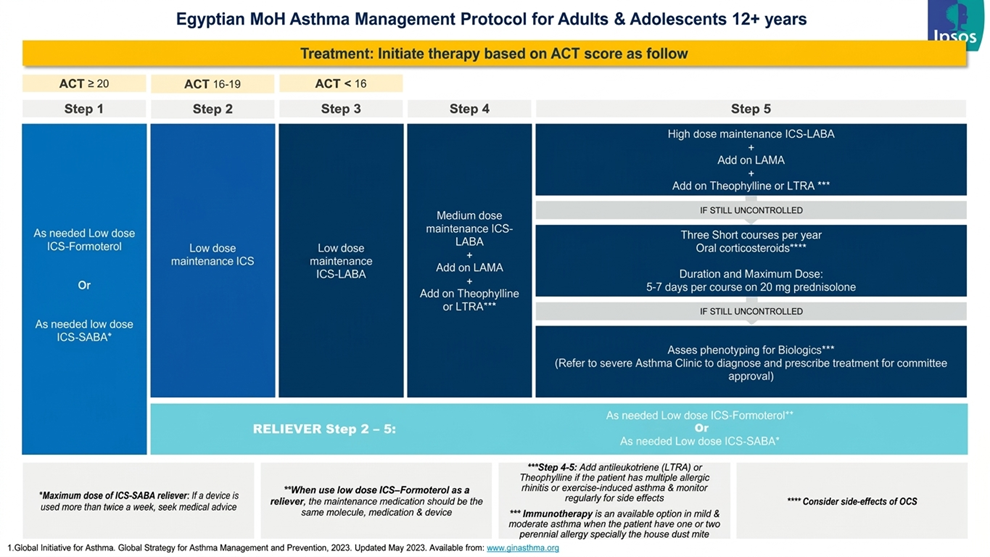
Initiate therapy by ACT score: ACT ≥20 → Step 1; ACT 16–19 → Step 2; ACT <16 → Step 3 (escalate to Steps 4–5 if still uncontrolled). Reliever at Steps 2–5: as-needed low-dose ICS-formoterol or ICS-SABA. Source: Egyptian MoH Asthma Management Protocol (2023).
Annex 2. Asthma Control Test (ACT) — Arabic patient version
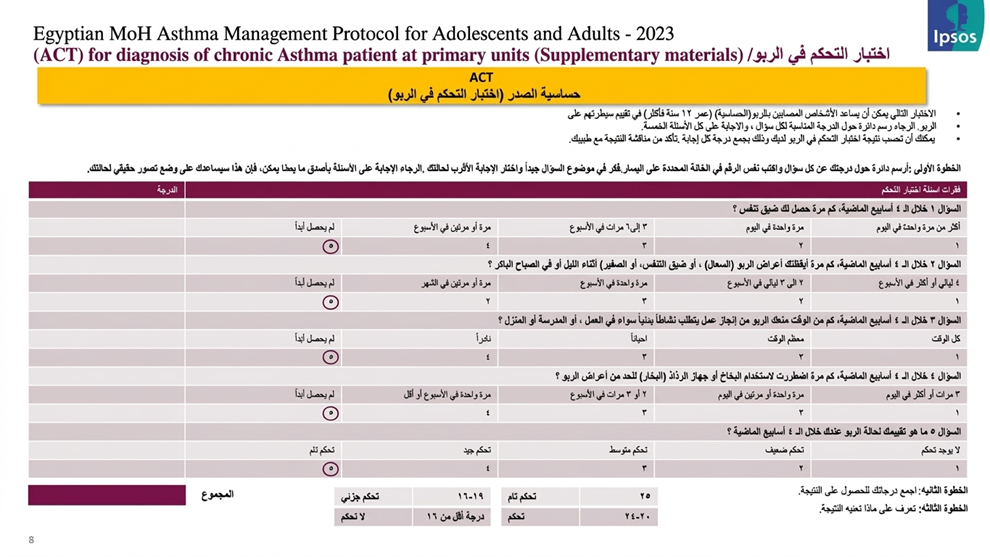
Scoring: total 20–25 = well controlled; 16–19 = partly controlled; <16 = uncontrolled. Source: Egyptian MoH Asthma Management Protocol (2023).
Annex 3. Checklists — comorbidities/aggravating factors and environmental triggers
|
Checklist for comorbidities / aggravating factors |
Yes |
No |
Checklist for triggers |
Yes |
No |
|
Allergic rhinitis |
☐ |
☐ |
Indoor — Animal dander |
☐ |
☐ |
|
Gastroesophageal reflux disease (GERD) |
☐ |
☐ |
Indoor — House dust mite |
☐ |
☐ |
|
Obesity |
☐ |
☐ |
Outdoor — Occupational |
☐ |
☐ |
|
Psychiatric disease |
☐ |
☐ |
Outdoor — Non-occupational |
☐ |
☐ |
|
Obstructive sleep apnea (OSA) |
☐ |
☐ |
|
|
|
Source: Egyptian MoH Asthma Management Protocol (2023).
Annex 4. Step-Down Table — options for stepping down by current step


Source: Egyptian MoH Asthma Management Protocol (2023).
Annex 5. Definition of severe asthma and its qualifying criteria
|
Severe asthma is asthma that requires treatment with high-dose ICS and LABA (± antileukotriene / theophylline) ± systemic corticosteroids for ≥50% of the previous year to prevent it from becoming uncontrolled, OR that remains uncontrolled despite this therapy — together with any one of the following: |
|
· Poor symptom control: ACQ >1.5, ACT <20 (or “not well controlled” by NAEPP/GINA). · Frequent severe exacerbations: ≥2 bursts of systemic corticosteroids (>3 days each) in the previous year. · Serious exacerbations: ≥1 hospitalization, ICU stay or mechanical ventilation in the previous year. · Airflow limitation: FEV₁ <80% predicted after appropriate bronchodilator withholding; FEV₁/FVC below the lower limit of normal. · Controlled asthma that worsens on tapering of treatment. |
Source: Chung KF et al. (reference 36); adopted by the Egyptian MoH Asthma Management Protocol (2023).
Annex 6. Difficult-to-treat versus severe asthma
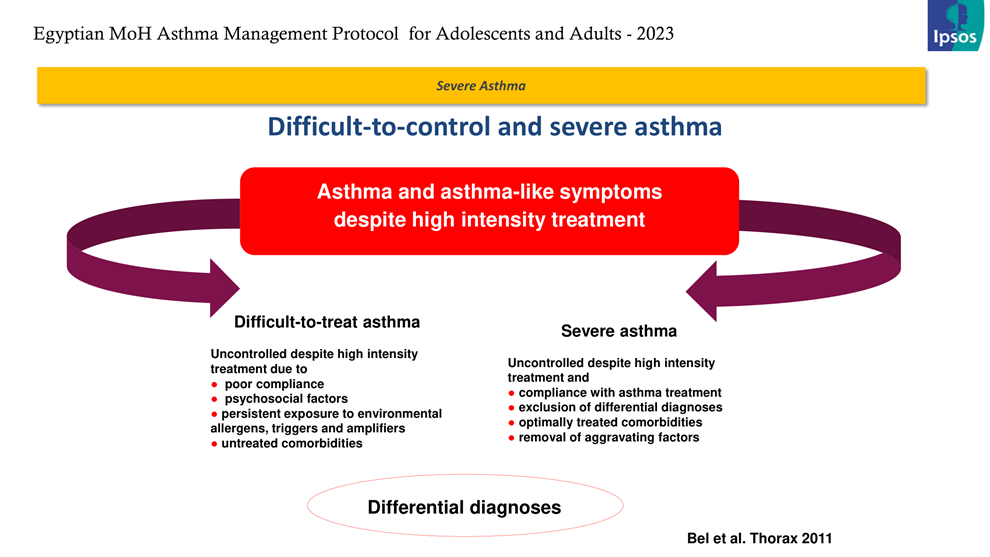
Source: Egyptian MoH Asthma Management Protocol (2023).
Annex 7. Panel of Type 2 biomarkers
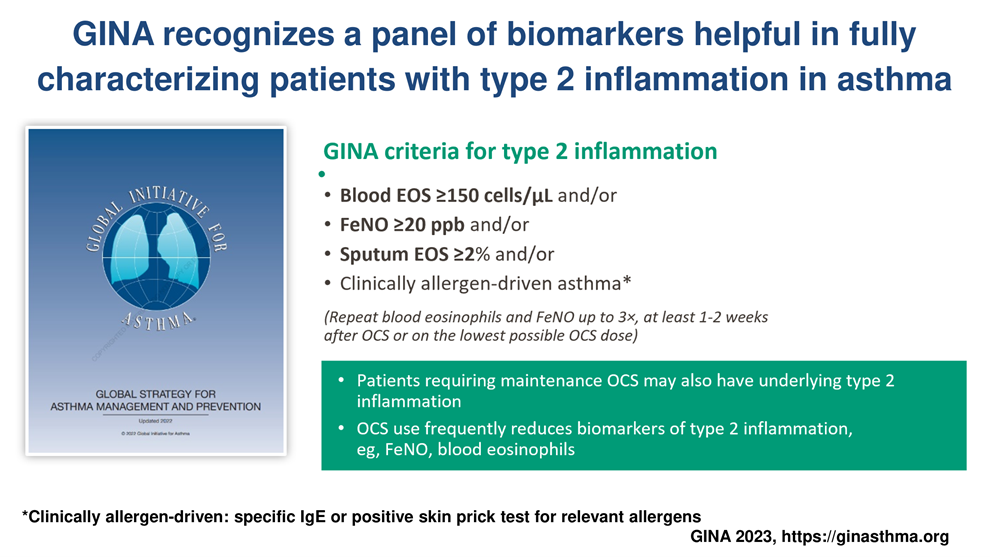
|
Class |
Name |
Age |
Asthma indication |
Other indications |
|
Anti-IgE |
Omalizumab |
≥6 years |
Severe allergic asthma |
Chronic spontaneous urticaria |
|
Anti-IL-5Rα |
Benralizumab |
≥12 years |
Severe eosinophilic / Type 2 asthma |
— |
|
Anti-IL-4Rα |
Dupilumab |
≥6 years |
Severe eosinophilic / Type 2 asthma, or maintenance OCS |
Atopic dermatitis, CRSwNP |
Clinically allergen-driven disease = specific IgE or positive skin-prick test for relevant allergens. Source: GINA 2023, adopted by the Egyptian MoH Protocol (2023).
Annex 8. Biologics in severe asthma in Egypt
|
Class |
Name |
Age |
Asthma indication |
Other indications |
|
Anti-IgE |
Omalizumab |
≥6 years |
Severe allergic asthma |
Chronic spontaneous urticaria |
|
Anti-IL-5Rα |
Benralizumab |
≥12 years |
Severe eosinophilic / Type 2 asthma |
— |
|
Anti-IL-4Rα |
Dupilumab |
≥6 years |
Severe eosinophilic / Type 2 asthma, or maintenance OCS |
Atopic dermatitis, CRSwNP |
Check local eligibility criteria for specific biologic therapies. Source: Egyptian MoH Asthma Management Protocol (2023).
Annex 9. Selection of biologics for severe uncontrolled asthma (by blood-eosinophil stratum)
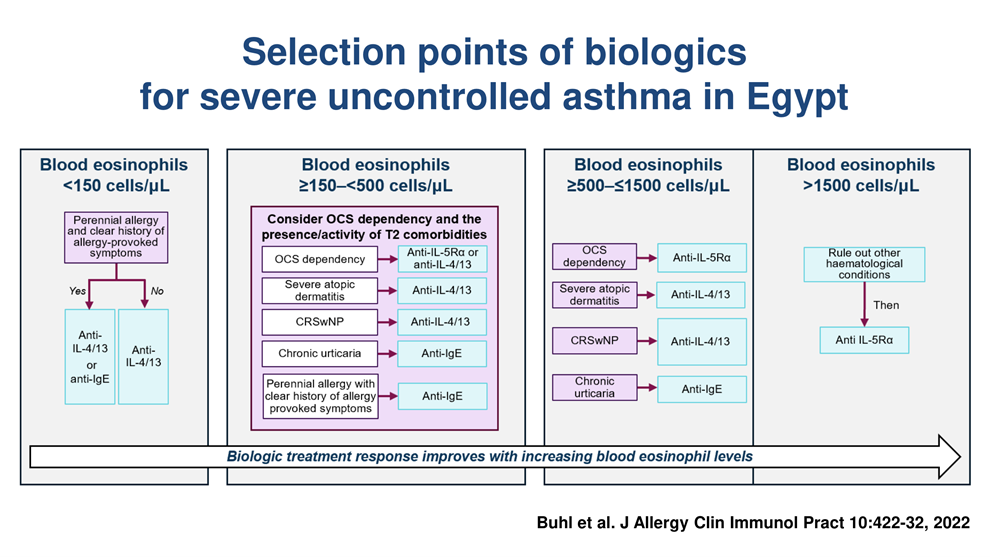
Source: Buhl R et al. (reference 42); adopted by the Egyptian MoH Protocol (2023).
Annex 10. Risk factors for asthma-related death
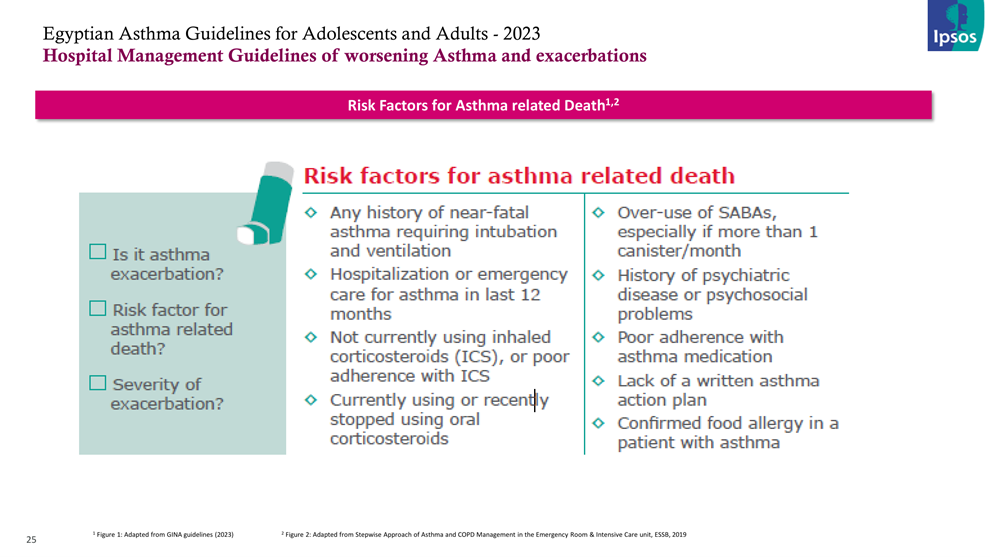
Source: GINA 2023 and ESSB 2019, adopted by the Egyptian MoH Protocol (2023).
Annex 11. Classification of asthma exacerbation severity
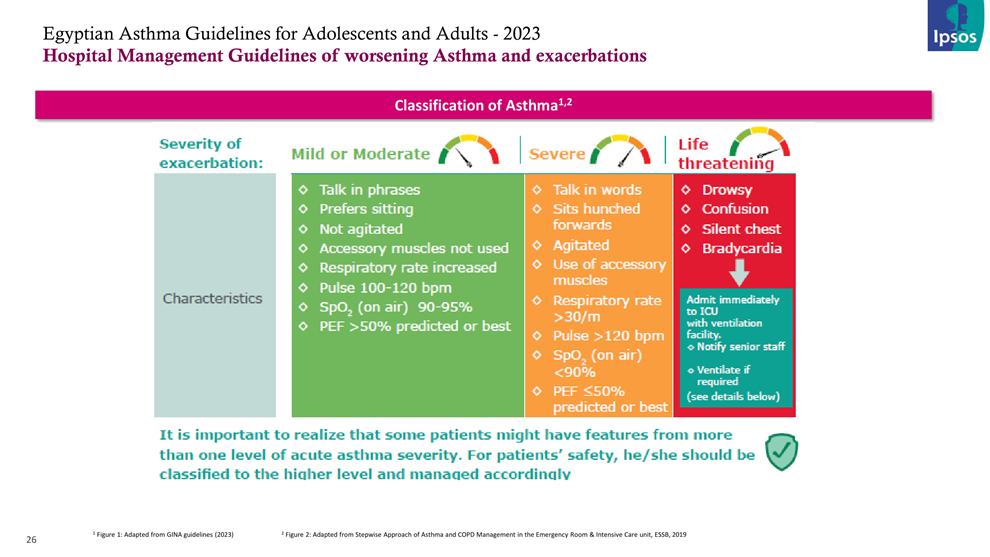
Patients with features of more than one severity level should be classified to the higher level and managed accordingly. Source: GINA 2023 and ESSB 2019.
Annex 12. Treatment of exacerbations by severity and time interval (ER / ICU)
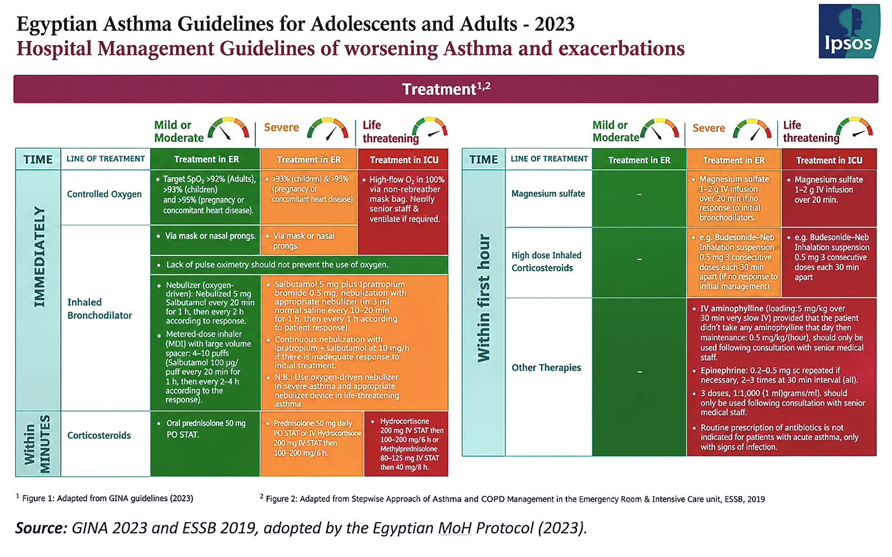
Source: GINA 2023 and ESSB 2019, adopted by the Egyptian MoH Protocol (2023).
Annex 13. Low, medium and high daily metered doses of inhaled corticosteroids
Retained to operationalize the Protocol’s “low/medium/high-dose ICS” prescribing.
Annex 14. Written Asthma Action Plan
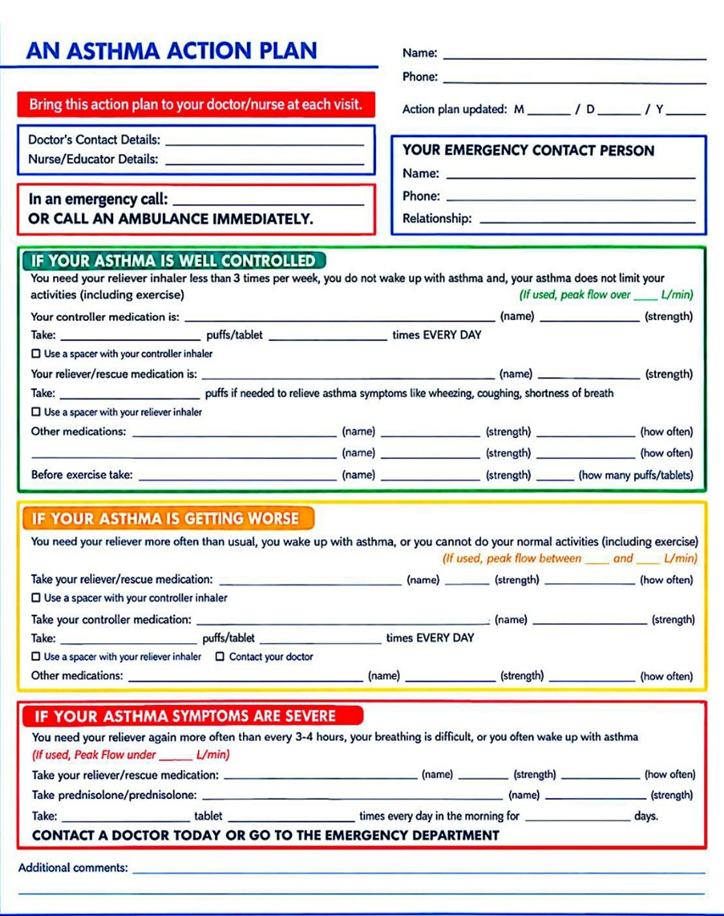
Retained; required by recommendations 4.13.3 and Section 8 (written action plan).
- References
1. Global Initiative for Asthma. Global strategy for asthma management and prevention, 2026 update. Fontana (WI): GINA; 2026. Available from: https://ginasthma.org/wp-content/uploads/2026/05/GINA-2026-Strategy-Report-WMS.pdf
2. Ministry of Health and Population, Egypt, in collaboration with the Egyptian Society of Chest Diseases and Tuberculosis. Egyptian MoH asthma management protocol for adolescents and adults (Egyptian asthma guidelines for adolescents and adults). Cairo: Ministry of Health and Population; 2023.
3. Louis R, Satia I, Ojanguren I, et al. European Respiratory Society guidelines for the diagnosis of asthma in adults. Eur Respir J 2022; 60: 2101585. doi:10.1183/13993003.01585-2021
4. National Institute for Health and Care Excellence, British Thoracic Society, Scottish Intercollegiate Guidelines Network. Asthma: diagnosis, monitoring and chronic asthma management. BTS/NICE/SIGN joint guideline (NICE NG245; SIGN 245). London: NICE; November 2024. Available from: https://www.nice.org.uk/guidance/ng245
5. Halvorsen T, Walsted ES, Bucca C, et al. Inducible laryngeal obstruction: an official joint European Respiratory Society and European Laryngological Society statement. Eur Respir J 2017; 50: 1602221. doi:10.1183/13993003.02221-2016
6. Mortimer K, Masekela R, Ozoh O, et al. The reality of managing asthma in sub-Saharan Africa – priorities and strategies for improving care. J Pan Afr Thorac Soc 2022; 3: 105-120.
7. Graham BL, Steenbruggen I, Miller MR, et al. Standardization of Spirometry 2019 Update. An Official American Thoracic Society and European Respiratory Society Technical Statement. Am J Respir Crit Care Med 2019; 200: e70-e88. doi:10.1164/rccm.201908-1590ST
8. Stanojevic S, Kaminsky DA, Miller MR, et al. ERS/ATS technical standard on interpretive strategies for routine lung function tests. Eur Respir J 2022; 60: 2101499. doi:10.1183/13993003.01499-2021
9. Coates AL, Wanger J, Cockcroft DW, et al. ERS technical standard on bronchial challenge testing: general considerations and performance of methacholine challenge tests. Eur Respir J 2017; 49: 1601526. doi:10.1183/13993003.01526-2016
10. Hallstrand TS, Leuppi JD, Joos G, et al. ERS technical standard on bronchial challenge testing: pathophysiology and methodology of indirect airway challenge testing. Eur Respir J 2018; 52: 1801033. doi:10.1183/13993003.01033-2018
11. Fahy JV. Type 2 inflammation in asthma – present in most, absent in many. Nat Rev Immunol 2015; 15: 57-65. doi:10.1038/nri3786
12. Korevaar DA, Westerhof GA, Wang J, et al. Diagnostic accuracy of minimally invasive markers for detection of airway eosinophilia in asthma: a systematic review and meta-analysis. Lancet Respir Med 2015; 3: 290-300. doi:10.1016/S2213-2600(15)00050-8
13. Hartl S, Breyer MK, Burghuber OC, et al. Blood eosinophil count in the general population: typical values and potential confounders. Eur Respir J 2020; 55: 1901874. doi:10.1183/13993003.01874-2019
14. Amaral R, Jacinto T, Malinovschi A, et al. The influence of individual characteristics and non-respiratory diseases on blood eosinophil count. Clin Transl Allergy 2021; 11: e12036. doi:10.1002/clt2.12036
15. Aaron SD, Vandemheen KL, FitzGerald JM, et al. Reevaluation of Diagnosis in Adults With Physician-Diagnosed Asthma. JAMA 2017; 317: 269-279. doi:10.1001/jama.2016.19627
16. Barnes PJ, Szefler SJ, Reddel HK, et al. Symptoms and perception of airway obstruction in asthmatic patients: Clinical implications for use of reliever medications. J Allergy Clin Immunol 2019; 144: 1180-1186. doi:10.1016/j.jaci.2019.06.040
17. O'Byrne PM, Reddel HK, Eriksson G, et al. Measuring asthma control: a comparison of three classification systems. Eur Respir J 2010; 36: 269-276. doi:10.1183/09031936.00124009
18. Thomas M, Kay S, Pike J, et al. The Asthma Control Test (ACT) as a predictor of GINA guideline-defined asthma control: analysis of a multinational cross-sectional survey. Prim Care Respir J 2009; 18: 41-49. doi:10.4104/pcrj.2009.00010
19. Yawn BP, Wollan PC, Rank MA, et al. Use of Asthma APGAR Tools in Primary Care Practices: A Cluster-Randomized Controlled Trial. Ann Fam Med 2018; 16: 100-110. doi:10.1370/afm.2179
20. Nathan RA, Sorkness CA, Kosinski M, et al. Development of the asthma control test: a survey for assessing asthma control. J Allergy Clin Immunol 2004; 113: 59-65. doi:10.1016/j.jaci.2003.09.008
21. Jones PW, Tomaszewski EL, Belton L, et al. Validity of the Chronic Airways Assessment Test (CAAT) in asthma, asthma+COPD and COPD in NOVELTY. ERJ Open Res 2025; 11: 01359-2024. doi:10.1183/23120541.01359-2024
22. Nwaru BI, Ekström M, Hasvold P, et al. Overuse of short-acting β-agonists in asthma is associated with increased risk of exacerbation and mortality: a nationwide cohort study of the global SABINA programme. Eur Respir J 2020; 55: 1901872. doi:10.1183/13993003.01872-2019
23. Zheng XY, Ding H, Jiang LN, et al. Association between Air Pollutants and Asthma Emergency Room Visits and Hospital Admissions in Time Series Studies: A Systematic Review and Meta-Analysis. PLoS One 2015; 10: e0138146. doi:10.1371/journal.pone.0138146
24. Redmond C, Akinoso-Imran AQ, Heaney LG, et al. Socioeconomic disparities in asthma health care utilization, exacerbations, and mortality: A systematic review and meta-analysis. J Allergy Clin Immunol 2022; 149: 1617-1627. doi:10.1016/j.jaci.2021.10.007
25. Meulmeester FL, Mailhot-Larouche S, Celis-Preciado C, et al. Inflammatory and clinical risk factors for asthma attacks (ORACLE2): a patient-level meta-analysis of control groups of 22 randomised trials. Lancet Respir Med 2025; 13: 505-516. doi:10.1016/S2213-2600(25)00037-2
26. Oosterholt S, Pavord ID, Brusselle G, et al. Modelling ASthma TrEatment Responses (MASTER): Effect of individual patient characteristics on the risk of exacerbation in moderate or severe asthma: A time-to-event analysis of randomized clinical trials. Br J Clin Pharmacol 2023; 89: 3273-3290. doi:10.1111/bcp.15801
27. den Dekker HT, Sonnenschein-van der Voort AMM, de Jongste JC, et al. Early growth characteristics and the risk of reduced lung function and asthma: A meta-analysis of 25,000 children. J Allergy Clin Immunol 2016; 137: 1026-1035. doi:10.1016/j.jaci.2015.08.050
28. Normansell R, Kew KM, Stovold E. Interventions to improve adherence to inhaled steroids for asthma. Cochrane Database Syst Rev 2017; (4): CD012226. doi:10.1002/14651858.CD012226.pub2
29. Melani AS, Bonavia M, Cilenti V, et al. Inhaler mishandling remains common in real life and is associated with reduced disease control. Respir Med 2011; 105: 930-938. doi:10.1016/j.rmed.2011.01.005
30. Usmani OS, Lavorini F, Marshall J, et al. Critical inhaler errors in asthma and COPD: a systematic review of impact on health outcomes. Respir Res 2018; 19: 10. doi:10.1186/s12931-017-0710-y
31. Denlinger LC, Phillips BR, Ramratnam S, et al. Inflammatory and Comorbid Features of Patients with Severe Asthma and Frequent Exacerbations. Am J Respir Crit Care Med 2017; 195: 302-313. doi:10.1164/rccm.201602-0419OC
32. Osborne ML, Pedula KL, O’Hollaren M, et al. Assessing future need for acute care in adult asthmatics: the Profile of Asthma Risk Study: a prospective health maintenance organization-based study. Chest 2007; 132: 1151-1161. doi:10.1378/chest.05-3084
33. Kitch BT, Paltiel AD, Kuntz KM, et al. A single measure of FEV1 is associated with risk of asthma attacks in long-term follow-up. Chest 2004; 126: 1875-1882. doi:10.1378/chest.126.6.1875
34. Reddel HK, Busse WW, Pedersen S, et al. Should recommendations about starting inhaled corticosteroid treatment for mild asthma be based on symptom frequency: a post-hoc efficacy analysis of the START study. Lancet 2017; 389: 157-166. doi:10.1016/S0140-6736(16)31399-X
35. Crossingham I, Turner S, Ramakrishnan S, et al. Combination fixed-dose beta agonist and steroid inhaler as required for adults or children with mild asthma. Cochrane Database Syst Rev 2021; (5): CD013518. doi:10.1002/14651858.CD013518.pub2
36. Chung KF, Wenzel SE, Brozek JL, et al. International ERS/ATS guidelines on definition, evaluation and treatment of severe asthma. Eur Respir J 2014; 43: 343-373. doi:10.1183/09031936.00202013
37. Heaney LG, Busby J, Bradding P, et al. Remotely Monitored Therapy and Nitric Oxide Suppression Identifies Nonadherence in Severe Asthma. Am J Respir Crit Care Med 2019; 199: 454-464. doi:10.1164/rccm.201806-1182OC
38. Hale EM, Greene G, Mulvey C, et al. Use of digital measurement of medication adherence and lung function to guide the management of uncontrolled asthma (INCA Sun): a multicentre, single-blinded, randomised clinical trial. Lancet Respir Med 2023; 11: 591-601. doi:10.1016/S2213-2600(22)00534-3
39. Sobieraj DM, Weeda ER, Nguyen E, et al. Association of Inhaled Corticosteroids and Long-Acting β-Agonists as Controller and Quick Relief Therapy With Exacerbations and Symptom Control in Persistent Asthma: A Systematic Review and Meta-analysis. JAMA 2018; 319: 1485-1496. doi:10.1001/jama.2018.2769
40. Bao W, Zhang X, Yin J, et al. Small-Airway Function Variables in Spirometry, Fractional Exhaled Nitric Oxide, and Circulating Eosinophils Predicted Airway Hyperresponsiveness in Patients with Mild Asthma. J Asthma Allergy 2021; 14: 415-426. doi:10.2147/JAA.S295345
41. McNicholl DM, Stevenson M, McGarvey LP, et al. The utility of fractional exhaled nitric oxide suppression in the identification of nonadherence in difficult asthma. Am J Respir Crit Care Med 2012; 186: 1102-1108. doi:10.1164/rccm.201204-0587OC
42. Buhl R, Bel E, Bourdin A, et al. Effective Management of Severe Asthma with Biologic Medications in Adult Patients: A Literature Review and International Expert Opinion. J Allergy Clin Immunol Pract 2022; 10: 422-432. doi:10.1016/j.jaip.2021.10.059
43. Cloutier MM, Baptist AP, Blake KV, et al. 2020 Focused Updates to the Asthma Management Guidelines: A Report from the National Asthma Education and Prevention Program Coordinating Committee Expert Panel Working Group. J Allergy Clin Immunol 2020; 146: 1217-1270. doi:10.1016/j.jaci.2020.10.003
44. Wang Z, Pianosi P, Keogh K, et al. The clinical utility of fractional exhaled nitric oxide (FeNO) in asthma management. Comparative Effectiveness Review No. 197. Rockville (MD): Agency for Healthcare Research and Quality; 2017. doi:10.23970/AHRQEPCCER197
45. Petsky HL, Li AM, Au CT, et al. Management based on exhaled nitric oxide levels adjusted for atopy reduces asthma exacerbations in children: A dual centre randomized controlled trial. Pediatr Pulmonol 2015; 50: 535-543. doi:10.1002/ppul.23064
46. Voorend-van Bergen S, Vaessen-Verberne AA, Brackel HJ, et al. Monitoring strategies in children with asthma: a randomised controlled trial. Thorax 2015; 70: 543-550. doi:10.1136/thoraxjnl-2014-206161
47. Peirsman EJ, Carvelli TJ, Hage PY, et al. Exhaled nitric oxide in childhood allergic asthma management: a randomised controlled trial. Pediatr Pulmonol 2014; 49: 624-631. doi:10.1002/ppul.22873
48. Leas BF, D’Anci KE, Apter AJ, et al. Effectiveness of indoor allergen reduction in management of asthma. Comparative Effectiveness Review No. 201. Rockville (MD): Agency for Healthcare Research and Quality; 2018. doi:10.23970/AHRQEPCCER201
49. Matsui EC, Perzanowski M, Peng RD, et al. Effect of an Integrated Pest Management Intervention on Asthma Symptoms Among Mouse-Sensitized Children and Adolescents With Asthma: A Randomized Clinical Trial. JAMA 2017; 317: 1027-1036. doi:10.1001/jama.2016.21048
50. Gøtzsche PC, Johansen HK. House dust mite control measures for asthma. Cochrane Database Syst Rev 2008; (2): CD001187. doi:10.1002/14651858.CD001187.pub3
51. Wilson SR, Strub P, Buist AS, et al. Shared treatment decision making improves adherence and outcomes in poorly controlled asthma. Am J Respir Crit Care Med 2010; 181: 566-577. doi:10.1164/rccm.200906-0907OC
52. Stapleton M, Howard-Thompson A, George C, et al. Smoking and asthma. J Am Board Fam Med 2011; 24: 313-322. doi:10.3122/jabfm.2011.03.100180
53. McConnell R, Barrington-Trimis JL, Wang K, et al. Electronic Cigarette Use and Respiratory Symptoms in Adolescents. Am J Respir Crit Care Med 2017; 195: 1043-1049. doi:10.1164/rccm.201604-0804OC
54. Okoniewski W, Lu KD, Forno E. Weight Loss for Children and Adults with Obesity and Asthma. A Systematic Review of Randomized Controlled Trials. Ann Am Thorac Soc 2019; 16: 613-625. doi:10.1513/AnnalsATS.201810-651SR
55. Adeniyi FB, Young T. Weight loss interventions for chronic asthma. Cochrane Database Syst Rev 2012; (7): CD009339. doi:10.1002/14651858.CD009339.pub2
56. Moreira A, Bonini M, Garcia-Larsen V, et al. Weight loss interventions in asthma: EAACI evidence-based clinical practice guideline (part I). Allergy 2013; 68: 425-439. doi:10.1111/all.12106
57. Carson KV, Chandratilleke MG, Picot J, et al. Physical training for asthma. Cochrane Database Syst Rev 2013; (9): CD001116. doi:10.1002/14651858.CD001116.pub4
58. Parsons JP, Hallstrand TS, Mastronarde JG, et al. An official American Thoracic Society clinical practice guideline: exercise-induced bronchoconstriction. Am J Respir Crit Care Med 2013; 187: 1016-1027. doi:10.1164/rccm.201303-0437ST
59. Dogaru CM, Nyffenegger D, Pescatore AM, et al. Breastfeeding and childhood asthma: systematic review and meta-analysis. Am J Epidemiol 2014; 179: 1153-1167. doi:10.1093/aje/kwu072
60. Lodge CJ, Tan DJ, Lau MX, et al. Breastfeeding and asthma and allergies: a systematic review and meta-analysis. Acta Paediatr 2015; 104: 38-53. doi:10.1111/apa.13132
61. Mastronarde JG, Anthonisen NR, Castro M, et al. Efficacy of esomeprazole for treatment of poorly controlled asthma. N Engl J Med 2009; 360: 1487-1499. doi:10.1056/NEJMoa0806290
62. Katz PO, Dunbar KB, Schnoll-Sussman FH, et al. ACG Clinical Guideline for the Diagnosis and Management of Gastroesophageal Reflux Disease. Am J Gastroenterol 2022; 117: 27-56. doi:10.14309/ajg.0000000000001538
63. O'Byrne PM, FitzGerald JM, Bateman ED, et al. Inhaled Combined Budesonide-Formoterol as Needed in Mild Asthma. N Engl J Med 2018; 378: 1865-1876. doi:10.1056/NEJMoa1715274
64. Beasley R, Holliday M, Reddel HK, et al. Controlled Trial of Budesonide-Formoterol as Needed for Mild Asthma. N Engl J Med 2019; 380: 2020-2030. doi:10.1056/NEJMoa1901963
65. Papi A, Chipps BE, Beasley R, et al. Albuterol-Budesonide Fixed-Dose Combination Rescue Inhaler for Asthma. N Engl J Med 2022; 386: 2071-2083. doi:10.1056/NEJMoa2203163
66. Pauwels RA, Pedersen S, Busse WW, et al. Early intervention with budesonide in mild persistent asthma: a randomised, double-blind trial. Lancet 2003; 361: 1071-1076. doi:10.1016/S0140-6736(03)12891-7
67. Ducharme FM, Ni Chroinin M, Greenstone I, et al. Addition of long-acting beta2-agonists to inhaled corticosteroids versus same dose inhaled corticosteroids for chronic asthma in adults and children. Cochrane Database Syst Rev 2010; (5): CD005535. doi:10.1002/14651858.CD005535.pub2
68. Kerstjens HA, Engel M, Dahl R, et al. Tiotropium in asthma poorly controlled with standard combination therapy. N Engl J Med 2012; 367: 1198-1207. doi:10.1056/NEJMoa1208606
69. Chauhan BF, Jeyaraman MM, Singh Mann A, et al. Addition of anti-leukotriene agents to inhaled corticosteroids for adults and adolescents with persistent asthma. Cochrane Database Syst Rev 2017; (3): CD010347. doi:10.1002/14651858.CD010347.pub2
70. Price DB, Trudo F, Voorham J, et al. Adverse outcomes from initiation of systemic corticosteroids for asthma: long-term observational study. J Asthma Allergy 2018; 11: 193-204. doi:10.2147/JAA.S176026
71. Brozek JL, Bousquet J, Baena-Cagnani CE, et al. Allergic Rhinitis and its Impact on Asthma (ARIA) guidelines: 2010 revision. J Allergy Clin Immunol 2010; 126: 466-476. doi:10.1016/j.jaci.2010.06.047
72. Fortescue R, Kew KM, Leung MST. Sublingual immunotherapy for asthma. Cochrane Database Syst Rev 2020; (9): CD011293. doi:10.1002/14651858.CD011293.pub3
73. Virchow JC, Backer V, Kuna P, et al. Efficacy of a House Dust Mite Sublingual Allergen Immunotherapy Tablet in Adults With Allergic Asthma: A Randomized Clinical Trial. JAMA 2016; 315: 1715-1725. doi:10.1001/jama.2016.3964
74. Buhl R, Kuna P, Peters MJ, et al. The effect of budesonide/formoterol maintenance and reliever therapy on the risk of severe asthma exacerbations following episodes of high reliever use: an exploratory analysis of two randomised, controlled studies with comparisons to standard therapy. Respir Res 2012; 13: 59. doi:10.1186/1465-9921-13-59
75. McKeever T, Mortimer K, Wilson A, et al. Quadrupling Inhaled Glucocorticoid Dose to Abort Asthma Exacerbations. N Engl J Med 2018; 378: 902-910. doi:10.1056/NEJMoa1714257
76. Hawkins G, McMahon AD, Twaddle S, et al. Stepping down inhaled corticosteroids in asthma: randomised controlled trial. BMJ 2003; 326: 1115. doi:10.1136/bmj.326.7399.1115
77. Rank MA, Hagan JB, Park MA, et al. The risk of asthma exacerbation after stopping low-dose inhaled corticosteroids: a systematic review and meta-analysis of randomized controlled trials. J Allergy Clin Immunol 2013; 131: 724-729. doi:10.1016/j.jaci.2012.11.038
78. Abramson MJ, Puy RM, Weiner JM. Injection allergen immunotherapy for asthma. Cochrane Database Syst Rev 2010; (8): CD001186. doi:10.1002/14651858.CD001186.pub2
79. Tay TR, Hew M. Comorbid "treatable traits" in difficult asthma: Current evidence and clinical evaluation. Allergy 2018; 73: 1369-1382. doi:10.1111/all.13370
80. Burks AW, Tang M, Sicherer S, et al. ICON: food allergy. J Allergy Clin Immunol 2012; 129: 906-920. doi:10.1016/j.jaci.2012.02.001
81. Lohia S, Schlosser RJ, Soler ZM. Impact of intranasal corticosteroids on asthma outcomes in allergic rhinitis: a meta-analysis. Allergy 2013; 68: 569-579. doi:10.1111/all.12124
82. Fokkens WJ, Lund VJ, Hopkins C, et al. European Position Paper on Rhinosinusitis and Nasal Polyps 2020. Rhinology 2020; 58 Suppl S29: 1-464. doi:10.4193/Rhin20.600
83. Bachert C, Han JK, Desrosiers M, et al. Efficacy and safety of dupilumab in patients with severe chronic rhinosinusitis with nasal polyps (LIBERTY NP SINUS-24 and LIBERTY NP SINUS-52): results from two multicentre, randomised, double-blind, placebo-controlled, parallel-group phase 3 trials. Lancet 2019; 394: 1638-1650. doi:10.1016/S0140-6736(19)31881-1
84. Gevaert P, Omachi TA, Corren J, et al. Efficacy and safety of omalizumab in nasal polyposis: 2 randomized phase 3 trials. J Allergy Clin Immunol 2020; 146: 595-605. doi:10.1016/j.jaci.2020.05.032
85. Global Initiative for Asthma. Difficult-to-treat and severe asthma in adolescent and adult patients: diagnosis and management. GINA pocket guide for health professionals, 2025. Fontana (WI): GINA; 2025. Available from: https://ginasthma.org/severeasthma/
86. Serrano-Pariente J, Plaza V, Soriano JB, et al. Asthma outcomes improve with continuous positive airway pressure for obstructive sleep apnea. Allergy 2017; 72: 802-812. doi:10.1111/all.13070
87. Teodorescu M, Barnet JH, Hagen EW, et al. Association between asthma and risk of developing obstructive sleep apnea. JAMA 2015; 313: 156-164. doi:10.1001/jama.2014.17822
88. Beuther DA, Sutherland ER. Overweight, obesity, and incident asthma: a meta-analysis of prospective epidemiologic studies. Am J Respir Crit Care Med 2007; 175: 661-666. doi:10.1164/rccm.200611-1717OC
89. Aaron SD, Vandemheen KL, Boulet LP, et al. Overdiagnosis of asthma in obese and nonobese adults. CMAJ 2008; 179: 1121-1131. doi:10.1503/cmaj.081332
90. Freitas PD, Ferreira PG, Silva AG, et al. The Role of Exercise in a Weight-Loss Program on Clinical Control in Obese Adults with Asthma. A Randomized Controlled Trial. Am J Respir Crit Care Med 2017; 195: 32-42. doi:10.1164/rccm.201603-0446OC
91. Scott HA, Gibson PG, Garg ML, et al. Dietary restriction and exercise improve airway inflammation and clinical outcomes in overweight and obese asthma: a randomized trial. Clin Exp Allergy 2013; 43: 36-49. doi:10.1111/cea.12004
92. Thomas M, Bruton A, Moffat M, et al. Asthma and psychological dysfunction. Prim Care Respir J 2011; 20: 250-256. doi:10.4104/pcrj.2011.00058
93. Foster JM, McDonald VM, Guo M, et al. "I have lost in every facet of my life": the hidden burden of severe asthma. Eur Respir J 2017; 50: 1700765. doi:10.1183/13993003.00765-2017
94. Kew KM, Nashed M, Dulay V, et al. Cognitive behavioural therapy (CBT) for adults and adolescents with asthma. Cochrane Database Syst Rev 2016; (9): CD011818. doi:10.1002/14651858.CD011818.pub2
95. Szczeklik A, Nizankowska E, Duplaga M. Natural history of aspirin-induced asthma. AIANE Investigators. European Network on Aspirin-Induced Asthma. Eur Respir J 2000; 16: 432-436. doi:10.1034/j.1399-3003.2000.016003432.x
96. Rajan JP, Wineinger NE, Stevenson DD, et al. Prevalence of aspirin-exacerbated respiratory disease among asthmatic patients: A meta-analysis of the literature. J Allergy Clin Immunol 2015; 135: 676-681.e1. doi:10.1016/j.jaci.2014.08.020
97. Szczeklik A, Sanak M, Nizankowska-Mogilnicka E, et al. Aspirin intolerance and the cyclooxygenase-leukotriene pathways. Curr Opin Pulm Med 2004; 10: 51-56. doi:10.1097/00063198-200401000-00009
98. Morales DR, Lipworth BJ, Guthrie B, et al. Safety risks for patients with aspirin-exacerbated respiratory disease after acute exposure to selective nonsteroidal anti-inflammatory drugs and COX-2 inhibitors: Meta-analysis of controlled clinical trials. J Allergy Clin Immunol 2014; 134: 40-45. doi:10.1016/j.jaci.2013.10.057
99. Dahlén SE, Malmström K, Nizankowska E, et al. Improvement of aspirin-intolerant asthma by montelukast, a leukotriene antagonist: a randomized, double-blind, placebo-controlled trial. Am J Respir Crit Care Med 2002; 165: 9-14. doi:10.1164/ajrccm.165.1.2010080
100. Lazarinis N, Jørgensen L, Ekström T, et al. Combination of budesonide/formoterol on demand improves asthma control by reducing exercise-induced bronchoconstriction. Thorax 2014; 69: 130-136. doi:10.1136/thoraxjnl-2013-203557
101. Agarwal R, Chakrabarti A, Shah A, et al. Allergic bronchopulmonary aspergillosis: review of literature and proposal of new diagnostic and classification criteria. Clin Exp Allergy 2013; 43: 850-873. doi:10.1111/cea.12141
102. Agarwal R, Sehgal IS, Muthu V, et al. Revised ISHAM-ABPA working group clinical practice guidelines for diagnosing, classifying and treating allergic bronchopulmonary aspergillosis/mycoses. Eur Respir J 2024; 63: 2400061. doi:10.1183/13993003.00061-2024
103. Murphy VE, Clifton VL, Gibson PG. Asthma exacerbations during pregnancy: incidence and association with adverse pregnancy outcomes. Thorax 2006; 61: 169-176. doi:10.1136/thx.2005.049718
104. Murphy VE, Namazy JA, Powell H, et al. A meta-analysis of adverse perinatal outcomes in women with asthma. BJOG 2011; 118: 1314-1323. doi:10.1111/j.1471-0528.2011.03055.x
105. Middleton PG, Gade EJ, Aguilera C, et al. ERS/TSANZ Task Force Statement on the management of reproduction and pregnancy in women with airways diseases. Eur Respir J 2020; 55: 1901208. doi:10.1183/13993003.01208-2019
106. Murphy VE, Gibson PG. Asthma in pregnancy. Clin Chest Med 2011; 32: 93-110. doi:10.1016/j.ccm.2010.10.001
107. Murphy VE, Powell H, Wark PAB, et al. A prospective study of respiratory viral infection in pregnant women with and without asthma. Chest 2013; 144: 420-427. doi:10.1378/chest.12-1956
108. Chaudhuri R, Livingston E, McMahon AD, et al. Effects of smoking cessation on lung function and airway inflammation in smokers with asthma. Am J Respir Crit Care Med 2006; 174: 127-133. doi:10.1164/rccm.200510-1589OC
109. Lazarus SC, Chinchilli VM, Rollings NJ, et al. Smoking affects response to inhaled corticosteroids or leukotriene receptor antagonists in asthma. Am J Respir Crit Care Med 2007; 175: 783-790. doi:10.1164/rccm.200511-1746OC
110. Global Initiative for Chronic Obstructive Lung Disease. Global strategy for the diagnosis, management, and prevention of chronic obstructive pulmonary disease: 2026 report. Available from: https://goldcopd.org
111. Hanania NA, Celli BR, Donohue JF, et al. Bronchodilator reversibility in COPD. Chest 2011; 140: 1055-1063. doi:10.1378/chest.10-2974
112. Kew KM, Seniukovich A. Inhaled steroids and risk of pneumonia for chronic obstructive pulmonary disease. Cochrane Database Syst Rev 2014; (3): CD010115. doi:10.1002/14651858.CD010115.pub2
113. Suissa S, Patenaude V, Lapi F, et al. Inhaled corticosteroids in COPD and the risk of serious pneumonia. Thorax 2013; 68: 1029-1036. doi:10.1136/thoraxjnl-2012-202872
114. van Huisstede A, Castro Cabezas M, van de Geijn GJ, et al. Underdiagnosis and overdiagnosis of asthma in the morbidly obese. Respir Med 2013; 107: 1356-1364. doi:10.1016/j.rmed.2013.05.007
115. Levy ML, Nicholson PJ. Occupational asthma case finding: a role for primary care. Br J Gen Pract 2004; 54: 731-733.
116. Baur X, Sigsgaard T, Aasen TB, et al. Guidelines for the management of work-related asthma. Eur Respir J 2012; 39: 529-545. doi:10.1183/09031936.00096111
117. Henneberger PK, Patel JR, de Groene GJ, et al. Workplace interventions for treatment of occupational asthma. Cochrane Database Syst Rev 2019; (10): CD006308. doi:10.1002/14651858.CD006308.pub4
118. Tarlo SM, Balmes J, Balkissoon R, et al. Diagnosis and management of work-related asthma: American College Of Chest Physicians Consensus Statement. Chest 2008; 134: 1S-41S. doi:10.1378/chest.08-0201
119. Sánchez-Ramos JL, Pereira-Vega AR, Alvarado-Gómez F, et al. Risk factors for premenstrual asthma: a systematic review and meta-analysis. Expert Rev Respir Med 2017; 11: 57-72. doi:10.1080/17476348.2017.1270762
120. Smetana GW, Lawrence VA, Cornell JE. Preoperative pulmonary risk stratification for noncardiothoracic surgery: systematic review for the American College of Physicians. Ann Intern Med 2006; 144: 581-595. doi:10.7326/0003-4819-144-8-200604180-00009
121. Woods BD, Sladen RN. Perioperative considerations for the patient with asthma and bronchospasm. Br J Anaesth 2009; 103 Suppl 1: i57-i65. doi:10.1093/bja/aep271
122. Coker RK, Armstrong A, Church AC, et al. BTS Clinical Statement on air travel for passengers with respiratory disease. Thorax 2022; 77: 329-350. doi:10.1136/thoraxjnl-2021-218110
123. Bel EH, Sousa A, Fleming L, et al. Diagnosis and definition of severe refractory asthma: an international consensus statement from the Innovative Medicine Initiative (IMI). Thorax 2011; 66: 910-917. doi:10.1136/thx.2010.153643
124. Egyptian Scientific Society of Bronchology (ESSB). Stepwise approach of asthma and COPD management in the emergency room and intensive care unit. Egypt: ESSB; 2019.
125. Suissa S, Ernst P, Boivin JF, et al. A cohort analysis of excess mortality in asthma and the use of inhaled beta-agonists. Am J Respir Crit Care Med 1994; 149: 604-610. doi:10.1164/ajrccm.149.3.8118625
126. Perrin K, Wijesinghe M, Healy B, et al. Randomised controlled trial of high concentration versus titrated oxygen therapy in severe exacerbations of asthma. Thorax 2011; 66: 937-941. doi:10.1136/thx.2010.155259
127. Rowe BH, Spooner C, Ducharme FM, et al. Early emergency department treatment of acute asthma with systemic corticosteroids. Cochrane Database Syst Rev 2001; (1): CD002178. doi:10.1002/14651858.CD002178
128. Kew KM, Kirtchuk L, Michell CI. Intravenous magnesium sulfate for treating adults with acute asthma in the emergency department. Cochrane Database Syst Rev 2014; (5): CD010909. doi:10.1002/14651858.CD010909.pub2
129. Nair P, Milan SJ, Rowe BH. Addition of intravenous aminophylline to inhaled beta(2)-agonists in adults with acute asthma. Cochrane Database Syst Rev 2012; (12): CD002742. doi:10.1002/14651858.CD002742.pub2
130. Normansell R, Sayer B, Waterson S, et al. Antibiotics for exacerbations of asthma. Cochrane Database Syst Rev 2018; (6): CD002741. doi:10.1002/14651858.CD002741.pub2
131. Mazenq J, Dubus JC, Gaudart J, et al. City housing atmospheric pollutant impact on emergency visit for asthma: A classification and regression tree approach. Respir Med 2017; 132: 1-8. doi:10.1016/j.rmed.2017.09.004
132. Murray CS, Poletti G, Kebadze T, et al. Study of modifiable risk factors for asthma exacerbations: virus infection and allergen exposure increase the risk of asthma hospital admissions in children. Thorax 2006; 61: 376-382. doi:10.1136/thx.2005.042523
133. Ownby DR, Johnson CC, Peterson EL. Exposure to dogs and cats in the first year of life and risk of allergic sensitization at 6 to 7 years of age. JAMA 2002; 288: 963-972. doi:10.1001/jama.288.8.963
134. Lodge CJ, Lowe AJ, Gurrin LC, et al. Pets at birth do not increase allergic disease in at-risk children. Clin Exp Allergy 2012; 42: 1377-1385. doi:10.1111/j.1365-2222.2012.04032.x
135. Burke H, Leonardi-Bee J, Hashim A, et al. Prenatal and passive smoke exposure and incidence of asthma and wheeze: systematic review and meta-analysis. Pediatrics 2012; 129: 735-744. doi:10.1542/peds.2011-2196
136. Kramer MS, Kakuma R. Maternal dietary antigen avoidance during pregnancy or lactation, or both, for preventing or treating atopic disease in the child. Cochrane Database Syst Rev 2012; (9): CD000133. doi:10.1002/14651858.CD000133.pub3