Nursing care for burn patients
| Site: | EHC | Egyptian Health Council |
| Course: | Nursing Procedure Guidelines for the Reception and Emergency Department |
| Book: | Nursing care for burn patients |
| Printed by: | Guest user |
| Date: | Sunday, 20 September 2026, 5:07 PM |
Description
"last update: 24 March 2025" تحميل الدليل
Table of contents
- - Prepared by
- - Definition
- - Causes of burns
- - Risk factors for burns
- - The objectives of burn relief
- - Types of burns
- - First degree burns and their symptoms
- - Educating the patient on how to deal with first-degree burns at home
- - Second degree burns
- - Third degree burns
- - Fourth degree burns
- - Symptoms and Signs of Burns Affecting the Throat and Airways
- Prepared by
Emergency guide
Under supervision
- Prof. Dr. Mohamed Latif, CEO of the Egyptian Health Council
Dr. Kawthar Mahmoud, Head of the Egyptian Nursing Syndicate - Member of the Senate
Supervised by
Dr. sherif wadie, advisor to the minster of health for emergency and urgent care
Prepared by
|
Title |
Name |
NO. |
|
Dean Of Faculty Nursing, Professor of Medical and Surgical Nursing, Tanta University |
Dr Afaf Abdel Aziz Abdel Aziz Basal |
1 |
|
Professor Of Critical Care Nursing |
Prof.Dr/Zeinab Hussain Ali |
2 |
|
Professor And Head of the Department of Medical Surgical Nursing. Faculty-. Benha University |
Prof.Dr Amal Said Taha Refaie |
3 |
|
Supervisor Of the Education Sector at Port Said University |
Prof.Dr Amal Ahmed Khalil Morsy |
4 |
|
Professor Of Medical Surgical Nursing- Faculty of Nursing- Cairo University |
Dr. Hanan Ahmed Al Sebaee |
5 |
|
Head of central administration on secondment at MOHP |
Dr Neveen ab drab al0nabi Mohamed |
6 |
|
Director Of Primary Health Care Nursing Department at MOHP. |
Maysa Hosny Ahmed Tammam |
7 |
|
Supervisor Of Technical Education- EHA |
Nancy Alaa Eldeen Abd-Elbaset Ali |
8 |
|
Supervisor Of Nursing Services Development- EHA |
Sherien Mohamed Saad |
9 |
|
Assistant Professor of Maternity and Neonatal Health Nursing - Faculty of Nursing- Ain Shams University |
Assist.Perof. Dr./Heba Mahmoud Mohammed |
10 |
|
General manager of general administration of health institutes affairs |
Dr Mai Galal Ibrahim Al-Assal |
11 |
|
Participants |
||
|
Director Of Curative Nursing Department MOHP |
Dr. Azza Galal Ahmed Khalil |
12 |
|
Member of the Nursing administration, EHA, Luxor Branch |
Mr. Ahmed Mohamed Ahmed Al Noubi
|
13 |
|
Nursing Specialist at the General Administration of Nursing - Ministry of Health |
MS. Angham Hamdy Abdel Khaleq
|
14 |
|
Nursing Specialist at the General Administration of Nursing - Ministry of Health |
Mr. Ahmed Muhammad Hussein Mubariz |
15 |
|
Nursing Specialist at the General Administration of Nursing - Ministry of Health |
Mr. Abdel-Azim Al-Saeed Abdel-Azim Al-Hanafi |
16 |
|
Nursing Specialist at the General Administration of Nursing - Ministry of Health |
Mr. Shawkat Yusre Hussein
|
17 |
|
nursing specialist at the General Administration of Nursing |
Mr. Karim Ahmed Sadik |
18 |
- Definition
It is the destruction and damage that occurs to the skin and body tissues due to exposure to an external factor of intense heat, such as hot water, direct flames, a corrosive chemical substance, or radiation. This results in several types of damage: psychological, physical, and sensory.
- Causes of burns
1- Heat : It has two types
A. Dry heat: fire flame
b. Moist heat: hot water or steam
2- Radiation Natural radiation such as sunlight, artificial radiation such like the radiation of cancer treatments.
3- Electricity.
4- Strong chemicals (strong acidic or alkaline materials)
- Risk factors for burns
: Area ➡️
The larger the area, the greater the risk
(the role of nines)
An increase in the burned area of more than 20%
in adults and 10% in children of the body surface is considered dangerous.
➡️Depth : This depends on the degree of the burn, as third degree is more dangerous than second degree
➡️ Location: The face, hands, chest, and genital area are considered some of the most critical parts of the body. This is due to their sensitivity and the presence of nerves and blood vessels.
➡️ Age : Children and the elderly (due to weak immunity).
➡️ Chemical burns: These are burns caused by the body being exposed to some caustic chemical materials such as concentrated acids or strong alkalis. These burns are characterised by being corrosive and puncturing to the body and penetrating deeply
- The objectives of burn relief
· Pain relief and elimination (cooling to reduce temprature)
· Prevent burn dirt and contamination
· shock treatment
- Types of burns
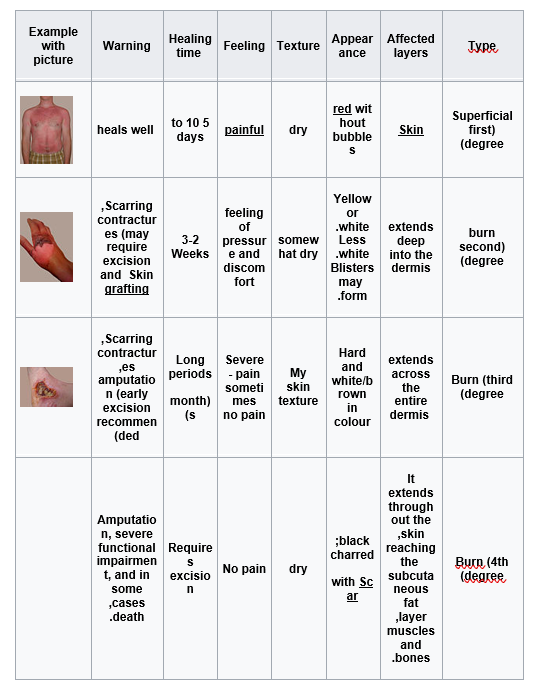
Burns that affect only the top layer of skin are known as superficial burns or first-degree burns. When damage reaches some of the layers beneath the skin, it is known as a partially deep burn or second-degree burn. In a full-thickness or third-degree burn, the injuries extend to all layers of the skin. A fourth-degree burn also involves damage to deeper tissue, such as muscle or bone.
- First degree burns and their symptoms
First-degree burns (superficial burns) affect only the superficial layer of the skin and are considered the least dangerous of other types of burns. In them, only the outer layer of the skin is burned. Healing occurs within 5-10 days and usually no physiological changes occur to the skin.
Its symptoms :
1. Redness of the skin at the site of the burn .
2. Redness is often accompanied by swelling .
3. Having pain .
Causes of first degree burns:
- Overexposure to the sun
- Simple contact with a hot pan or spillage of hot water
- Exposure of the skin to water vapor or small amount of chemicals.
First aid for minor burns:
• Move the injured person quickly away from the fire
• Remove your watch or any jewelry
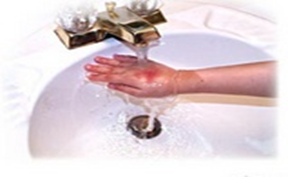
• Immerse the burned area in cold water for 10 minutes or until the pain disappears.
• No hospital needed
- Educating the patient on how to deal with first-degree burns at home
First-degree burns, like minor burns, are treated at home as follows:
1. Cool the burn area: This can be done by placing the burned part under cold (not icy) running water, such as tap water, submerging the burn in a container of cold water, or applying cold compresses to the affected area for 10 to 15 minutes or until the pain subsides.
2. Cover the burn area: Use a sterile gauze bandage to cover the burn, ensuring not to apply the gauze tightly to avoid putting pressure on the burned skin.
3. Administer a pain reliever: Provide an over-the-counter pain reliever if needed.
However, if the burns affect large areas of the hands, feet, face, thighs, buttocks, or a major joint in the body, these cases require immediate medical attention or a visit to the nearest hospital.
notes:
Cooling the burn site prevents swelling of the site by stopping more heat from reaching the skin at the burn site .
1. Use cold water to cool the burn site, and do not use ice on the burn site, as it can increase the burn and damage the skin .
2. Place sterile gauze on the burn site and avoid placing cotton or any type of fabric that may stick to the burn site .
3. Do not put egg whites, butter, or toothpaste on the burn
4. Follow up on the burn site, which often heals on its own. However, if any signs of infection are noticed, such as increased pain, redness, swelling, or if it is accompanied by a high temperature, a doctor must be consulted .
- Second degree burns
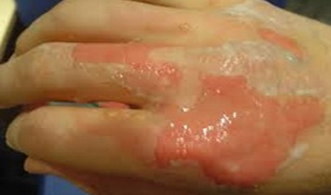
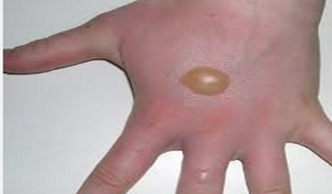
It affects the outer and inner layers of the skin, and is characterized by the presence of blisters and subcutaneous infiltration. Healing occurs within 2-3 weeks
Symptoms:
It is characterized by the appearance of blisters, visible swelling, severe pain, subcutaneous infiltration, and plasma oozing through the damaged skin layers.
First aid for 2nd degree burns:
- Move the injured person away from the heat source.
- Remove any clothing over the burned area.
- Immerse the burned area in cold water to reduce pain (cooling the tissues this way helps lower the temperature of the tissues adjacent to the skin).
- Do not use ice or iced water as it can cause tissue damage.
- Dry the area afterward with sterile bandages or a clean, ironed, and cool cloth.
- Cover the burn with Vaseline gauze followed by a dry bandage, ensuring not to remove or puncture the burned tissues.
- Change the bandage every 1–2 days or if it becomes soaked with plasma fluid.
- Watch for signs of infection, such as fever, unexplained pain, or pus.
- Second-degree burns on the face or neck, or burns larger than 3 cm, require medical attention.
- Third degree burns
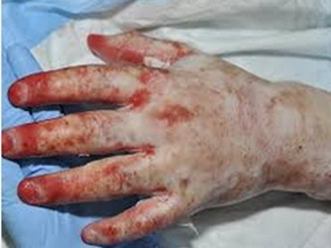
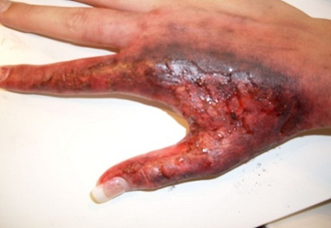
It affects all layers of the skin and can extend to the tissues beneath the skin, such as muscles and bones. It causes the victim to lose sensation in the burned area due to damage to sensory nerves, and the skin becomes charred.
In third-degree burns, the burned area appears waxy white or blackened. The victim does not feel pain immediately after the burn because the nerve endings are damaged.
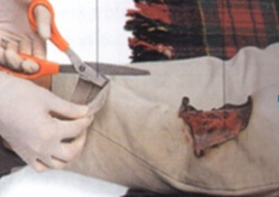
- Do not remove clothing from the burned area to avoid tearing the skin.
- Do not apply cold water or medication to the burn.
- Place a clean, moist piece of gauze on the burn.
- Take the victim to the hospital immediately.
- If the injury is on the foot or hand, elevate it above heart level to reduce blood flow.
- If the burn is on the face, monitor for any breathing difficulties.
- Fourth degree burns
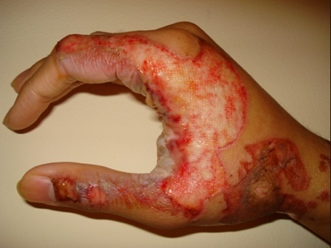
Burns caused by fire in individuals who are in a coma
and unable to move away from the flames, during explosions, or from lightning
strikes and high-voltage electricity are treated with limb amputation and major
cosmetic surgeries for the remaining body parts.
Secondly, burns are classified based on the surface area of the affected part:
1. Minor Burn: Covers less than 15% of the body surface area in adults and less than 10% in children.
2. Moderate Burn: Covers 15–25% of the body surface area in adults and 10–20% in children.
3. Severe Burn: Includes burns affecting the head, circumferential burns involving the limbs, chest, genital area, and joints. In such cases, the victim must immediately go to a burn center for appropriate treatment.
- Symptoms and Signs of Burns Affecting the Throat and Airways
When the airways or the throat and mouth are affected by burns, the following signs may be observed:
· Brown or black spots around the mouth or signs of burns on the lips.
· Burn lesions on the head, face, or around the neck.
· A feeling of hoarseness in the throat or sometimes a burning pain.
· Changes in voice tone.
· Difficulty breathing.
· Episodes of irritating coughing.
· Presence of singed nasal hair or eyebrows.
· Dark, carbon-stained mucus discharge from the nose.
Complications of burns:
1. plasma loss
2. loss of body fluids
3. body tissue rupture
4. Choking
The rule of nines:
The body is divided according to this rule into sections, with each section assigned a percentage of 9%. This allows for a quick estimation of the affected area at the scene of the incident.
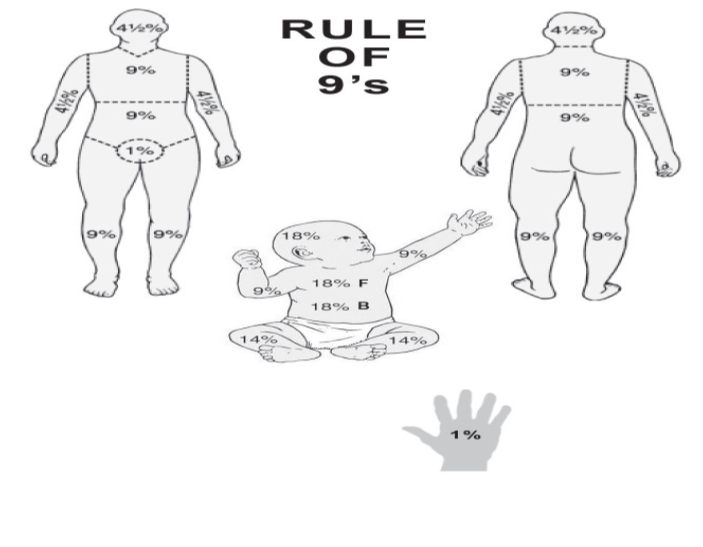
divide Body As follows
- Head = 9%
- Right arm = 9%
- Left arm = 9%
- Front of the torso = 18%
(Chest = 9%, Abdomen = 9%) - Back of the torso = 18%
(Back = 9%, Buttocks = 9%) - Front of each lower limb = 9%
- Back of each lower limb = 9%
- Genital area = 1%
First aid for major burns
• If the injured person's clothes are on fire, lay them on the ground, lying on their back, and cover them with a blanket or rug.
• Open the airway and ensure proper breathing.
• Do not remove anything stuck to the burned area.
• Do not apply ointments or non-medical substances.
• Do not use cold or ice water on large burn areas to avoid shock.
• Cover the burned area with a clean dressing or clothing to prevent contamination.
• Transport the injured person to a medical center for proper care.
• To prevent shock, provide the patient with fluids and electrolytes.
Chemical burns:
These are burns caused by the body being hit by some caustic chemicals such as concentrated acids or strong alkalis. These burns are characterised by being corrosive and puncturing to the body and penetrating deeply
First aid for chemical burns
• Make sure you are safe from caustic chemicals
• Remove clothing from over the burned area
• Remove any watch or accessories that have been exposed to the chemical
• Wash the burned area with cold water for at least 20 minutes in case of liquid chemicals, then apply cold compresses
• Remove powdery chemicals with a brush before washing
• Cover the entire burned area with a clean dressing or clothing to prevent contamination
• Transfer the injured person to the nearest hospital if the burn becomes second degree , there is severe pain, or the burn extends to the eye, face, or genitals
Electrical burns
Electrical burns are caused by exposure to high voltage electricity. Electricity causes injury at the point where the electric current enters and exits
First aid for electrical burns
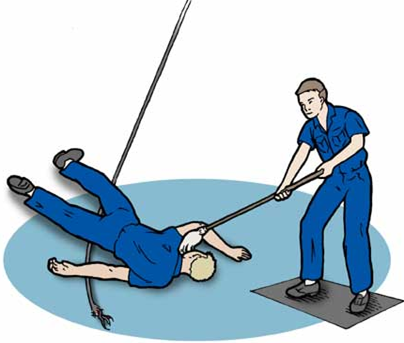
• Do not touch the victim if he is still connected to electricity
• Disconnect the power source
• Use a long, dry stick made of insulating material to move the source of electricity away from the victim .
• If the cause of the electricity is high voltage, keep a distance of several meters away from the injured person and do not approach him
• Make sure that the injured person is breathing and that his heart is still beating by feeling the pulse
• Immediately begin CPR if necessary
• Cover the burn with a sterile bandage, cover the patient with a clean sheet, and seek immediate help.
Call the ambulance (123) in the following cases:
- Difficulty breathing
- Cardiac arrest
- Cardiac arrhythmia
- Severe burns
- Convulsions
- Deterioration or loss of consciousness
Fire prevention, safety and early warning methods that reduce damage and losses
• Smoke detectors should be installed, and they must be connected to fire alarm bells in homes and workplaces.
• Fire extinguishers should be provided in every corner of the home and workplace, and their functionality should be regularly checked.
• Water hose cabinets for firefighting should be installed in homes and workplaces.
• Raise awareness among children by teaching them safety and prevention methods, especially in using devices that could potentially cause fires. Safety rules regarding fire hazards should be taught to them, making them aware of fire sources and the causes of burns. These educational lessons should be provided both at home and in school. Children should be advised against playing with flammable materials such as gas stoves, matches, gasoline, fireworks, faulty electrical appliances, exposed electrical wires, or placing conductive materials in electrical outlets, or playing with burning candles, among other dangerous behaviors.
• All citizens, workers, and students should be trained on proper fire extinguishing methods based on scientific principles. This training should be conducted periodically. Additionally, fire-related authorities such as civil defense, Red Crescent, and emergency departments in hospitals should organize regular practical training sessions supported by awareness lectures. These programs should educate people on the causes of fires, how to combat them, how to prevent them, and how to reduce their spread. Training should also include how to deal with burns and provide first aid to victims to save lives, prevent complications, and alleviate their anxiety and pain before specialized medical help arrives.
• Strict laws should be enacted to mandate the installation of emergency staircases and doors in every residential or commercial building, to be used for escape in the event of a fire.
Good habits for dealing with burns, and common bad habits for dealing with burns
➡️ Don't do (bad habits) with burns | ➡️ Do (good habits) with burns |
➡️ Do not use ice, toothpaste, flour, butter, oil, or eggs to soothe a burn ➡️ Do not use dirt or sand to avoid contaminating the wounds and hindering the cleaning process ➡️ Do not open skin burn blisters ➡️ Do not use cotton directly to cover wounds, as it will stick to the burn ➡️ Do not remove clothing quickly if it is stuck to the burn to avoid causing skin injuries ➡️ Do not continue to wear clothes that have been spilled with caustic chemicals | ➡️ Immerse the burned part of the body under cold running tap water ➡️ Sterile and clean materials should be used to cover the wound ➡️ Cool down Clothes With water cold if difficult Take it off ➡️ Take off Jewelry before Occurrence Swelling ➡️ Remove clothing that has been spilled with caustic chemicals ➡️ Go to the nearest medical center quickly |