
Book
Infertility in Cattle
- Body Condition Score (BCS) in Cattle
Body condition refers to the relative amount of subcutaneous body fat or energy reserve. It identifies the degree of preparedness of animals to meet the specific production task expected, whether quantity and/or quality. It is a visual assessment of the animal’s state of fatness and is expressed as a numerical score typically ranging from 1 – 5 (although some species use a range of 1 – 9) with 1 indicating very poor condition (i.e. emaciated) and 5 representing excessive fat deposition (i.e. obese) Often scores will be further subdivided into quarters, or tenths or +/- to provide greater precision.
Cattle Body Condition Scoring
It is an important management tool for maximizing milk production and reproductive efficiency while reducing the incidence of metabolic and other peripartum diseases in dairy cows. Most body condition scoring (BCS) systems in dairy cattle use the 5-point scoring system (Wildman et. al.1982) with 0.25 increments. Over-conditioning (BCS>4.0) at the time of calving results in reduced feed intake and increased incidence of peripartum problems. While the under-conditioning at calving (BCS) often results in less peak milk yield and lower milk for the entire lactation. The excessive loss of body condition in early lactation has been shown to reduce reproductive efficiency.
A flow chart system has been developed as an organized process for BCS dairy cows (Ferguson et al., 1994). This system concentrates its accuracy toward the mid scores (2.5 to 4.0) as the mid-range BCS are the most critical for making management decisions. The flow chart directs the scorer to view certain anatomical sites of the loin and pelvic areas.
Steps of BCS flow chart:
1- Determine if the line from the hook bone, to the Thuri, to the pin bone is angular (V) (BCS ≤ 3) or crescent (U) (BCS ≥ 3.25).
2- If uncertain of the V or U proceed to the next step. View the cow from the rear. Observe the amount of padding over the hook and pin bones and the prominence of the tailhead and sacral ligaments.
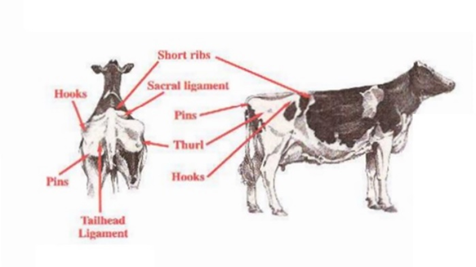
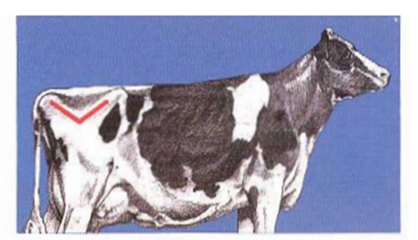
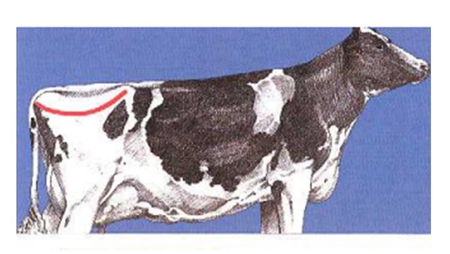
Grades of BCS in cattle (Huţu & Onan, 2019)
|
BCS |
Description |
|
1 |
Cows in poor physiological condition; no palpable fat deposit. |
|
2 |
Spinous processes of loins are individually visible; no fat in stifle region; Thurles concave; tail-head depression deep. |
|
2.5 |
Thin cows; insufficient fat deposits; discrete spinous processes; very little flank fullness; Thurles concave, relatively deep tail-head depression; concave loin shape with minimal fat deposition. |
|
3 |
Well-fed cows; spinous processes still discretely visible; flanks slightly concave; tail-head depression smooth. |
|
3.5 |
Defines the ideal condition of cows during the 2nd third of lactation; if in the final third of lactation, the cow still needs to develop the condition. Spinous processes are no longer individually visible (the top of the back is straight); flanks are nearly smooth; thurls are flat; the tailhead cavity is filled with fat tissue. |
|
4 |
Identifies condition goal for cows at calving (too much condition for other production stages); spinous processes not visible--flat line profile; flanks full; thurls flat; tailhead cavity bulging with rolls of fat around tailhead itself. |
|
5 |
Overfat conditions leave cows prone to metabolic disorders; spinous processes are set deep within a fat layer; bulging flanks, bulging thurls; bulging fat in tailhead depression and around the tailhead base. |
