كتاب
Equine fluid therapy
- Basics of Body Fluid
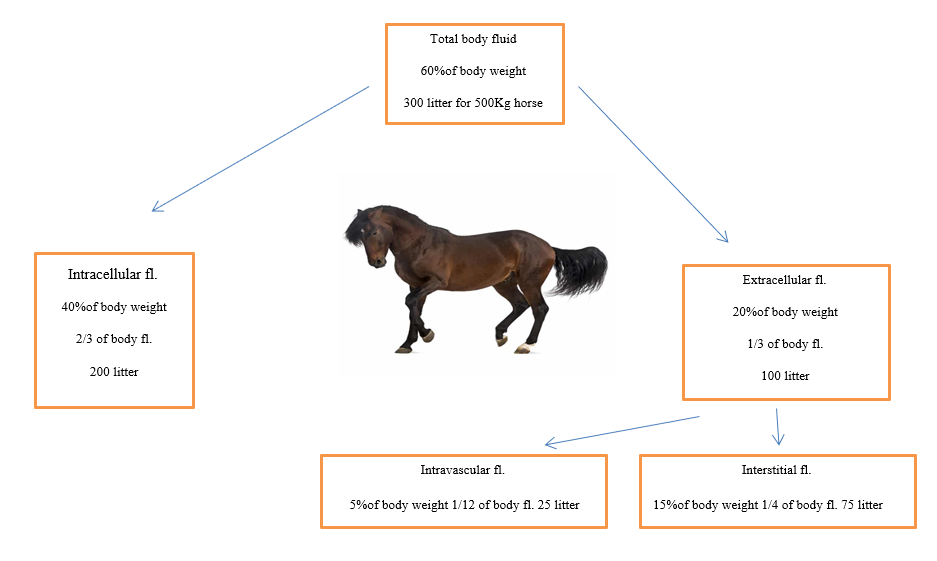
- An adult horse contains about 60% fluid of its body weight.
- Intracellular fluid (ICF)
which include (Ca, Mg, K, PO4 and protein) consists of about 2/3 of total body fluids.
- The extracellular fluids (ECF)
which include (Na, Cl and Hco3) consist of about 1/3 of the total body fluids. It is divided into three sub compartments interstitial, intravascular, and transcellular.
a- The interstitial contains 3/4 of all the fluid in the extracellular space.
b- The intravascular contains1/12 of body fluid, the fluid mostly plasma, that is within the blood vessels 5% of body weight .
- The fluid in the transcellular compartment is produced by specialized cells responsible for cerebrospinal fluid, gastrointestinal fluid, bile, glandular secretions, respiratory sections, and synovial fluids.
- Daily water intake is about 10% of the body weight (can vary from animal to animal with respect of their age, environment, feed intake etc.).
- Daily water loss equals daily intake and this loss occurs through the skin, lung, kidney and gastrointestinal tract.
- Body water contains solutes (substances that dissolve in solvent).
- Electrolytes are substances that split into ions when placed in water.
- Primary ions in the body are sodium, potassium, chloride, phosphate, and bicarbonate.
- Cations are positively charged ions.
- Anions are negatively charged ions.