
Book
The Planning Process in Nursing Management
- Planning
Definition of planning
· It is setting the necessary plans to achieve the goals and it is the primary function on which the rest of the other management functions depend
· It is a mental process that depends on logic and order, in which an effort is made to clarify the goals that the administration wants and to search for the best means to achieve them, as well as to try to predict or anticipate the obstacles that may hinder it and how to overcome them
Therefore, planning is essential for time management and thus facilitates the implementation process The planning function also requires reaching answers to the following questions in a systematic manner
· What? Where? When? How much? How??
Since the planning function is a complex and diverse function, it is recommended that all team members participate in it by answering these questions
|
Determine the required activities |
|
|
Beginning and end of each activity |
|
|
Identify who is responsible for each part |
|
|
How it works |
|
|
The place where the nursery is to be built |
|
The importance of planning
The importance of planning is represented in the following points
- Focuses efforts on achieving desired goals
- Enables optimal use of human and material capabilities
- It helps workers cooperate, coordinate their efforts and achieve their production efficiency
- It is considered the basis for monitoring implementation, performance evaluation and the extent to which objectives are achieved
- It helps to detect problems before they occur and provides an opportunity to correct the course if necessary
Steps to make the plan
The plan process includes the following steps
- Define the goal and collect data on
- Current status
- Available possibilities
- Statistics and reports
- Develop a set of plans and alternatives to achieve the goal, specifying the cost and implementation period
- Study the steps, compare them and choose the best one
- Set priorities and put the plan into action
Preparing the action plan, which is summarized in the following table
|
Responsible for follow-up |
Evaluation Officer |
Task performance evaluation |
Time limit for implementation From - To |
Executive Officer |
Task to be done
|
|
|
|
|
|
|
|
|
|
|
|
|
|
|
|
|
|
|
|
|
|
Characteristics of a sound plan
A sound plan has the following characteristics
- Exploiting the available capabilities in implementation, which will lead to reducing the cost
- Choose a plan that achieves more than one goal
- Flexibility to allow for necessary adjustments in the event of difficulties or unexpected changes during implementation
- To be written and known to those who carry out the implementation
- To be integrated and consistent in its components and not to have any conflict in its parts
- Involvement of those who will implement it in the planning process, which helps in its efficient implementation
- To be based on realistic data and statistics
Planning obstacles
The most important obstacles facing the development of a sound plan are the following
- One person (top management) makes plans
- Freezing the planning process in formal templates makes it lose flexibility and simplicity
- Lack of interest in reviewing plans periodically to determine the level of the leader / according to the goals Sudden decisions are made outside the scope of the plan
- Management performs daily executive tasks and allocates less time for strategic planning
- Not caring about setting goals The facility
- Lack of involvement of executives in the planning process
- Not relying on plans as criteria for measuring and evaluating managers’ performance
Characteristics of successful planners
· Curiosity
· Creativity
· Competitiveness
· Self-confidence
· Perseverance
· Wisdom
· process (practical person)
Why don't we plan?
· instability and impatience
· Lack of conviction in the usefulness of planning
· Ignorance of planning and lack of knowledge Its importance
· Lack of familiarity with planning skills
· fear of the unknown
· Not knowing priorities and arranging them according to importance
Types of planning
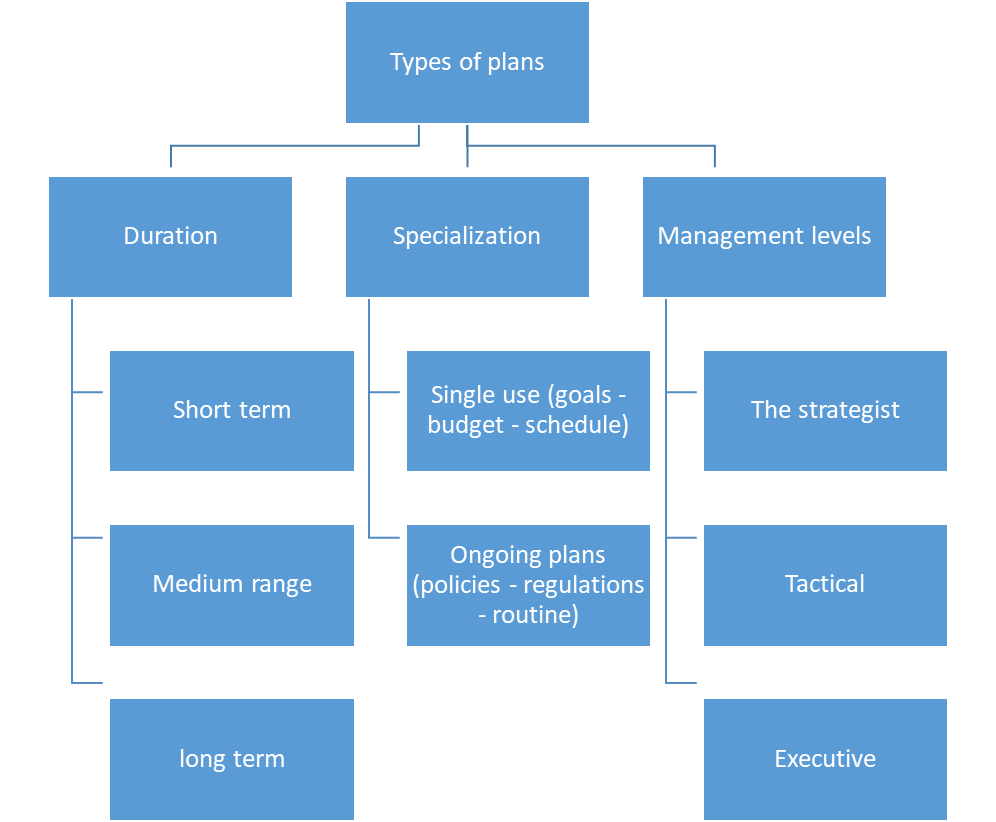
According to the administrative levels, it is divided as follows
1-Strategic planning
called long- term planning, which requires 5-10 years to achieve it also defines the general objectives of the organizatio It is
2- Tactical planning
He is primarily concerned with implementing strategic plans at the middle management level It is called medium term planning Which needs to be achieved by 1 - 5 Years
3- Operational planning
Focuses on planning the needs to accomplish the specific responsibilities of managers, divisions, or departments It is called short term planning Which needs from one day to 12 months to achieve
SWOT analysis
This means identifying the strengths and weaknesses in the internal environment of the organization , which it has control over, and the opportunities and threats in the external environment, which constitutes a pivotal element in the process of preparing the strategic plan, by providing a general framework for thinking about the internal and external environment of the organization
It is an analytical framework within the planning process for analysis
• Internal environment Strengths and weaknesses
• External environment Opportunities and Threats
Why do we use the approach SWOT in analysis?
Analysis points help in preparing a plan that takes into account many internal and external factors, and increases the possibility of taking advantage of the strengths and available opportunities And reduce the impact of weaknesses and threats
Necessary requirements before starting to conduct a SWOT analysis
• Clearly define the roles and tasks you must perform
• Internal or self- resource assessment
• Analyze and understand the external conditions related to the organization
The internal environment of the institution
· The internal environment is all the operational areas within the organization (financial management, human resources, programming, activities , etc)
· The organization must identify the strengths and weaknesses in implementing its functional and administrative performance ( since any organization will not It has equal relative powers in all its practical (functional ) areas
· This helps the organization prepare alternative strategies to take advantage of opportunities and avoid threats
Internal Environment Analysis Basics
Analysis process The internal environment of the organization helps to identify strengths and weaknesses
This process is based on the use of specific criteria that help in making comparisons, the most important of which are
• Past performance analysis
• Comparison of rates and ratios
• Analysis of the indicators of the work of this NGO compared to other organizations
• Compare the performance of this NGO with the ideal performance of other organizations
Strengths
Strengths are actually internal capabilities that exist in the organization and help to take advantage of available opportunities and combat threats
The questions
· What are you good at ?
· How are our competitors ?
· What are our resources?
Weaknesses
The presence of any factors or conditions Weakness prevents the organization from meeting its needs and taking advantage of available opportunities
Questions
What are our weaknesses ?
What are the most annoying things for our service users?
Opportunities
• They are any external conditions or specific situations that facilitate the achievement of general goals
The questions
• What external changes or conditions help in implementing the program?
Threats
Any conditions or situations that affect the efficiency of the organization
The questions
What external changes or conditions could affect the organization or program?
Practical planning skills
One of the most important skills of a successful leader is making decisions and solving problems
