
Book
Traumatic Brain edema
- Introduction
Posttraumatic cerebral edema is a complex process. The incidence is around 60% in trauma-related hematoma or mass lesion and around 15% without mass lesions. cerebral edema is described as a special condition of the brain with excessive tissue volume due to the increase water content in the brain. The excessive tissue volume leads to increase in intracranial pressure (ICP) and decrease cerebral perfusion pressure (CPP), which eventually increases the mortality after traumatic brain injury (TBI). Diverse pathways are involved in the development of cerebral edema after brain injury. 1
Mainly two types cerebral edema occur after TBI-vasogenic edema and cytotoxic edema. Vasogenic edema is the fluid accumulation in interstitial space, and cytotoxic edema is swelling of the cells. 2
Cytotoxic edema occurs due to the involvement of different pathways or ionic channels and correlates with the secondary type of brain injury.3
Vasogenic edema develops due to disruption of the blood-brain barrier (BBB) or altered permeability of BBB and correlates with the level of impact and activation of molecular pathways related with neuroinflammation. Occasionally, mixed type of cerebral edema exits due combination of the vasogenic and cytotoxic component.4
Symptoms appear as the intracranial pressure (ICP) rises above 20 cmHg in most patients. Treatment for cerebral edema targets the underlying cause and any life-threatening complications. Treatments include hyperventilation, osmotherapy, diuretics, corticosteroids, and surgical decompression.5
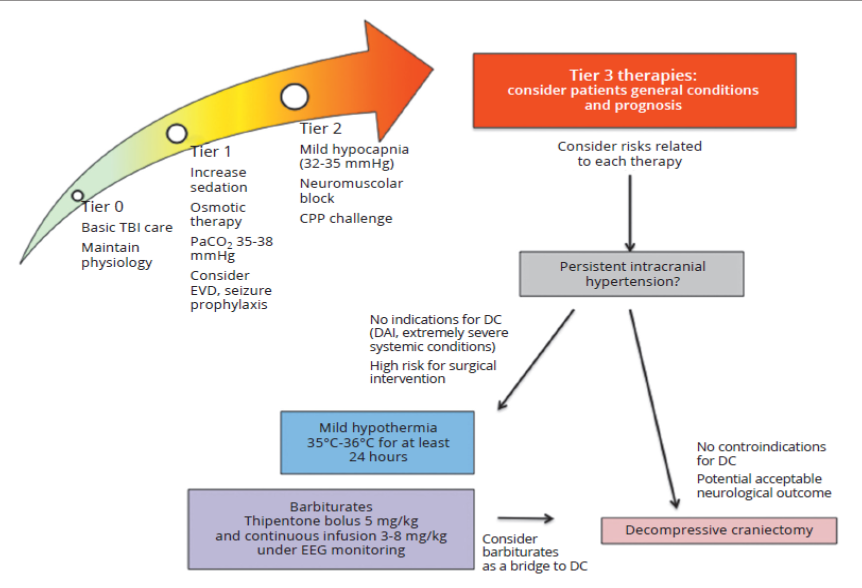
Staircase clinical approach to the use of tier-three therapies for the management of increased intracranial pressure.
