
Book
Rationalizing the use of caesarean section in Egypt through implementing 10 group Classification system
- How to classify women in Robson classification?
This can be as simple as going manually through each patient record looking for the core variables and adding a manual note with a pencil with the number of the Robson group. Or, it can be as complex as asking a team of information specialists to create software which picks the core variables in the electronic patient record and automatically assigns the specific Robson group to each record, based on pre- established formulas. (See table 4 )
The following flow chart (fig 2 ) provides guidance about the order in which the categorization can be most easily performed. Cases with missing data (no information in one or more of the six core variables) should be categorized as “Unclassifiable” and the missing variable should be noted to facilitate analyses of these cases.
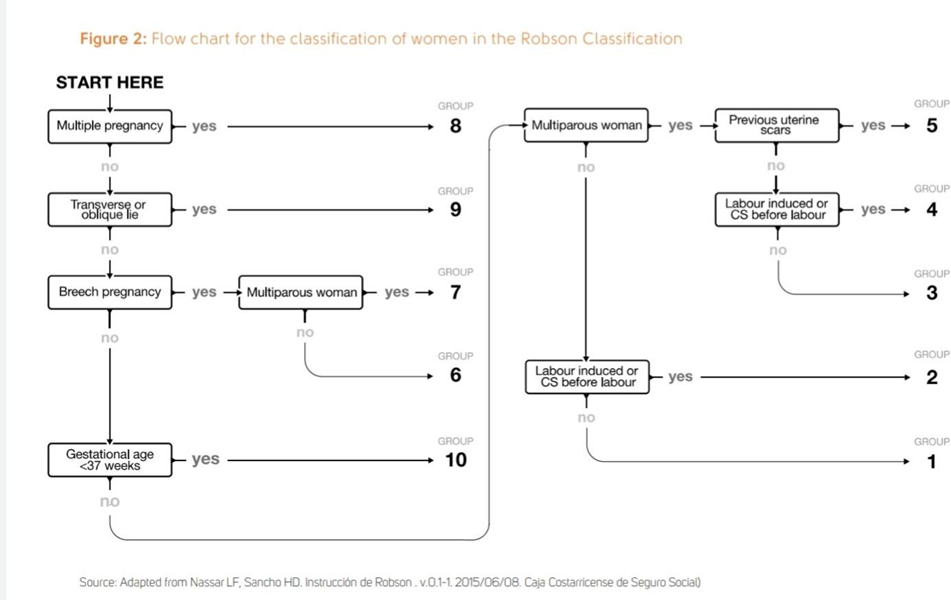
Table 4: Summary of specifications for variables in each Robson group
|
Grou p |
Parit y |
Previou s CS |
Numb er of fetuses |
Fetal presentatio n or lie |
Gestationa l age (weeks) |
Onset of labour |
|
1 |
0 |
No |
1 |
Cephalic |
≥ 37 |
Spontaneou s |
|
2 |
0 |
No |
1 |
Cephalic |
≥ 37 |
Inducedor CSbefore labour |
|
3 |
≥ 1 |
No |
1 |
Cephalic |
≥ 37 |
Spontaneou s |
|
4 |
≥ 1 |
No |
1 |
Cephalic |
≥ 37 |
Inducedor CSbefore labour |
|
5 |
≥ 1 |
Yes |
1 |
Cephalic |
≥ 37 |
Any |
|
6 |
0 |
No |
1 |
Breech |
Any |
Any |
|
7 |
≥ 1 |
Any |
1 |
Breech |
Any |
Any |
|
8 |
Any |
Any |
≥
2 |
Any |
Any |
Any |
|
9 |
Any |
Any |
1 |
Transverse or Oblique |
Any |
Any |
|
10 |
Any |
Any |
1 |
Cephalic |
< 37 |
Any |
NB ( you will receive a program that can automatically calculate the Robson classification after this workshop ) This table should be filled on cases by case basis by the attending resident or specialist of the hospital then robson group assigned and verified either manually or electronically.
Examples of women classification in Robson groups (Table 5 ) (Can be done as exercise to practice)
Table 5
|
Parity senarios |
Robson Group and Explanation |
|
Emergency cs for full term nullipara cephalic single due to fatal distress |
Robson 1 |
|
G5P4 28 weeks vaginal delivery |
10 |
|
G4P0+3 spontaneous labor 38 weeks single cephalic |
1 |
|
G2P1 with previous myomectomy ,for elective CS 38 weeks single cephalic |
2 ( only if previous scar uterus due to cs should we consider class 5 ) |
|
Onset of labour senarios |
|
|
G1P0 39 weeks single cephalic presentation in labour (3 contractions /10 min and rupture memberanes ) |
1 |
|
The same previous case ( monitor after 4 hours showed no progress of cervical dilatation so oxytocin was infused for augmentation of labor .will this change the group |
NO still it is group 1 |
|
G3P2 gestional DM planned for elective cs on 39 weeks .came on spontaneous labour 38 weeks cephalic single |
Group 3 (actual status is spontaneous and the classification always considers howlabourstartedin thecurrent pregnancy, regardless of how delivery wasplanned. |
|
G4P3 full term single cephalic .planned foe elective cs due to marked oligohydramnios |
2 |
|
Multiple pregnancy senarios |
|
|
G2P1 twin first breech |
8 ( All women with multiple pregnancies regardless of the first baby presentation ) |
|
G1P0 twin pregnancy at 8 weeks then vanishing twin and at at 39 weeks in spontaneous labour, the live fetus is in cephalic presentation |
1 ( the current situation is single pregnancy ) |
|
A 42 year old multipara (2 previous CS) was diagnosed by ultrasound with a twin pregnancy at 10 weeks. At 31 weeks, she is admitted because of severe preeclampsia and fetal growth restriction, with both fetuses alive. On the second day, one of the fetuses dies. She is immediately taken to the labour ward for a pre-labour CS. The presenting fetus is breech and dead.The surviving fetus is cephalic. How should I classify this woman: in Group 5.2, Group 7 or Group 8? |
8 as twin ( the death of one twin occur after medico legal viability age ) |
|
Presentation senarios |
|
|
G4P3 in spontaneous labour at 39 weeks, 5 cm dilated, with ruptured membranes, and a singleton fetus in cephalic presentation with a hand alongside the head. Should I classify her in Group 3 or in Group 9? |
This woman should be in Group 3. As long as the presenting part is the fetal head, this is considered a cephalic presentation. Group 9 is only for women in transverse or oblique lie possible with a prolapsed arm which is not the case here. |
|
G1P0 in spontaneous labour at 38 weeks, 8 cm dilated, with a face presentation? |
This woman belongs in Group 1. All face, brow or compound cephalic presentations should be categorized in Group 1. As long as the presenting part is the fetal head, this is considered a cephalic presentation. |
|
Fetal age and malformation |
|
|
G1P0 32 weeks, fully dilated, with a live singleton cephalic fetus and umbilical cord prolapse. Should this woman be classified in Group 1, 10 or Group 9? |
Group 10 because it includes all preterm singleton, cephalic pregnancies. Group 1 is not for her because her pregnancy is not at term (37 weeks or more) and Group 9 is only for transverse or oblique lies, which is not her case. |
|
G3P2 previous 2 CS 30 weeks, with severe pre- eclampsia, not in labour, with a dead fetus in breech presentation. Should this woman be included in the Robson Classification at all since her fetus is dead? If we classify her, does she belong in Group 5, Group 7 or Group 10? |
The Robson Classification does not exclude stillbirths; therefore, this woman should be included in the classification. She belongs in Group 7 because it includes “All multiparous women with a single breech including those with previous CS”. She does not belong in Group 5 or Group 10 because the fetus is breech and these groups only include cephalic presentations. |
|
G3P2 with an anencephalic fetus is admitted at 28 weeks for induction. The fetus is dead and in a cephalic presentation. Should we classify her at all in the Robson Classification? If we classify her, should she be categorized in Group 2 or Group 10? |
The Robson Classification does not exclude malformed or dead fetuses; therefore, this woman should be included in the classification. She belongs in Group 10, which includes all women with a single cephalic preterm fetus; the fact that the fetal head has a malformation does not change the fact that the presentation is still cephalic. Group 2 is for term, cephalic presentation, which is not the case here. |