كتاب
Equine Laminitis
- Prognosis of laminitis
- Rapid diagnosis of laminitis with modern therapies the most laminitic horses will be able to bear a rider or completely recover, if treated quickly, and if the laminitis was not severe or complicated (e.g. by equine metabolic syndrome or Cushing's disease). Even in these cases, a clinical cure can often be achieved.
- Endotoxic laminitis (e.g. after foaling) tends to be more difficult to treat.
- Successful treatment requires a competent farrier and veterinarian, and success is not guaranteed.
- A horse can live with laminitis for many years, and although a single episode of laminitis predisposes to further episodes.
- Most of the horses suffering an acute episode without pedal bone displacement make a complete functional recovery.
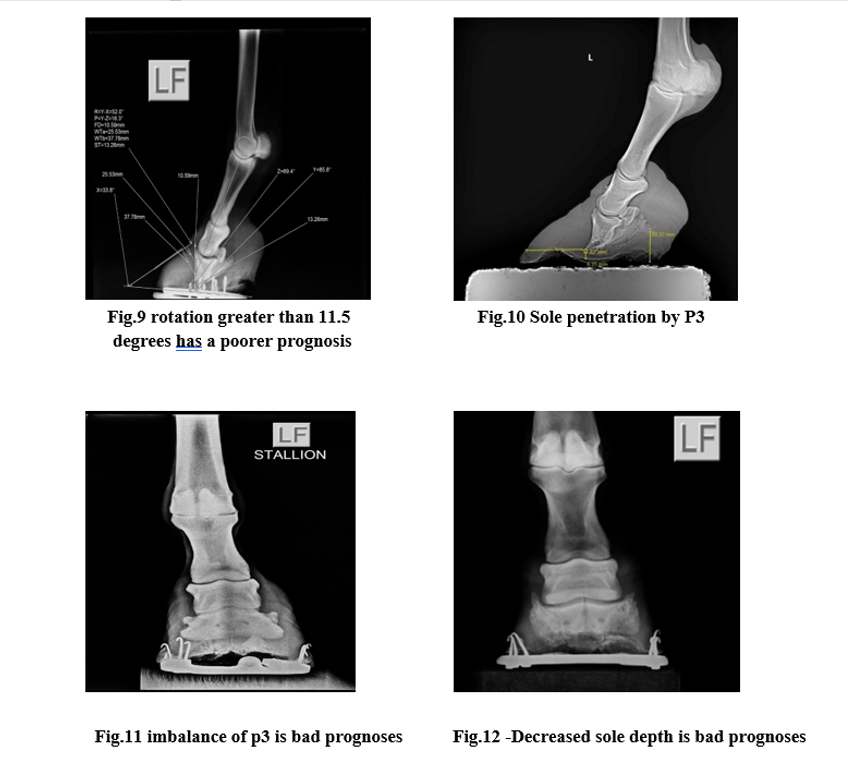
Several radiographic abnormalities can be judged to correlate with a worsened prognosis:
- Increased degree of rotation of P3 relative to the dorsal hoof wall (rotation greater than 11.5 degrees has a poorer prognosis).
- Increased founder distance, the vertical distance from the coronary band (seen with a radio-opaque marker) to the dorsoproximal aspect of P3 (distance greater than 15.2mm has a poorer prognosis).
- Decreased sole depth.
- Sole penetration by P3.