كتاب
Equine Laminitis
- Trimming and shoeing
Trimming
1- Correct trimming can help improve stabilization. This usually includes bringing the "break over" back to decrease the fulcrum-effect that stresses the laminae.
2- Trimming the heels helps to ensure frog pressure and increases surface area for weight-bearing on the back half of the hoof.
3- Altering the palmar angle. Often with the use of special shoes which have a wedge in the heel of approximately 20 degrees. The position of P3 within the hoof is monitored with radiographs.
4- Corrective hoof trimming will restore proper hoof form and function. Corrective trimming will allow the hooves to be healthy again.
Shoeing
There are three main considerations involved in shoe selection and shoeing technique these principles based on history, physical examination, and radiographs:
(1) The position of the breakover point
To improve the ease of movement by decreasing the stresses within the dorsal lamellae, the optimal position for the point of breakover should really be in horses can be obtained by drawing a line on the radiograph from the dorsal margin of the distal phalanx to the line indicating the desired plane of the trim and perpendicular to it . The point of breakover is positioned ~6-9 mm dorsal to the junction of the two lines which can significantly decrease the amount of weight-bearing ground surface of the foot.
(2) Whether to provide support for the ground surface of the frog and sole.
(3) Whether to elevate the heels.
- To decrease the tension in the DDFT, which the decreases the pressure of the distal interphalangeal joint with the intention of decreasing the stresses within the dorsal lamellae.
-This is usually most appropriate in horses with phalangeal rotation that are landing toe first.
- The amount of heel elevation varies between 2° and 4°. Heel elevation may be obtained with wedged shoes, bar wedge inserts, or rails.
- The efficacy of heel elevation is best judged by the comfort of the horse, after trimming at rest and walking.
- Ideally, the heel elevation is such that the horse just lands heel first. If a horse lands markedly heel first, there is too much heel elevation, and if it lands toe first, there is not enough heel elevation.
- Unfortunately, prolonged heel elevation may result in heel contracture, which potentially causes the heels themselves to become painful. Thus, it is prudent, if using heel elevation, to remove it as rapidly as possible compatible with the improvement in lameness.
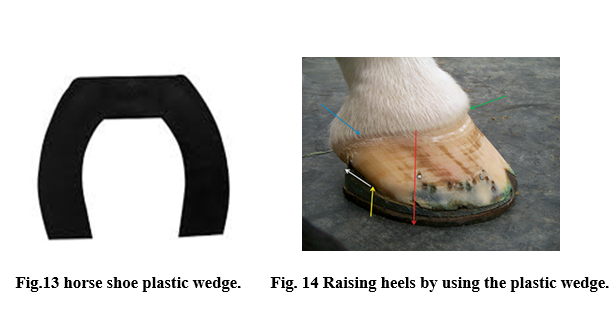
Types of Shoes can be used with laminitic horses
Success technique increases with the experience of both the veterinarian and the farrier.
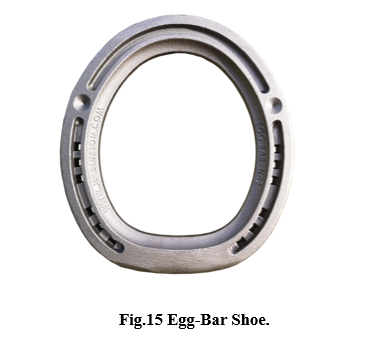
1- Egg-Bar Shoe:
- The egg-bar shoe is a closed heel shoe in which the bar extends palmarly.
- This palmar extension act as a lever if the shoe extends too far beyond the heels. Specifically, if the horse is kept on deep soft bedding, it causes the heels to remain higher on the bedding than the toe and can act as a heel wedge.
- In horses with chronic laminitis, egg-bar shoes should be used in conjunction with a synthetic polymer to provide support to the ground surface of the foot depending on the degree of stability of the distal phalanx, heel elevation may be obtained by using a wedged rim pad or a manufactured wedge shoe.
- The disadvantage to this shoe is that it does not ease mediolateral breakover.
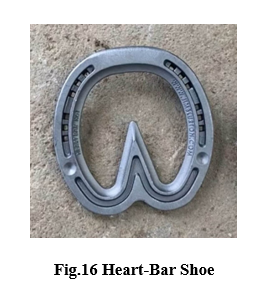
2- Heart-Bar Shoe
-The heart-bar shoe should be positioned in relation to the solar margin of the distal phalanx.
- The apex of the bar should extend to a point 9 mm palmar to the trimmed apex of the frog.
- The heart-bar is thought to enable the frog to load and redistribute some of the weight born by the limb away from the wall.
- Heart-bar shoes are increasingly used in combination with other forms of sole support that are either poured or pressed into the cavity formed between the branches of the shoe and the bar to provide additional support to the ground surface of the foot.
- Disadvantages of this shoe are that its application demands skill, it is difficult to apply heel elevation; the shoe does not address mediolateral breakover.
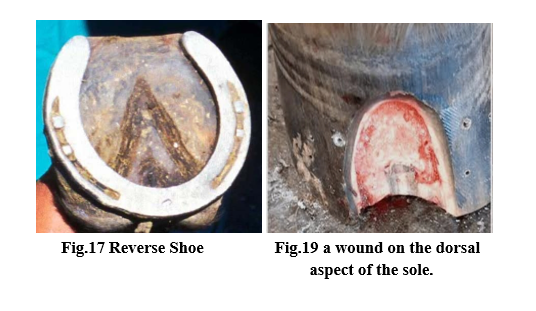
3- Reverse Shoe
- The principle benefits of a reverse shoe are that it moves the breakover palmarly. Because the toe of the shoe is absent, it puts no pressure on the dorsal sole, and it functions as an egg-bar shoe at the heels.
- Depending on the degree of stability within the foot, it must be used with appropriate sole and frog support.
- The principle disadvantage is that it concentrates stress where the dorsal margins of the branches of the shoe contact the wall.
- This shoe is most useful in horses in which there is a wound on the dorsal aspect of the sole that requires treatment and would be covered up by the toe of other shoe types.
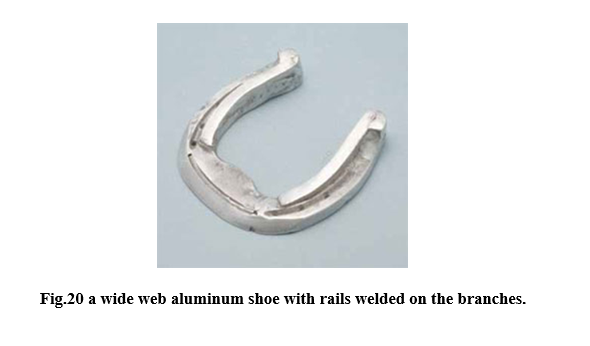
4- Wide Web Aluminum Rail Shoe
- It’s based on an open heeled pattern with square, blunt, or heavily rolled toes.
- This type of shoe makes use of "rails." Rails are narrow, wedge-shaped distal extensions that are applied to the axial side of the ground surface of the shoe.
- They elevate the heels and ease medial and lateral breakover.
- The advantage of the commercial system is that the rails can be changed to alter the height after the shoe has been applied to the horse's foot.
- When using the aluminum rail shoe, the sole and frog support is achieved by applying silicone putty between the branches of the shoe.
- The shoe provides improved breakover, heel elevation, and sole and frog support.
- The wide web aluminum shoe can also be used with a 2° or 3° bar wedge substituted for the rails.
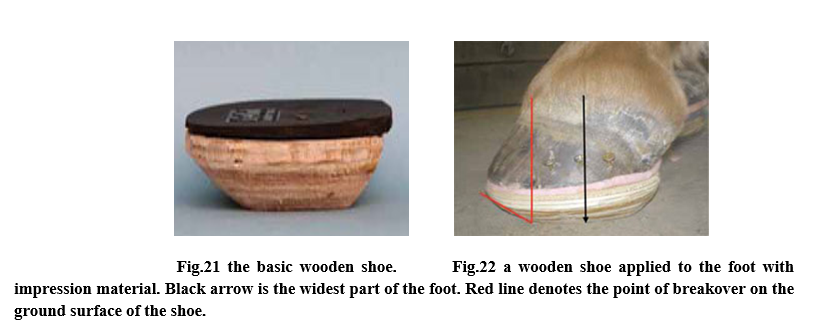
5 - Wooden Shoe
- Is generally fabricated from plywood.
- It is shaped based either on the natural shape of the foot or the closest fitting natural Balance shoe.
- The principle layer is cut out of 3/4-in plywood, and the perimeter is beveled at an angle of 45°.
- This not only moves the breakover palmarly but also moves the medial and lateral weight-bearing surfaces axially enhancing medial and lateral breakover.
- Two main modifications of this pattern have been described. In one, a second layer of 3/4-in thick rubber matting, cut to match the ground surface of the block, is screwed to the ground surface of the shoe.
- The margins of the rubber are beveled in a similar manner to the wood to further enhance breakover.
- In the second modification, a second layer of 1/2- or 3/8-in plywood is cut to match the foot side of the shoe and attached to it with glue and screws. The bevel on the front of the shoe is then increased with a rasp until the point of breakover is positioned to correspond to vertical line drawn from the coronary band.
- A layer of silicone putty is applied between the ground surface of the foot and shoe and allowed to set with the horse in a weight-bearing position.
- The shoe is attached with screws inserted through pilot holes drilled in the distal hoof wall and into the shoe.
- Alternatively, screws can be screwed into the plywood adjacent to the margin of the distal hoof wall and the shoe secured by incorporating the screw heads in a synthetic adhesive applied to the adjacent wall or by placing 2in casting tape around the perimeter of the foot.
- A wedge pad may be applied to the foot surface of the shoe to provide heel elevation if needed.
- If the sole has prolapsed below the level of the wall or if the distal phalanx has penetrated the sole, the foot surface of the shoe is recessed to remove any direct pressure from the sole and the silicone putty removed from that area.