كتاب
Affections Of Specific Parts and Organs of Food Animals
- I. Affections of the Skin
1. Dermatitis
Causative agent: Infectious, allergic, nutritional, or parasitic.
Judgment: Case-dependent.
2. Sheep and Swine pox
Causative agent: Poxvirus
Judgment: With fever: Total condemnation; Without: Condemn affected parts.
3. Lumpy Skin Disease
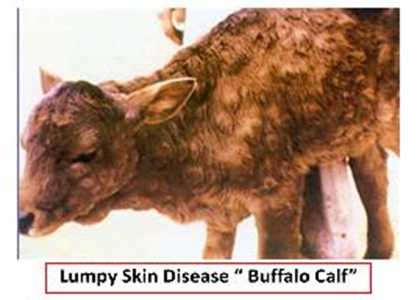
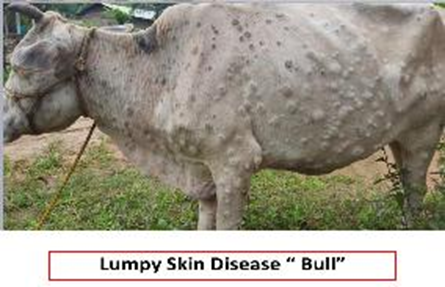
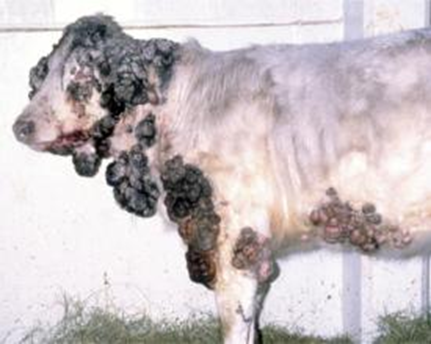
Lumpy skin disease is highly infectious viral disease of cattle characterized by the presence of firm nodules in the skin, lung, digestive and reproductive tracts accompanied by fever and lymphangitis. The nodules may be ruptured leaving ulcers or become indurated..
Causative agent: Mild form of herbs virus.
Appearance: Thickening of the skin with red raised spots become scabs.
Judgment: As in pox, or Removal of affected parts with heat treatment of carcass and viscera.
|
Fig. 1 |
Fig. 2 |
4. Mange
Causative agent: Parasites.
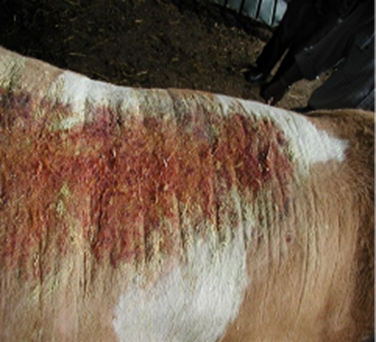
Appearance: Thickening of skin with red raised spots become scabs.
Judgment: In cattle and sheep, condemn the carcass if there is emaciation, while if there is no emaciation, condemn the skin only / In swine stripping of affected skin.
|
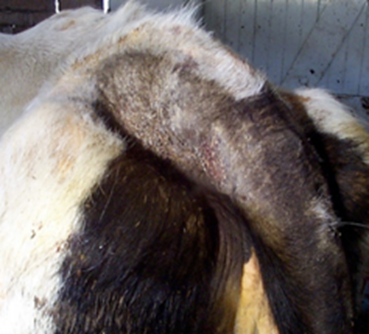
Fig. 3. Severe crusting lesions caused by psoroptic mange in a bull |
Fig. 4. Mange at the trailhead of a dairy cow causing scaling, itching and hair loss |
5. Wounds and Injuries
Causative agent: Trauma, diseases.
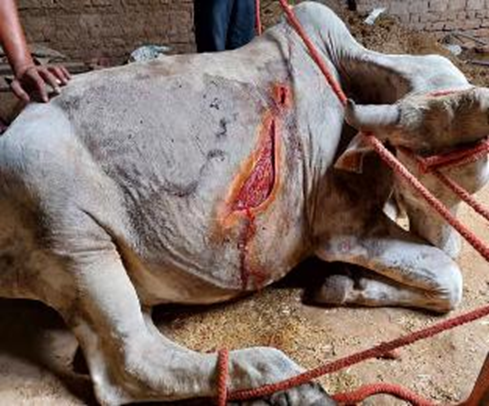
Appearance: May be local lesions or multiple.
Judgment: Total condemnation in the presence of systemic disturbances. / Condemnation of affected parts in absence of systemic disturbances.
|
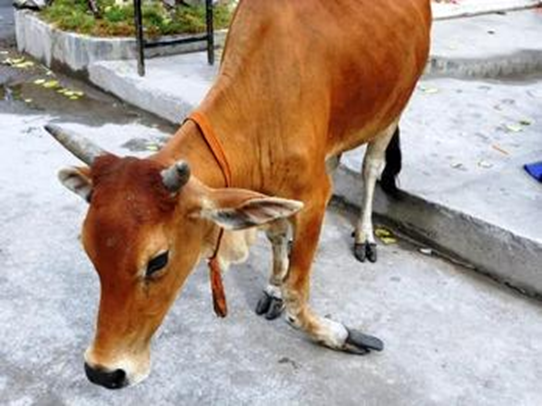
Fig. 5 Fracture |
Fig. 6 Wound |
6. Tumors
As papilloma, melanoma, squamous cell carcinoma.
Appearance: May be benign or malignant
Judgment:
- Total condemnation in malignant tumors.
- Condemnation of affected parts in benign tumors.
|
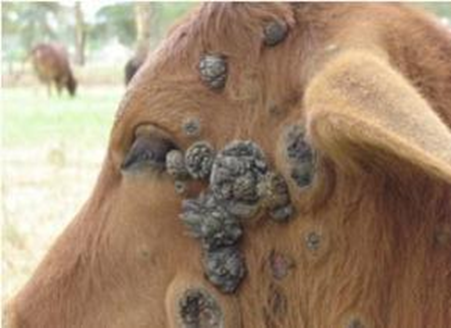
Fig. 7 Squamous cell carcinoma |
Fig. 8 Squamous cell carcinoma |
7. Skin tuberculosis
Causative agent: Mycobacterium tuberculosis.
Appearance:
· Hard painless nodules up to hen's egg. Subcutaneous or intra-dermal of to lymphatic vessels.
· Lesions are found in limbs, fore arm, rarely on chest and shoulders. On section fibrous wall enclosing a caseo-calcareous center or thick yellow gelatinous pus or dried material like powder maize.
Judgment:
· Total condemnation in case of generalization, or localization and emaciation.
· Condemnation of skin in case of localized affection.
8. Acute skin congestion
Acute skin congestion in the pig may be widespread or localized. As in; swine fever, swine erysipelas, urticaria, pig paratyphoid.
9. Transit erythema
Affects pig on long rail journeys in the form of red patches on the skin in contact with floor due to irritant effect of disinfectant and urine on the floor. The condition is localized and the affected areas should be condemned. In severe cases extravasations of blood into the subcutaneous fat occur which only required removal of all colored fatty tissues. While in very severe cases there is congestion of the lymph nodes and fevered appearance of the carcass, which required total condemnation.
10. Foot and Mouth Disease
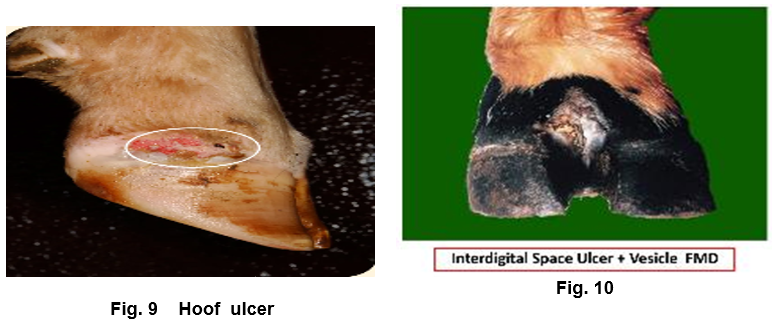
The lesions appear on the lips, muzzle or on the skin of the hoofs in the form of vesicles between the clefts of the feet, on the heel near the digits and / or around the cornet.
11. Ring worm
Ringworm is a common skin lesion affection but of no significance in meat inspection
12. Contagious foot rot ‘Foul of the foot’, Interdigital necrobacillosis “
Foot rot is an infectious disease of cattle associated with Sphaerophorus necrophorus. One or more of the feet may be involved with inflammation and necrosis at the top of the interdigital clefts. In acute stage there is edema and hyperemia of the affected part. In early stages there is sever lameness often with fever and loss of condition. In sheep the condition may be seen around the coronet and may cause emaciation. In local condition the carcass approved for food after condemnation of the affected part.
13. Contagious pustule dermatitis “ORF”
ORF is a highly contagious viral disease of sheep and appears in the form of papule, vesicle, pustule and crust chiefly involving lips and feet. It is a local condition necessitating condemnation of the affected parts, but care should be taken in handling of the infected material, as the disease is transmissible to man.
14. Warble fly
The ox hide may be damaged by the warble fly larvae or ticks bites. These bites may be left a white spots on the skin after tanning.