
كتاب
Affections Of Specific Parts and Organs of Food Animals
- V-Affections of the Pleura
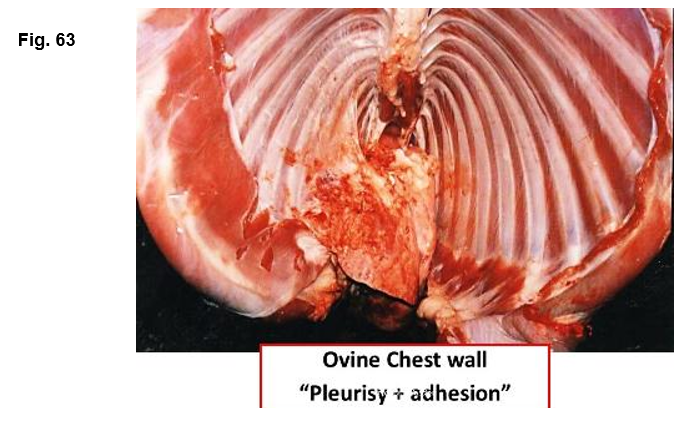
1. Pleurisy
It is the inflammation of the pleura. Usually associated with pneumonia and in acute stage is characterized by fibrinous exudates, which in cattle has red and velvety appearance. Acute pleurisy may tend to assume a chronic form with the production of fibrinous adhesions between the partial pleura and lung surface. This condition required stripping of the pleura.
2. Sub-pleural petechial hemorrhage
The condition may be seen in many septicemic diseases including swine fever, swine erysipelas, & requires total condemnation.
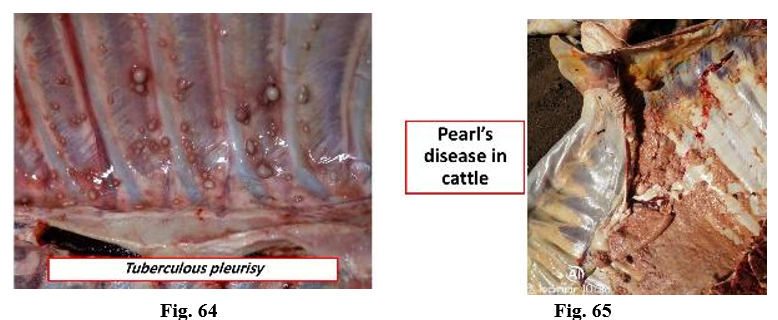
3. Tuberculous pleurisy
|
Localized |
Stripping of the pleura and flaming of the affected part. |
|
Diffuse Acute Chronic
|
Condemnation of full forequarter at 11th intercostal space. Axillary’s negative: Ribbing, oystering, racking. Axillary’s positive: Condemnation of full forequarter at 9th intercostal space. |
Oystering means removal of the dorsal vertebrae, sternum and ribs from the outer muscular mass which is passed for food if the axillary lymph node not affected.
4. Hydrothorax
It is an extensive accumulation of fluids in the pleural cavity. Occurs in congestive heart failure, bovine viral leucosis and generalized edema due to malnutrition.
5. Empyemia
Empyemia refers to the collection of pus in the pleural cavity.
6. Abscesses
Small abscesses containing pale green pus may be seen on the pleura.
7. Back bleeding
Occurs when the pleural membrane at the entrance of the chest is punctured during slaughtering with the aspiration of blood into the thoracic cavity.
