
Book
Introduction to Stroke and the Stroke Care Unit
- Brain Anatomy
The brain contains several essential structures that play major roles in the body’s functions. Its principal components include:
https://youtu.be/9wGSAC1vbyM?si=eV0p6uwipXRg6Ms6
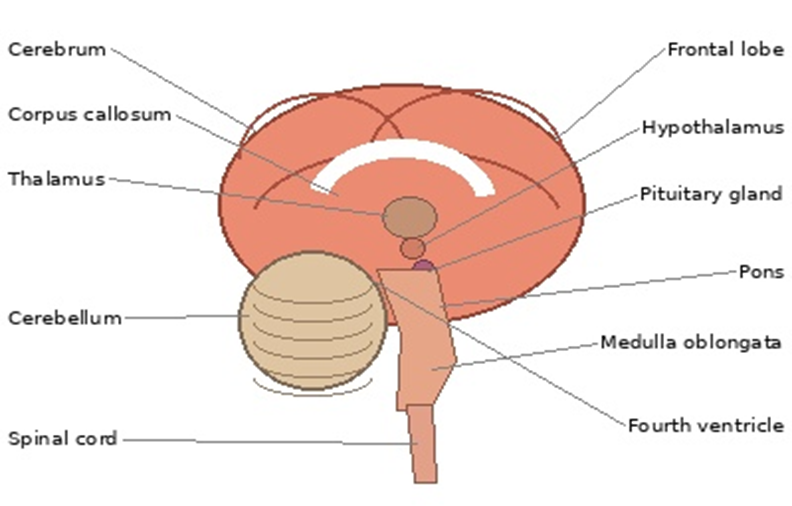
Cerebrum-
The largest and uppermost part of the brain.
It is divided into two hemispheres (right and left); each hemisphere controls activities on the opposite side of the body.
Functions: Controls thinking, memory, perception, emotions, voluntary movement, and interaction with the environment.
Cerebral Cortex:
The outer layer of the cerebrum. It contains neurons and serves as the center for thought, perception, and consciousness. It is divided into four lobes:
Frontal Lobe: Associated with logical thinking, planning, voluntary movement, and emotional control.
Parietal Lobe: Responsible for touch, pain, temperature sensation, and spatial awareness.
Temporal Lobe: Associated with hearing, memory, and language.
Occipital Lobe: Responsible for visual processing.
Cerebellum-
Located below the cerebrum and above the brainstem.
Functions: Controls motor coordination, balance, and the sense of movement, and contributes to learning fine motor skills.
Brainstem:
Located at the lower part of the brain, where it connects with the spinal cord. It consists of:
Midbrain: Helps control visual and auditory movements and reflexes.
Pons: Connects the cerebrum and cerebellum and contributes to the regulation of breathing.
Medulla Oblongata: Controls vital functions such as breathing, heart rate, blood pressure, and digestion.
Internal Brain Structures-
Cerebral Ventricles: Cavities filled with cerebrospinal fluid, which helps protect the brain.
Thalamus: Serves as a major relay center for sensory information traveling to the cerebral cortex.
Hypothalamus: Regulates essential body functions such as temperature, hunger, thirst, and the sleep-wake cycle.
Pituitary Gland: Produces hormones that regulate growth, reproductive functions, and many other body processes.
Areas Responsible for Movement and Language-
Broca’s Area: Located in the frontal lobe and responsible for speech production.
Wernicke’s Area: Located in the temporal lobe and involved in language comprehension.
These structures are intricately interconnected to ensure that all body functions are performed properly and in a coordinated manner.
Relationships Between the Structures:
The brain communicates with the rest of the body through the spinal cord, which transmits electrical signals that regulate different functions.
The brain integrates multiple functions to coordinate sensation, movement, and emotional control.
Neuroanatomy of Stroke
The brain receives its blood supply through major blood vessels, including the carotid and vertebral arteries. When one of these vessels becomes blocked or ruptures, blood flow to specific areas of the brain is interrupted, resulting in oxygen deprivation and damage to neural tissue.