
Book
Introduction to Stroke and the Stroke Care Unit
- Symptoms of Stroke:
Symptoms of stroke or TIA usually begin suddenly and vary according to the precise location of the cerebral blockage or bleeding. Each area of the brain is supplied by specific arteries. For example, if an artery supplying the area that controls movement of the left leg becomes blocked, the leg may become weak or paralyzed. If an area responsible for touch sensation in the right arm is damaged, sensation in that arm may be lost.
Consequences of Damage to Specific Brain Areas
Different brain regions control specific functions; therefore, the function lost depends on the location of the brain injury.
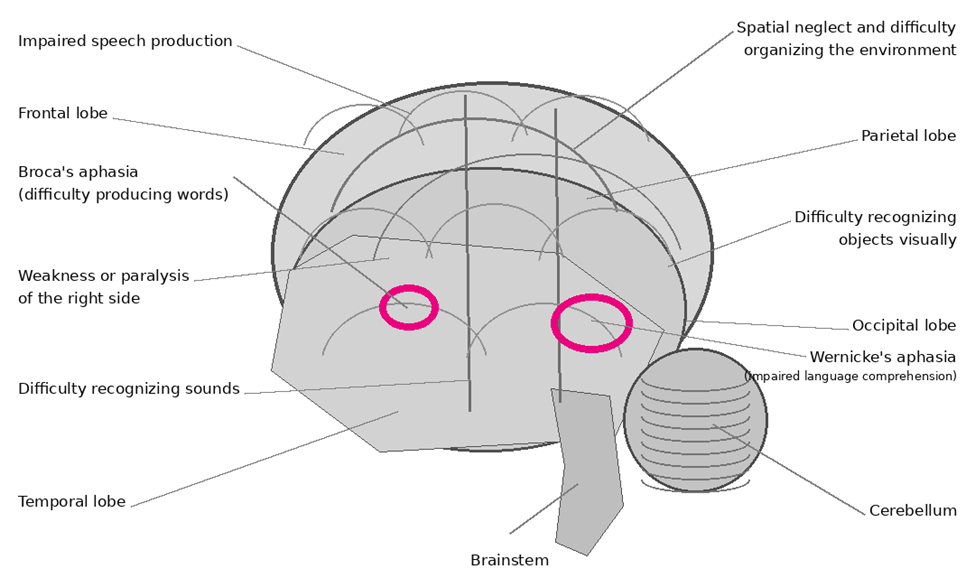
Stroke usually affects only one side of the brain because most nerve pathways cross to the opposite side of the body.
Symptoms therefore generally appear on the side of the body opposite the damaged cerebral hemisphere. However, when a stroke damages the brainstem and affects certain cranial nerves, some symptoms may occur on the same side as the brainstem lesion. Brainstem strokes may also affect both sides of the body. The brainstem connects the cerebrum—the largest part of the brain—with the spinal cord. Cranial nerves connect the brain and brainstem directly to the eyes, ears, nose, throat, and various structures of the head, neck, and trunk.
Stroke symptoms may include:
Difficulty speaking or understanding others. A person who has experienced a stroke may lose consciousness, slur words, or be unable to understand what is being said.
Numbness, weakness, or drooping of the face, or weakness or paralysis of an arm or leg. These symptoms usually affect only one side of the body. Ask the person to raise both arms above the head; downward drift of one arm may indicate a stroke. Drooping of one side of the mouth while smiling may also be a warning sign.
Visual disturbances in one or both eyes. The person may suddenly experience blurred or darkened vision in one or both eyes or may see double.
Headache. Stroke may be accompanied by a sudden severe headache, sometimes with vomiting, dizziness, or altered consciousness.
Difficulty walking. The person may stumble, lose balance, or have difficulty controlling movement.
Recognizing the signs and symptoms of stroke can save lives. Time is critical in stroke treatment: the earlier treatment begins, the better the chance of recovery. Because stroke symptoms may resemble other conditions, the only reliable way to confirm the diagnosis is to seek medical assessment as quickly as possible.
Additional Symptoms
Symptoms may include hemiplegia, facial muscle weakness, numbness or reduced sensation, initial flaccidity (reduced muscle tone), spasticity (increased muscle tone), and hyperreflexia. In most cases, symptoms affect only one side of the body. Depending on the injured area of the brain, the neurological deficit is usually on the opposite side of the body. If the brainstem is affected, cranial nerve deficits may occur, including:
Altered smell, taste, hearing, or partial or complete vision loss.
Drooping of the eyelid (ptosis) and weakness of the ocular muscles.
Reduced reflexes affecting speech, swallowing, or responsiveness.
Reduced facial sensation and facial muscle weakness.
Balance problems.
Changes in breathing and heart rate.
Weakness of the sternocleidomastoid muscle with inability to turn the head to one side.
If the cerebral cortex is affected, central nervous system pathways may be impaired, resulting in:
Aphasia (difficulty with verbal expression, auditory comprehension, reading, and/or writing).
Apraxia (impaired performance of voluntary movements).
Visual impairment.
Memory deficits associated with temporal-lobe involvement.
Disorganized thinking, confusion, and abnormal or inappropriate gestures.
If the cerebellum is affected, the patient may develop:
An altered gait.
Poor coordination of movement.
Dizziness, impaired balance, and difficulty moving the tongue from side to side.
Other Associated Symptoms
Loss of consciousness, headache, and vomiting occur more often with hemorrhagic stroke than with ischemic stroke because of increased intracranial pressure and compression of brain tissue. If symptoms are severe at onset, subarachnoid hemorrhage or embolic stroke may be the cause.
Spatial neglect (hemispatial neglect) is a cognitive-behavioral syndrome that may occur after stroke or other brain injury. It involves impaired spatial awareness, difficulty distinguishing right from left, and inability to recognize or navigate previously familiar places. This perceptual impairment may be temporary or permanent.
The principal warning signs of stroke can be remembered using B.E. F.A.S.T.:
Balance: Has the person suddenly lost balance or coordination?
Eyes: Is the person having difficulty focusing or experiencing double vision? Can the person see clearly?
Face: Can the person smile normally? Is one side of the face drooping?
Arms: Can the person raise both arms, or does one arm drift downward?
Speech: Can the person speak? Is speech slurred or unusual?
Time: Time is critical. Call emergency services immediately if any of these signs are present.