
Book
Topogaraphical, clinical and therapeutic ophthalmology
- OCULAR PHARMACOLOGY AND THERAPEUTICS
I- ROUTES OF ADMINISTRATION OF OCULAR DRUGS
The main factors governing choice of the route of administration are as follows
1- Inherent properties of the drug.
2- Site of desired action (surface or intraocular structures.
3- Frequency of administration possible.
4- Drug concentration required at target tissue.
5- Vascularity of the target tissue.
Sites of drug administration
1- Topically applied ointments
Suspensions and solutions achieve high drug concentrations on the corneal and conjunctival surface.
2- Subconjunctival injections
Facilitate high drug concentrations at the ocular surface and provide a variable-duration depot effect.
3- Intraocular (intracameral or intravitreal)
Injection of drugs is used rarely because general anesthesia is needed, serious ocular risks are associated with this route of therapy.
4- Systemically administered drugs (oral or parenteral)
Reach all vascular ocular structures but are not delivered in useful concentration.
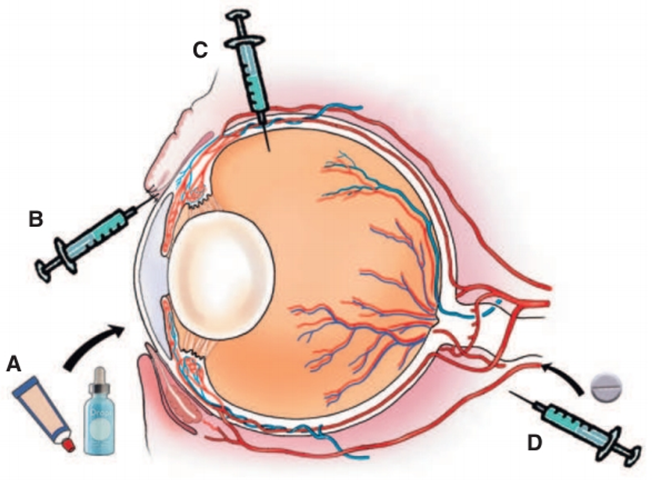
Fig.31: Sites of drug administration. A, Topically applied ointments, B, Subconjunctival C, Intraocular (intracameral or intravitreal) injection. D, Systemically administered drugs (oral or parenteral). (Budras et al.,2002).
