
Book
NICTITATING MEMBRANE (THIRD EYELID)
- Inversion and eversion of the nictitating membrane “scrolled third eyelid”
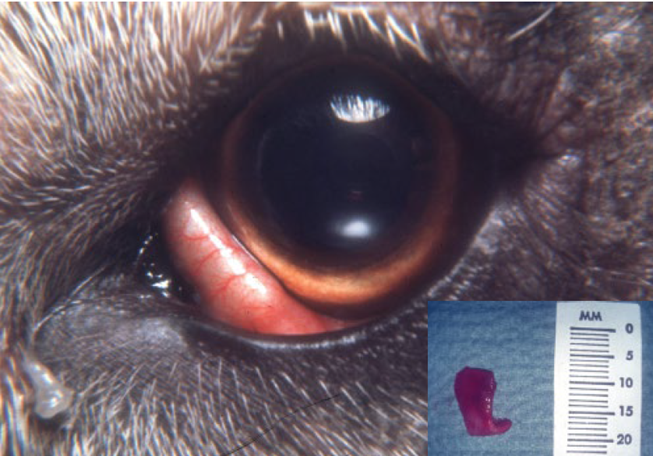
Fig.4: Everted
cartilage of the nictitans in a German Shepherd puppy. Note the leading pigmented
margin is absent and folded over (everted) exposing the defective cartilage
(see insert: bent cartilage upon removal).
Inversion and eversion of the third eyelid refer to rolling in or rolling out of the free margin of the membrane respectively. Congenital eversion seems to be more common than inversion. The condition may be unilateral or bilateral and seen mostly in young animals but may develop in middle aged animals. Traumatic injuries and improper suturing of the conjunctival membrane of the third eyelid during operations may also result in eversion or inversion.
Symptoms:
1- Increase visibility of the third eyelid.
2- Inversion or eversion of the free margin of the membrane.
3- Slight degree of conjunctivitis and mucoid discharge may be evident.
Treatment:
The aim of the treatment is the removal of the abnormally curved part of the cartilage. Sometimes the whole deformed cartilage is removed.
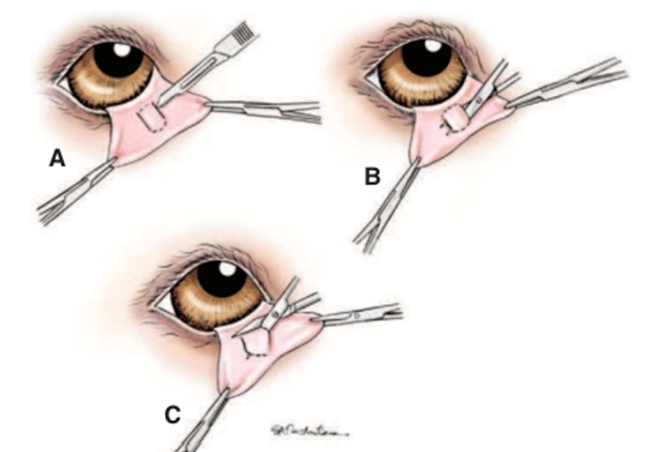
Fig.5: Surgical correction of third eyelid cartilage eversion. A, on the bulbar side of the third eyelid, the conjunctiva is incised overlying each side of the scrolled vertical part of the third eyelid cartilage. B, The scrolled cartilage and overlying conjunctiva are undermined with tenotomy scissors. C, The undermined section of scrolled cartilage and overlying conjunctiva is resected. No sutures are required. (Martin, 1970).
