
Book
Predict, Prevent and Manage Severe Hyperbilirubinemia in Term and Late Preterm Newborns
- IMPLEMENTATION TOOLS
Education material was prepared for the implementation of the “Egyptian clinical practice guideline for the prediction, prevention and management of hyperbilirubinemia in term and late preterm newborns”. Each item can be printed out in the form of posters to be hung in different nurseries or NICUs or an information leaflet to be given to parents. Also, it can be utilized within a protocol book of procedures to facilitate its use by physicians in clinics or MCHC.
SUMMARY OF RECOMMENDATIONS:
1. Antenatal orientation of mothers about neonatal jaundice especially if she is of a risky blood group type (Rh negative or O).
2. Early promotion and support of successful breastfeeding.
3. Set protocols for the identification and evaluation of hyperbilirubinemia should be in all nurseries
4. Any infant jaundiced in the first 24 hours should have his total serum bilirubin (TSB) or transcutaneous bilirubin (TcB) level measured.
5. All bilirubin levels should be interpreted according to the infant’s age in hours.
6. Infants < than 38 weeks’ gestation, particularly those who are breastfed, are at higher risk of developing severe hyperbilirubinemia and require closer surveillance and monitoring.
7. A systematic assessment should be performed on all infants before discharge from maternity hospital for the risk of severe hyperbilirubinemia.
8. Parents should be provided with written and verbal information about newborn jaundice.
9. Appropriate follow-up date based on the time of discharge and the risk assessment should always be arranged and written in a follow up card.
10. Any baby presenting with hyperbilirubinemia should be examined for cause as well as signs of ABE.
11. Prompt treatment of newborns, when indicated, with phototherapy or exchange transfusion should be decided based on TSB (without subtracting direct component).
12. Immediate exchange transfusion is indicated in any baby with signs of ABE.
13. Follow up of any baby with severe hyperbilirubinemia should include ABR, neurodevelopmental follow up and follow up for anemia if cause was hemolytic.
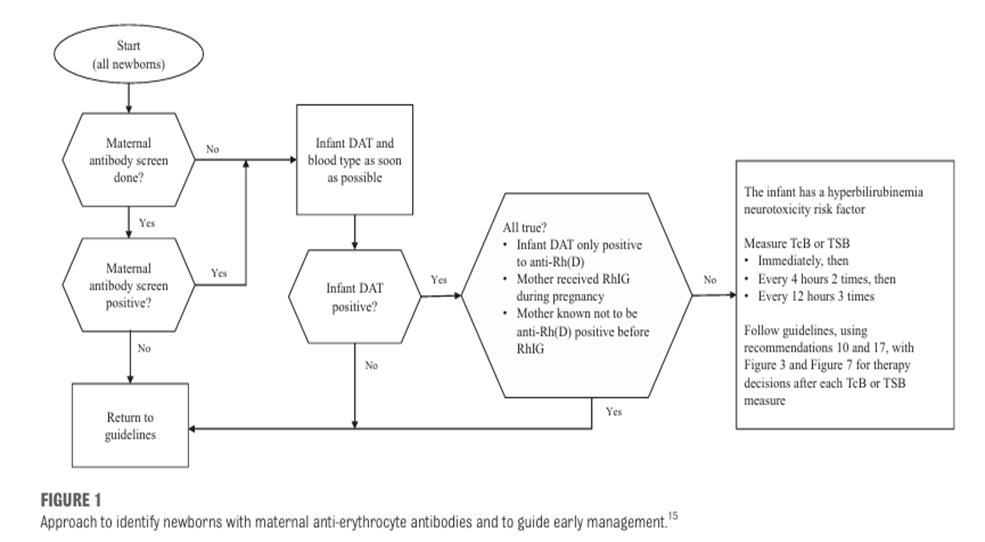
Figure-1: Approach to identify newborns with maternal anti-erythrocyte antibodies and to guide early management (6)
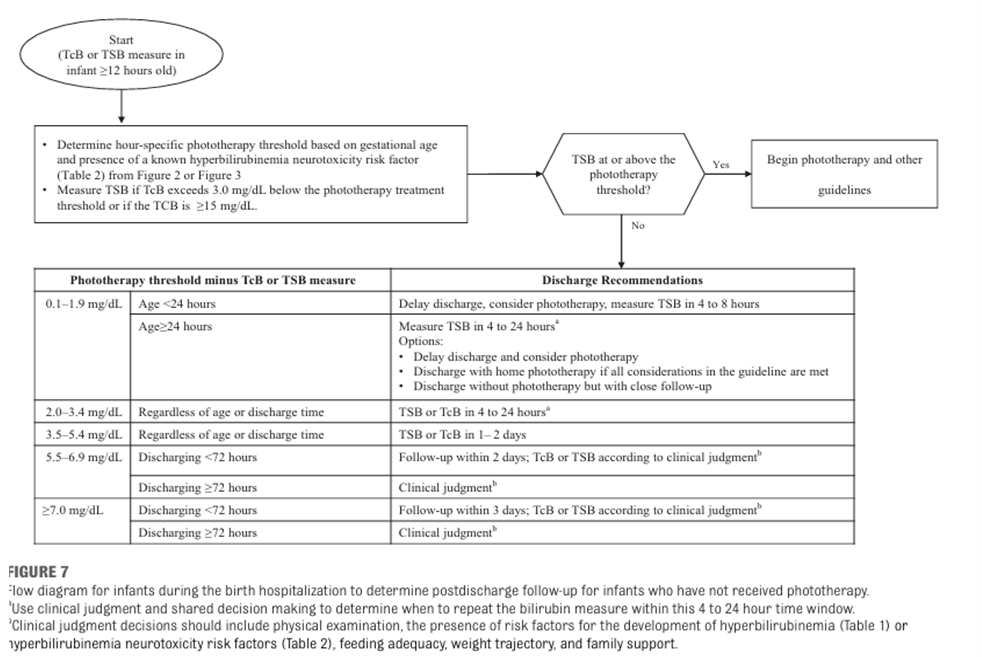
Figure-2: Flow diagram for infants during birth hospitalization to monitor jaundice follow up (6)
Table-6: Timing of follow up (unless seen earlier according to nomogram):
|
Infant Discharged |
Should be seen by Age |
|
Before age 24 hours |
72 hours |
|
Between 24-47.9 hours |
96 hours |
|
Between 48 and 72 hour |
120 hours |
(AAP guideline, Pediatrics 2004)(3)
Table-7: Risk Factors for Development of significant hyperbilirubinemia: (6)
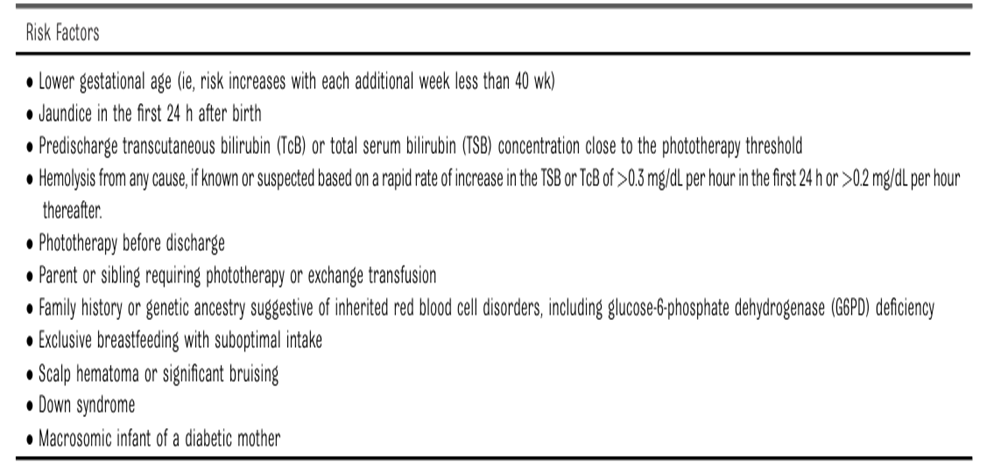
Table-8: Hyperbilirubinemia neurotoxicity risk factors: (6)
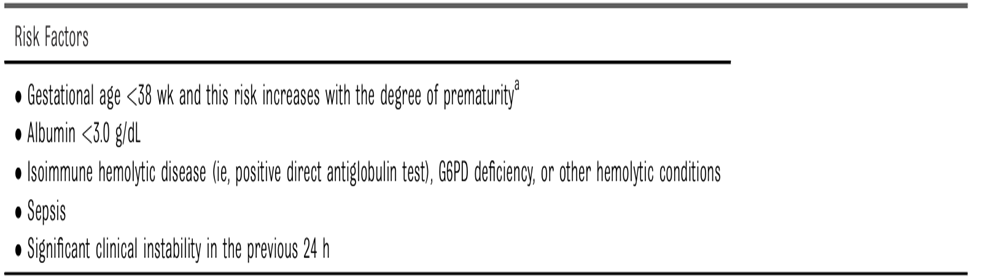
Table-9: Clinical assessment of neurotoxicity using the Modified BIND score: (51)
|
CLINICAL SIGN |
SCORE |
SEVERITY |
Date/Time |
|
MENTAL STATUS |
|||
|
-Normal |
0 |
None |
|
|
-Sleepy but arousable - Decreased feeding |
1 |
Mild |
|
|
- Lethargy - Poor suck and/or - Irritable/jittery with short-term strong suck |
2 |
Moderate |
|
|
-Semi-coma -Apnea -Seizures -Coma |
3 |
Severe |
|
|
MUSCLE TONE |
|||
|
- Normal |
0 |
None |
|
|
- Persistent mild hypotonia |
1 |
Mild |
|
|
- Moderate hypotonia - Moderate hypertonia - Increasing arching of neck and trunk on stimulation without spasms of arms and legs and without trismus |
2 |
Moderate |
|
|
- Persistent retrocollis - Opisthotonus - Crossing or scissoring of arms or legs but without spasms of arms and legs and without trismus |
3 |
Severe |
|
|
Total / 3 |
|||
|
CRY PATTERN |
|||
|
- Normal |
0 |
None |
|
|
- High pitched |
1 |
Mild |
|
|
- Shrill |
2 |
Moderate |
|
|
- Inconsolable crying or - Cry weak or absent in child with previous history of high pitched or shrill cry |
3 |
Severe |
|
|
Total / 3 |
|||
|
OCCULOMOTOR OR EYE MOVEMENTS |
|||
|
- Normal |
0 |
None, Mild |
|
|
- Sun-setting - Paralysis of Upward Gaze |
3 |
Severe |
|
|
Total / 3 |
|||
|
Total ABE Score / 12 |
|||
Choose one number for each domain. Final score out of 12 (zero: Normal, 1-4: mild encephalopathy, 5-6: moderate encephalopathy, 7-12: severe encephalopathy) (58)
Table-10: Laboratory Evaluation of the Jaundiced Infant of 35 or More Weeks’ Gestation: (3)
|
Indications |
Assessments |
|
Jaundice in first 24 hour |
Measure TcB and/or TSB and decide according to Table-7 |
|
Infant receiving phototherapy or TSB rising rapidly, crossing percentiles (Figure-6), and unexplained by history and physical examination
|
-Blood type and Coombs’ test. - Complete blood count and smear. - Reticulocyte count. - It is an option to perform G6PD (if retics are high and no incompatibility), and ETCO2, if available. - Measure (direct) conjugated bilirubin. - Repeat TSB in 4–24 hour depending on infant’s age and TSB level. |
|
TSB approaching exchange levels or not responding to phototherapy |
Perform reticulocyte count, G6PD, albumin, ETCO if available and consider exchange transfusion.
|
|
Elevated direct-reacting (or conjugated) bilirubin level |
Do urinalysis and urine culture. Evaluate for sepsis including TORCH screen if indicated by history and physical examination. |
|
Jaundice present at or beyond age 2 weeks, or sick infant |
- Total and direct-reacting (or conjugated) bilirubin level, if direct-reacting bilirubin elevated, evaluate for causes of cholestasis. - Check results of newborn thyroid and galactosemia screen, and evaluate infant for signs or symptoms of hypothyroidism or late onset sepsis. |
Table-11: Example of a Clinical Pathway for Management of the Newborn Infant Readmitted for Phototherapy or Exchange Transfusion: (3)
Treatment:
- Use intensive phototherapy and/or exchange transfusion
Laboratory tests:
- TSB and direct-reacting (or conjugated) bilirubin levels.
- Blood type (ABO, Rh).
- Direct antibody test (or Coombs’ test).
- Serum albumin.
- Complete blood cell count with differential and smear for red cell morphology.
- Reticulocyte count.
- ETCO (if available).
- G6PD if suggested by ethnic or geographic origin or if poor response to phototherapy.
- Urine for reducing substances.
- If history and/or presentation suggest sepsis, perform blood culture, urine culture, and cerebrospinal fluid for protein, glucose, cell count, and culture.
Interventions:
- If TSB ≥25 mg/dL (428 µmol/L) or ≥20 mg/dL (342 µmol/L) in a sick infant or infant ≤ 38 week gestation, obtain a type and cross match, and request blood in case an exchange transfusion is necessary.
- In infants with isoimmune hemolytic disease and TSB level rising in spite of intensive phototherapy or within 2-3 mg/dL (34-51 µmol/L) of exchange level (Figures-7 & 8), administer intravenous immunoglobulin 0.5–1 g/kg over 2 h, and repeat in 12 h if necessary.
- If infant’s weight loss from birth is 12% or there is clinical or biochemical evidence of dehydration, recommend expressed breast milk or formula. If oral intake is in question, give intravenous fluids.
