
Book
Most common fish viral diseases
- Viral Nervous Necrosis (VNN)
Definition:
Nervous necrosis virus (NNV), also known as Viral Encephalopathy and Retinopathy (VER). It is a highly devastating disease affects marine and freshwater fishes characterized clinically by abnormal swimming behavior and congestion and edema in brain and retina. Fry and juveniles fish are highly susceptible with mortalities ranged 80-100% due to destruction of central nervous system and brain.
Etiology:
Nervous necrosis virus (NNV) is the causative agent of VNN, it is a betanodavirus classified within the family Nodaviridae. NNV is a small naked virus whose genome is organized into two molecules of positive sense and single – strand RNA (RNA1 and RNA2). RNA1 codes for the RNA-dependent RNA-polymerase (RdRp), whereas RNA2 encodes the capsid protein (Cp) (Mori et al., 1992 ). The NNV classification is based on a partial sequence of the RNA2 that differentiates 4 genotypes: Stripped Jack Nervous Necrosis Virus (SJNNV). Red-Spotted Grouper Nervous Necrosis Virus (RGNNV), Tiger Puffer Nervous Necrosis Virus (TPNNV) and Barfin Flounder Nervous Necrosis Virus (BFNNV) (Bandín & Souto, 2020).
Mode of transmission:
The Nervous necrosis virus (NNV) is transmitted through two primary pathways: horizontally (fish -to- fish via water) through cohabitation with infected fish and vertically (spawners- to -offspring through eggs) from the broodstock to offspring as virus particles released during spawning (Munday et al., 2002).
NB. Outbreak survivors act as asymptomatic carriers shed virus into water or via eggs.
Susceptible host:
Marine and freshwater fishes are susceptible to infection, such as European Sea bass, gilthead Sea bream, Groupers, Barfin flounder, Striped Jack and Tiger puffer, Eel and Tilapia.
Clinical signs:
Nervous manifestation in the form of abnormal swimming behavior (spiral, whirling, and side swimming), exophthalmia, skin erosions and change in pigmentation
PM lesions:
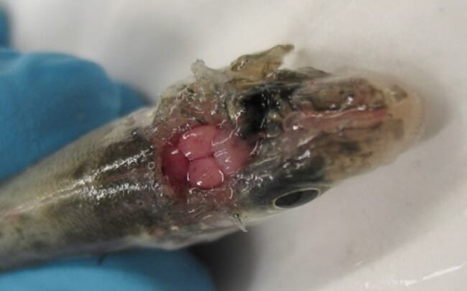
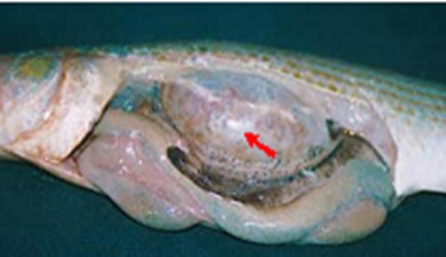
Swim bladder inflamed, hemorrhagic or edematous brain, popeye, blindness and abdominal distension are observed in affected fish.
Some fish undergo a subclinical course exhibiting no clinical signs or lesions.
|
|
|
|
A sea bass showing with chronic VNN showed hemorrhagic or edematous brain thefishsite.com/articles/farmers-sought-for-betanodavirus-forum |
Swim bladder showed inflammation |
Histopathological lesions:
Large vacuolated areas, gliosis, perivascular cuffing, the cell bodies of neurons showed pyknosis and lysis, and inclusion bodies in the nervous tissue in Brain.
Massive vacuolar degeneration and necrosis of the inner and outer nuclear layers of retina
Hyperplasia and necrotic changes in gas glandular epithelia and cellular vacuolation in swim bladder
