
كتاب
Management of Hip Fractures in the Elderly
- Annexes
Annex 2: Minimum interruption intervals
(summary table)
These intervals apply to neuraxial and deep/non-compressible procedures. For superficial/compressible single-shot blocks, apply site-based risk assessment.
|
Drug (generic [trade]) |
Dose category (examples) |
Minimum hold before neuraxial/deep |
Superficial/compressible single-shot blocks |
|
LMWH: enoxaparin [Clexane/Lovenox]; dalteparin [Fragmin]; tinzaparin [Innohep]
|
Low dose (prophylaxis); e.g., enoxaparin ≤40 mg/day |
≥12 h (if CrCl <30: halve dose or extend to 24 h) |
May proceed; next dose at routine time (site-based risk assessment) |
|
High dose (>50 IU anti-Xa/kg/day or therapeutic); often BID |
≥24 h (if CrCl <30: halve dose or extend to 48 h) |
May proceed; next dose at routine time (site-based risk assessment) |
|
|
Unfractionated heparin (UFH) [Heparin]
|
Low-dose SC UFH (≤200 IU/kg/day) |
≥4 h |
May proceed; next dose at routine time (site-based risk assessment) |
|
High-dose UFH (IV or SC) |
IV: ≥6 h; SC: ≥12 h (or until aPTT/anti-Xa/ACT returns to local normal range) |
May proceed; next dose at routine time (site-based risk assessment) |
|
|
Fondaparinux [Arixtra]
|
Low dose (≤2.5 mg/day) |
≥36 h (if CrCl <50: ≥72 h) |
May proceed; next dose at routine time (site-based risk assessment) |
|
High dose (>2.5 mg/day) |
Not recommended; if unavoidable, consider ~4 days or level-guided (specialist decision) |
Site-based; consider alternative strategy |
|
|
Vitamin K antagonist: warfarin [Coumadin] |
Therapeutic |
Stop ~5 days; proceed when INR is normal/acceptable per local policy |
Site-based; deep/non-compressible sites require INR target |
|
Direct anti-Xa DOACs: rivaroxaban [Xarelto]; edoxaban [Lixiana/Savaysa]; apixaban [Eliquis]
|
Low dose |
Rivaroxaban/edoxaban: ≥24 h (≥30 h if CrCl <30); apixaban: ≥36 h |
May proceed; next dose at routine time (site-based risk assessment) |
|
High dose |
≥72 h (or level-guided in renal impairment where available) |
May proceed; next dose at routine time (site-based risk assessment) |
|
|
Direct thrombin inhibitor DOAC: dabigatran [Pradaxa]
|
Low dose |
≥48 h |
May proceed; next dose at routine time (site-based risk assessment) |
|
High dose |
≥72 h (or level-guided if CrCl <50) |
May proceed; next dose at routine time (site-based risk assessment) |
|
|
Aspirin [Aspirin]
|
Low dose (≤200 mg/day) |
No mandatory hold |
No mandatory hold |
|
High dose (≥200 mg/day) |
≥3 to 7 days |
Site-based; consider risk–benefit |
|
|
Clopidogrel [Plavix] |
P2Y12 inhibitor |
≥5 to 7 days |
Site-based; consider risk–benefit |
|
Ticagrelor [Brilinta] |
P2Y12 inhibitor |
≥5 days |
Site-based; consider risk–benefit |
|
Prasugrel [Effient] |
P2Y12 inhibitor |
≥7 days |
Site-based; consider risk–benefit |
Operational catheter notes (LMWH): once-daily prophylaxis: first LMWH dose ≥12 h after needle/catheter placement; remove catheter ≥12 h after last LMWH dose; next dose ≥4 h after catheter removal. Twice-daily prophylaxis: remove neuraxial catheter before initiating LMWH; delay LMWH ≥4 h after catheter removal; and if LMWH used >4 days, check platelet count before neuraxial/deep procedures or catheter removal.
Annex 3:
FLACC score and
Ramsay sedation score
FLACC Score
|
CATEGORY |
0 POINTS |
1 POINT |
2 POINTS |
|
Face |
Disinterested |
Occasional grimace, withdrawn |
Frequent frown, clenched jaw |
|
Legs |
No position or relaxed |
Uneasy, restless, tense |
Kicking or legs drawn up |
|
Activity |
Normal position |
Squirming, tense |
Arched, rigid, or jerking |
|
Cry |
No crying |
Moans or whimpers |
Constant crying, screams or sobs |
|
Consolability |
Content, relaxed |
Distractible |
Inconsolable |
Ramsay Sedation Score
|
Score |
Description |
|
1 |
Anxious and agitated or restless, or both |
|
2 |
Cooperative, orientated, and tranquil |
|
3 |
Drowsy, but responds to commands |
|
4 |
Asleep, brisk response to light glabellar tap or loud auditory stimulus |
|
5 |
Asleep, sluggish response to light glabellar tap or loud auditory stimulus |
|
6 |
Asleep and unarousable |
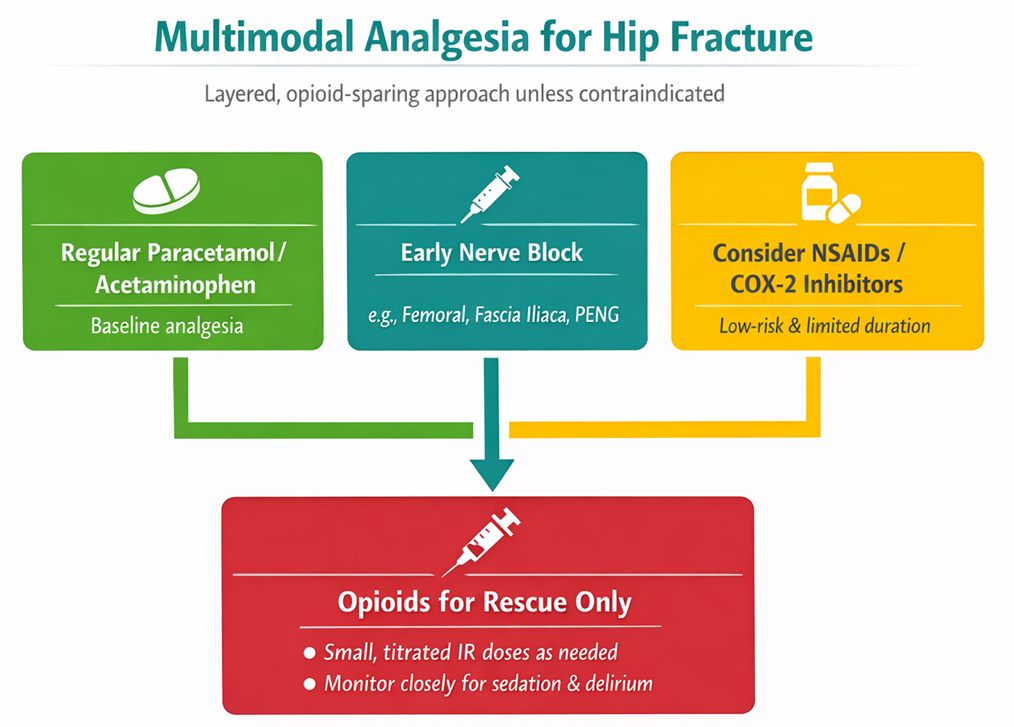
Annex 4: Multimodal analgesia for hip fracture
Annex 6: Garden Classification of Femoral Neck Fracture
|
Type |
Description |
Displacement |
Fracture Line |
Stability |
|
Type I |
Incomplete valgus impacted fracture |
None (impacted in valgus) |
Incomplete, doesn't traverse full width of neck |
Stable |
|
Type II |
Complete fracture |
Non |
fragments not displaced |
Stable |
|
Type III |
Complete fracture |
Partial displacement femoral head rotated into varus |
Complete, with partial displacement |
Unstable |
|
Type IV |
Complete fracture |
Complete displacement of femoral head |
Complete, totally displaced fragments |
Unstable |
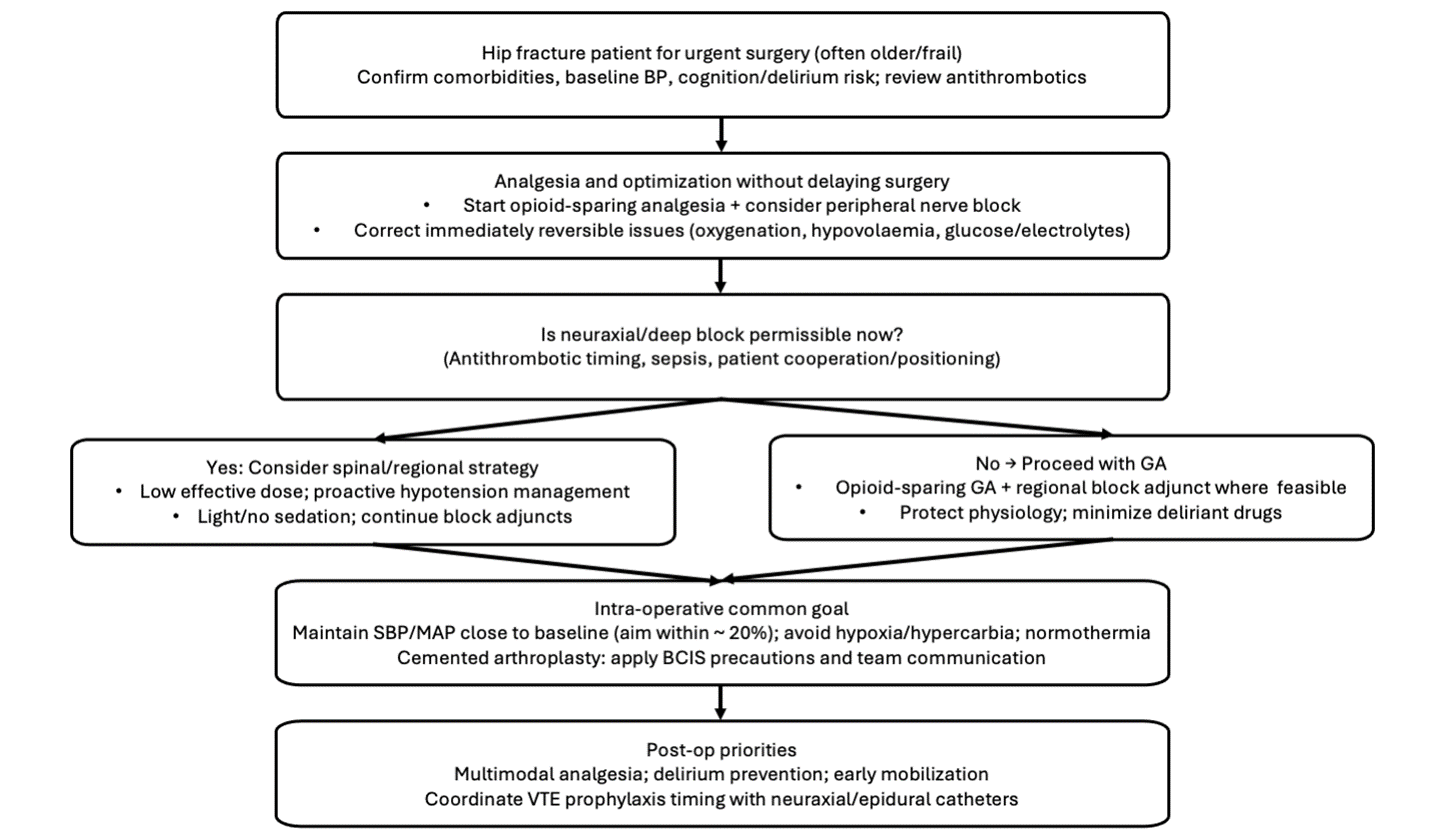
Annex 7: Blood transfusion in elderly hip fracture patients (flowchart)
Annex 8: Tranexamic acid (TXA) in elderly hip fracture patients