
كتاب
Nile tilapia propagation
- Challenges facing Nile Tilapia aquaculture
6. 1 Seasonality of the climate
- Summer temperatures (25–30 °C) are very suitable for growth and reproduction of Nile tilapia, meanwhile, in cold weather (winter), surface water temperatures fall between 7–10 °C that causing stress and leading to high mortalities if low temperatures persist (Saleh, 2007).
- Several solutions have been applied by farmers for overwintering including cover small ponds with greenhouses to increase water temperatures and facilitate early spawning of tilapia, other operators have established tank based spawning systems, enclosed by greenhouses and often supplied with heated water (Sadek, 2011), and others increase pond depth to 2.5 m and hence keep the water warm at pond bottom for fish, however, in some cases they can lead to thermal stratification and low oxygen level at the bottom. So, it’s necessary to use aerators in deeper ponds to break up stratification and mix warmer, oxygenated water from the surface with the bottom water.
6. 2 - Filamentous algal growth
Tilapia does not stir up the water, so the ponds remain clear and the light penetrates to the bottom. As a result, filamentous algae often develops and this creates difficulties in harvesting small fry and also reduce oxygen level in ponds causing asphyxia. To avoid this problem male carp averaging 500 g. (250-300 /ha) can be introduced in tilapia spawning ponds.
6. 3 - Overpopulation
- Mixed-sex populations progress a large size variance among harvested fish, which affects marketability. Moreover, the presence of female tilapia leads to uncontrolled reproduction, excessive recruitment of fingerlings, competition for food, and stunting of the original stock, which may not reach marketable size. To overcome this problem some points can be considered:
1- Rearing mixed male and female tilapia and marketing them before they attain sexual maturity.
2- Introduction of some predators such as African catfish, Nile perch, or duck to control the problem of wild spawning.
3- Cage culture of Tilapia avoids problems with overbreeding because eggs fall through the cage meshes.
4- Intensive tank culture avoids overpopulation problems, because there is no space for males to set up spawning area.
5- Rearing male monosex populations. All male populations are usually used for growing out purposes on commercial farms because of males grow approximately 40 % faster compared to sexually matured females. For producing all male tilapia population, several methods can be applied such as:
a. Manual separation of sexes
Sex can be separated before they reach sexual maturity. However, it is difficult for even skilled farmers due to it is done in fish larger than 40-50 g, time consuming, causing stress, and inaccurate.
b. Hybridization
Hybridization is a process of breeding between different strains for producing male hybrid with high growth rate, cold tolerance to 10 °C, better catchability as O. aureus is difficult to catch by seining and burrowing into the mud, high and Marketability due to hybrid male is lighter than parents (Nwachi and Esa, 2016).
The common crossbreeding occurs between Nile Tilapia × Blue Tilapia (O. aureus)
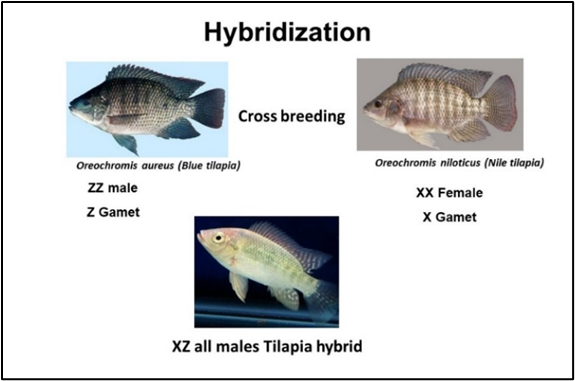
and Nile Tilapia × Mozambique Tilapia (O. mossambicus). Tilapias have different sex-determining mechanism which is the key to produce all male population. The species differ in chromosomal pattern, the Nile tilapia (Oreochromis niloticus) has mammalian-type XY chromosome system with heterogamety male XY and homogamety female XX, while Oreochromis aurous (Blue tilapia) has Bird-like type WZ chromosomal system with heterogamety female WZ, where the males are ZZ and females are WZ (Mair et al., 1991; El-Zaeem S.Y and Salam G.M., 2013). Hybridization occurs between two species of tilapia to produce an all-male hybrid population. Breeding of O. niloticus female and O. aureus male produces 80-90 % males, with the growth vigor of O. niloticus and the cold tolerance of O. aureus, the reason for this may be due impure broodstock and autosomal sex modifying genes. The produced hybrid showed market appeal (lighter than parents), superior growth rate (grow about 25-30 % better than either parent), higher disease resistance and greater environmental tolerance (tolerance of low temperature to 10 °C and higher salinity) compared to the purebred tilapia species (Anjar et al., 2023). The hybrid fed like O. niloticus mainly herbivore along the whole water column that is important in poly culture system.
c. Sex reversal
Sex reversal is a breeding program used for obtaining mono-sex population which is desirable if one sex grow faster than other. This program used in tilapia culture to produce all-male populations.
1. Hormonal sex reversal (Direct sex reversed fry)
Sex reversal has become a widely used method of producing monosex tilapia populations. In tilapia, sex is labile during the first 28 days of their life cycle and administration of hormone (androgen or estrogen) during this period can reverse the majority of fry to the desirable sex, and hormonal sex reversal of fry affected by several factors including fish species, hormone dosage, way of application, water temperature and exposure period.
The most common hormones used to produce all-male tilapia populations are methyl or ethyl testosterone (30 - 60 mg/kg of feed). An initial feeding rate of 20-30 percent body weight per day from the first exogenous feeding is gradually decreased to 10-20 percent by the end of 3-4 weeks sex-reversal period. Immersion in hormone solutions has also been used for sex reversal (Wassermann and Afonso, 2003). In addition, non-steroidal compounds, such as aromatase inhibitors (letrozole) and tamoxifen (anti-estrogen) have potential for production of monosex population in tilapia (El Asely et al., 2007), as well as exposure to high temperature of 36 rearing water during the first four weeks of their life can produce all male tilapia population ( Abbass and Radwan, 2004).
2. YY male tilapia technology (Sex reversed brood stock)
The production of YY males (GMT) is genetically engineered way used to produce 100% male offspring with two Y chromosomes. The process involves treating the tilapia fry during the first four weeks of their life with estrogens (female
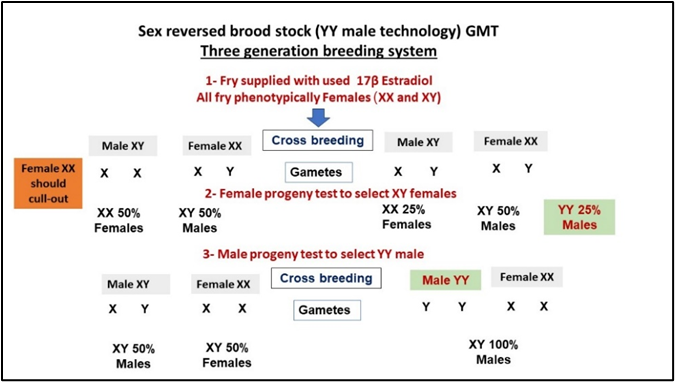
hormones) to produce all female fry population (phenotypically females) that are XX and XY. When feminized males XY are propagated with normal XY males, the produced progeny will have the following genotypes: 1 XX females: 2 XY males: 1 YY male, males were selected based on their phenotypic traits including the shape of genital papilla and number of orifices (Abucay and Mait, 2004). Breeding of produced males XY and YY with normal Females XX (Male progeny test) used to select YY male. Cross breeding YY males with normal XX females will result in all-XY male offspring. Producing YY males without using hormone during the growing phase with no risks in the hatchery environment, increase consumer acceptance (Mair et al., 1995).