
كتاب
Tinnitus (ORL) ECPG
- Annexes
Editorial Independence:
· This guideline was developed without any external funding.
· All the guideline development group members have declared that they do not have any competing interests.
Annex 1: A flow chart of the Tinnitus guideline.
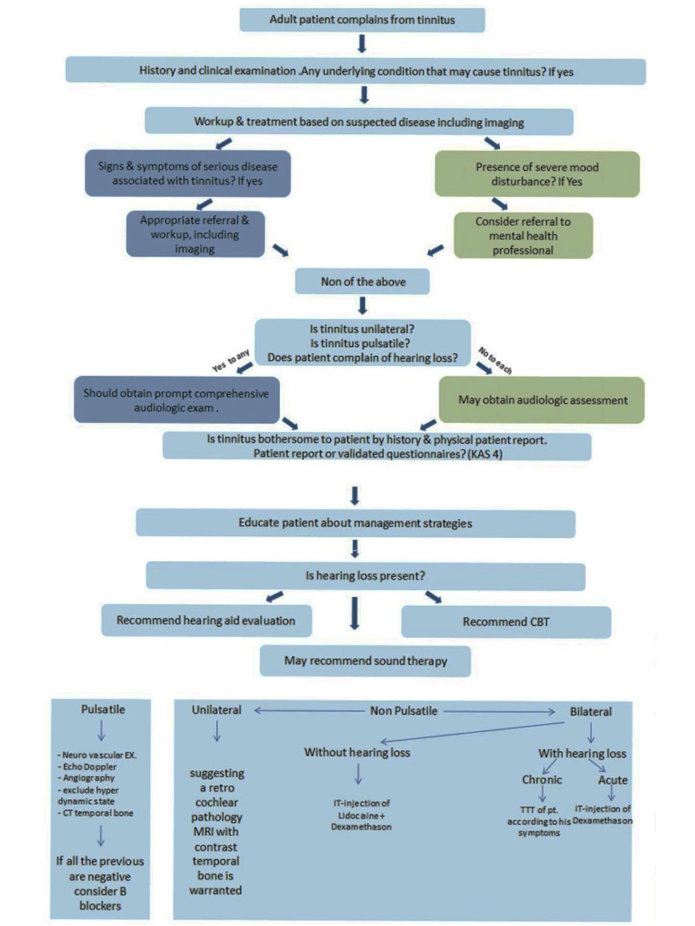
Annex 2: Assessment of Currency Table
|
Number |
Name |
Responsible organization |
Date of Publication |
Expected Review Date |
Date of original details in the references |
|
1 |
Practice Guidance: Fitting of combination hearing aids for subjects with tinnitus |
British Society of Audiology |
2020 |
NR |
recent references |
|
2 |
NICE Guideline |
National Institute for Health and Care Excellence |
2020 |
NR |
recent references |
|
3 |
A multidisciplinary European guideline for tinnitus: diagnostics, assessment, and treatment |
European |
2019 |
NR |
recent references |
|
4 |
Clinical practice guideline: tinnitus |
AAO-HNSF |
2014 |
NR |
Not recent references |
|
5 |
Clinical practice guidelines for diagnosis and treatment of chronic tinnitus in Japan |
Oto-Rhino-Laryngological Society of Japan |
2019 |
NR |
recent references |
Annex 3: Assessment of Content Table
|
Score Items (each to be given score from (1-9) |
British Society Of Audiology (2020) |
NICE Guideline
|
European guideline |
AAO-HNSF |
Japanese guidelines |
|
Credibility |
9 |
9 |
9 |
9 |
9 |
|
Observability |
8 |
7 |
8 |
9 |
7 |
|
Relevance |
9 |
9 |
7 |
9 |
9 |
|
Relative advantage |
8 |
5 |
8 |
9 |
8 |
|
Easy to Install |
9 |
7 |
9 |
9 |
6 |
|
Compatibility |
8 |
7 |
7 |
8 |
7 |
|
Testability |
5 |
7 |
- |
9 |
7 |
|
Total score |
56 |
51 |
48 |
62 |
53 |
Annex 4: Assessment of Quality Table
|
Domain |
British Society Of Audiology (2020) |
NICE Guideline
|
European guideline |
AAO-HNSF |
Japanese guidelines |
|
Transparency |
A |
A |
A |
A |
A |
|
Conflict of interest |
A |
A |
A |
A |
A |
|
Development group |
A |
A |
A |
A |
A |
|
Systematic review |
A |
A |
A |
A |
A |
|
Grading of evidence |
A |
A |
A |
A |
A |
|
Recommendation |
A |
A |
A |
A |
A |
|
External review |
A |
A |
A |
A |
A |
|
Updating |
B |
B |
B |
C |
A |
Annex 5: The risks and benefits of added and/or modified statements
|
Statement |
Risk |
Benefit |
|
Imaging studies |
No risk |
We focused on the role of imaging studies to find the primary cause of tinnitus, which may improve the management outcomes. |
|
Medical therapy |
Side effects of the used medications. |
This may improve the outcomes, especially in specific situations such as the associated depression of somatosensory manifestations. |
|
Intratympanic injection |
Tympanic membrane residual perforation |
It may be helpful in severe and resistant cases. |
