
Book
Surgical Patient Positioning Guide
- Litho-sacral position
Lithotomy Position (Dorsosacral Position)
This position is used for:
- Vaginal surgeries
- Rectal (anal) surgeries
- Certain cystoscopy (bladder endoscopy) procedures
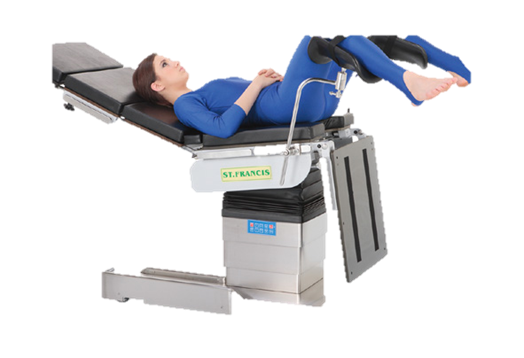
Positioning Steps:
1. The patient lies on their back with the legs positioned on the lower section of the operating table, forming a 90-degree angle with the body.
2. The knees are bent, and the legs are rotated outward, supported by leg holders.
3. The feet should hang freely from the straps, ensuring proper support.
4. The buttocks are positioned toward the edge of the operating table, allowing optimal surgical access.
Additional Requirements:
- 2 Leg Holders with Straps
- 2 Small Pillows
- 1 Head Pillow
- 2 Elbow Supports
Steps for Lithotomy Positioning:
1. Once the patient is anesthetized and the anesthesiologist gives approval, begin positioning.
2. Move the patient upward on the table so that the buttocks are positioned over the table’s curve between the legs and upper body.
o Ensure that the buttocks do not rest directly on the table’s edge.
3. Lift and secure the patient's legs.
4. Adjust the lower section of the operating table downward to its maximum angle, ensuring it forms a 90-degree angle with the upper body.
5. Alternative method (if positioning before anesthesia):
o Lower the foot section of the table.
o Position the patient so that the buttocks are at the edge of the table.
o Secure the legs on temporary supports until they can be placed in the leg holders after anesthesia.
6. Attach the leg holders to the clamps on both sides of the table.
o Adjust the holders to be at the same height and aligned with each other.
o Ensure the clamps are securely fastened.
7. Two personnel are required to lift the legs simultaneously.
o Hold the foot with one hand and support the knee with the other.
8. Gently place the legs into the leg holders.
9. Secure the feet in the straps, ensuring:
o One strap wraps around the sole of the foot.
o Another strap wraps around the ankle joint.
o Ensure the straps are not twisted.
10. Place padding between the legs and the leg holders for comfort and to prevent pressure injuries.
11. Position the arms across the abdomen and secure them either with:
- A rolled blanket around the elbows.
- Elbow supports.
12. Place a pillow under the patient's head for support.
