
Book
Intravenous Therapy for Newborns
- Blood Transfusion and Its Components
Components of Blood:
- Plasma: Represents 55% of the total blood volume.
- Blood Cells: Represent 45% of the total blood volume.
Clinical Uses of Blood and Blood Components
|
Indications for Blood or Component Transfusion |
Components |
Blood Derivatives |
|
Severe hemorrhage and shock (e.g., placental abruption, pulmonary or intracranial bleeding) |
All blood components |
Whole blood |
|
Anemia |
Red blood cells after plasma separation (hematocrit 60–80%) |
Packed red blood cells |
|
Hemorrhage due to thrombocytopenia |
Platelets |
Platelet concentrate |
|
Neonates with bleeding due to coagulation factor deficiency, DIC, or hypovolemia (increased blood viscosity) |
Plasma separated and frozen |
Fresh frozen plasma |
|
Hemorrhage due to coagulation factor deficiency (e.g., hemophilia) |
Specific clotting factors separated from fresh frozen plasma |
Cryoprecipitate |
|
Hypoalbuminemia |
Plasma protein (albumin) |
Albumin |
Required Equipment
- Blood bag or the required derivative.
- Neonate identification slip (with full name and medical record number).
- Blood transfusion set.
- Sterile gloves.
- Normal saline solution.
- Adhesive tape.
- Cannula (size 22).
Preparation for Blood Transfusion
- Withdraw 2 ml of the neonate’s blood for:
- Blood grouping.
- Rh factor determination.
- Cross-matching test.
- Label the test tube with:
- Neonate’s name.
- Medical record number.
- Send the sample to the blood bank with a blood transfusion request form containing the patient’s barcode.
Procedure of Blood Transfusion
- Transfusion is carried out only upon a written medical order.
- Informed consent must be obtained from the parents after explaining the rationale.
- Perform hand hygiene and prepare the necessary equipment.
- Verify neonate identification (name and medical record number) according to hospital policy.
- The physician and nurse must jointly verify:
- The neonate’s name, blood group, and Rh factor on the blood bag.
- The cross-matching results.
- The bag serial number matches the neonate’s identification slip.
- Screening tests confirm that the blood is free from infectious diseases.
- Confirm:
- The required blood volume.
- The expiry date on the blood bag.
- Initiate transfusion using the transfusion set connected to the blood bag.
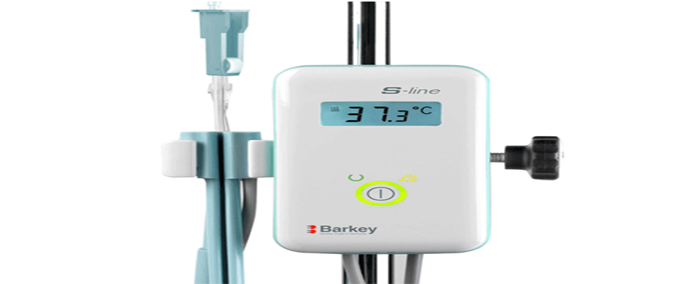
Blood
Warmer
- Ensure that the blood is free from clots.
- Monitor the neonate’s vital signs and record them in the medical file.
- Transfusion must be performed under the supervision of a neonatologist.
- The blood bag should be kept at room temperature for no longer than 30 minutes (or as per institutional policy). Warming the bag using hot water or any heat source is strictly prohibited to avoid hemolysis.
- Blood must pass through a dedicated blood filter during administration via a direct intravenous cannula; mechanical pumps must not be used for red blood cells to prevent hemolysis.
- The neonate should be connected to a cardiac monitor to observe vital signs throughout the transfusion.
Essential Precautions in Neonatal Blood Transfusion
1. Blood Safety
- The transfused blood must be free from all infectious viruses, particularly Cytomegalovirus (CMV), Hepatitis B & C, and HIV.
2. Type of Blood
- Irradiated blood is preferred whenever possible, as irradiation prevents lymphocyte proliferation, reducing the risk of transfusion-related graft-versus-host disease.
- Indications for irradiated blood include:
- Ensure that the blood is free from clots.
- Monitor the neonate’s vital signs and record them in the medical file.
- Transfusion must be performed under the supervision of a neonatologist.
- The blood bag should be kept at room temperature for no longer than 30 minutes (or as per institutional policy). Warming the bag using hot water or any heat source is strictly prohibited to avoid hemolysis.
- Blood must pass through a dedicated blood filter during administration via a direct intravenous cannula; mechanical pumps must not be used for red blood cells to prevent hemolysis.
- The neonate should be connected to a cardiac monitor to observe vital signs throughout the transfusion.
Essential Precautions in Neonatal Blood Transfusion
1. Blood Safety
- The transfused blood must be free from all infectious viruses, particularly Cytomegalovirus (CMV), Hepatitis B & C, and HIV.
2. Type of Blood
- Irradiated blood is preferred whenever possible, as irradiation prevents lymphocyte proliferation, reducing the risk of transfusion-related graft-versus-host disease.
- Indications for irradiated blood include:
- Neonates weighing <1200 g at birth.
- Neonates with immunodeficiency disorders.
- Neonates receiving blood from a first-degree relative.
3. Venous Access
- Use a 22-gauge IV cannula; smaller sizes may cause hemolysis.
- Arterial lines and umbilical arterial catheters must never be used for transfusion.
- The IV line used for parenteral nutrition should not be used for transfusion simultaneously; the transfusion cannula must be removed immediately after the procedure.
- No medications or solutions may be added to the blood bag or its components.
- After transfusion, flush the IV cannula with normal saline to prevent clot formation.
- If transfusion is slow, blood glucose levels should be checked hourly as per physician’s instructions, to avoid hypoglycemia.
4. Monitoring for Transfusion
Reactions
Signs of transfusion reactions include:
- Fever > 38°C.
- Tachycardia.
- Respiratory distress.
- Hypotension.
- Facial flushing.
- Irritability.
- Vomiting.
- Hematuria (+1 or more on urine dipstick).
- Skin rash.
5. Management of Transfusion
Reactions
If any reaction occurs:
- Immediately stop the transfusion.
- Flush the IV cannula with normal saline.
- Notify the attending physician for immediate assessment.
- Monitor and record vital signs every 15 minutes until the neonate stabilizes.
- Report the event to the blood bank physician.
- Send the neonate’s medical file, the blood bag, and the transfusion set back to the blood bank.
- Send the first available urine sample for urgent analysis.
- Administer antihistamines before subsequent transfusions, as directed by the physician.
- Complete and document the blood transfusion reaction report.
6. Post-Transfusion Care
- Administer 10 ml of normal saline.
- Record all transfusion-related details in the neonate’s chart.
- Monitor vital signs hourly after transfusion.
- Complete the blood transfusion follow-up form.
- Monitor for potential transfusion-related complications (see Table 26–2).
Table 26–2: Blood Transfusion Complications
|
Adverse Effect |
Cause |
Prevention / Management |
|
Septicemia |
Bacterial contamination of blood |
Use blood within 4 hours of release from blood bank; strict asepsis; perform blood cultures if contamination is suspected. |
|
Hypothermia |
Rapid transfusion of cold blood |
Warm blood to room temperature; maintain neonate’s warmth during transfusion. |
|
Fluid overload |
Rapid transfusion of large blood volumes |
Transfuse slowly (except in emergencies); diuretics (e.g., furosemide) may be used if prescribed. |
|
Hypocalcemia (tremors, seizures) |
Citrate anticoagulant in stored blood |
Monitor serum calcium; ECG monitoring; IV calcium as indicated. |
|
Hyperkalemia |
Potassium accumulation in stored blood |
Monitor serum potassium; ECG monitoring; IV diuretics (e.g., furosemide) as indicated. |
Transfusion Time Limits
- The transfusion time is calculated from the moment the blood leaves the blood bank refrigerator.
- The longer the blood remains at room temperature, the greater the risk of hemolysis and bacterial contamination.
|
Blood Component |
Minimum Time |
Maximum Time |
|
Whole blood / Red blood cells |
2 hours |
4 hours |
|
Fresh frozen plasma |
30 minutes |
4 hours |
|
Platelets |
5–15 minutes per unit |
4 hours |
|
Cryoprecipitate |
2 minutes per unit |
4 hours |
